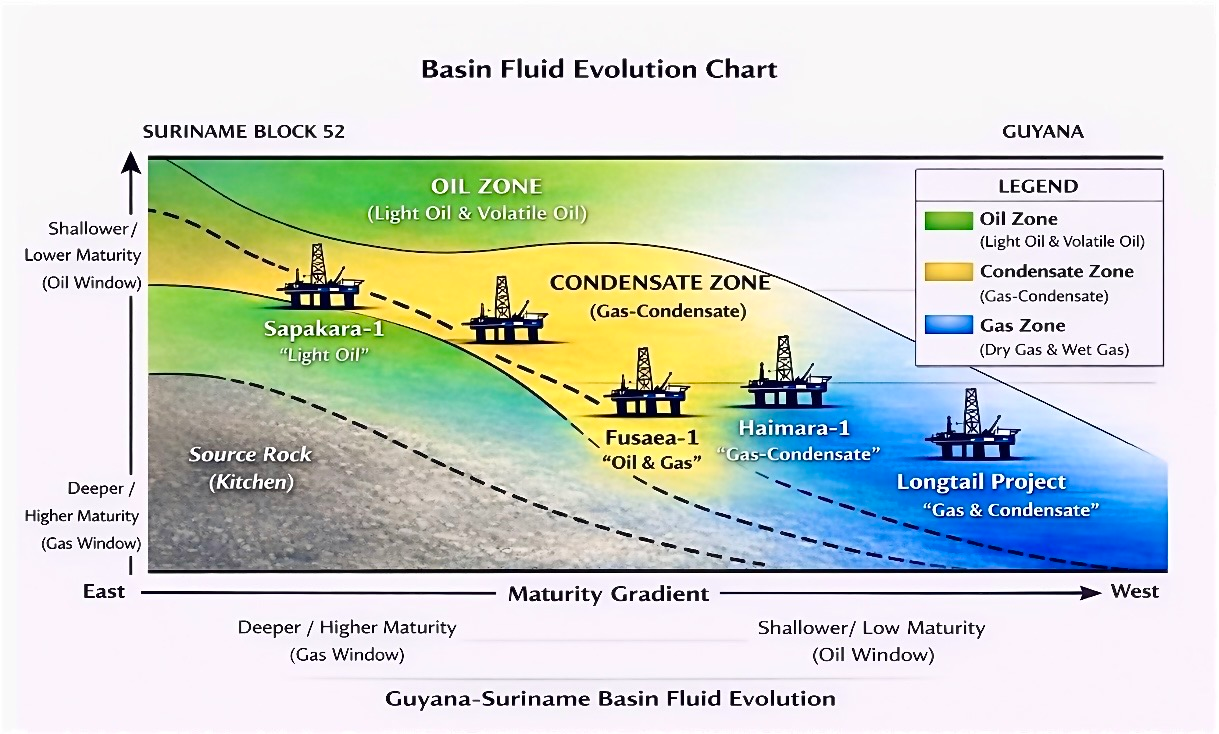
A Basin Fluid Evolution Perspective Integrating Block 52 and Stabroek Discoveries
Author: M. Chin-A-Lien – February 2026
Golden Lane Investments Advisory Group
Petroleum & Energy Advisor
Abstract
Five wells — Sapakara-1, Fusaea-1, Sloanea-1, Haimara-1 and Longtail-1 — collectively reveal a coherent maturity gradient across the Golden Lane fairway of the Guyana–Suriname Basin (GSB).
Rather than isolated discoveries, these wells define a thermally progressive petroleum system evolving from light oil into volatile oil and ultimately gas-condensate.
Integration of subsurface architecture from the GeoAtlas of Suriname (Staatsolie) supports a basinward deepening of the Jurassic–Cretaceous depocenters toward the east, consistent with increasing burial, thermal maturity and phase transition.
1. Basin Architecture — Evidence from the GeoAtlas of Suriname
The GeoAtlas documents:
- Jurassic rift grabens containing oil-prone lacustrine source rocks.
- Progressive Cretaceous passive margin subsidence.
- Thicker Upper Cretaceous deepwater turbidite packages basinward.
- Structural deepening toward the eastern offshore sector.
These structural elements imply increasing burial depth and thermal maturity eastward — precisely where gas and condensate discoveries occur.
2. Fluid Evolution Along the Golden Lane
| Well | Block | Fluid Type | Thermal Interpretation |
|---|---|---|---|
| Sapakara-1 | Block 58 (Suriname) | Light Oil | Late Oil Window |
| Fusaea-1 | Block 52 (Suriname) | Oil + Gas | Volatile Oil / Early Condensate |
| Sloanea-1 | Block 52 (Suriname) | Non-Associated Gas | Gas Window |
| Haimara-1 | Stabroek (Guyana) | Gas-Condensate | Deep Gas Window |
| Longtail-1 | Stabroek (Guyana) | Gas-Condensate | Deep Gas Window |
3. Basin Fluid Evolution Figure
See main figure at the top.
The maturity gradient (bottom axis) runs from East (deep, gas window) to West (shallower, oil window). Block 52 sits structurally closer to the thermogenic gas kitchen relative to western oil-dominant fairways.

4. Subsurface Petroleum System Interpretation
Stage 1 – Light Oil Generation (Ro 0.6–0.9%)
Typical of Sapakara-type fluids. API likely 32–38°. Moderate GOR.
Stage 2 – Volatile Oil Transition (Ro 0.9–1.1%)
Fusaea-1 likely occupies this threshold. Elevated GOR. Gas cap potential.
Stage 3 – Gas-Condensate Phase (Ro 1.1–1.4%)
Sloanea, Haimara and Longtail represent mature thermogenic gas systems with condensate yield.
5. Why Block 52 Represents a Higher-Maturity Fairway
- Greater sediment thickness basinward.
- Proximity to deeper Jurassic source kitchens.
- Structural alignment with mature migration pathways.
- Phase shift evidence from oil to gas-condensate.
This is not random variation. It is systematic basin evolution.
6. Exploration & Development Implications
Exploration
- Expect fluid phase complexity.
- High-pressure retrograde systems possible.
- Kitchen mapping becomes decisive.
Development
- Western oil fairway → FPSO oil model.
- Eastern gas-condensate fairway → Hybrid FLNG / Gas-to-Shore potential.
7. Eight Basin Conclusions
- The Golden Lane is thermally segmented.
- Block 52 lies closer to deep kitchen maturity.
- Fusaea indicates volatile oil threshold.
- Sloanea confirms gas window entry.
- Haimara & Longtail confirm mature gas province.
- GeoAtlas structural data supports basinward deepening.
- Fluid evolution is systematic, not anomalous.
- The eastern GSB is transitioning into a gas-condensate province.
Technical Annex – References
- GeoAtlas of Suriname, Staatsolie Maatschappij Suriname N.V.
- Staatsolie Offshore Block 52 Technical Briefings.
- ExxonMobil Stabroek Block Discovery Reports (Haimara, Longtail).
- Tissot & Welte (1984). Petroleum Formation and Occurrence.
- Hunt, J.M. (1996). Petroleum Geochemistry and Geology.
- Allen & Allen (2013). Basin Analysis.
- Magoon & Dow (1994). The Petroleum System Concept.
- Recent peer-reviewed publications on Atlantic margin Cretaceous source rocks.
About the Author
M. Chin-A-Lien is a petroleum geoscientist and energy advisor with over four decades of international exploration experience. He studied Earth Sciences at Leiden University and has worked on major hydrocarbon discoveries, including light oil systems in the Maracaibo Basin and strategic basin evaluation across northern South America. Founder of Golden Lane Investments Advisory Group, he focuses on basin intelligence, petroleum system analysis, fiscal modeling and national energy architecture.
© Golden Lane Investments Advisory Group