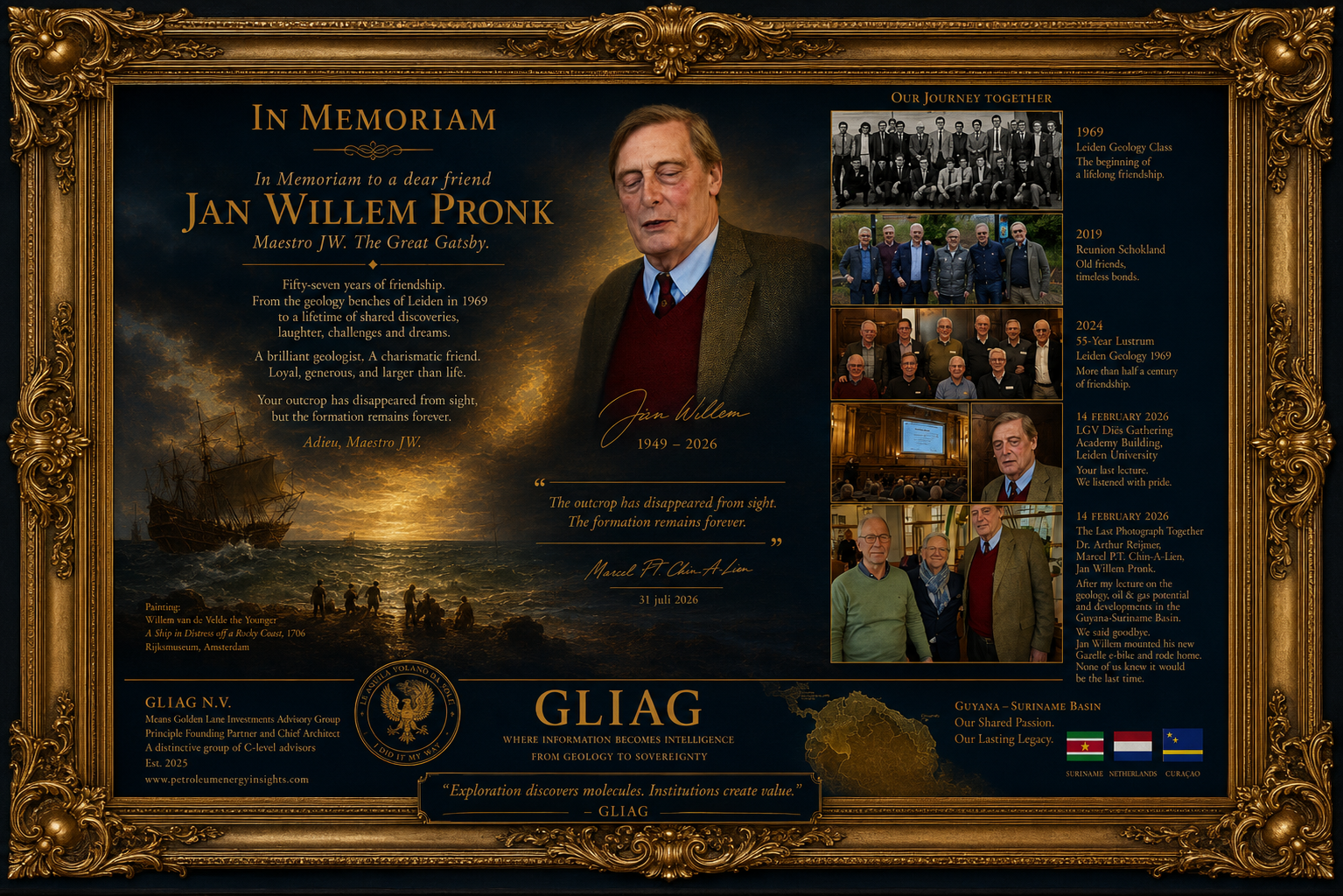
IN MEMORIAM | JAN WILLEM PRONK
IN MEMORIAM
Jan Willem Pronk
9 April 1950 – 23 July 2026
— ◆ —
MAESTRO JW • THE GREAT GATSBY • FRIEND FOR FIFTY-SEVEN YEARS
“Friendship, like geology, is not measured only by the years visible at the surface, but by the depth of the layers beneath.”
A personal remembrance by
Marcel P.T. Chin-A-Lien
Leiden Geology Class of 1969
THE FORMATION REMAINS
Dear friends, dear fellow geologists of 1969,
There are moments when time ceases to behave like a clock. It becomes tangible: a sequence of horizons, a slow accumulation of voices, journeys, jokes, reunions and farewells. Memory settles layer upon layer until, almost without our noticing, friendship becomes part of the bedrock beneath our lives.
Jan Willem Pronk belonged to that bedrock. For fifty-seven years, from the autumn of 1969 until his final days, he remained one of the rare constants in a world that kept changing around us. He was a charismatic and legendary co-student, a geologist of distinction, a gentleman without display, and a friend whose presence gave warmth and character to every gathering.
To me he was never merely Jan Willem. He was “Maestro JW”. Often he was “The Great Gatsby” – a title bestowed with affection upon a man who carried a natural elegance, an old-world charm and a mischievous sparkle that no formal description could capture. On rare occasions I called him “Mr Balikpapan”, in honour of the place where his life began, or “Maestro Jan Guillermo”. He would answer with that unmistakable smile: amused, patient and entirely his own.
Some people enter a room and demand attention. Jan Willem did something subtler. He entered, and the room became more alive. Conversation gained rhythm. Old stories returned. The years between meetings dissolved. His charisma was not theatrical; it came from curiosity, intelligence, humour and the genuine interest he continued to show in the lives of others. He remembered people. He asked after families. He wanted to know what had become of classmates scattered across companies, countries and continents. In his company, the class of 1969 never felt dispersed.

Leiden geology students, 1969 – the beginning of a friendship that would endure for fifty-seven years.
We were young in that photograph – impossibly young, as all old photographs eventually make us appear. We stood before a future none of us could yet read. We had chosen geology because the Earth seemed to promise a lifetime of discovery. We would learn to reconstruct vanished seas, uplifted mountains, buried basins and migrating continents. Yet one of the most important discoveries of those years was not in a lecture hall, laboratory or outcrop. It was the discovery of one another.
A university cohort is formed by circumstance, but a fellowship is formed by time. Some classmates become names in an old address book. Some become professional acquaintances. A very few become companions across an entire lifetime. Jan Willem belonged to that rarest group.
A LEGENDARY CO-STUDENT
Jan Willem possessed the gift of being memorable without ever needing to promote himself. Even in our student years there was something distinctive about him: an ease of manner, a cultivated wit, a certain Gatsby-like style, and an ability to move between seriousness and laughter without diminishing either. He could discuss geology with precision and, moments later, puncture solemnity with a perfectly timed observation.
That quality remained with him. Through careers in the international petroleum world, through changing companies and shifting geographies, through all the triumphs and disappointments that accompany a long professional life, he never lost the human scale of things. Geology mattered. Petroleum mattered. Work mattered. But friendship mattered too – and perhaps, in the end, more.
Whenever our paths crossed, the intervening years fell away. We resumed rather than restarted. The conversation continued from some earlier horizon, as if no unconformity had ever separated us. This is one of the quiet miracles of an old friendship: it does not need to be constantly rehearsed in order to remain true.

The Leiden geology friends reunited at Schokland in 2019 – older in years, but still bound by the same formation.
At Schokland in 2019, we gathered again. Around us lay a landscape shaped by water, human persistence and geological memory. Before us stood the friends with whom we had once begun. Faces had changed, bodies had slowed, careers had become histories, but the essential chemistry of the group survived. Jan Willem was part of its spirit: recognisable not only by appearance, but by the energy he brought with him.
Reunions are deceptive. They seem to celebrate the past, but they also reveal the present with unusual clarity. They show us what time has altered and what it has been unable to touch. In Jan Willem, time had altered much, as it does in all of us, but it had not erased his warmth, his wit or his loyalty.

The 55-year Leiden geology reunion, September 2024 – a generation still standing together.
The September 2024 reunion carried a deeper resonance. Fifty-five years had passed since our first meeting. We stood together not simply as former students, but as survivors and witnesses of an era. Each of us carried private histories invisible in the photograph: departures and returns, marriages and children, discoveries and dry holes, illnesses, griefs, ambitions fulfilled and ambitions quietly surrendered.
After that reunion I repeatedly urged Jan Willem to write his geological memoirs. “Do it now, JW,” I told him. “Your stories deserve another life.” He had lived through a world of geology and petroleum that was already disappearing. He possessed memories that no database could reproduce: personalities, judgments, field impressions, boardroom tensions, laughter after difficult wells, and the unwritten culture of our profession.
He never completed them. Perhaps he intended to. Perhaps, like so many of us, he believed time would remain available. His unwritten memoir has become one of the great regrets surrounding his departure. It is also one reason I now feel compelled to complete my own. Stories disappear more quickly than rocks. First the detail erodes, then the voices, then the laughter. Eventually only names remain – and, after that, silence.
THE LAST TIME WE MET
The last time I saw Jan Willem alive was at my LGV Diës lecture in the historic Academy Building of Leiden University. I spoke about the petroleum potential of the Guyana-Suriname Basin – a subject that had occupied so much of my professional and intellectual life. The setting itself carried the weight of history, but what I remember most clearly now is that Jan Willem came.
By then his health was fragile. Attendance required effort. He could easily have remained at home, and no one would have questioned it. Yet he appeared. That simple act said more about friendship than any eloquent tribute written after death. He came because old bonds still mattered. He came because a friend was speaking. He came because, until the end, he remained part of our shared geological world.

At the LGV Diës gathering in Leiden: Arthur Reijmer, Marcel Chin-A-Lien and Jan Willem Pronk – one of our final moments together.
After the lecture he approached me with the familiar twinkle in his eyes. He congratulated me on the presentation and the slides. Then, with perfect Jan Willem timing, he confessed that he had understood almost nothing. He had been sitting in the back row, he said, and was by then “already half deaf”. The remark contained no self-pity. It was simply honest, funny and affectionate. We laughed.
“Marcel, beautiful slides, fascinating lecture – but I understood absolutely nothing. I was sitting in the last row and I am already half deaf. Anyway, congratulations.”
That was Jan Willem: intelligent enough never to pretend, humorous enough to turn frailty into companionship, and generous enough to come despite the cost. At the time, the exchange felt like another of the countless small moments accumulated over fifty-seven years. Only later did it reveal itself as a farewell.
Jan Willem at the LGV Diës lecture – one of the last photographs I took of my friend.
I took two photographs of him that day without knowing what they would become. They are not merely records of appearance. They preserve presence: the line of his profile, the attentive stillness, the dignity of a man whose strength was diminishing but whose spirit had not withdrawn. Photographs acquire their true weight only after the moment they contain can no longer return.
When I look at this final portrait, I do not see illness first. I see the legendary co-student of 1969. I see Maestro JW. I see the Great Gatsby. I see the friend who continued to show up.
ONE LAST JOURNEY
On the morning of his funeral I left home an hour and a half early. I could not bear the thought of arriving in haste. Some farewells require silence before words. The roads seemed unusually empty, although perhaps grief simply alters the scale of a landscape.
Then, by a coincidence I shall carry with me for the rest of my life, I found myself driving directly behind the hearse that was carrying Jan Willem from the mortuary along the Haarlemmerstraatweg toward the Groene Kerk in Oegstgeest. There was no procession behind it. Mine was the only car following.
For several quiet kilometres, after fifty-seven years of conversation, we travelled without speaking. No geology. No teasing. No reports from distant basins. No questions about classmates or families. Only the hearse ahead, the road unfolding between familiar trees, and the knowledge that this was the last journey I would ever make in his company.
It felt less like an accident than a final act of friendship granted by fate. I had not planned to accompany him from the mortuary. I had only tried to be early. Yet there I was – the sole witness behind him, following my friend toward the church where we would say goodbye.
We geologists are trained to distrust easy meaning. We know how readily human beings impose patterns upon incomplete evidence. Yet some coincidences enter the heart before reason can object. This was one of them.
WHAT REMAINS
The death of an old friend does more than create absence. It rearranges the landscape of one’s own life. Roads once travelled together lead somewhere different. Photographs change their meaning. Old jokes become precious artefacts. Even one’s own memories acquire urgency.
Jan Willem’s passing made me understand more clearly why memoirs must be written while voices can still be heard. We spent our professional lives recovering histories from fragments: a fossil, a seismic reflector, a change in grain size, a fault whose movement could be inferred though never witnessed. Now we ourselves have become part of history. Our memories, too, survive only in fragments unless someone gathers them.
This remembrance will therefore become part of my memoir, The Earth Remembers. Jan Willem belongs there not as a footnote, but as a formative horizon: a friend whose companionship stretched from youth into old age, and whose unwritten memoir helped awaken the necessity of mine.
He was charismatic. He was legendary among his co-students. He was elegant without vanity, humorous without cruelty, intelligent without pretension and loyal without ceremony. He carried the past lightly, but he never abandoned it. He made people feel remembered.
— ◆ —
The outcrop has disappeared from sight. The formation remains forever.
— ◆ —
Dear Maestro, thank you for fifty-seven years. Thank you for the laughter, the wit, the elegance, the professional kinship and the quiet loyalty. Thank you for coming to that last lecture. Thank you for one final joke. Thank you, even, for that last silent journey to the Groene Kerk.
The geological formation known as “Leiden Geology 1969” has lost one of its most distinctive and beloved strata. Yet a formation is never only what can still be seen at the surface. It continues beneath the landscape, supporting everything that came after.
So it shall be with you.
Adieu, Maestro JW.
Adieu, Great Gatsby.
Until we meet again – beyond the last outcrop, where old geologists may resume the conversations that never truly ended.
With enduring friendship,
Marcel P.T. Chin-A-Lien
Friend and fellow geologist | Leiden University, Class of 1969
A Final Farewell
Our final gathering in the Groene Kerk, Oegstgeest. A moment of quiet remembrance, gratitude, and farewell. This is how I wish to remember you, Maestro JW—not only for the life you lived, but for the friendships you inspired.
Adieu, Maestro JW.
The outcrop has disappeared from sight. The formation remains forever.
IN MEMORIAM | JAN WILLEM PRONK

The Last Photograph Together
Kamerlingh Onnes Building, Leiden – 14 February 2026
Left to right: Dr. Arthur Reijmer, Marcel P.T. Chin-A-Lien and Jan Willem Pronk
Taken after the LGV conference in Leiden, where I spoke on the geology, oil and gas potential, and continuing developments of the Guyana-Suriname Basin. Arthur and Jan Willem had been our fellow geology students since 1969.
A few moments later, Jan Willem said goodbye, mounted his new Gazelle e-bike and rode home. None of us knew that this ordinary farewell would become the last photograph of the three of us together.
Sometimes the final photograph does not announce itself. Only memory, much later, reveals what the camera had preserved.