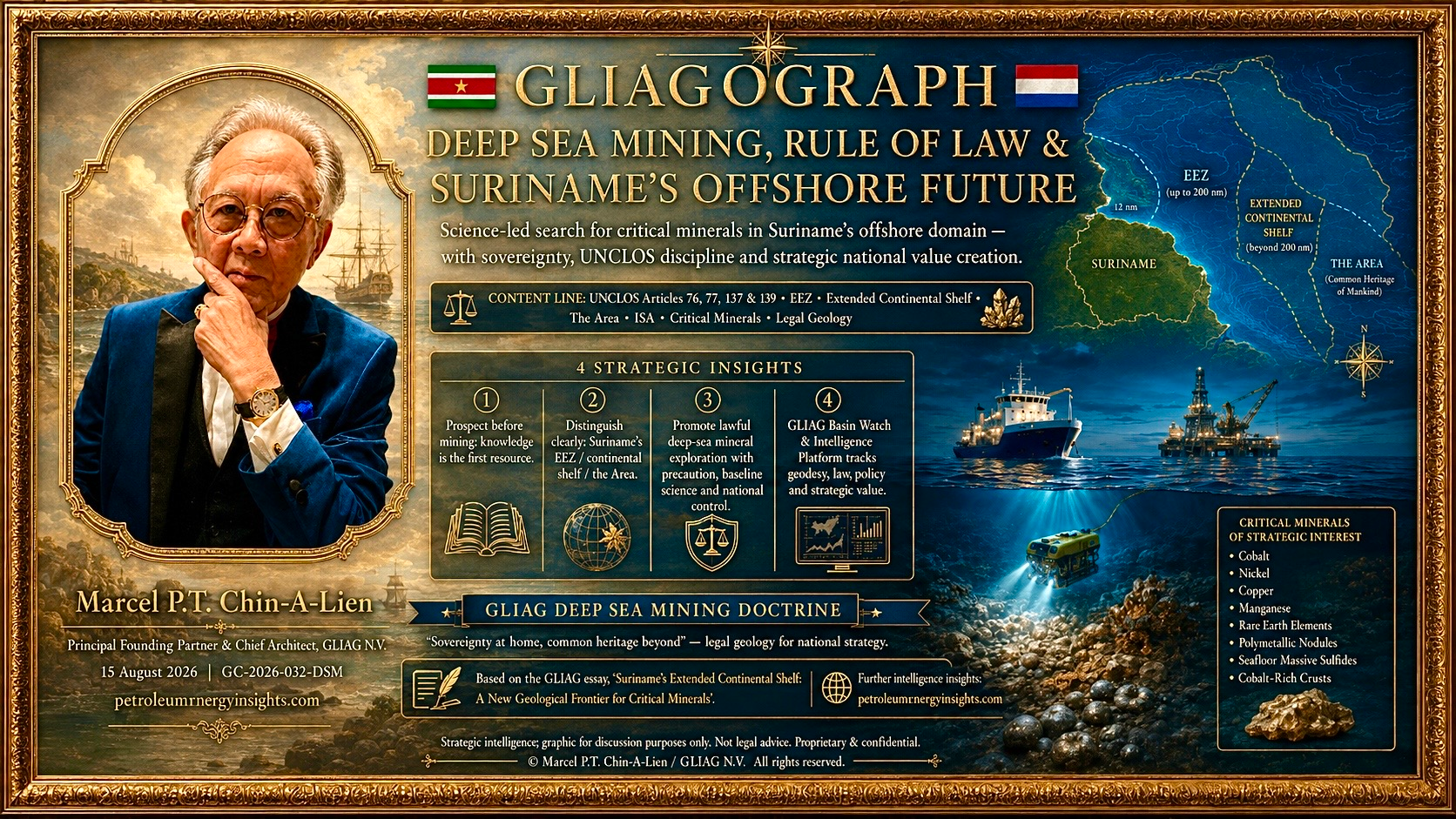
GLIAGOGRAPH · GOLDEN LANE INVESTMENTS ADVISORY GROUP
GLIAG STRATEGIC ESSAY · GG-2026-032-DSM REV001
The Seabed Is Not a Legal Vacuum
Why Suriname should search its deep offshore for critical minerals — under UNCLOS, before others define the future.
Marcel P.T. Chin-A-Lien
Principal Founding Partner & Chief Architect, GLIAG N.V.
Zoetermeer / Paramaribo · 15 August 2026
CONTENT LINE: UNCLOS Articles 76, 77, 82, 137 & 139 • Suriname EEZ • Continental Shelf • Extended Continental Shelf • The Area • International Seabed Authority • Critical Minerals • Deep-Offshore Exploration • Legal Geology • GLIAG Basin Watch & Intelligence Platform
Suriname should not begin its deep-sea-minerals strategy with a mining machine. It should begin with law, geology and knowledge.
There is a profound legal distinction between mineral resources located on Suriname’s continental shelf — including a legally established continental shelf beyond 200 nautical miles — and minerals situated farther seaward in “the Area,” which UNCLOS declares the common heritage of humankind.
That distinction creates an opportunity. Suriname can simultaneously defend the international rule of law governing the Area and launch a scientifically rigorous national campaign to determine whether its own deep offshore contains strategically important minerals.
Exploration is not exploitation. Prospecting is not appropriation. Knowledge is the first resource. That should become the foundation of Suriname’s deep-offshore minerals policy.
SEAWARD FROM THE COAST · THREE LEGAL SPACES
EXCLUSIVE ECONOMIC ZONEGenerally to 200 nautical miles. Water column, living and non-living resources.
CONTINENTAL SHELF & ECSSeabed and subsoil. Extends beyond 200 nm where Article 76 is satisfied. Sovereign rights under Article 77 — exclusive.
THE AREABeyond national jurisdiction. Common heritage of humankind under Articles 136–137. ISA Part XI regime.
↑ The gold line is the legal firewall. Everything to its left is Suriname’s to govern. Everything to its right belongs to no one and to everybody.
01 – One ocean — three very different legal spaces
The greatest conceptual mistake in discussing deep-sea mining is to treat everything beyond the shoreline as one legal space. It is not.
For Suriname, three zones must be kept analytically separate. The first is the Exclusive Economic Zone, extending generally to 200 nautical miles. The second is Suriname’s continental shelf, which concerns the seabed and subsoil and can extend beyond 200 nautical miles where the requirements of UNCLOS Article 76 are satisfied. The third is the Area: the seabed beyond the limits of national jurisdiction.
For mineral strategy, the continental shelf is decisive. Under UNCLOS Article 77, the coastal State exercises sovereign rights over its continental shelf for the purpose of exploring it and exploiting its natural resources. Those rights are exclusive: if the coastal State does not explore or exploit them, another State may not simply do so without its express consent.
Suriname submitted information concerning its continental shelf beyond 200 nautical miles to the UN Commission on the Limits of the Continental Shelf in December 2008. The CLCS process is therefore central not merely to cartography but to long-term national resource strategy.
That is why I have argued in earlier work that Suriname should begin treating its extended continental shelf not merely as a boundary accomplishment but as a mineral-policy asset.
AUTHOR’S UNCLOS PRACTITIONER PERSPECTIVE
From outer-limit geometry to diplomacy
This proposal is not written from a purely academic distance. I participated directly in Suriname’s work on the continental shelf beyond 200 nautical miles as part of a small technical-policy team associated with the Ministry of Natural Resources / Petroleum Contracts function. The work combined geology, geophysics, law-of-the-sea requirements and the exact geodetic construction of outer-limit points.
I worked in that process with Prof. Dr. Hinz and a compact specialist team. Coalter G. Lathrop also assisted in checking and determining the precise geographic positions of Outer Limit Points and in the construction and drafting of the resulting outer-limit line. That practical experience is one reason why I insist on a “Legal Geology” approach: a geological argument has no sovereign value until it is translated into coordinates, formulae, constraints, charts and legally defensible lines under UNCLOS Article 76.
The public institutional record confirms the success of Suriname’s formal process. Suriname lodged its submission concerning the continental shelf beyond 200 nautical miles with the Commission on the Limits of the Continental Shelf on 5 December 2008. On 30 March 2011, the Commission adopted its Recommendations in regard to Suriname’s submission by consensus. These are properly termed CLCS Recommendations rather than an “award”; under Article 76(8), outer limits established by a coastal State on the basis of such recommendations are final and binding.
My involvement also extended into the diplomatic dimension that necessarily accompanies overlapping maritime interests. I participated in pre-deliberations and bilateral diplomatic discussions with Guyana in the Ministry of Foreign Affairs in Paramaribo, in settings involving senior officials, ambassadors and the Minister of Foreign Affairs. This experience reinforced an essential lesson: continental-shelf science, outer-limit delineation and bilateral delimitation are connected in strategy, but legally distinct processes. UNCLOS Article 83 requires continental-shelf delimitation between adjacent or opposite States to be effected by agreement in order to achieve an equitable solution, while pending agreement the parties are to make every effort to enter provisional arrangements and not jeopardize or hamper a final agreement.
The separate Guyana–Suriname maritime boundary dispute was ultimately resolved by an Annex VII UNCLOS arbitral tribunal, whose Award was issued on 17 September 2007. That Award is an important part of the legal-geographic context in which any Suriname deep-offshore minerals strategy must operate. It should not be confused with the later CLCS recommendations on Suriname’s continental shelf beyond 200 nautical miles.
For GLIAG, this is more than professional biography. It is institutional memory. The same discipline used to transform seismic, bathymetric and geodetic evidence into a defensible continental-shelf case should now be applied to critical minerals: know the geology, establish jurisdiction, fix the coordinates, negotiate where necessary, legislate before licensing, and only then consider commercial extraction.
Official documentary record:
Suriname CLCS Submission — Executive Summary (5 December 2008) · UN CLCS — Suriname submission & recommendations page · CLCS Recommendations concerning Suriname · PCA — Guyana v. Suriname, Annex VII UNCLOS Award (17 September 2007) · UNCLOS Part VI — Articles 76, 77 and 83
02 – Suriname should explore before it decides whether to mine
I support a vigorous Surinamese deep-offshore critical-minerals programme. But the sequence matters. Search first. Characterise second. Regulate third. Decide on exploitation last.
The geological hypothesis should be tested rather than politically assumed. In earlier GLIAG work I identified the deep offshore north of the Demerara Plateau and associated transform-margin domain as deserving systematic investigation. The geological rationale includes crustal transition, faulting, volcanic and hydrothermal processes and deep-ocean depositional settings that may justify investigation for several classes of mineralisation. The operative word is may: geological prospectivity is not the same thing as a mineral discovery, resource or reserve.
The appropriate Suriname programme should therefore start with multibeam bathymetry, backscatter, marine gravity, magnetics, reprocessed seismic, water-column geochemistry, seabed imaging, controlled sampling, mineralogy, geochemistry, environmental baseline surveys and resource assessment.
This is exactly where petroleum expertise becomes transferable. Suriname already possesses an expanding offshore petroleum knowledge base. Data acquired to understand sedimentary basins, basement architecture, structural configuration and petroleum systems may have a second life in evaluating seabed morphology, volcanic edifices, basement structures, transform systems and possible mineralising environments.
The first strategic resource is therefore not cobalt, nickel or copper. It is data.
03 – The critical legal firewall: Suriname’s shelf is not “the Area”
Beyond the outer limit of national continental-shelf jurisdiction, a fundamentally different legal system begins.
UNCLOS Article 136 declares the Area and its resources the common heritage of humankind. Article 137 prohibits States from claiming sovereignty or sovereign rights over the Area or appropriating its resources outside the Part XI system.
This is where present international controversy becomes strategically important. The International Seabed Authority has maintained that UNCLOS States Parties must not recognize acquisitions of mineral rights from the Area that are inconsistent with Part XI.
In 2026, the ISA Assembly was presented with ISBA/31/A/8 concerning a possible request under UNCLOS Article 191 for an advisory opinion from the ITLOS Seabed Disputes Chamber on the legal implications of activities in the Area undertaken by non-States Parties.
Among the questions raised is whether the Article 137 non-appropriation principle also operates as customary international law vis-à-vis States that are not parties to UNCLOS. That question should not be prejudged politically; it is precisely the type of question international adjudication exists to clarify.
For Suriname, one principle should already be clear: defending Suriname’s sovereign rights over its own continental shelf and defending the common-heritage regime beyond national jurisdiction are not contradictory positions. They are two sides of the same UNCLOS order.
Sovereignty at home. Common heritage beyond.
04 – Article 139 means that States cannot simply look away
Article 139 places responsibility on States Parties to ensure compliance with Part XI by activities in the Area undertaken by States, State enterprises and qualifying private entities linked through nationality or effective control.
The landmark 2011 ITLOS Seabed Disputes Chamber Advisory Opinion makes clear that the sponsoring State’s responsibility is a genuine due-diligence obligation. It requires appropriate laws, regulations and administrative measures rather than passive governmental sponsorship.
ITLOS identified important direct obligations concerning assistance to the ISA, precaution, best environmental practices, environmental-impact assessment, emergency protection and access to compensation.
That judgment carries a major warning for developing States: a deep-seabed-mining sponsorship is not a flag-rental business. A State taking on sponsorship can expose itself to regulatory, diplomatic, environmental and potentially financial responsibilities.
Suriname should therefore not rush into sponsoring commercial operations in the Area merely to obtain nominal participation in an international mining venture. Build regulatory capacity first.
05 – An important fiscal detail: Article 82
If non-living resources are ultimately produced from that part of Suriname’s continental shelf lying beyond 200 nautical miles, UNCLOS Article 82 provides for payments or contributions through the International Seabed Authority after the initial production period.
The mechanism begins in the sixth year of production at 1 per cent of the value or volume of production at the site, increasing annually until reaching 7 per cent from the twelfth year onward, subject to the Convention’s specific provisions and developing-State exception.
That means an extended-continental-shelf mineral project may fall under Surinamese resource jurisdiction without becoming an ISA mining project, while nevertheless carrying an international benefit-sharing obligation under Article 82.
That distinction should eventually be incorporated into project economics, fiscal modelling and legislation.
06 – Environmental law is part of the resource right
Sovereign rights do not mean sovereign freedom from environmental obligation.
UNCLOS Articles 192 and 194 establish broad duties to protect and preserve the marine environment and to prevent, reduce and control marine pollution. Article 206 addresses environmental assessment where planned activities may cause substantial pollution or significant harmful changes.
Suriname should therefore establish the environmental baseline before the commercial pressure arrives: biological inventories, benthic ecology, sediment characteristics, current systems, natural turbidity, geochemistry, habitat mapping and long-duration monitoring should precede any exploitation licence.
Baseline science is not an obstacle to development. It is sovereign negotiating power.
07 – Build a Suriname Offshore Minerals Act before the industry arrives
Petroleum taught Suriname an important lesson: legislation should ideally precede commercial urgency.
The country therefore needs a dedicated national framework for offshore mineral resources. Such legislation should distinguish unmistakably between resources under Surinamese jurisdiction and activities in the international Area.
It should regulate exploration licensing, beneficial ownership, environmental assessment, environmental bonds, financial assurance, data ownership, seabed sampling, commerciality declarations, development plans, abandonment, monitoring, liability, inspection, mineral traceability and sanctions.
It should also incorporate Suriname’s responsibilities as an UNCLOS State Party if Surinamese nationals, companies, vessels or controlled entities become involved in mining activities in the Area.
The objective is not regulation for regulation’s sake. It is to avoid discovering later that the State issued rights before it understood what those rights were worth.
08 – From the Guyana–Suriname Basin Watch to a wider intelligence architecture
This is also why the GLIAG Basin Watch and GLIAG Intelligence Platform should increasingly extend beyond petroleum.
The geology does not recognize the administrative compartments governments traditionally create between oil, gas, minerals, maritime boundaries, environmental policy and geopolitics. Neither should strategic intelligence.
The same offshore domain can simultaneously contain petroleum systems, continental-margin mineral systems, submarine geomorphological targets, strategic infrastructure corridors, fisheries and ecosystems, sovereign maritime rights, UNCLOS boundary questions, environmental liabilities and geopolitical interests.
The next generation of the GLIAG Basin Watch is therefore conceived not simply as a petroleum-news monitor but as an integrated geology–law–economics–policy intelligence system.
For Suriname, that means continuously connecting developments in the Guyana–Suriname Basin, the ISA, UNCLOS jurisprudence, critical-mineral markets, offshore technology, environmental science and national industrial strategy.
Because intelligence becomes most valuable before everyone else reaches the same conclusion.
09 – The strategic position Suriname should take
Suriname does not have to choose between becoming an environmental absolutist and becoming an indiscriminate seabed miner. There is a stronger position: be aggressively pro-knowledge.
Map the seabed. Acquire the data. Sample selectively. Train Surinamese geoscientists. Reprocess existing offshore datasets. Establish environmental baselines. Determine the mineral systems. Define the jurisdiction. Build the legislation. Model the economics. Then decide whether individual mineral occurrences should ever proceed to development.
Meanwhile, defend without ambiguity the UNCLOS architecture governing the international Area. There is no strategic reason for Suriname to confuse urgency with haste.
10 – GLIAG conclusion — prospect before mining
Suriname’s petroleum history demonstrated what patient geological knowledge can ultimately become. Deep-offshore minerals require the same intellectual discipline.
Do not begin by proclaiming reserves that have not been demonstrated. Do not begin by promising mines that have not been proven environmentally, technically or commercially feasible. And do not surrender national optionality because another country, company or commodity market suddenly declares critical minerals urgent.
Begin instead with a national programme to know the seabed.
If commercially significant mineral systems are eventually demonstrated on Suriname’s continental shelf, Suriname will negotiate from evidence rather than speculation. If environmental science demonstrates that a deposit should not be exploited, the country will know that too. And if strategic mineral occurrences are discovered that should be preserved for a later generation, geological knowledge will still have increased national wealth.
Prospect before mining. Knowledge before concession.Jurisdiction before investment. Baseline before disturbance.
Sovereignty at home. Common heritage beyond.
Suriname should explore its deep offshore not because mining is inevitable. It should explore because a sovereign State ought to know what it owns before the world decides what it wants.
Selected authoritative references
- United Nations — full text of UNCLOS
- United Nations — UNCLOS Part XI: principles governing the Area
- ITLOS — Case No. 17: 2011 Advisory Opinion on responsibilities and obligations of sponsoring States
- International Seabed Authority — statements, ISBA/31/A/8, 31st Session (2026) and the draft Exploitation Regulations
- United Nations CLCS — Suriname submission page
- Permanent Court of Arbitration — Guyana v. Suriname, Annex VII UNCLOS Award (17 September 2007)
- GLIAG — Suriname’s deep-sea mining potential
- GLIAG — critical raw materials: Suriname’s onshore and offshore potential
- GLIAG — critical minerals from Guiana Shield mantle processes
- Petroleum & Energy Insights — GLIAG Intelligence Platform
Marcel P.T. Chin-A-Lien
Drs., MBA, M.Sc., Ing. Geologist
Principal Founding Partner & Chief Architect, GLIAG N.V. — Golden Lane Investments Advisory Group
Certified Professional Geologist Nr. 5201-1996 (AAPG) · Chartered European Geologist Nr. 92-1996 (EFG) · Energy Negotiator June 2021 (AIEN)
Zoetermeer / Delft · Paramaribo · petroleumenergyinsights.com
Author’s relevant UNCLOS experience. The author participated in Suriname’s continental-shelf work beyond 200 nautical miles, including technical work on outer-limit geometry and points and pre-deliberation and bilateral diplomatic discussions concerning maritime interests with Guyana. This professional account is presented as the author’s own experience; the formal public outcomes are documented in the UN CLCS records and the 2007 Guyana v. Suriname Annex VII Award linked above.
Converting bare headlines into deep strategic, added value.
GLIAG · Where Information Becomes Intelligence. Where Discoveries Become Strategy.
DISCLAIMER · COPYRIGHT · INTELLECTUAL PROPERTY
Disclaimer. This GLIAG strategic essay is provided for professional, policy and strategic discussion purposes. It does not constitute legal, investment, environmental or engineering advice, nor an offer, solicitation or recommendation in respect of any transaction, licence or security. Geological concepts discussed herein constitute exploration hypotheses unless expressly supported by published resource data. No statement concerning mineral prospectivity should be interpreted as establishing a mineral discovery, resource, reserve or commercial mining project.
Independence. GLIAG N.V. is independent. The views expressed are those of the author and do not represent the position of any government, ministry, operator, licensee or international organisation referenced herein.
Forward-looking statements. This essay contains forward-looking assessments concerning geology, law, policy and markets. Such statements involve known and unknown risks and uncertainties; actual outcomes may differ materially.
Copyright. © 2026 Marcel P.T. Chin-A-Lien / GLIAG N.V. — Golden Lane Investments Advisory Group. All rights reserved. Proprietary intellectual work. Reproduction, commercial redistribution or adaptation without prior written authorisation is prohibited.
Text and data mining reservation. The rightholder expressly reserves the right to reproductions and extractions of this work for text and data mining purposes, including the training of artificial intelligence and machine-learning systems, pursuant to Article 4(3) of Directive (EU) 2019/790. No licence for AI or ML training is granted by publication.