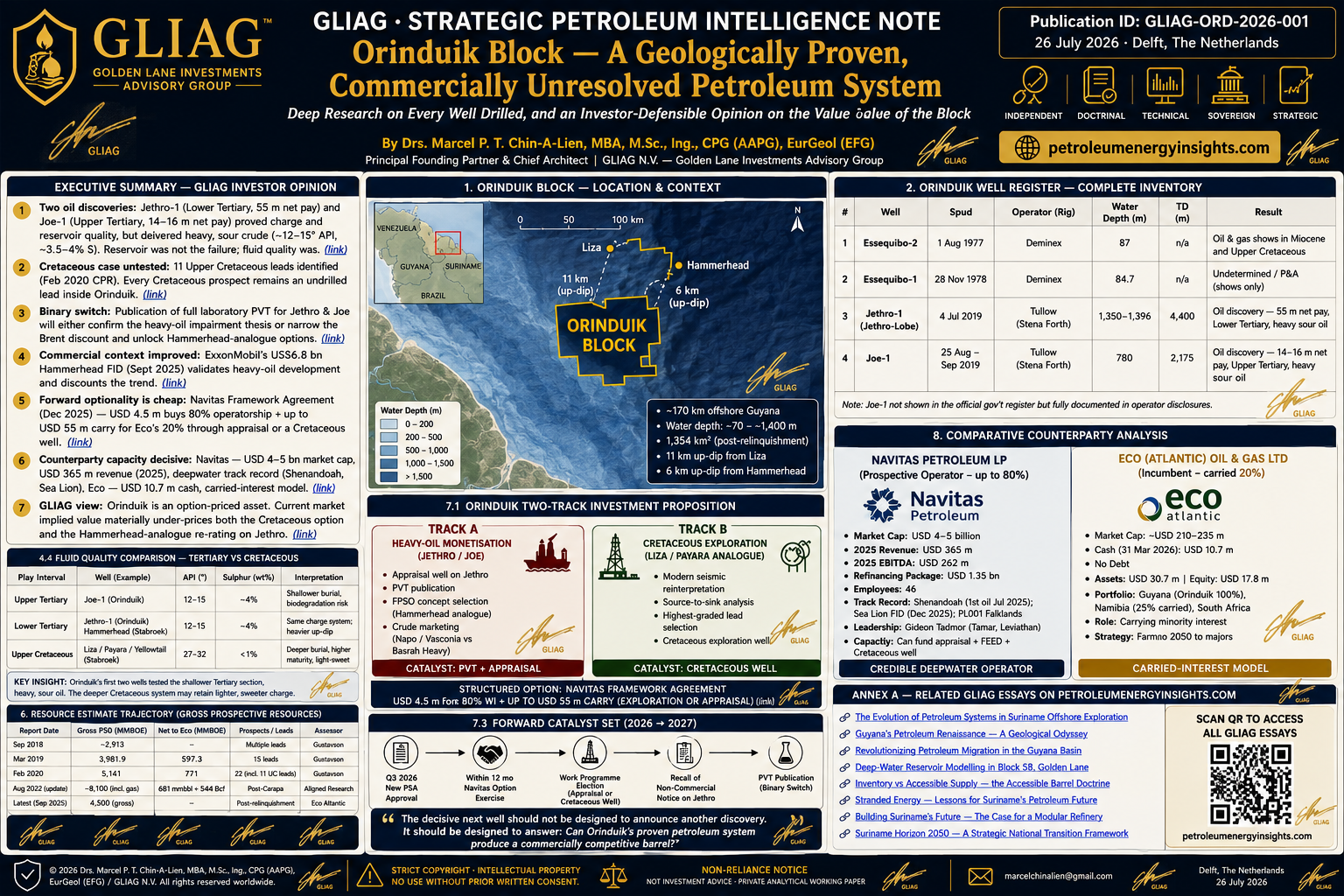
GLIAG · STRATEGIC PETROLEUM INTELLIGENCE NOTE
Orinduik Block — A Geologically Proven,
Commercially Unresolved Petroleum
System
Deep Research on Every Well Drilled, and an Investor-Defensible Opinion on the Value
of the Block
By Drs. Marcel P. T. Chin-A-Lien, MBA, M.Sc., Ing., CPG (AAPG), EurGeol (EFG)
Principal Founding Partner & Chief Architect
GLIAG N.V. — Golden Lane Investments Advisory Group
Publication ID: GLIAG-ORD-2026-001 · 26 July 2026 · Delft, The Netherlands
Strict Copyright, Intellectual Property & Non-Reliance Notice
© 2026 Drs. Marcel P. T. Chin-A-Lien, MBA, M.Sc., Ing., CPG (AAPG), EurGeol (EFG) Golden Lane Investments Advisory Group. All rights reserved worldwide.
/ GLIAG N.V. —
This document — including its title, structure, argument, analytical framework, geological and
petroleum-system interpretation, subsurface reconstructions, fluid-quality reasoning, commercial and
fiscal analysis, counterparty due-diligence content, tables, figures, charts, citations, footnotes, annexes,
and all doctrinal terminology (including but not limited to the GLIAG Dynamic Charge–Biodegradation
Continuum Doctrine, the Accessible Barrel Doctrine, the Sovereign Conversion Doctrine, the
Infrastructure Continuity Doctrine, and Suriname Horizon 2050 / SH-2050) — constitutes the original
intellectual property of Drs. Marcel P. T. Chin-A-Lien, in his personal capacity as author and as Principal
Founding Partner and Chief Architect of GLIAG N.V., and of GLIAG N.V. itself.
No use without prior written consent. No part of this document, in whole or in part, in any form or
medium (including but not limited to text, tables, figures, screenshots, extracts, paraphrase, summary,
translation, derivative works, machine-readable outputs, embeddings, vector databases, retrieval-
augmented generation systems, fine-tuning corpora, or any other input to any artificial-intelligence,
machine-learning, or generative model), may be copied, reproduced, quoted, circulated, republished,
cited, translated, stored, indexed, ingested, or otherwise used — by any natural person, corporation,
partnership, sovereign entity, financial institution, investment vehicle, media outlet, or automated
system — without the explicit, prior written consent of Drs. Marcel P. T. Chin-A-Lien, the writer,
Principal Founding Partner and Chief Architect of GLIAG N.V. Requests for permission must be directed
to marcelchinalien@gmail.com.
No investment, commercial or transactional use. This document is a private analytical working paper
prepared for petroleum-systems, basin-strategy and doctrinal reference. It is not an investment
recommendation, offering document, prospectus, financial-advisory memorandum, reserves report,
competent person’s report, farm-in or farm-out solicitation, valuation opinion, credit opinion, or fairnessopinion. It does not constitute investment advice under any jurisdiction. No party may rely on this
document, in whole or in part, as the basis for any investment decision, farm-in, farm-out, acquisition,
disposal, financing, hedging, valuation, mandate, credit exposure, syndication, listing, delisting, capital
raise, joint-venture negotiation, arbitration submission, expert-witness opinion, regulatory filing, tax
filing, sovereign advisory position, or any other commercial or financial transaction of any kind,
without the explicit, prior written consent of Drs. Marcel P. T. Chin-A-Lien. Any such use in the absence
of prior written consent is expressly disclaimed and prohibited, and shall not create any duty of care,
fiduciary duty, contractual obligation, or liability of any kind on the part of the author or GLIAG N.V.
Sources and independence. All third-party sources are cited inline and in Annexes A and B. Rights in
third-party material remain with their respective owners. Views expressed are those of the author and
GLIAG N.V. and do not represent the views of any client, counterparty, government, regulator or
operator referenced herein. The author has no undisclosed material interest in Eco (Atlantic) Oil & Gas
Ltd, Navitas Petroleum LP, Tullow Oil plc, TotalEnergies SE, QatarEnergy, ExxonMobil Corporation, or any
other named entity as at the date of publication.
Enforcement of these terms is expressly reserved. Prepared 26 July 2026 · Delft, The Netherlands.
About the Author
Drs. Marcel P. T. Chin-A-Lien, MBA, M.Sc., Ing., CPG (AAPG), EurGeol (EFG) — Principal Founding
Partner & Chief Architect of GLIAG N.V. (Golden Lane Investments Advisory Group).
Marcel is a petroleum and energy advisor with multi-decade experience in offshore petroleum
exploration and development, subsurface geology and geophysics, Production Sharing Contracts and
petroleum-agreement architecture, project finance and bankability analysis, refinery design and
economics, FLNG and gas-monetisation strategies, and comparative petroleum-systems analysis across
the Guyana–Suriname, West African, Eastern Mediterranean and Gulf of Mexico basins. He is the author
of the GLIAG doctrinal series on the Dynamic Charge–Biodegradation Continuum, the Accessible Barrel
Doctrine, the Sovereign Conversion Doctrine, the Infrastructure Continuity Doctrine, and the long-cycle
sovereign framework Suriname Horizon 2050 (SH-2050).
Based in Delft, The Netherlands. Working languages: Dutch, English, Spanish, Papiamentu, Sranan
Tongo. Publication surface: petroleumenergyinsights.com. Contact: marcelchinalien@gmail.com.
About GLIAG — Golden Lane Investments Advisory Group
GLIAG N.V. is a Suriname- and Guyana–Suriname-Basin-focused petroleum, energy and project-
management-consulting advisory platform, founded and led by Drs. Marcel P. T. Chin-A-Lien as Principal
Founding Partner and Chief Architect. GLIAG delivers institutional-grade, investor-defensible strategic
intelligence at the intersection of subsurface science, petroleum-fiscal architecture, project finance, and
sovereign energy policy.
Mandate. GLIAG advises sovereign clients, national oil companies, institutional investors, project
sponsors and multilateral lenders on offshore petroleum exploration and development, PSC and legal-
framework design, bankability and pre-FEED / FEED sequencing, gas-to-shore and LNG monetisation,
refinery and downstream-conversion economics, and long-cycle national transformation planning.
Doctrinal stack. GLIAG’s analytical output is anchored in a proprietary doctrinal framework: the Dynamic
Charge–Biodegradation Continuum Doctrine (basin-scale fluid-quality reasoning), the Accessible Barrel
Doctrine (headline resources vs sovereign-capturable barrels), the Sovereign Conversion Doctrine(domestic conversion before LNG lock-in), the Infrastructure Continuity Doctrine (bankable route-to-
market discipline), and Suriname Horizon 2050 (SH-2050) (long-cycle sovereign transformation).
Deliverables. Bankable pre-feasibility and feasibility studies; PSC and fiscal-regime architecture;
investor-defensible essays and strategic intelligence notes; sovereign policy reviews; refinery and gas-
monetisation techno-economics; project-management-consulting for petroleum-sector operators and
governments.
Publication surface. petroleumenergyinsights.com. All GLIAG doctrinal frameworks, working papers and
strategic intelligence notes are the intellectual property of Marcel P. T. Chin-A-Lien and GLIAG N.V.
Author’s frame. GLIAG working paper for petroleum-systems and basin-strategy reference. Scope. Every
well drilled on the Orinduik acreage, from the Deminex campaign of the 1970s to the Tullow-era 2019
programme and the Eco Atlantic / Navitas restructuring cycle that continues into 2026. Basis.
Government of Guyana well register, operator RNS releases, JV partner disclosures, Competent Person’s
Reports, and specialist trade press. Status. Private analytical working paper. Not an investment
recommendation. Not for transactional reliance without prior written consent of the author (see notice
above).
Executive Summary — GLIAG’s Investor Opinion on
Orinduik
Orinduik is not a failed block. Nor is it yet a development. It is a geologically proven, commercially
unresolved petroleum system whose forward value is defined less by what has been drilled than by
what has never been drilled — the deeper Upper Cretaceous section — and by whether the two heavy-
oil discoveries already made can be re-underwritten against a Hammerhead-analogue development
case post the ExxonMobil FID of September 2025.
1. 2. 3. 4. 5. The block has demonstrated charge more convincingly than commercial petroleum quality.
Two of the four modern wells (Jethro-1 and Joe-1) are oil discoveries; both encountered high-
quality sandstone; both delivered heavy, sour crude at rig-site sampling. Reservoir quality was
not the failure. Fluid quality was.
The Cretaceous case has never been drilled inside the licence. The Feb 2020 CPR identified 22
prospects and leads including 11 Upper Cretaceous leads, none of which has been penetrated
inside Orinduik. Every Cretaceous prospect on the block is an undrilled lead.
A binary technical switch controls the equity value. The publication of a full laboratory PVT
report for Jethro-1 and Joe-1 will either confirm the November-2019 heavy-oil impairment
thesis, or narrow the Brent discount and unlock Hammerhead-analogue development options.
That switch has not been thrown.
The commercial context in 2025–26 is materially better than in 2020. ExxonMobil’s US$6.8 bn
Hammerhead FID (22 September 2025), FPSO award and 2029 first-oil schedule provide the first
live, sanctioned, offshore-Guyana heavy-oil development on the trend.
The forward option is well-defined, contractually structured, and cheap. Under the December
2025 Navitas Framework Agreement, USD 4.5 million of Navitas option payments buys 80 %
operatorship in Orinduik together with up to USD 55 million gross work-programme carry
covering Eco’s 20 % interest through either a Cretaceous exploration well or a Jethro / Joe
appraisal.6. 7. Counterparty capacity is now the critical underwriting variable. Navitas Petroleum — the
prospective operator — carries a USD 4–5 billion market capitalisation, USD 365 m 2025
revenue, USD 262 m EBITDA, a USD 1.35 bn refinancing package, and demonstrable deepwater
execution at Shenandoah (first oil 2025) and Sea Lion (FID Dec 2025). Eco Atlantic runs on USD
10.7 m cash, no debt, and a carried-interest model. Section 8 sets out the full comparative
diligence.
GLIAG’s value view. On a risk-adjusted basis, GLIAG assesses Orinduik as an option-priced asset,
not a discovery-priced asset. GLIAG’s view is that the current market-implied value of Orinduik
materially under-prices both the Cretaceous option and the Hammerhead-analogue re-rating
on Jethro.
1. Block Setting
The Orinduik Block sits in the Guyana–Suriname Basin, approximately 170 km offshore Guyana, in water
depths ranging from ~70 m on its landward edge to ~1,400 m on its outboard flank (Eco Atlantic —
Guyana project page). The block sits 11 km up-dip from ExxonMobil’s Liza discovery and 6 km up-dip
from the Hammerhead discovery on the neighbouring Stabroek Block — a location that shaped every
pre-2019 valuation narrative for the acreage.
1.1 Acreage evolution
Period Gross area Trigger
2016 award – early 2023 1,800 km² Original Petroleum
Agreement (Tullow / Eco / – )
2023 – Jan 2024 ~1,440 km² Mandatory 20%
relinquishment at end of First
Renewal Period (OilNOW,
2022)
Jan 2024 – Jan 2026 1,354 km² Entry into Second Phase of
Second Renewal Period
Post 14 Jan 2026 Rights preserved only over
Jethro-1 & Joe-1
Pending appraisal-
programme approval
(Investing News Network,
14 Jan 2026)
1.2 Working-interest history (headline dates)
Effective Operator Working-interest owners
Jan 2016 Tullow Oil Tullow 100% (Eco earning in
on carry)
Sep 2017 – 2018 Tullow Tullow 60% / Eco 40%
Sep 2018 Tullow Tullow 60% / Total 25% / Eco
15% (TotalEnergies, 2018)
Nov 2023 Eco Atlantic Eco 75% / TOQAP (Total
60% / Qatar 40%) 25%
(Stabroek News, 2023)
Jan 2024 Eco Atlantic Eco 100% after TOQAPEffective Operator Working-interest owners
relinquishment (OilNOW,
Jan 2024)
Q3 2026 (planned) Navitas Petroleum Navitas 80% / Eco 20%
(carried up to US$11 m)
(Offshore Technology, Dec
2025)
Tullow’s exit in August 2023 for US$0.7 m cash upfront plus contingent milestones (US$4 m on
commercial discovery; US$10 m on production licence award; 1.75% royalty on its former 60% WI)
crystallised the market view that the Tertiary discoveries had failed to prove commercial (Reuters, 10
Aug 2023). At 31 December 2022 Tullow’s audited gross asset value on the transferred interest was just
US$1.5 m, against gross 2C resources of 47.7 mmbbls.
2. Complete Register of Wells Drilled in the Orinduik
Acreage
Guyana’s Ministry of Natural Resources publishes a single official well register that lists three wells in the
Orinduik Block. The register omits Joe-1, which was drilled by Tullow in August–September 2019 on the
northern part of the block and is universally documented in operator RNS releases and CPRs
(petroleum.gov.gy; cross-checked against Tullow RNS and Eco AIM 2020 CPR). Including Joe-1 gives a
four-well historical inventory:
# Well Spud Operator
Water
depth
(m) TD
Coordina
tes Result
1 Essequib
o-2
1977 Deminex 87 Not
disclosed
7.9497 N
/
57.5741
W
Water
(oil & gas
shows in
Miocene
and
Upper
Cretaceo
us)
2 Essequib
o-1
28 Nov
1978
Deminex 84.7 Not
disclosed
7.9339 N
/
57.5844
W
Undeter
mined /
P&A
(shows
only)
3 Jethro-1
(Jethro-
Lobe)
4 Jul
2019
Tullow
(Stena
Forth)
1,350–
1,396
4,400 m 8.1461 N
/
57.2785
W
Oil
discover
y — 55 m
net pay,
Lower
Tertiary
sandston
e# Well Spud Operator
Water
depth
(m) TD
Coordina
tes Result
4 Joe-1 25 Aug –
Sep 2019
Tullow
(Stena
Forth)
780 2,175 m Northern
block
(not
publishe
d)
Oil
discover
y — 14–
16 m net
pay,
Upper
Tertiary
channel
sandston
e
Analyst note on Carapa-1. Carapa-1 is routinely discussed alongside the Orinduik wells because Tullow,
Total and Repsol were common JV partners and because its Cretaceous light-oil result was interpreted
as a direct de-risking event for Orinduik’s deeper prospects. However, Carapa-1 was drilled on the
Kanuku Block, not on Orinduik. It is included below under Section 3.4 as a play-de-risking well, not as an
Orinduik well.
3. Well-by-Well Technical Deep Dive
3.1 Essequibo-2 (1977) and Essequibo-1 (1978) — Deminex
Two vertical exploration wells drilled from a jack-up (water depths 85–87 m) on the southern shelf
portion of what is today the Orinduik acreage. Only fragmentary technical information survives in the
modern public record.
Essequibo-2 (spud 1 Aug 1977) is credited with oil and gas shows in Miocene and Upper
Cretaceous intervals — the earliest recorded hydrocarbon indication in what became the
Orinduik acreage (OilNOW basin history, 2020).
Essequibo-1 (spud 28 Nov 1978) is filed in the official register as “Undetermined” outcome;
contemporary basin histories treat it as sub-commercial.
The importance of these two wells is not the volumetrics they produced but that they demonstrated a
live petroleum system in the southern Orinduik shelf four decades before the Liza-1 breakthrough.
Operator and rig identification (canonical). Both 2019 wells were operated by Tullow Guyana B.V. on
behalf of a JV holding Tullow 60% / Total 25% / Eco Atlantic 15%. Both were drilled using the Stena Forth
drillship, per Tullow’s contemporaneous RNS announcements and result presentations. A later
independent Competent Person’s Report incorrectly refers to the drilling unit as Stena Carron; the
operator records identify Stena Forth, which should therefore be treated as the controlling
identification.
3.2 Jethro-1 — the Lower Tertiary discovery (August 2019)
Purpose and geological concept
Jethro-1 targeted a Lower Tertiary stratigraphic accumulation in the northeastern part of the block,
close to the Hammerhead fairway on neighbouring Stabroek. It was interpreted pre-drill as a turbiditelobe or channel-associated sandstone with more than 100 mmbbl of potential recoverable oil, subject
to appraisal. It was simultaneously a prospect test and a petroleum-system calibration well (Tullow
Jethro-1 result presentation).
Rig, operations, depths and cost
Drilled by Stena Forth, spudded 4 July 2019, completed August 2019, result announcement 12
Aug 2019.
Total depth 4,400 m TVD in approximately 1,350 m of water per Tullow; the Feb 2020 CPR gives
water depth of 1,364 m; the government register lists 1,396 m.
Total well cost ~US$51.5 m gross per the Feb 2020 CPR. Tullow’s original result presentation
referred to ~US$30 m net well cost, most likely representing Tullow’s 60% net share.
Reservoir
55 m (180.5 ft) of net oil pay in Lower Tertiary amalgamated sandstones. The Feb 2020 CPR places the
principal reservoir interval between approximately 4,178.5 and 4,233 m MD and assigns it an Early
Oligocene (Rupelian) age. Both Tullow and Gustavson describe the reservoir as high-quality, laterally
mappable on seismic, strongly overpressured.
Trap geometry
Slope-channel to turbidite-lobe element trapped stratigraphically by lateral and vertical facies changes.
Commercial volume is controlled by sand-body continuity, channel or lobe amalgamation, updip seal,
lateral pinch-out, seismic-amplitude connectivity and possible compartmentalisation. The 55 m of net
pay establishes substantial vertical reservoir presence at the well; it does not establish the connected
field area.
Reservoir engineering parameters
Initial reservoir pressure ~8,500 psi with ~2,600 psi of overpressure above normal hydrostatic
(Eco RNS, 13 Nov 2019).
Reservoir temperature ~94 °C, estimated flowing wellhead temperature ~90 °C.
Recoverable oil resource announced as “in excess of 100 mmbbl” — explicitly conditional on
appraisal and never converted into reserves.
Fluid quality — public disclosure sequence
Initial Aug 2019 announcements: oil discovery, quality not disclosed.
Nov 2019 Eco RNS and broker updates: mobile heavy crude, ~12–15° API, ~3.5–4% sulphur.
Tullow’s Jan 2020 material: approximate range 11–12° API and 4–5% sulphur for the Jethro /
Joe oils collectively.
Eco investor presentations: ~11.5–14° API and ~4.5% sulphur.
Feb 2020 Gustavson CPR: preliminary 12–15° API, noting that final PVT information had not
been supplied to the evaluator.
Was Jethro-1 flow-tested? There is no reliable public evidence that Jethro-1 underwent a full drill-stem
test or extended production test. Subsequent disclosures reference wireline logs, pressure data and
fluid samples, but do not report a flow rate, choke size, flowing bottom-hole pressure or test duration.
Claims that Jethro was “successfully flow-tested” should not be made. The oil was demonstrated to bemobile through sampling and laboratory analysis, but mobility is not equivalent to a commercial well
test.
Current technical status
Jethro remains a discovery, but its commerciality was never established. No appraisal well has been
drilled. No reserves were booked publicly. No development plan or FID has followed. The principal
unresolved questions are: connected hydrocarbon volume; live-oil viscosity at reservoir and surface;
productivity; recovery factor; aquifer support; reservoir continuity; crude blending and marketing; FPSO
processing requirements; metals, TAN and residuum characteristics; and, ultimately, economic scale.
3.3 Joe-1 — the Upper Tertiary discovery (September 2019)
Purpose and geological concept
Joe-1 was drilled immediately after Jethro and targeted a shallower Upper Tertiary stratigraphic play in
the western Orinduik area. It tested whether the working petroleum system extended into shallower
shelf-to-slope reservoirs and farther west across the block. Joe was therefore a genuine play-opening
well, not an appraisal of Jethro.
Rig, operations, depths and cost
Spudded 25 August 2019 using the Stena Forth; result announcement 16 Sep 2019.
Total depth 2,175 m in approximately 776–780 m of water.
Total well cost ~US$21 m gross per the Feb 2020 CPR — less than half of Jethro-1’s gross.
The Feb 2020 CPR records 27 days for drilling, sidetrack operations, logging and abandonment.
Sidetrack. The Feb 2020 CPR explicitly states that the Joe operation included a sidetrack; the public
documents do not clearly explain why. Standard offshore-exploration reasons include poor hole
condition; inability to acquire adequate logs or samples; mechanical difficulties; the need to optimise
penetration of the target; or geological repositioning. No primary public source identifies the reason —
attributing it to either a drilling failure or a deliberate geological step-out would be speculative on
current disclosure.
Reservoir
Tullow announced 14 m of net oil pay in high-quality Upper Tertiary sandstone; some Eco documents
reported 16 m of continuous high-quality oil-bearing reservoir. The apparent discrepancy is definitional
— 14 m most likely represents petrophysically interpreted net pay, while 16 m most likely represents
the gross or continuous oil-bearing reservoir interval. The operator’s 14 m net-pay number is the safer
figure. The CPR places the main high-quality sand around 2,102 m MD, with an additional silty
sandstone package near 2,085 m MD. Pre-drill Gustavson resource: 148.3 mmboe gross unrisked P50,
chance of success 43.2%.
Geological significance
Joe-1 was described as the first oil discovery in Guyana’s Upper Tertiary play. It proved that oil had
migrated into a shallower and more western part of Orinduik than Jethro. “Play-opening” is not
equivalent to “commercially successful” — it means the essential elements (reservoir, charge, trap)
worked at least locally.Fluid quality
Joe also contained mobile heavy, high-sulphur oil. The Feb 2020 CPR gives a preliminary estimate near
13° API. Later group disclosures generally combined Joe and Jethro within the approximate 11.5–14° API
and 4–5% sulphur range. Joe’s oil was therefore not the hoped-for lighter crude that might have
differentiated the western Upper Tertiary play from Jethro’s Lower Tertiary result.
Flow test and commercial limitations
As with Jethro, there is no public evidence of a conventional production test or DST. The published
result is based on logging, pressure interpretation and fluid sampling. No sustained flow rate has been
disclosed. Joe is shallower and cheaper to drill than Jethro; however, it has materially thinner net pay,
uncertain areal extent, heavy sour crude, no appraisal, no public dynamic flow data, and no certified
resource estimate. Joe is best regarded as a petroleum-system discovery and possible satellite
accumulation — not yet a standalone development candidate.
3.4 (Adjacent) Carapa-1 — the Kanuku Cretaceous well relevant to
Orinduik (2019–20)
Not an Orinduik well, but included because it re-set the geological case for Orinduik.
Drilled by the Rowan EXL II jack-up on the Kanuku Block (Repsol 37.5% / Tullow 37.5% / TOQAP
25%), ~55 km south of Jethro and ~40 km southeast of Hammerhead.
Total depth 3,290 m in 68 m water depth.
Encountered only ~4 m of net oil pay in Upper Cretaceous sandstones — materially below pre-
drill expectation — but the oil was 27° API, <1% sulphur.
The Carapa result decoupled the reservoir problem from the fluid problem: the Cretaceous fluid on the
trend is light and sweet, but the reservoir was poorly developed at the well location. That gave
Orinduik’s Cretaceous prospect inventory a live, adjacent light-oil calibration point which the operator
subsequently used to lift Orinduik’s Gross Prospective Resources from 3,981 MMBOE (Mar 2019) →
5,141 MMBOE (Feb 2020) in successive CPRs (Offshore Engineer, 3 Feb 2020).
4. Play Architecture — Why Orinduik Delivered
Heavy Oil in the Tertiary
4.1 What Jethro-1 and Joe-1 proved together — and what they did
not
1. 2. 3. Two Tertiary petroleum plays are working. Jethro proved a Lower Tertiary slope-channel /
turbidite-lobe play; Joe proved a shallower Upper Tertiary play. Together they showed
hydrocarbons had migrated into at least two distinct Tertiary reservoir levels.
Reservoir quality was not the principal failure. Both wells encountered high-quality sandstone.
The main commercial problem was the quality of the oil, not the absence of reservoir.
Orinduik’s wells were geological successes but incomplete commercial tests.
Heavy, sour oil was present in both plays. Because the shallower Joe discovery also contained
heavy crude, the campaign weakened the hypothesis that moving updip or shallower wouldencounter lighter oil. Heavy-oil charge may be regionally extensive across parts of the Tertiary
4. 5. section.
Neither well tested the central Cretaceous thesis. Eco later stated that the two wells had tested
less than 10% of the block’s interpreted potential, while the Feb 2020 CPR identified 22
prospects and leads, including 11 Upper Cretaceous leads.
The undrilled inventory has not been proven — only preserved. “Less than 10% tested” does
not mean that the remaining ~90% exists as recoverable oil. It means that ~90% of the pre-2019
interpretation remains prospective and untested.
4.2 Play-analogue and boundary wells that must not be
misclassified as Orinduik wells
Carapa-1 — drilled on the Kanuku Block, not Orinduik. ~4 m of Upper Cretaceous net oil pay
with ~27° API, <1% sulphur. Relevance to Orinduik: demonstrated a lighter Cretaceous charge
south of the block, but does not prove equivalent reservoir and charge inside Orinduik.
Hammerhead wells — drilled on the Stabroek Block. A Tertiary heavy-oil accumulation and the
closest regional commercial analogue for Jethro / Joe. Should be treated as an analogue and a
boundary-risk issue — not as an Orinduik discovery.
Jaguar-1 — drilled in the Georgetown offshore area under a different licence. Important for
regional pressure understanding but not an Orinduik well.
Eagle-1 — predates the Orinduik drilling campaign and lies outside the Orinduik inventory. Not
an Orinduik well.
4.3 Stratigraphic fluid model — why Orinduik delivered heavy oil in
the Tertiary
The single most consequential intellectual result of the 2019 campaign is that the Guyana-Suriname
basin’s oil quality is stratigraphically layered, and Orinduik sits on the wrong side of that boundary in its
shallow-to-medium section.
Play interval
Representative
wells API gravity Sulphur Interpretation
Upper Tertiary
channel sands
Joe-1 (Orinduik) 12–15° High (~4%) Charged from
same kitchen;
heavier due to
shallower burial,
likely
biodegradation
risk
Lower Tertiary
amalgamated
sands
Jethro-1
(Orinduik);
Hammerhead
(Stabroek)
12–15° High Same charge
system;
migration path
favours heavier
fractions up-dip
Upper
Cretaceous
sands
Carapa-1
(Kanuku); Liza /
Payara /
Yellowtail
27–32° <1% Deeper burial,
higher thermal
maturity, light-
sweetPlay interval
Representative
wells API gravity Sulphur Interpretation
(Stabroek)
The pre-2019 assumption was that Orinduik would produce the same Cretaceous light-sweet crude as
Liza, because it sits directly up-dip. What actually happened is that the first two Orinduik wells tested
the shallower Tertiary section, and the shallower charge did not benefit from the burial and maturation
history of the Cretaceous (Hannam & Partners, Nov 2019). This is why every partner communication
from Q4 2019 onwards pivoted the block narrative from “prove up Tertiary volumes” to “drill a
Cretaceous target”.
4.4 Fluid-property comparison: Jethro / Joe vs Hammerhead vs Liza
Property
Jethro-1
(Orinduik) Joe-1 (Orinduik)
Hammerhead
(Stabroek) Liza (Stabroek)
Reservoir age Lower Tertiary Upper Tertiary Tertiary Upper
Cretaceous
API gravity (°) ~13–15 ~12–15 15–24
(Routledge cites
20–25)
31.9–32.0
Density @ 15 °C
(g/cc)
~0.965–0.978 ~0.965–0.984 ~0.910–0.966 0.8656
Total sulphur
(wt %)
~3.5–4.0 High — same
signature as
Jethro
Not publicly
disclosed
(heavier but
marketable)
0.58–0.59
Viscosity Not disclosed;
heavy but
mobile
~125 cP at
reservoir
Not disclosed 14.6 cSt @ 20°C
· 7.56 cSt @
40°C
Reservoir
pressure
~8,500 psi
(2,600 psi over-
pressure)
Not disclosed Not disclosed Normally
pressured,
~1,900 m subsea
Reservoir
temperature
~94 °C, flowing
WHT ~90 °C
Not disclosed Not disclosed Not disclosed
Net pay 55 m (180.5 ft) 14–16 m ~60 m at
Hammerhead-1
Multiple stacked
zones
Water depth (m) 1,350–1,396 780 750–1,250
(FPSO ~1,025 m)
~1,500–1,900
Recoverable
resource
“In excess of
100 mmbbl”;
Eco 2025 refers
to ~1 Bbbl
potential
Pre-drill 148
mmboe P50
unrisked
~445 mmbbl
(production
licence)
1.7+ Bbbl (Liza-1
& Liza-2)
Development
status
Recall of non-
commerciality
notice under
discussion (Q3
2026)
Included in
Navitas
appraisal carry
scope
FID Sep 2025,
US$6.8 bn, first
oil Q2 2029
Producing since
Dec 2019Sources for the fluid-property table: Jethro/Joe rig-site figures per finnCap Nov 2019, Hannam &
Partners Nov 2019, Eco 2020 CPR, Eco RNS 13 Nov 2019; Hammerhead per JPT / MODEC FEED note,
OilNOW Jan 2025, Reuters Sep 2025; Liza per ExxonMobil Liza assay PDF, May 2024 and S&P Global Feb
2021.
Key take-aways from the fluid comparison
1. Jethro / Joe crude is a full 15–20° API points heavier than Liza and 5–10° API heavier than
Hammerhead, and carries roughly 6–8× the sulphur of Liza.
2. Hammerhead is the missing bridge. ExxonMobil’s decision to FID Hammerhead at US$6.8 bn on
a heavy-oil column is the strongest external validation available to the Orinduik Tertiary case.
3. Jethro’s high reservoir temperature (94 °C) and over-pressure (2,600 psi) partially offset the
heavy fluid. Joe’s rig-site viscosity of ~125 cP is well below the ~1,000 cP+ threshold where
heavy-oil economics typically break down.
4. The sulphur gap is the harder commercial problem than the API gap. Jethro / Joe at ~3.5–4%
sulphur sit in the same refining tier as Basrah Heavy or Mars.
5. Final PVT is still not in the public record for either Orinduik well — the single largest technical
unknown carried into the appraisal / Cretaceous-well decision.
4.5 PVT uncertainty: what publication of the final Jethro-1 and
Joe-1 PVT would change
Everything the market currently knows about Jethro-1 and Joe-1 fluid quality comes from rig-site
samples analysed on-board, plus a handful of secondary lab measurements. A full laboratory PVT
programme — recombined bottom-hole samples run through constant-composition expansion,
differential liberation, viscosity-vs-pressure, separator tests, SARA, and detailed compositional analysis
to C36+ — has not been published. This gap matters because the PVT report is the input that turns a
fluid description into a producible reservoir volume and a sales-crude netback.
PVT parameter
Currently disclosed /
assumed
What full PVT would
resolve
Direction of impact
on economics
Stock-tank API 13–15° (Jethro), 12–
15° (Joe) rig-site
Whether stock-tank
API rises to a
marketable 16–19°
band, or stays
sub-14°
Every +1° API above
15° narrows Brent
discount by US$0.5–
1.0/bbl; sub-14°
forces pricing off
Basrah Heavy /
Merey
Solution GOR &
bubble-point
Not disclosed; “low
GOR” implied
Whether fluid is
saturated at
reservoir or
undersaturated with
useful solution gas
Higher Rs = natural
drive and gas-lift;
very low Rs = early
ESP / hot-water-flood
needed
Live-oil viscosity vs
pressure
Only Joe rig-site:
~125 cP at reservoir
Full μ-vs-P curve and
μ at abandonment
pressure
Confirms whether
cold flow with ESP is
viable (target <200
cP) or
thermal/steam-
assisted neededPVT parameter
Currently disclosed /
assumed
What full PVT would
resolve
Direction of impact
on economics
Total sulphur (final) 3.5–4.0 wt% rig-site
(Jethro)
Confirmation, plus
H₂S content in
solution gas
Final S at 2.5–3.0%
improves netback by
US$2–4/bbl vs
Basrah Heavy; H₂S
>100 ppm triggers
sour-service CRA
tubulars (+15–25%
well cost)
TAN (acidity) Not disclosed Whether crude clears
TAN 0.5 threshold
TAN >1 mgKOH/g
forces crude into
Chinese / Indian
teapot markets at
US$3–5/bbl haircut;
Liza is 0.26
Pour point / wax
content
Not disclosed Whether pipeline /
riser cold-flow
additives or subsea
heating needed
High wax (>15%) at
~4°C seabed temp =
electrically-heated
flowlines
(Hammerhead-style),
CapEx uplift ~US$300
–500 m
Metals (Ni, V),
asphaltenes
Not disclosed Refinery classification
and coker feedstock
discount
High V (>200 ppm)
locks out FCC
refineries, pushes
into deep-conversion
coking; US$1–3/bbl
further discount
Formation-volume
factor (Bo)
Not disclosed Converts OOIP into
surface-barrel
volumes; calibrates
recovery-factor
forecasts
5% Bo error = 5%
recoverable-resource
move; ~US$150–250
m NPV impact on a
100 mmbbl case at
US$60 Brent
Economic sensitivities that final PVT would unlock or foreclose
1. Netback per barrel. A confirmed PVT at 16–18° API, 3.0–3.5% S, TAN <1 would justify pricing
Jethro against Napo (Ecuador) / Vasconia (Colombia) rather than Basrah Heavy — a delta of
roughly US$3–6/bbl.
2. Recovery factor. Rig-site viscosity of 125 cP suggests primary + waterflood RF of 18–25% is
achievable; full μ-vs-P confirmation could push toward Hammerhead-analogue 25–32%. Each RF
point on 350–500 mmbbl OOIP is worth ~US$40–80 m NPV10 at US$60 Brent.
3. Development concept selection. Full PVT is the gate between (a) stand-alone converted-VLCC
FPSO with gas re-injection (Hammerhead template, ~US$5–7 bn), (b) subsea tie-back to a
Stabroek host (~US$2–3 bn Orinduik share), or (c) phased early-production system with leased
FPSO (~US$1.5–2.5 bn).4. 5. 6. Bankability / DFI perspective. Lenders’ technical advisers will not underwrite an FID case on rig-
site fluid analysis alone. A laboratory PVT report cross-signed by an independent lab is a
precondition to any Reserves-Based Lending facility.
Government fiscal expectations. The 2016 Orinduik PSC contains no explicit heavy-oil / sour-
crude adjustment; any development case will require a quality-differential clause on cost-oil
valuation.
Analyst / market re-rating trigger. Publication of a laboratory PVT with any of {higher API, lower
sulphur, lower TAN, higher Bo} would be the first hard technical catalyst since Nov 2019,
capable of supporting a 15–25% equity re-rating on Eco Atlantic.
Bottom line. The absence of a laboratory PVT is a binary switch on the Orinduik commercial case. Its
publication does not add incremental information — it either confirms the November-2019 impairment
thesis (in which case appraisal is deferred and a Cretaceous well becomes the only viable path forward),
or it materially narrows the Brent discount and unlocks Hammerhead-analogue development options.
4.6 Well-data items that are still not publicly available
Exact wellhead coordinates (Joe-1); complete directional surveys; full mud-log records.
Complete wireline suites; pressure-depth plots; individual fluid-sample depths.
Full PVT reports; viscosity-vs-temperature curves; gas-oil ratios.
Formation-water salinity; oil-water contacts.
Core-analysis results; permeability distributions.
Test-flow data (rates, choke, duration); abandonment schematics.
Certified discovery volumes (2C / 2P); current well-integrity status.
4.7 GLIAG technical interpretation
Jethro is the more important discovery. It has substantially thicker net pay, a larger mapped seismic
expression and stronger evidence of material scale. It remains the logical primary appraisal candidate.
However, the first appraisal well should not simply confirm oil presence; it must answer: can the
reservoir flow at commercially useful rates? How rapidly does pressure decline? How connected are
the sands? What recovery factor is realistic? How much water handling will be required? Can the
crude be processed and marketed economically?
Joe is strategically valuable but probably secondary. Its greatest value lies in proving a second
petroleum play and calibrating the western Tertiary system. Unless remapping reveals much larger
connected volumes, it appears less likely than Jethro to support a standalone development.
GLIAG’s technical preference is a programme that first acquires decisive dynamic data on Jethro while
preserving a separately ranked Cretaceous prospect for the next exploration phase. This is also the
sequence that best fits the appraisal-carry structure embedded in the Navitas Framework Agreement.
5. Commercial and Financial Consequences
5.1 The November 2019 heavy-oil shock
The 13 Nov 2019 disclosure that Jethro and Joe contained heavy, sour crude ended the Guyana euphoria
that had built through Q3. Tullow shares fell ~27–30% on 13 Nov 2019, to 156p (Interactive Investor).
Eco Atlantic fell ~50% on the day to as low as 55p, wiping out its post-Jethro rally from ~70p to a
September peak above 170p.
Analyst NAVs were re-cut: finnCap moved from 196p → 98p retaining Buy; Stifel cut its target
from 170p → 137p (finnCap Nov 2019; Stifel Nov 2019).
5.2 Tullow’s exploration write-offs on Orinduik / Kanuku
Year (audited) Guyana asset Write-off (US$ m)
Recoverable amount
after write-off
2022 Kanuku 75.3 0
2022 Orinduik 22.4 0
2023 Kanuku 1.7 0
2023 Orinduik 0.7 0
Sources: Tullow Oil 2022 Annual Report; Tullow Oil 2023 Annual Report. Total Tullow write-offs against
its Guyana E&E book stand at US$100.1 m across 2022–23, on top of an initial ~US$30 m net well cost to
its share of Jethro-1 in 2019.
5.3 Ownership restructuring, 2023–26
10 Aug 2023 — Tullow sale to Eco. US$0.7 m cash on completion for 60% WI + operatorship,
plus contingent US$4 m (commercial discovery), US$10 m (production licence), and 1.75%
royalty on 60% WI net entitlement.
Nov 2023 — Government approval. Eco takes 75% and operatorship; TOQAP retains 25%.
22 Jan 2024 — TOQAP relinquishes. TotalEnergies / Qatar exit; TOQAP’s 25% is transferred to
Eco Guyana. Eco enters the Second Phase with a hard commitment to drill one Cretaceous
exploration well by 13 Jan 2026 at an estimated gross cost of US$30 m.
Mar 2024 – Sep 2025 — Farm-out process. Eco holds 100% and runs an active farm-out
targeting an 80% carry deal; nine parties reportedly engaged, no partner secured in time to drill
within the licence term (Kaieteur News, 21 Sep 2025).
4 Dec 2025 — Navitas Framework Agreement. Israel’s Navitas Petroleum pays US$2 m for
exclusive options on Orinduik and South Africa’s Block 1 CBK; if Navitas exercises the Orinduik
Option, it pays a further US$2.5 m, takes 80% and operatorship, and carries Eco (20%) up to
US$11 m net through either an exploration well or a Jethro/Joe appraisal programme.
14 Jan 2026 — licence term expiry. Formal licence lapses. Rights over Jethro-1 and Joe-1
preserved pending MNR approval of an appraisal work programme (Investing News Network).
Q3 2026 — PSA negotiations. Eco and Navitas in advanced PSA negotiations with MNR for a
new appraisal-and-exploration licence over the Orinduik area including Jethro and Joe
(Morningstar/Accesswire, 17 Jun 2026).
5.4 The Hammerhead-catalysed reappraisal of Jethro (2025–26)
The single most important commercial development for the Orinduik discoveries since 2020 was
ExxonMobil’s 22 Sep 2025 FID on the US$6.8 bn Hammerhead project — the seventh Stabroek
development — which is aimed at a heavy-oil accumulation whose fluid is chemically comparable to
Jethro/Joe (Reuters, 22 Sep 2025).Eco CEO Gil Holzman used the Hammerhead FID as the trigger to initiate discussions with the
Government of Guyana to recall Tullow’s non-commercialisation notice on Jethro and to reposition the
block for a heavy-oil development case rather than a Cretaceous light-oil case (OilNOW, Apr 2026). This
is the strategic pivot embedded in the Navitas Framework Agreement carry, which names “drilling the
first exploration well or performing an appraisal programme over the existing Jethro-1 and Joe-1
heavy oil discoveries” as the alternative work-programme options.
6. Resource Trajectory — What the CPRs Have Said
Over Time
Report date
Gross
Prospective
Resources (P50,
MMBOE) Net to Eco
Prospects /
leads Assessor
Sep 2018 ~2,913 (partner-
weighted)
Multiple leads Gustavson
Associates
Mar 2019 3,981.9 597.3 15 leads Gustavson
Associates
Feb 2020 5,141 771 22 prospects
incl. 11 Upper
Cretaceous
leads
Gustavson
Associates
Aug 2022
update
~8,100 (gross
incl. gas)
681 mmbbl +
544 Bcf net
Post-Carapa,
pre-
relinquishment
Aligned
Research
summary
Latest (Sep
2025)
4,500 (gross) — Post-
Eco Atlantic
relinquishment
1,354 km² block
The pattern is characteristic of a frontier basin: resource estimates rose whenever adjacent wells de-
risked the Cretaceous, and were partially reset downward whenever acreage was relinquished — but
the underlying volumetric case has not been retracted.
7. The GLIAG Opinion — What Orinduik is Worth to
an Investor
7.1 The two-track investment case
Track A — Heavy-oil monetisation of Jethro / Joe (Hammerhead analogue). Requires: (i) release of a
modern laboratory PVT programme; (ii) an appraisal well designed to acquire dynamic productivity data;
(iii) FPSO concept selection between converted-VLCC standalone, subsea tie-back to Stabroek, or leased
FPSO EPS; (iv) resolution of the crude marketing pathway (Napo / Vasconia vs Basrah Heavy / Merey
benchmark).
Track B — Cretaceous exploration (Liza / Payara analogue). Requires: (i) modern re-processing and
reinterpretation of 3D seismic; (ii) source-to-sink reconstruction rather than amplitude brightness alone;(iii) prospect selection and drilling of the highest-graded Upper Cretaceous target; (iv) new competent-
person report tied to the new PSA polygon.
Both tracks are compatible with the Navitas Framework Agreement’s carry structure, which explicitly
names “drilling the first exploration well or performing an appraisal programme over the existing
Jethro-1 and Joe-1 heavy oil discoveries” as alternative work-programme options.
7.2 GLIAG’s valuation view
Do not price Orinduik as a discovered-resource asset. Neither well has certified 2C volumes nor
dynamic flow data.
Do not price Orinduik as a failed asset. The Nov 2019 shock has been overtaken by
Hammerhead’s sanction and by the material improvement in heavy-oil offshore economics
between 2019 and 2026.
Price Orinduik as an option. The correct framework is a two-track real-option valuation where
the strike prices are (i) the PVT release and Jethro appraisal work-programme; (ii) the
Cretaceous exploration well; and the underlying is Guyana-basin peer valuations.
Orinduik’s current market-implied value materially under-prices (a) the Cretaceous exploration
optionality and (b) the Hammerhead-analogue re-rating optionality on Jethro. Publication of a
modern PVT with any of {higher API, lower sulphur, lower TAN, higher Bo} should support a 15–
25% equity re-rating on Eco Atlantic and re-open Orinduik farm-in interest.
The single most decision-relevant data release is the laboratory PVT report. It is a binary
switch.
7.3 The forward catalyst set (2026 into 2027)
1. Q3 2026 — Eco / Navitas / MNR conclusion of the new PSA covering appraisal and exploration
on the Orinduik area including Jethro and Joe.
2. Within 12 months of December 2025 — Navitas exercise of the Orinduik Option (US$2.5 m; 80%
operatorship; US$11 m carry on Eco’s 20%).
3. Work-programme election between a Cretaceous exploration well and a Jethro / Joe appraisal
well.
4. 5. Formal recall of the Tullow-era non-commercialisation notice on Jethro.
Publication of a laboratory PVT report by an independent lab (Corelab / Stratum /
Weatherford).
8. Investor Analysis — Financial and Geological
Capacity of the Orinduik Counterparties
The Orinduik work programme is now inseparable from the two entities that will execute it: Navitas
Petroleum LP (prospective operator, up to 80 % WI on farm-in) and Eco (Atlantic) Oil & Gas Ltd
(incumbent 100 % WI, prospective carried 20 % partner). A defensible investor view of Orinduik must
therefore be a view of both counterparties: their balance sheets, their technical pedigree, and their
capacity to convert a heavy-oil discovery plus untested Cretaceous prospects into produced barrels.8.1 Navitas Petroleum — the prospective operator
Corporate profile. Navitas Petroleum LP is an Israeli oil-and-gas limited partnership listed on the Tel Aviv
Stock Exchange under the ticker NVPT, and a constituent of the TA-125 benchmark index. It is
headquartered in Herzliya (Israel) with subsidiary offices in Houston and London, and reports 46
employees supporting a portfolio anchored in the US Gulf of Mexico and expanding into the South
Atlantic and Guyana-Suriname basins (Navitas Petroleum — About Us; Wikipedia — Navitas Petroleum).
Financial scale. Navitas’ market capitalisation is in the order of USD 4–5 billion on the Tel Aviv Stock
Exchange, with 2025 revenue of approximately USD 365 million and EBITDA of approximately USD
262 million, and cumulative capital raised since inception exceeding USD 2.2 billion of equity and debt
(companiesmarketcap.com — Navitas market cap; FT.com — NVPT tearsheet; Navitas — corporate
financials). A USD 1.35 billion refinancing package concluded in 2025 further expanded the
partnership’s borrowing base for the Shenandoah and Sea Lion development programmes.
Governance and technical pedigree. The partnership is chaired by Gideon Tadmor, one of the founders
of Delek Drilling and a pioneer of the Eastern Mediterranean gas province (Tamar, Leviathan), who
personally holds approximately 11 % of the partnership units. The chief executive is Amit Kornhauser;
subsurface and operations are led by Dr. Nadav Sorek (VP Subsurface & Operations); the CFO is Tamar
Rosenberg; and the US subsidiary is led by Jonathan Sternberg as CEO of Navitas USA. Tadmor’s basin-
opening track record in the Levantine gas play is the most direct precedent for a partnership of Navitas’
size acting as a first-mover operator in a frontier basin (Navitas — leadership).
Development execution track record. Navitas’ operational credibility rests on three concrete data
points:
Shenandoah (US Gulf of Mexico, 49 % WI). Achieved first oil in July 2025 after prior owners had
invested more than USD 1.8 billion in appraisal without reaching FID. The project is currently
generating in the order of USD 98 million quarterly revenue and USD 67.6 million EBITDA to the
Navitas share (Navitas — Shenandoah project page).
Sea Lion (Falkland Islands, 65 % WI operator). Independently audited 216 MMBOE 2P plus
603 MMBOE 2C. Navitas and partner Rockhopper took FID on 10 December 2025 and signed an
MoU for a second FPSO in May 2026 (Navitas — Sea Lion project page; JPT — Sea Lion FID;
Offshore Engineer — second FPSO study).
Buckskin and PL001 Falklands. Producing GoM asset plus a farm-in from JHI (in which Eco
Atlantic held 6.6 %) covering PL001 adjacent to Sea Lion, with up to USD 14 million loan-carry
consideration (Offshore Energy — Navitas Falklands expansion).
Shenandoah is the most technically relevant precedent for Orinduik. It is a deep, high-pressure,
heterogeneous reservoir project that repeatedly stalled under prior owners because the subsurface and
commercial cases were not aligned. Navitas re-underwrote the asset, closed the financing, and delivered
first oil. That is precisely the operational profile Orinduik requires — a partner willing to fund appraisal
drilling into an already-discovered but commercially unresolved heavy-oil column, and to persist through
iterative subsurface interpretation.
8.2 Eco (Atlantic) Oil & Gas — the incumbent junior
Corporate profile. Eco (Atlantic) Oil & Gas Ltd is a TSX-V (EOG) and AIM (ECO) dual-listed Atlantic-Margin
exploration junior, incorporated in Ontario, with primary trading migrated to the LSE SETS platform on19 February 2026 to improve liquidity. It holds licence interests in Guyana (Orinduik, 100 % WI,
operator), Namibia (PEL 97, 99, 100, 85 % WI operator), and South Africa (Block 3B/4B 5.25 % WI, Block
1 CBK 75 % WI operator) totalling approximately 61,757 km² of gross Atlantic-margin acreage
(Morningstar — Eco Atlantic FY2026 audited results (23 Jul 2026); World Oil — Eco portfolio update (23
Jul 2026)).
Financial scale (audited FY ending 31 March 2026). Eco reported USD 10.7 million cash, no debt, total
assets USD 30.7 million, total liabilities USD 12.9 million (dominated by a USD 10.8 million warrant
liability), and total equity USD 17.8 million, with a net loss of USD 7.5 million and operating cash
outflow of USD 3.7 million. Cash was rebuilt via a USD 10 million net equity subscription in January 2026
to Israeli institutional investors and a further USD 0.57 million from post-period option exercises (Josh
Thompson — Eco FY2026 results analysis (23 Jul 2026); Morningstar — audited FY2026 results).
Market capitalisation. As of Q2 2026 Eco’s LSE market capitalisation was approximately GBP 163–180
million (equivalent USD 210–235 million), reflecting a 60 % year-to-date rerating driven by the BP
Namibia farm-down and the Navitas Strategic Partnership (MarketBeat — LON:ECO market data; AJ Bell
— Eco Atlantic LSE:ECO). On the TSX-V (EOG) the equivalent market capitalisation is in the range of CAD
300–350 million (Simply Wall St — TSXV:EOG; Investing.com — Eco Atlantic TSXV data).
Governance and technical pedigree. Eco is led by co-founder Gil Holzman (President & CEO), a mining
and energy executive with a business/finance background (BA Finance, LLB Reichman University, MBA
Arison School), who has personally driven every farm-out cycle since the 2015 IPO. The board features
Keith Hill as non-executive director — a Lundin Group veteran with 40 years of exploration experience
whose prior mandates include President and CEO of Africa Oil Corp (Kenya’s Ngamia-1 discovery),
ShaMaran Petroleum, Valkyries Petroleum and BlackPearl Resources, and earlier exploration roles at
Occidental and Shell. Peter Nicol adds 40 years of oil-and-gas corporate experience as a further non-
executive (Eco Atlantic — Board and Team). Hill’s Africa Oil playbook — assemble frontier acreage,
prove the play, farm down to a super-major — is the most direct precedent for the transformation now
under way at Eco.
The 2025–2026 portfolio pivot. Between December 2025 and July 2026 Eco executed the most
significant restructuring in its history:
Orinduik Block, Guyana. Framework and Option Agreement signed with Navitas on 4 December
2025. Navitas paid USD 2.0 million for exclusive options; on exercise (within 12 months, for a
further USD 2.5 million) Navitas farms in for 80 % WI and operatorship and carries Eco up to
USD 55 million gross of forward work (exploration well or Jethro/Joe appraisal) (Eco /
Morningstar — Framework Agreement terms).
Block 1 CBK, South Africa. Navitas exercised its option on 20 May 2026, taking 37.5 % WI and
operatorship (up to 47.5 % pending Eco–OrangeBasin option) with a USD 4.0 million cash
payment and a full carry of Eco’s remaining share of the current exploration programme (World
Oil — Block 1 CBK farm-down).
PEL 97 / 99 / 100, Namibia. Farm-down of 60 % PI to BP Namibia Energy Ltd signed 10 April
2026. Eco retains 25 % carried through the current exploration phase (3D seismic on PEL 99/100,
reprocessing on PEL 97), receives USD 2.7 million cash on completion, and holds a Put Option
cascade capped at USD 63 million aggregate carry if the partnership commits to a Second
Renewal Period drilling programme in 2028 (Eco / BP farm-down terms). Block 3B/4B, South Africa. Eco retains a 5.25 % carried interest; a further USD 11.5 million is
receivable from JV partners on spud of the first exploration well, subject to resolution of an
environmental-approval appeal.
PL001, North Falkland Basin. Eco acquired JHI Associates in March 2026, indirectly gaining
exposure to PL001 (Sea Lion adjacent, operated by Navitas post-transfer), with attributable net
prospective resource of approximately 490 MMBBL excluding Johnson Gas (World Oil — PL001
update).
The net effect is that Eco has converted a cash-constrained, operator-heavy exploration book into a
carried-interest structure in which the two largest cash calls (Guyana and Namibia deep-water drilling)
are underwritten by counterparties an order of magnitude larger. Whether this is a viable operating
model over a decade rests on the credibility of those counterparties — which is why the Navitas due
diligence in Section 8.1 is the core underwriting question.
8.3 Comparative capacity — the GLIAG scorecard
Dimension Navitas Petroleum LP Eco (Atlantic) Oil & Gas Ltd
Primary listing Tel Aviv Stock Exchange
(NVPT), TA-125 constituent
LSE / AIM (ECO), TSX-V (EOG)
Market capitalisation ≈ USD 4–5 billion ≈ USD 210–235 million (GBP
163–180 million)
Cash (latest reported) Producing cashflow; USD
1.35 bn refinancing package
(2025)
USD 10.7 million; no debt (31
Mar 2026)
2025 revenue / EBITDA USD 365 m revenue / USD
262 m EBITDA
Nil revenue; net loss USD
7.5 m FY2026
Cumulative capital raised > USD 2.2 bn equity + debt
since inception
Multiple AIM/TSX-V rounds;
USD 10 m January 2026
subscription
Independently audited
resources
1,127 MMBOE (2P + 2C)
across GoM, Sea Lion, PL001
Gross prospective (Gustavson
2020 CPR): 4,537 MMBOE
P50 Orinduik; plus ≈
490 MMBBL PL001
Deepwater development
execution
Shenandoah first oil July
2025; Sea Lion FID Dec 2025;
second FPSO MoU May 2026
None as operator; historic
reliance on farm-down
partners (Tullow,
TotalEnergies, QatarEnergy,
BP, Navitas)
Basin-opening pedigree Chairman Tadmor: Tamar,
Leviathan (Eastern Med gas
province)
NED Hill: Africa Oil Corp,
Ngamia-1 (East African rift
oil)
Employees 46 (Herzliya + Houston +
London)
Small executive team;
leverages external technical
consultants
Ability to fund a stand-alone
Cretaceous well (≈ USD 30–
50 m gross)
Yes — from operating
cashflow and existing debt
facilities
No — reliant on Navitas USD
55 m carry or a further farm-
out
Ability to fund Jethro/Joe Yes — comparable to No — structurally impossibleDimension Navitas Petroleum LP Eco (Atlantic) Oil & Gas Ltd
appraisal + FEED (≈ USD 150–
300 m gross)
Shenandoah re-underwriting
scale
on the current balance sheet
8.4 GLIAG comparative opinion
Navitas is the credible operator counterparty for Orinduik. The combination of Shenandoah execution,
Sea Lion FID delivery, a USD 4–5 billion equity base, USD 365 m producing revenue, and Tadmor’s basin-
opening pedigree gives Navitas the balance-sheet depth, technical capacity, and organisational patience
required to complete either a Cretaceous exploration well or a Jethro/Joe appraisal-plus-FEED cycle. The
Shenandoah re-underwriting precedent is directly transferable to Orinduik’s principal weakness — a
discovered but commercially unresolved heavy-oil column that must be reopened technically before it
can be reopened commercially.
Eco Atlantic’s investable proposition is the carried interest itself, not stand-alone operatorship. With
USD 10.7 m cash and no development track record, Eco cannot fund Orinduik or Namibia drilling on its
own balance sheet. What Eco can do — and has now demonstrably done — is convert 100 % operated
frontier acreage into carried minority interests in multi-hundred-million-dollar work programmes
underwritten by BP (Namibia), Navitas (Guyana and South Africa), and TotalEnergies/QatarEnergy (Block
3B/4B). Keith Hill’s Africa Oil playbook is the correct mental model: the value inflection is the farm-
down, not the drill bit.
The two-counterparty structure is the source of Orinduik’s investability. Neither company alone would
be a defensible Orinduik owner. Navitas without Eco would face an entry cost of a full block acquisition
into a fiscal regime it did not negotiate; Eco without Navitas would face a farm-out market that has
already priced Tullow’s exit at a discount. Together, the structure gives Eco shareholders exposure to a
USD 55 m fully-carried appraisal or exploration well, and gives Navitas shareholders a Cretaceous option
adjacent to the Stabroek fairway at approximately 5 % of the acreage-acquisition cost that ExxonMobil
paid inside Stabroek. That is the analytically correct reading of the Framework Agreement.
GLIAG risk overlay. The two structural risks specific to the counterparty analysis are (i) delay in the new
Orinduik PSA beyond Q3 2026, which would compress Navitas’ 12-month option window and could
trigger renegotiation of the USD 55 m carry; and (ii) Eco’s dependency on warrant-driven equity for
working capital, which introduces dilution risk if the Orinduik or Block 3B/4B milestones slip. Both risks
are monitorable: the first via the Guyana MNR gazette, the second via Eco’s quarterly disclosure of
warrant exercises and cash runway.
9. Risks That Could Invalidate the Case
PVT worse than rig-site suggests. If final PVT confirms sub-14° API, TAN >1 mgKOH/g, or
vanadium >200 ppm, standalone development economics deteriorate and Jethro monetisation
becomes contingent on host-tie-back or ExxonMobil participation.
Cretaceous well fails. A single Cretaceous test is not a play-killer, but a dry hole would delay
farm-in interest by 12–24 months.
Licence extension delay. Slippage of the new PSA beyond Q3 2026 would compress the Navitas
option window and could force renegotiation of the carry terms.
Heavy-oil pricing environment. A protracted period of narrow Brent–Basrah Heavy differentials
would erode the Hammerhead-analogue netback assumption. Fiscal renegotiation risk. The 2016 Orinduik PSC contains no explicit heavy-oil / sour-crude
adjustment; any development case will require a quality-differential clause.
10. GLIAG’s Highest-Level Synthesis
Orinduik’s exploration history produced a paradox. The wells succeeded in the classical geological sense
— two wells, two oil discoveries, two reservoir levels, high-quality sandstone, proven regional charge.
But they failed to resolve the questions that create commercial value — dynamic flow, connected
volume, recovery factor, fluid gradients, development architecture, crude marketability.
The Tertiary discoveries should be understood as partially de-risked geological accumulations but
largely unresolved petroleum assets. The deeper Cretaceous potential remains geologically attractive
because it may combine better fluid quality with Stabroek-type reservoir systems. Yet it remains almost
entirely uncalibrated inside the licence.
The most probable unifying interpretation is that hydrocarbons were generated in deeper Upper
Cretaceous kitchens and migrated up-dip through a vertically connected but stratigraphically complex
system. Some oil entered shallow Tertiary reservoirs early enough to undergo extensive biodegradation
and water-related alteration. The deeper system may preserve less altered petroleum, but reservoir
presence, trap integrity and local charge remain untested.
11. Final Judgement — GLIAG’s Investor Opinion
Orinduik is a geologically proven, commercially unresolved petroleum system containing:
a substantial Lower Tertiary heavy-oil discovery at Jethro;
a thinner Upper Tertiary heavy-oil discovery at Joe;
untested deeper Cretaceous prospects;
strong evidence for basinward-to-updip migration;
unresolved charge timing and fluid transformation;
major uncertainty in connected volume and dynamic productivity.
The correct investor stance is:
Value the block as a two-track real option, not as a discovered-reserves asset;
Underwrite Track A (Jethro / Joe appraisal) only after independent PVT publication;
Underwrite Track B (Cretaceous exploration) on the basis of source-to-sink reconstruction, not
amplitude brightness;
Treat the Navitas Framework Agreement carry as the cheapest exposure currently obtainable
to a proven Guyanese acreage with meaningful Cretaceous upside — tie any incremental capital
deployment to specific, observable pre-drill milestones.
The decisive next well should not be designed to announce another discovery. It should be designed
to answer the question that the 2019 wells left unresolved: Can Orinduik’s proven petroleum system
produce a commercially competitive barrel — or must its deeper Cretaceous system provide the block’s
true second life?Annex A — GLIAG Companion Essays on Petroleum
& Energy Insights
The following prior essays by the author on petroleumenergyinsights.com establish the analytical
framework, basin doctrines and comparative-basin evidence base referenced in this note.
The Evolution of Petroleum Systems in Suriname Offshore Exploration — Reads the
architecture of the Guyana–Suriname petroleum province and situates Orinduik within a basin-
wide charge-and-reservoir story.
Guyana’s Petroleum Renaissance — A Geological Odyssey — Chronicles the ACT source system,
Berbice Canyon sediment routing and the FPSO-led production model that anchors any Orinduik
commercial case.
Revolutionizing Petroleum Migration in the Guyana Basin — Introduces the offshore-to-
onshore migration conveyor and the Tambaredjo landward end-member, directly relevant to
Orinduik’s heavy-oil signature.
Deep-Water Reservoir Modelling in Block 58, Golden Lane — Establishes the core-data-
grounded reservoir-modelling standard that GLIAG applies to any Guyana-basin appraisal well,
including Jethro / Joe.
Inventory vs Accessible Supply — the Accessible Barrel Doctrine — Frames why Orinduik’s
headline prospective resources are not the same as accessible, deliverable, sovereign-
capturable barrels.
Stranded Energy — Lessons for Suriname’s Petroleum Future — Applies the GLIAG
Infrastructure Continuity Doctrine to the risks of proving a resource without a bankable route to
market.
Building Suriname’s Future — The Case for a Modular Refinery — Sets out the downstream-
conversion counterpart to a heavy-oil upstream development and the sovereign-conversion
doctrine underpinning heavy-crude netbacks.
Suriname Horizon 2050 — A Strategic National Transition Framework — Provides the long-
cycle sovereign-transformation framework against which any Guyana-basin block, including
Orinduik, must ultimately be underwritten.
Annex B — Trusted External References
Government of Guyana / Regulator
Guyana Ministry of Natural Resources — Well activities register
Guyana Ministry of Natural Resources — Orinduik Block page
Operator Disclosures
Tullow Oil — Jethro-1 oil discovery RNS (12 Aug 2019)
Tullow Oil — Jethro-1 result presentation (PDF)
Tullow Oil — Joe-1 oil discovery RNS (16 Sep 2019)
Tullow Oil — 2022 Annual Report (Guyana E&E write-off)
Tullow Oil — 2023 Annual Report
Eco Atlantic — Guyana project page Eco Atlantic — February 2020 AIM Competent Person’s Report (Gustavson Associates)
Eco Atlantic — Guyana Operational Update (24 Oct 2019)
Eco Atlantic — Board and Team (Holzman, Hill, Nicol)
Eco (Atlantic) Oil & Gas — Corporate homepage
Navitas Petroleum — About Us and financial disclosures
Navitas Petroleum — Shenandoah project (GoM, first oil July 2025)
Navitas Petroleum — Sea Lion project (Falkland Islands, FID Dec 2025)
Eco Atlantic — Initial fluid analysis update (13 Nov 2019)
ExxonMobil — Hammerhead-1 discovery (30 Aug 2018)
ExxonMobil — Hammerhead FID / US$6.8 bn (22 Sep 2025)
ExxonMobil — Liza crude assay (May 2024, PDF)
TotalEnergies — Entry into Guyana basin (5 Feb 2018)
Operator Financials, Filings and Market Data
Morningstar / Accesswire — Eco (Atlantic) audited results for the year ended 31 March 2026 (23
Jul 2026)
Josh Thompson — Eco Atlantic FY2026 balance-sheet and portfolio analysis (23 Jul 2026)
World Oil — Eco advances Namibia, Guyana and South Africa exploration portfolio (23 Jul 2026)
Yahoo Finance — Eco Atlantic 2026 Operational and Business Update (18 Jun 2026)
MarketBeat — LON:ECO share price and market data (2026)
AJ Bell — Eco (Atlantic) Oil & Gas LSE:ECO market data
Simply Wall St — Eco (Atlantic) TSXV:EOG company information
Investing.com — Eco Atlantic TSXV:EOG live quote
FT.com — Navitas Petroleum NVPT:TLV tearsheet
companiesmarketcap.com — Navitas Petroleum LP market capitalisation
Wikipedia — Navitas Petroleum corporate profile
Journal of Petroleum Technology — Sea Lion partners greenlight project (Dec 2025)
Offshore Engineer — Sea Lion partners eye second FPSO expansion (21 May 2026)
Offshore Energy — Navitas signs off on Falkland Islands portfolio expansion (3 Mar 2026)
Broker and Technical Research (2019–2020)
finnCap — Eco Atlantic Nov 2019 broker note (PDF)
Stifel — Eco Atlantic Nov 2019 note (PDF)
Hannam & Partners — Heavy-oil technical note, Nov 2019 (PDF)
Financial Press and Industry Trade Press
Reuters — Tullow Guyana asset sale to Eco (10 Aug 2023)
Reuters — Hammerhead FID (22 Sep 2025)
Stabroek News — Tullow exits Guyana (11 Aug 2023)
Offshore Technology — Eco / Navitas partnership (4 Dec 2025)
Morningstar / Accesswire — Eco 2026 operational update (17 Jun 2026)
Investing News Network — Eco Guyana Licence Update (14 Jan 2026) Kaieteur News — Eco farm-out talks and Jan 2026 deadline (21 Sep 2025)
Demerara Waves — Hammerhead heavy-oil build-out (24 Oct 2025)
OilNOW — Jethro reconsidered as Hammerhead reshapes heavy-oil outlook (Apr 2026)
OilNOW — Hammerhead rivals Liza with superior reservoirs (Jan 2025)
JPT / SPE — MODEC FEED award for Hammerhead FPSO (Apr 2025)
S&P Global — Platts launches Liza crude assessment (Feb 2021)
Offshore Engineer — Feb 2020 Orinduik resource-estimate boost
GeoExpro — Guyana–Suriname: the hotspot that keeps on giving (Sep 2020)
S&P Global via OilNOW — Biodegradation risk in Guyana offshore (Jan 2023)
Interactive Investor — Tullow and Eco share reaction (13 Nov 2019)
OilNOW — Guyana basin exploration history (2020)
Copyright · Intellectual Property · Non-Reliance · Attribution
© 2026 Drs. Marcel P. T. Chin-A-Lien, MBA, M.Sc., Ing., CPG (AAPG), EurGeol (EFG) Golden Lane Investments Advisory Group. All rights reserved worldwide.
/ GLIAG N.V. —
This essay is the original intellectual property of Drs. Marcel P. T. Chin-A-Lien, in his personal capacity as
author and as Principal Founding Partner and Chief Architect of GLIAG N.V., and of GLIAG N.V. itself. No
part of this document — in whole or in part, in any form or medium, including text, tables, figures,
extracts, paraphrase, summary, translation, derivative works, or inputs to any machine-learning,
retrieval-augmented, or generative-AI system — may be copied, reproduced, quoted, circulated,
republished, cited, translated, stored, indexed, or otherwise used without the explicit, prior written
consent of Drs. Marcel P. T. Chin-A-Lien (marcelchinalien@gmail.com).
Non-reliance. This document is a private analytical working paper. It is not an investment
recommendation, offering document, prospectus, competent person’s report, valuation opinion, or
fairness opinion. No party may rely on it as the basis for any investment decision, farm-in, farm-out,
acquisition, disposal, financing, hedging, valuation, credit exposure, mandate, joint-venture negotiation,
sovereign advisory position, or any other commercial or financial transaction, without the prior written
consent of the author. Any such reliance is expressly disclaimed.
Doctrinal IP. Doctrines and analytical frameworks referenced herein — including the GLIAG Dynamic
Charge–Biodegradation Continuum Doctrine, the Accessible Barrel Doctrine, the Sovereign Conversion
Doctrine, the Infrastructure Continuity Doctrine, and Suriname Horizon 2050 / SH-2050 — are the
intellectual property of Drs. Marcel P. T. Chin-A-Lien and GLIAG N.V. Third-party marks and source
materials remain the property of their respective owners.
Prepared 26 July 2026 · Delft, The Netherlands · Publication surface: petroleumenergyinsights.com.
Enforcement of these terms is expressly reserved.