Written by Marcel Chin-A-Lien – Petroleum & Energy Advisor – 16 february 2026
marcelchinalien@gmail.com
Basin Thinking ACT Hybrid Playbook — Frack or Not? Why, Where, How?
From La Luna (1984) to the Guiana–Suriname Basin Kitchen
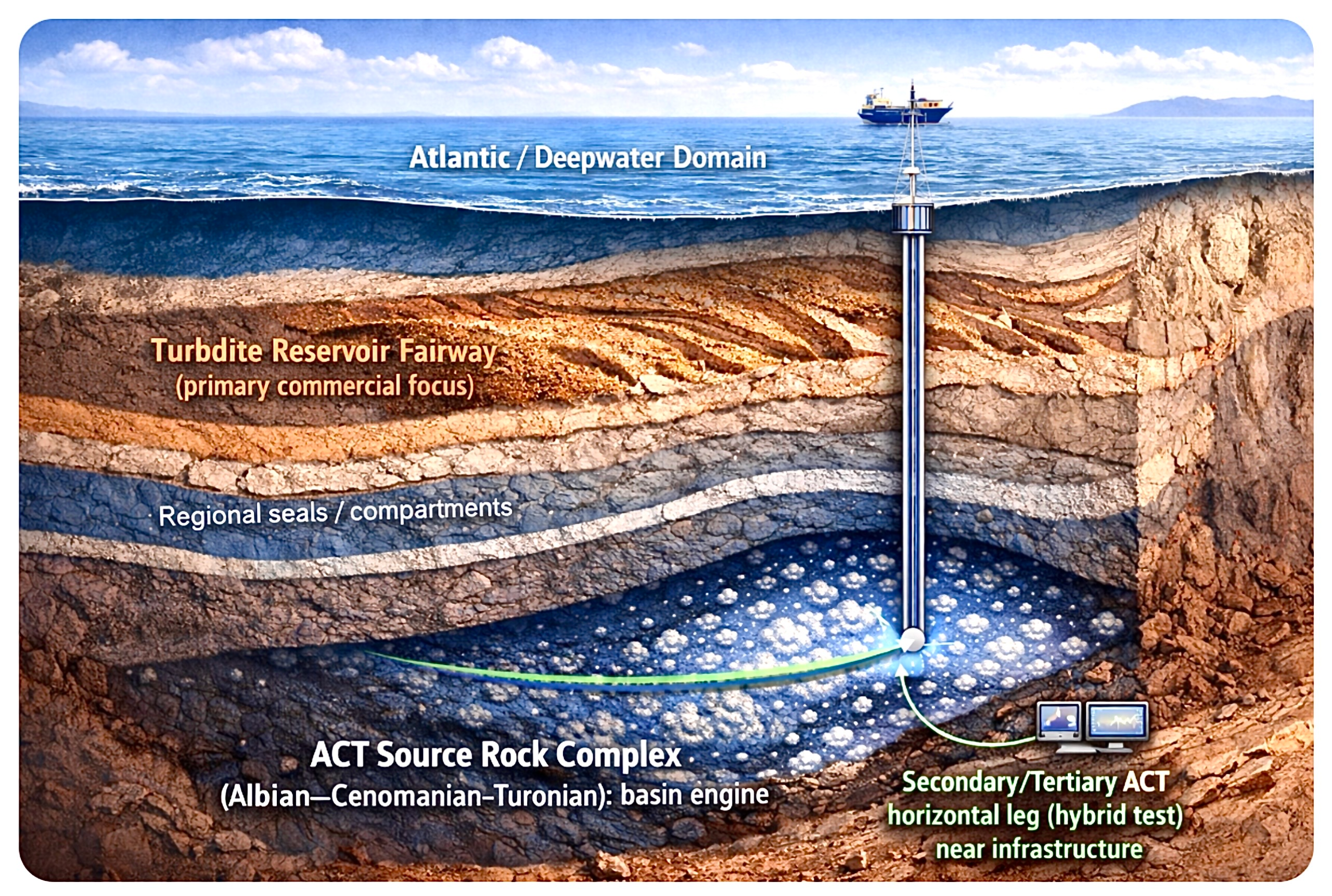
• A disciplined hybrid (source + collectors) optionality framework Atlantic / Deepwater Domain Golden Lane Turbidite Reservoir Fairway (primary commercial focus) Regional seals / compartments ACT Source Rock Complex (Albian–Cenomanian–Turonian):
basin engine Secondary/Tertiary ACT horizontal leg (hybrid test) near infrastructure Wellbore Land & drill lateral in ACT
Hero schematic: primary turbidite development above; ACT kitchen below; optional hybrid horizontal leg as secondary/tertiary target near an FPSO/tieback corridor.
Basin-Thinking Paper • PetroleumEnergyInsights.com
ACT Hybrid Playbook — Frack or Not? Why, Where, How?
From La Luna (1984) to the Guiana–Suriname Basin Kitchen:
a disciplined, evidence-led framework to evaluate offshore hybrid (source + collectors) potential as a secondary/tertiary target alongside Golden Lane turbidite development.
ContentsAbstract1. The 1984 Origin of the Idea2. GSB Context from the GeoAtlas3. Evidence Base: Onshore USA + Offshore Fracturing4. Transferability Matrix: What Carries Offshore5. Where It Could Work in GSB (GeoAtlas-anchored)6. Eagle Ford Benchmark + ACT EUR Envelope7. Quantitative SRV Thought Experiment8. How to Drill & Complete an ACT Hybrid Leg (Tangible Design)9. One-Well Pilot Blueprint: Three Proofs10. When Does a Source Rock Become a Reservoir?ReferencesAuthor CV
Primary reference (GeoAtlas). This paper is grounded in the GeoAtlas of Suriname (Staatsolie) for petroleum-system framing (ACT engine, maturity corridors, pressure domains, and charge architecture).
Integrated and blended with many other seminal and trusted publications on this subject.
Abstract
In 1984, during basin-scale generation and migration research in the Maracaibo Basin, the La Luna Formation presented an obvious paradox:
it was among the world’s most prolific petroleum kitchens, yet its ultra-low permeability precluded it from being treated as a reservoir.
A question emerged for myself:
could the kitchen itself produce if permeability limitations were overcome?
Three decades later, onshore North America demonstrated that organic-rich, low-permeability source rocks can be engineered into reservoirs via horizontal drilling and multistage hydraulic fracturing.
The Guiana–Suriname Basin (GSB), powered by the Albian–Cenomanian–Turonian (ACT) source complex, now invites the same question—cautiously.
This paper proposes a disciplined, framework to evaluate ACT hybrid potential as a secondary/tertiary target alongside the proven Golden Lane turbidite development.
The approach is evidence-led:
(i) onshore shale performance envelopes (Eagle Ford),
(ii) documented offshore stimulation case histories (including subsea horizontal multi-fracturing and North Sea multistage campaigns), and
(iii) GeoAtlas-defined maturity and pressure domains for the GSB.
1. The 1984 Origin of the Idea
In the Maracaibo Basin, La Luna was always the engine.
The basin’s producing systems were built upon its charge efficiency.
The concept that the source interval might itself be producible—through stimulation—was intellectually natural but technologically premature in 1984.
Onshore US shale development later validated the physics: tight source rocks can become reservoirs if connectivity is engineered at scale.
The question that returns in the GSB is not whether the ACT generates (Golden Lane proves it does); it is whether discrete corridors within the ACT—where maturity, brittleness, stress, pressure, and infrastructure intersect—could function as a hybrid reservoir layer.
2. GSB Context from the GeoAtlas
Key GeoAtlas-derived constraints (practical):
- ACT is treated as the basin’s dominant petroleum engine (Albian–Cenomanian–Turonian source complex).
- Maturity continuity is described from Golden Lane toward AKT-1ST2 (oil and gas-condensate windows).
- The deep offshore domain is distinguished as overpressured, with vertical “fill and spill” style charge architecture.
- A “union zone” is highlighted where ACT richness and thermal stress overlap—linked to Golden Lane field success.
- Demerara Plateau ACT is cautioned as potentially immature (implying “don’t chase ACT there first”).
These are screening constraints, not guarantees of fracability; rock mechanics must be measured in a pilot.
3. Evidence Base: Onshore USA + Offshore Fracturing
3.1 Onshore USA: what is robustly established
The core US lesson is the convergence of horizontal drilling and hydraulic fracturing into a repeatable development method. EIA overview material emphasizes how hydraulic fracturing—especially when combined with horizontal drilling—unlocked tight resources at scale.[1]
Induced seismicity risk must be framed correctly: USGS notes that felt earthquakes directly caused by hydraulic fracturing are extremely rare, while wastewater disposal is a major driver of induced seismicity in many regions.[2] Offshore hybrid proposals must therefore include a realistic produced-water/disposal plan, not just stimulation designs.
3.2 Offshore: fracturing is real, but constrained
Subsea horizontal multi-fracturing (Campos Basin, Brazil). A documented case study describes multiple hydraulic fractures in a subsea horizontal well in a low-permeability limestone (Quissamã Formation), including deliberate well orientation to encourage longitudinal fracture growth.[3]
North Sea: multistage stimulation under offshore SIMOPS constraints (Clair/Clair Ridge). Industry material referencing SPE work describes operational learnings and efficiency drivers for offshore multistage fracturing campaigns (SIMOPS, CT intervention evolution, workflow optimization).[4]
Practical implication: Offshore stimulation exists along a spectrum—frac-packs/sand control, conventional reservoir stimulation, and more intensive multi-stage productivity fracturing.
Any ACT hybrid concept must be explicit about which tier it targets.
4. Transferability Matrix: What Carries Offshore
| Factor | Eagle Ford (Onshore) | ACT Hybrid (Offshore GSB) | Transferability |
|---|---|---|---|
| Thick mature source | Yes | Yes (ACT engine) | Transfers (physics) |
| Oil/condensate window corridor | Yes | Yes (corridor described) | Transfers (screenable) |
| Overpressure potential | Common in tight plays | Deep offshore overpressure domain | Transfers (with drilling penalty) |
| Horizontal drilling | Routine | Routine offshore | Transfers |
| Multistage proppant fracturing | Routine | Feasible (documented offshore cases) | Transfers (cost/logistics constrained) |
| Manufacturing repetition | High | Limited | Does not transfer |
| Low well cost + rapid iteration | Yes | No | Does not transfer |
Bottom line: physics transfers; manufacturing economics does not.
Therefore, ACT hybrid is rational only as a high-value, low-well-count, hub-adjacent optionality layer—not as an offshore clone of the Permian.
5. Where It Could Work in GSB (GeoAtlas-anchored, tangible)
The “where” must be constrained by known basin behavior. A defensible first-pass selection is:
Fairway AGolden Lane “union zone”.
The corridor described where ACT richness and thermal stress overlap—linked to Golden Lane fields—defines the best first-pass hybrid test area.
Logic: if hybrid cannot work here, it is unlikely to work elsewhere in the basin at current cost structures.
Fairway B – Golden Lane → AKT-1ST2 maturity continuity corridor. Use the described maturity continuity to reduce “window risk” in pilot placement.
Target liquids-dominant segments unless a gas solution is in place.
Fairway C – Shelf thick ACT near AKT-1ST2. Thickness improves potential SRV contact, but if gas-prone, it becomes a strategic gas layer (monetization dependent).
Upside Domain Deep offshore overpressure corridor.
Overpressure can enhance deliverability but amplifies drilling/completions complexity and cost. Treat as upside-only until proven.
6. Eagle Ford Benchmark + ACT EUR Envelope
A credible offshore proposal must be numerically honest. USGS-indexed work on Eagle Ford EUR distributions reports mean values on the order of ~150–160 thousand barrels of oil, with maxima around ~400–420 thousand barrels in the referenced datasets.[5]
US shale decline behavior is steep early; EIA commentary has discussed first-year decline magnitudes in major tight plays as commonly very high (order-of-magnitude ~60–70% in many shale contexts).[6]
Offshore viability threshold (liquids-focused): because offshore cannot rely on cheap repetition, an ACT hybrid leg should plausibly clear a higher bar:
- Minimum viable EUR: ≥ 200 kbbl liquids per well (order-of-magnitude)
- Strategically interesting: ≥ 300 kbbl
- Transformational layer: ≥ 400 kbbl
These are decision envelopes, not predictions; the pilot’s job is to falsify or validate them.
7. Quantitative SRV Thought Experiment
The goal is to test plausibility: do reasonable geometries and recovery factors yield offshore-relevant barrels?
Mid-case geometry (illustrative):
- Effective ACT thickness contacted: 40 m
- Horizontal lateral length: 1,800 m
- Effective stimulated width: 200 m
SRV: 40 × 1,800 × 200 = 14.4 million m³ ≈ 90.6 million bbl of rock
Assume: 6% porosity, 60% hydrocarbon saturation, 7% recovery → ~228,000 bbl recoverable
Sensitivity: halve effective SRV or recovery factor and the well falls below offshore viability thresholds. This is why fracability and containment measurement is non-negotiable.
8. How to Drill & Complete an ACT Hybrid Leg (tangible, plausible)
An ACT hybrid test should be engineered as a conventional deepwater development well with an optional secondary/tertiary sidetrack into the ACT—anchored economically in the primary turbidite objective and only then adding the hybrid leg.
8.1 Well architecture (secondary/tertiary target logic)
- Primary objective: conventional turbidite reservoir (the proven Golden Lane value driver).
- Secondary/Tertiary objective: optional ACT horizontal leg in the documented in-window corridor (liquids preferred).
- Execution concept: drill and evaluate the primary target; if conditions are favorable (window, pressure), then sidetrack/land in ACT.
8.2 Drilling and casing (offshore realism)
- Pressure management: design for the deep offshore overpressure regime where relevant; MPD may be required depending on local margins.
- Casing design: set casing above ACT; run a production liner across the lateral; prioritize cemented isolation for controlled stimulation.
- Geosteering: land in the most brittle sub-intervals (carbonate/silica laminae), avoid ductile clay-rich zones; use real-time LWD and image logs.
8.3 Completion options (pilot-stage)
Option A (preferred): Cemented liner + plug-and-perf
- 8–15 stages (pilot-scale), diagnostics-first
- Conservative proppant intensity initially
- Stage isolation with plugs; perforation clusters tuned to stress orientation
- Supports controlled stimulation and post-frac evaluation
Why preferred: maximizes control offshore, minimizes “unknown connectivity,” enables incremental scaling.
Option B: Open-hole packer system (selective stimulation)
- Swell/mechanical packers for interval isolation
- Selective treatment and testing
- Potentially fewer cementing dependencies
Risk: less predictable isolation; containment uncertainty may increase; better suited once geomechanics are proven.
8.4 Stimulation design (offshore adapted)
- Fluids: slickwater or hybrid systems; consider seawater-based approaches where feasible (industry literature explores seawater-based fracturing fluids in offshore contexts).[7]
- Diagnostics: DFIT/mini-frac, pressure diagnostics; microseismic/DAS/DTS if feasible for fracture geometry confirmation.
- Flowback strategy: conservative drawdown to protect integrity; manage proppant flowback and sand production risk.
Sand control note: unlike unconsolidated turbidites, the ACT hybrid lateral generally prioritizes fracture conductivity and containment over classic sand control. The key completion risks are proppant flowback, integrity under drawdown, and unintended connectivity.
9. One-Well Pilot Blueprint: Three Proofs
One well must prove three things—no illusions:
- Proof of window: maturity/phase and pressure conditions in the targeted corridor.
- Proof of fracability: brittleness, stress regime, and containment (measured, not assumed).
- Proof of commercial signal: rate × decline × forecast EUR that clears offshore viability thresholds.
9.1 Minimum dataset (non-negotiable)
- Core and XRD/mineralogy (brittleness proxy)
- Rock mechanics (static/dynamic moduli; triaxial tests where possible)
- Image logs (natural fracture density/orientation)
- DFIT / mini-frac (stress profile; frac gradient; near-wellbore condition)
- Pressure and fluid sampling
- Frac monitoring (microseismic or fiber where feasible)
9.2 Decision triggers (falsifiable)
- If the interval is not in a monetizable window (e.g., dry gas with no solution) → stop.
- If brittleness/stress/containment fails → stop.
- If forecast liquids EUR cannot plausibly reach ~200 kbbl in the best corridor → archive the concept.
10. When Does a Source Rock Become a Reservoir?
The shale revolution blurred the source/reservoir boundary.
The distinction becomes functional: a source rock becomes a reservoir when it contains movable hydrocarbons, can be stimulated into connected permeability, and the induced permeability is sustainable—and economic.
The Golden Lane proves the ACT kitchen works.
The disciplined question is whether a limited set of ACT corridors can also produce—selectively, optionally, and adjacent to infrastructure.
Conclusion (disciplined):
This is neither advocacy nor dismissal. It is structured optionality.
A single, properly designed pilot can validate or falsify the hybrid proposition and, either way, improve basin understanding.
References (key sources used in this paper)
- U.S. Energy Information Administration (EIA). Review of Emerging U.S. Shale Gas and Shale Oil Plays (2011, PDF).
Used for: context on shale plays and the combined role of horizontal drilling + hydraulic fracturing.
https://www.eia.gov/analysis/studies/usshalegas/pdf/usshaleplays.pdf - U.S. Geological Survey (USGS). “How is hydraulic fracturing related to earthquakes and tremors?” (FAQ).
Used for: risk framing—HF vs wastewater disposal induced seismicity.
https://www.usgs.gov/faqs/how-hydraulic-fracturing-related-earthquakes-and-tremors - OnePetro. “Case Study of Multiple-Hydraulic-Fracture Completion in a Subsea Horizontal Well, Campos Basin (Quissamã Formation).”
Used for: documented subsea horizontal stimulation case history in a low-perm limestone reservoir.
https://onepetro.org/DC/article/25/01/113/192833/Case-Study-of-Multiple-Hydraulic-Fracture - SPE Aberdeen (industry material referencing SPE papers). “Hydraulic fracture stimulation on Clair Ridge…” (PDF; refers to SPE-215632-MS).
Used for: offshore multistage fracturing operational learnings (SIMOPS, CT intervention evolution).
https://www.spe-aberdeen.org/uploads/1550_Hydraulic-fracture-stimulation-on-Clair-Ridge.pdf - Karacan, C.Ö. et al. “Estimated Ultimate Recovery (EUR) Prediction for Eagle Ford Shale using integrated datasets and artificial neural networks.” Energies (2025). DOI: 10.3390/en18195216.
Used for: Eagle Ford EUR distribution (means ~150–160 kbbl oil; maxima ~400–420 kbbl in referenced datasets).
https://www.mdpi.com/1996-1073/18/19/5216
USGS record: USGS Publications Warehouse entry - EIA (Today in Energy). Commentary on shale/tight decline behavior (historical context and typical steep early declines).
Used for: decline-shape realism; not a single-field “truth,” but a caution against treating shale legs like conventional plateaus.
https://www.eia.gov/todayinenergy/detail.php?id=18171 - OnePetro / SPE IHFT. Example offshore-oriented fracturing fluid work: “Seawater-Based Fracturing Fluid…” (SPE IHFT 2023; Clair Ridge context).
Used for: illustration that offshore constraints drive fluid-system adaptation (seawater-based concepts, logistics).
https://onepetro.org/SPEIHFT/proceedings-pdf/23IHFT/2-23IHFT/3249470/spe-215625-ms.pdf - SPE Journal of Petroleum Technology (JPT). “High-Intensity Hydraulic Fracturing May Hold Off US Gulf Oil Declines…” (May 2024).
Used for: evidence that deepwater operators are deploying larger stimulations (with constraints) in the Gulf of Mexico.
https://jpt.spe.org/high-intensity-hydraulic-fracturing-may-hold-off-us-gulf-oil-declines-but-shell-study-reveals-that-its-no-easy-feat - Rivas, L. et al. (SPE). “Development and Use of High Density Fracturing Fluid in Deep Water Gulf of Mexico Frac and Packs” (SPE ATCE, 2008).
Used for: offshore fluid-system adaptation for high-pressure conditions (stimulation/sand control contexts).
https://onepetro.org/SPEATCE/proceedings-abstract/08ATCE/All-08ATCE/144910 - USGS. “Steps taken for calculating estimated ultimate recoveries (EURs)…” (2020).
Used for: methodological credibility of EUR calculation within USGS resource assessments.
https://www.usgs.gov/publications/steps-taken-calculating-estimated-ultimate-recoveries-wells-eagle-ford-group-and
Note on GeoAtlas referencing:
This article cites the Staatsolie GeoAtlas, as the source of much basic information on Suriname, in addition to many other public sources researched.
Author CV (for website publication)
M. Chin-A-Lien
Petroleum & Energy Advisor • Founder, PetroleumEnergyInsights.com
Short Professional Profile
- Geoscientist and basin analyst with 49 years’ experience in petroleum systems, exploration strategy, and energy advisory.
- Co-author (with S. Talukdar and O. Gallango) of the widely cited integrated basin study on hydrocarbon generation and migration in the Maracaibo Basin.
- Specialist in basin-scale petroleum system framing, source rock evaluation, carbonate and clastic plays, and strategic E&P positioning.
Selected Expertise
- Integrated basin modeling and petroleum systems analysis
- Source rock evaluation, maturity/charge risk, kitchen mapping
- Exploration portfolio strategy and prospect/play risk assessment
- Carbonate and clastic reservoir systems, regional stratigraphic synthesis
- Strategic energy advisory across mature and frontier basins
© M. Chin-A-Lien. All rights reserved. Please cite appropriately.