GLIAG · Petroleum & Energy Insights · Essay
| GLIAG · PETROLEUM & ENERGY INSIGHTS · ESSAYGolden Lane Investments Advisory Group |
They Are Mixing Unmixable Things
Contract Ring vs. Fiscal Ring in Suriname’s PSC Framework
I was privileged to have the unique opportunity, within others, to help craft the model PSC.
In the period 2008-2010 when I served Petroleum Contracts, pre-curser of Suriname Hydrocarbon Institute (SHI).
By drs. Marcel P.T. Chin-A-Lien, MBA., MSc. · Founding Partner & Chief Architect, GLIAG · 23 July 2026
The Starnieuws exchange of 21 July 2026 between S. Kenswil and R. Shyamnarain on “fiscale ringfencing” in the Surinaamse olie- en gassector has surfaced a real and important question about ring fencing in Suriname’s petroleum sector.
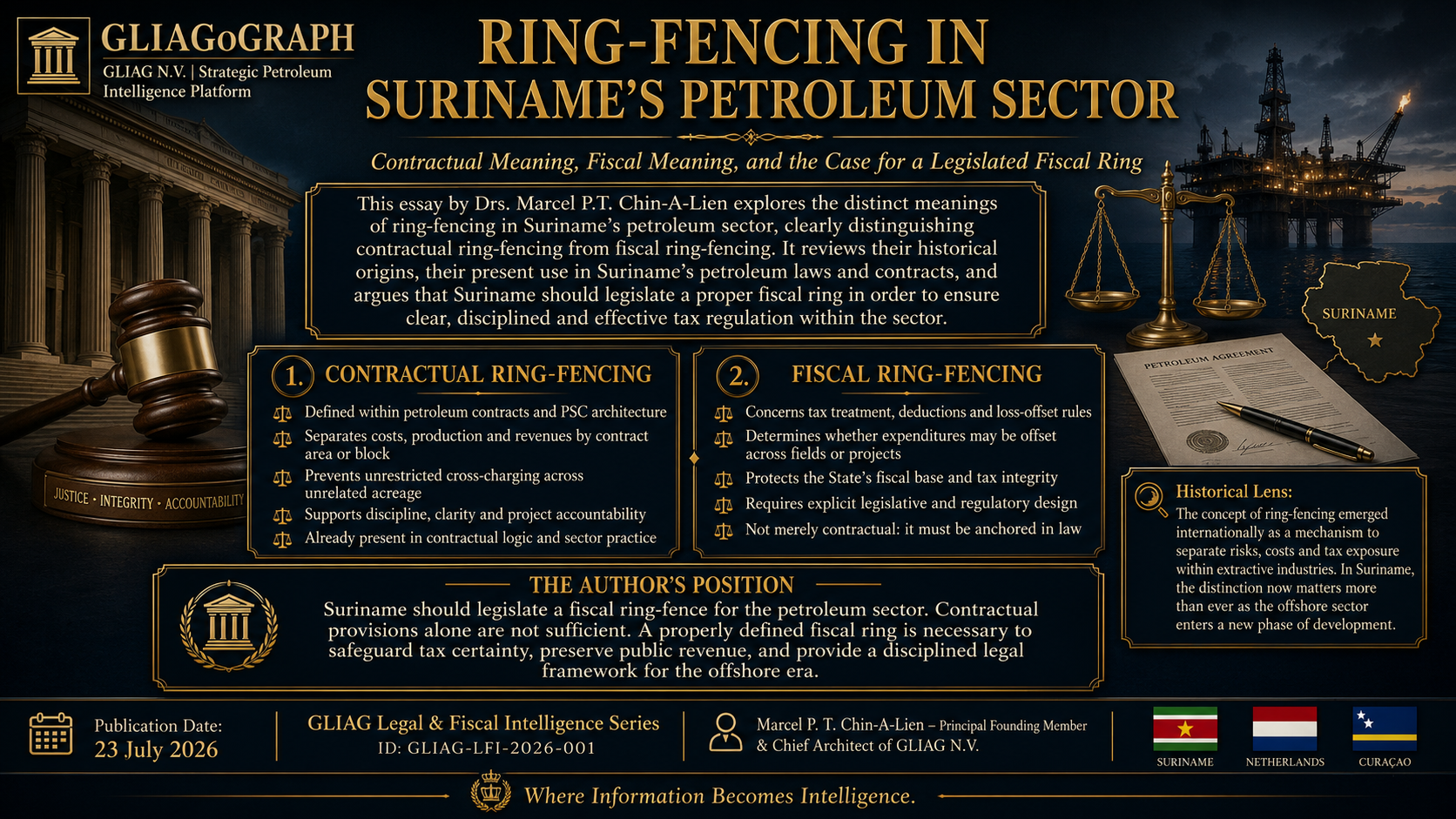
But the term itself carries two distinct meanings that are easily conflated — a contractual meaning inside the PSC, and a fiscal meaning inside a tax statute.
Understanding which of the two is meant, and where each properly sits in Suriname’s legal architecture, is the purpose of this essay.
This essay separates the two rings, traces their historical origin from the English pastoral fence and the UK Oil Taxation Act 1975 through the IMF, World Bank and IGF doctrinal chain, and examines how the concept applies — and does not yet apply — under Suriname’s current fiscal laws.
I write with the direct interest of a co-drafter: with two colleagues at Petroleum Contracts / SOM I helped put the bankable form of the current Surinaamse model-PSC — including its ring-fencing-per-Commercial-Field clause — into shape in 2008–2010. That clause is a contract clause. It has always operated on the cost-oil side of the PSC, and continues to do so as designed.
One word. Two legal universes. Each doing its own work.
1. Where the term comes from — and what it actually points to
1.1 The literal object: an English pastoral fence
Before it was a metaphor, a ring fence was a physical thing. In the English lexicon it denotes “a fence which encircles a large area, or a whole estate, within one enclosure.” On an English or Welsh farm a “ring-fence holding” meant a farm whose fields lay together inside a single continuous perimeter — as distinct from the older open-field system where a yeoman’s strips were scattered across the parish and mixed with those of his neighbours. The point of the ring fence was double: it kept the farmer’s own livestock in, and it kept other people’s animals, other people’s claims, and other people’s customary rights of common out. That double function — inclusion of what belongs inside, exclusion of what belongs outside — is the exact conceptual DNA that every later use of the word inherits.
1.2 The historical moment: the Enclosure movement
Ring-fenced farms are a product of the Enclosure movement — the long English legal-economic transformation, running from the 12th century, intensifying under the Tudors, and formalised by Parliamentary Act from the 1750s onward, in which open common land was consolidated into privately owned, physically bounded holdings. Between 1604 and 1914 more than 5,200 enclosure Bills were enacted, covering roughly a fifth of England — some 6.8 million acres. Enclosure did two things at once. It extinguished the customary rights of common that had allowed the community to graze, glean and cut wood across shared land, and it created a compact, individually accountable production unit inside a legally recognised perimeter.
Understand this and the modern financial term becomes transparent. A ring fence is always a legally recognised perimeter around a production unit, drawn to make what happens inside the perimeter accountable on its own terms — separate from the commons of a company’s wider activity. The pasture became the field; the field became the estate; the estate became, eventually, the balance sheet.
1.3 The metaphor enters finance and law
The figurative use appears in written English by the early 20th century — Roger Fry writes in 1903 of an attempt “to ring-fence Italian art” — and moves into the general business vocabulary in the 1980s to describe “funds that are set aside for a project and cannot be spent on anything else.” The metaphor is doing the same work the pastoral fence did four centuries earlier: it separates a defined pool of value from the surrounding commons of a company or a portfolio, and asserts that what is inside the fence is accountable on its own terms. That is why banking regulators speak of ring-fencing a retail bank away from its investment bank; why bankruptcy lawyers speak of ring-fencing a subsidiary’s assets away from parent-company creditors; and why an insurance regulator will ring-fence a policyholder pool. In every case, one legal universe is being kept out of another.
1.4 The petroleum-tax moment: UK Oil Taxation Act 1975
The word crosses into petroleum vocabulary at a single, datable, sourceable moment. In November 1974 the UK Government tabled the Oil Taxation Bill in response to the first North Sea commercial discoveries. Part II of what became the Oil Taxation Act 1975 — the same statute that created Petroleum Revenue Tax — “introduced a ring fence around corporation tax profits from UK oil production to prevent profits from the UK oil resource being diluted by losses or allowances on other activities.” PRT itself was field-based: “losses would not normally be transferable between fields.” Read those two lines slowly. The 1975 Parliament borrowed the English pastoral image directly, and used it for exactly the same purpose the Tudor enclosers had used it for four hundred years earlier: to draw a legally recognised perimeter around a valuable production unit — this time the UKCS oilfields — so that the value generated inside the perimeter could not be diluted by whatever was going on outside it. What had once been sheep were now barrels of oil. What had once been common grazing was now the loss-making refinery, the retail division, the overseas exploration write-off. The 1975 Act simply said: these barrels are inside the fence. Those losses are outside it. The two do not meet.
Everything the world now calls “ring fencing” in extractives fiscal design descends from that single 1975 move. The IMF’s canonical definition is explicit: a ring fence is a “fiscal boundary within which costs and revenues of companies in common ownership may be consolidated for tax purposes.” The IMF places the ring at three possible statutory levels — sector, licence / contract area, or project — and the choice is a legislative act, not an accounting convention. The World Bank operating rule follows: “all costs associated with a given block or license must be recovered from revenue generated within that block.” The IGF draft on ring-fencing mining income reaches the same conclusion for extractives generally. Every one of those instruments is a tax instrument, adopted by a legislator, not an administrator.
1.5 What the word actually points to
Strip away four centuries of borrowing and the term always points at the same three elements:
• A perimeter — a legally recognised boundary drawn around a defined unit of production or value (a field, a farm, an estate, a subsidiary, an oilfield, a licence, a contract area, a project).
• An inside — a pool of value whose income and expenses are consolidated with each other and with nothing else.
• An outside — everything else, whose losses, allowances, and claims are not permitted to cross the line.
The identity of the perimeter is what tells you which universe you are in. A contract can draw a perimeter around a Commercial Field for cost-oil purposes. A tax statute can draw a perimeter around upstream income for CIT purposes. They both use the same English word. They are not the same instrument, and they were never meant to be. Keeping the two rings analytically distinct is the first step to understanding both.
2. What the 2008–2010 Surinaamse model-PSC actually rings
The Surinaamse model-PSC — whose bankable form was put together in 2008–2010 inside Petroleum Contracts / SOM by the drafting team I was part of — carries the phrase in an entirely different register. The operative language reads: “Exploration Operations shall continue in the remaining portion of the Contract Area until the end of the Exploration Period, subject to ring fencing per Commercial Field.” That is not a tax rule. It is a cost-recovery boundary: once a Commercial Field is declared inside a Contract Area, exploration and appraisal costs on the rest of the block cannot cross the fence and be recovered against that field’s cost-oil pool. The IGF confirms this is standard PSC design worldwide.
The table below sets the two rings side by side. They do not overlap on a single row.
| Dimension | Contractual PSC ring (Suriname model-PSC) | Fiscal ring (UK 1975 / IMF doctrine) |
| Source of law | Contract: Staatsolie ↔ Contractor | Tax statute (Petroleumwet is not a tax statute) |
| Object | Cost oil / cost gas — the recoverable cost pool | Taxable income base for CIT / special petroleum tax |
| Boundary | Commercial Field inside a Contract Area | Sector, licence, or project — legislator’s choice |
| Counterparty | Staatsolie, via cost-oil accounting | Belastingdienst, via tax return |
| Effect if breached | Wrong cost-oil → wrong profit-oil split | Wrong CIT base → assessment / dispute |
| Instrument to change | PSC amendment or new Model PSC | Legislation (or model-PSC read into legislation) |
Figure 1 — Anatomy of the two rings. Same word, different legal universe.
3. What artikel 19 Petroleumwet 1990 actually is
The specific question the Starnieuws contribution of 21 July 2026 raises is whether artikel 19 Petroleumwet 1990 can carry a fiscal ring in the sense of the previous section. The answer, on the current text, is that it cannot — and it was not designed to.
Artikel 19 Petroleumwet 1990 is a kantoor- en registratieplicht. Lid 1 requires the contractor to maintain a kantoor in Paramaribo; lid 2 requires registration met inachtneming van de daaromtrent geldende wettelijke bepalingen — and the Memorie van Toelichting bij de Petroleumwet points expressly to the Wetboek van Koophandel and the Handelsregisterwet, not to the fiscale wetgeving.The article sits in the administrative and organisational chapter of the wet, not in the fiscale hoofdstuk.
This matters because Suriname’s constitutional order sets a clear ceiling on how fiscal rules may be created. Artikel 155 lid 2 Grondwet — the legaliteitsbeginsel — requires that belasting geheven wordt uit kracht van een wet. The Memorie van Toelichting bij S.B. 2022 no. 152 (wijziging Petroleumwet) restates this rule verbatim in the petroleum context: “de fiscale positie van de betreffende contractor moet gebaseerd zijn op regels, die zijn ontleend aan een wet in formele zin.”A per-veld or per-contract aftrekbegrenzing is a substantive fiscal rule. To create such a rule requires a wet in formele zin — not an interpretive reading of a registration article.
On the current text of the Petroleumwet 1990, the Wet Inkomstenbelasting 1922, and the Staatsolie Model PSC, there is therefore no existing statutory hook on which a per-block or per-contract fiscal ring can hang. That is not a criticism of anyone in the current discussion; it is simply what the primary sources say. The reading of artikel 19 as a kantoor- en registratieplicht is well founded in text, systematiek and Memorie van Toelichting.
4. The underlying policy question
Beneath the specific artikel 19 question lies a more general and legitimate policy question that every petroleum jurisdiction faces once commercial production begins: should a multi-block contractor be able to consolidate the losses of one block against the profits of another for corporate income tax purposes? Or should each block, each licence, or each project stand on its own?
This is a real policy question, and it has been asked and answered in different ways across jurisdictions. The United Kingdom answered it in 1975 with an explicit statutory ring-fence. Norway, Angola, Ghana, and Guyana (in the Stabroek framework) followed with variations. The IMF, World Bank and IGF have written the doctrinal guidance on how to design such a ring: at the sector, licence, or project level, in a wet in formele zin, on a forward basis.
Suriname has not yet answered this policy question in a fiscal statute. It has answered it in the contract — via the ring-fencing-per-Commercial-Field clause of the 2008–2010 Model PSC — but that clause operates on cost-oil, not on CIT. Whether Suriname should also legislate a fiscal ring, at what level, and on what transition terms, is a policy choice that belongs to DNA, informed by the sector’s technical and financial advisers.
5. Application to Suriname’s fiscal laws
It is useful to walk through the four Surinaamse instruments that would be involved in any such policy step, to see clearly what each currently does and does not contain.
5.1 Petroleumwet 1990 (S.B. 1991 no. 7, z.l.g.b. S.B. 2022 no. 152)
The Petroleumwet is a mijnbouw-rechtelijk kaderwet. Its fiscale hooks are artikel 9 lid 1 (contractors are subject to the general belastingwetgeving of Suriname), artikel 9 lid 8 (stabilisation of the IB 1922 tarief geldend bij ondertekening), artikel 17 (local content), artikel 18 (transfer pricing / arm’s length), and artikel 92 (indirect-tax facilities). None of these articles limits deductibility per block, per veld, or per contract for CIT purposes. Artikel 19 is the kantoor- en registratieplicht discussed in Section 3. Artikel 20 (numbered blocks) and artikel 21 (relinquishment) define the geographic units of the contract, not of the tax return.
5.2 Wet Inkomstenbelasting 1922 (G.B. 1921 no. 112, laatstelijk gewijzigd S.B. 2021 no. 176)
The IB 1922 defines de belastbare winst on an entity basis. It contains no ring-fence provision — no field-of-licence ring, no sectoral limitation on the consolidation of deductions and losses within a single contractor entity. The 2021 wijziging did not introduce one. A fiscal ring therefore cannot be created by administrative interpretation of the IB 1922; it would require a wetswijziging.
5.3 Staatsolie Model Production Sharing Contract
The Model PSC carries the contractual ring — ring-fencing-per-Commercial-Field for cost-oil purposes. Its Article 19.2.1 then routes tax assessment back to the Wet IB 1922, which as noted in 5.2 has no ring. The Model PSC therefore does not — and by its contractual nature could not — impose a fiscal ring on the CIT base.
5.4 Artikel 155 lid 2 Grondwet — the ceiling
This is the highest-level, contract-defensible ground. The Grondwet requires that any belasting be geheven uit kracht van een wet in formele zin. That formulation means a substantive charging rule adopted by DNA, on the record, with a Memorie van Toelichting. The MvT bij S.B. 2022 no. 152 restates the same rule verbatim for the petroleum context.
5.5 The stabilisation and treaty layer
A ring created after signature of an existing PSC could not reach into that PSC without contractwijziging, because artikel 9 lid 8 Petroleumwet freezes the fiscale regime at the tarief geldend bij ondertekening. That is the treaty-robust boundary of any Surinaamse fiscal reform in the petroleum sector: any new ring would apply on a forward basis, with an explicit election regime for existing contractors who wish to opt in. The IMF Mexico 19/337 case study documents the standard template for exactly this transition.
6. How to remediate
If Suriname wishes to legislate a fiscal ring — that is, to answer the policy question of Section 4 affirmatively — the treaty-robust, legality-respecting, bankability-preserving path is well-established in international practice. It has three components.
6.1 Legislate the fiscal ring in a wet in formele zin
A dedicated chapter in a new petroleum-fiscal statute — whether a stand-alone Gas Act, an amendment to the Petroleumwet, or a hoofdstuk in a modernised IB 1922 — that defines four elements clearly:
• The level of the ring — Suriname’s policy choice among sector, licence/contract area, or project. International practice for petroleum favours licence/contract area as the workable middle ground.
• The scope of what is inside — exploration, appraisal, development, production, and decommissioning costs of the ring-fenced unit.
• The treatment of losses — carry-forward inside the ring, with no cross-ring offset against income from other rings or from unrelated activity.
• An election / transition regime — how existing PSCs may opt into the new regime, and on what terms.
6.2 Respect stabilisation
Existing PSCs with artikel 9 lid 8 protection remain on the tarief geldend bij ondertekening. The new ring applies to new contracts on a forward basis. Existing contractors may elect in on defined terms. This preserves the treaty-robust character of the fiscal regime and protects Suriname’s country-risk profile at the DFI credit-committee level. It is precisely the template the IMF documented for Mexico’s 2013–2015 hydrocarbon reform.
6.3 Keep the contractual ring where it is
The Model PSC’s ring-fencing-per-Commercial-Field clause performs its own function on the cost-oil side. It should not be diluted or renamed to fit the new fiscal ring, nor should it be asked to do the fiscal ring’s job. Both fences coexist, each doing its own work, on its own account, with its own counterparty. Mature petroleum jurisdictions have both.
Taken together, these three steps close the legislatieve leemte identified in Section 5 without stretching artikel 19, without touching artikel 9 lid 8 for existing contractors, and without offending artikel 155 lid 2 Grondwet. It is the ordinary route by which OECD-grade petroleum jurisdictions have handled the same question over the past fifty years.
Annex — Trusted References
All references below are cited in the footnotes and are grouped here for the reader’s convenience, with clickable hyperlinks. Section E lists the author’s own publications on Petroleum & Energy Insights, offered as further reading on adjacent topics.
A. Suriname primary law
• Petroleumwet 1990 (S.B. 1991 no. 7, z.l.g.b. S.B. 2001 no. 58) — Staatsolie official text
• Petroleum Law 1990 (English translation) — Staatsolie
• S.B. 2021 no. 176 — Wet nadere wijziging Inkomstenbelasting 1922 — De Nationale Assemblée
• Staatsolie Model Production Sharing Contract
• EITI Suriname 2023–2024 Final Report — fiscal framework overview
• S. Kenswil — Starnieuws Opinie on fiscale ringfencing, 21 July 2026
B. UK 1975 — the historical anchor
• Oil Taxation Act 1975 (UK) — full text
• HMRC Oil Taxation Manual OT00150 — overview of the 1975 ring fence
C. IMF, World Bank, IGF — doctrinal chain
• IMF — Fiscal Regimes for Extractive Industries: Design and Implementation (2012)
• IMF Working Paper WP/24/89 — Cash-Flow Analysis of Fiscal Regimes for Extractive Industries (2024)
• IMF Country Report No. 19/337 — Mexico Fiscal Regime for the Hydrocarbons Sector (2019)
• World Bank — Fiscal Systems for Hydrocarbons: Design Issues (Working Paper 123)
• IGF — Ring-Fencing Mining Income (public consultation draft, November 2024)
D. Etymology — where the term comes from
• Wiktionary — “ringfence” (a fence encircling a whole estate)
• The Phrase Finder — “ring-fence”: pastoral origin, figurative use
• UK Parliament — Living Heritage: Enclosing the Land (5,200+ Enclosure Acts, 1604–1914)
• Investopedia — Ring-Fence: modern finance definition
E. Further reading — author’s own publications on Petroleum & Energy Insights
Offered as further reading on adjacent topics in Suriname’s petroleum framework.
• The Legal Framework for Sloanea Gas Development (GLIAG Sloanea Legal Series, Vol. II) — 16 July 2026
• Enhancing Suriname’s PSC: Lessons from Guyana’s Stabroek — 5 July 2025
• Sloanea Gas Discovery: Evolution in Petroleum Law — 16 July 2026
• GranMorgu’s Revenue Waterfall: A Look at Suriname’s Future — 13 July 2026
• Gran Morgu Fiscal Assessment 2028–2053 — 18 February 2026
• Understanding Petroleum Law’s Role in Suriname’s Development — 11 June 2026
• Libya’s PSA: Lessons in Petroleum Contract Design and Investment — 11 July 2026
• Financial Assurance, Offshore Risk and Petroleum Governance — 8 May 2026
• Structuring the Suriname Savings and Stabilization Fund (SSFS) — White Paper, 10 August 2025
About the author
drs. Marcel P.T. Chin-A-Lien, MBA., MSc., Engineering Geologist, is Founding Partner & Chief Architect of Golden Lane Investments Advisory Group (GLIAG). Between 2008 and 2010 he co-drafted, with two colleagues at Petroleum Contracts / SOM, the bankable form of the Surinaamse model Production Sharing Contract, including the ring-fencing-per-Commercial-Field clause discussed in this essay.
Published on petroleumenergyinsights.com — the publication surface of GLIAG.
© 2026 Golden Lane Investments Advisory Group (GLIAG). Published on petroleumenergyinsights.com. Not legal or tax advice. · p. /