Cuba’s Music, Memory and the Hidden Petroleum System of the Northern Margin
Marcel P. T. Chin-A-Lien
Petroleum & Energy Advisor | Founding Partner & Chief Architect
GLIAG – Golden Lane Investments Advisory Group
June 2026
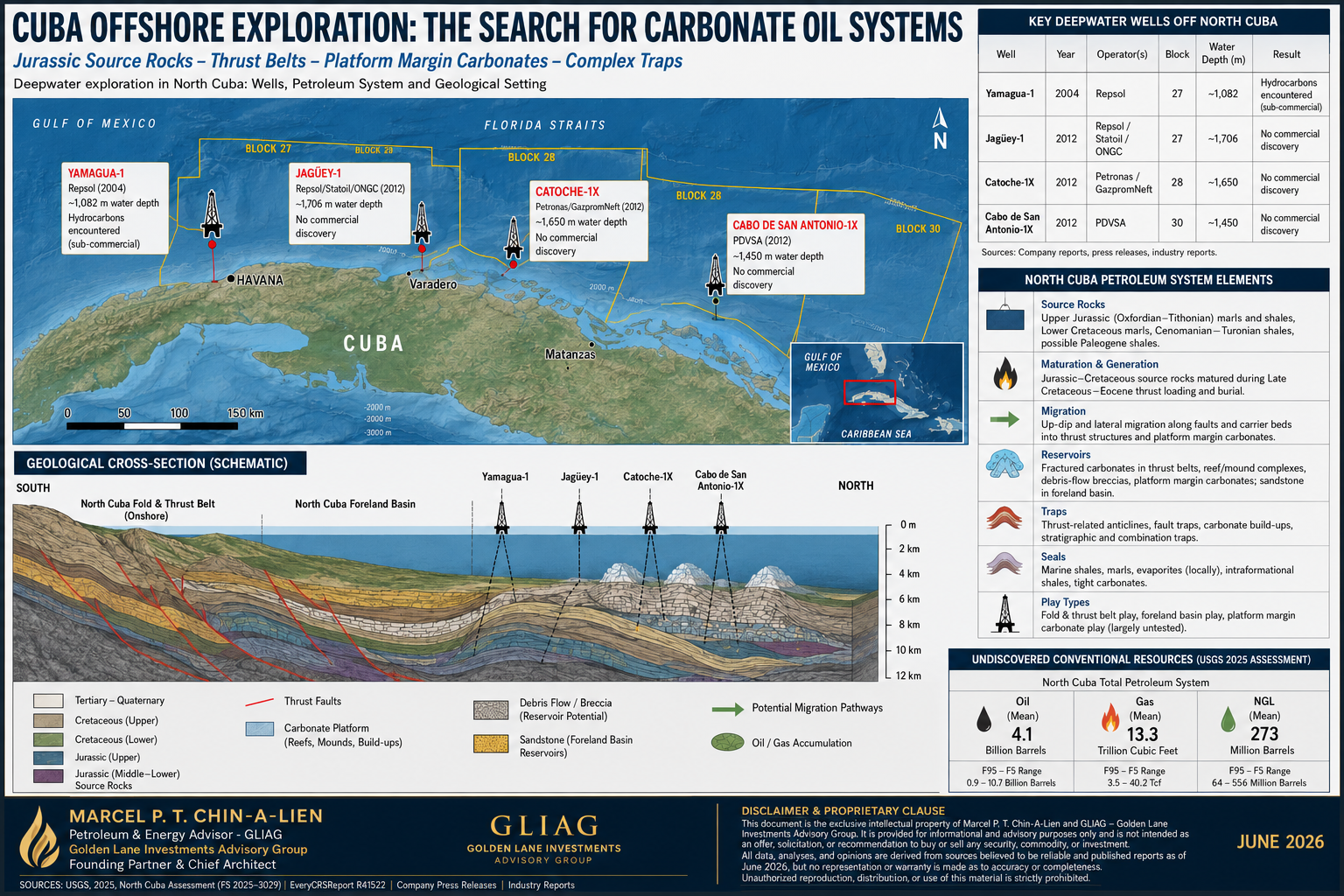
Hero image: North Cuba offshore exploration, petroleum-system elements and key deepwater wells. Conceptual GLIAG synthesis based on public-domain and publicly reported sources; verify exact well coordinates and subsurface interpretations before formal publication.
Musical companion: Celina y Reutilio — Pedacito de Mi Vida. Listen here
A geological and cultural essay on fragments, reconstruction, source rocks, carbonates, wells, memory and Cuba.
Cuba Reveals Itself Through Fragments
There are petroleum provinces that announce themselves loudly. The Permian. The North Sea. The deep waters of Guyana and Suriname. The discovery well is drilled, hydrocarbons flow, development accelerates and the narrative hardens around abundance.
Cuba is different. Cuba unfolds.
A melody drifts from an open window in Havana. The rhythm of son, bolero and salsa moves through a narrow street. A worn Pedro Juan Gutiérrez novel lies on a café table. Tobacco, sea air and old plaster mix with the sound of conversation. Nothing appears all at once. The island reveals itself gradually, as if each street, song and memory were only a small piece of a larger, unfinished story.
The petroleum geology of northern Cuba behaves in the same way. It does not present itself as a clean, continuous passive-margin archive. It must be reconstructed from oil seeps, producing fields, fractured carbonate reservoirs, displaced thrust sheets, seismic hints, offshore wells and public assessments that leave as many questions as answers.
That is why the old Celina y Reutilio song Pedacito de Mi Vida works as more than atmosphere. It is a structural metaphor. A little piece of my life. A little piece of the basin. A little piece of evidence. Northern Cuba’s petroleum system is a story assembled from pedacitos.
The Geology Beneath the Music
Beneath the music lies one of the most intriguing tectonic settings in the Americas. Northern Cuba occupies the collision zone between Caribbean and North American tectonic domains. Its petroleum geology is fundamentally different from the passive Atlantic margin of the Guyana-Suriname Basin. Guyana tells a story of continuity; Cuba tells a story of reconstruction.
In the USGS model, the North Cuba petroleum system developed through multiphase tectonic evolution: Triassic-Early Jurassic rifting, Jurassic salt and marine source-rock deposition, Cretaceous carbonate platform development, Late Cretaceous platform drowning and, most importantly, Late Cretaceous-Eocene collision and thrust loading during the formation of the North Cuba Fold and Thrust Belt [1,2].
This matters. The petroleum system is not simply a matter of source and reservoir. It is a matter of tectonic biography. Source rocks were buried and matured through thrust loading and foreland burial. Hydrocarbons migrated into fold-thrust structures, foreland traps and possibly carbonate platform-margin reservoirs along the Yucatan, Florida and Bahamas platform systems [1,2].
The result is a province of structural complexity: fractured fine-grained carbonates, faulted anticlines, displaced stratigraphic packages, possible foreland sandstones, and speculative platform-margin carbonates including karst, dolomites, reefs, mounds and debris-flow breccias [1]. It is not a simple clastic deepwater play. It is a tectonic-carbonate puzzle.
A Short Petroleum History of Northern Cuba
Cuba’s petroleum history is older than many readers expect. The first field, Motembo, was discovered onshore in northwestern Cuba in 1881 and is described by USGS as Cuba’s only condensate field. More than twenty oil fields were subsequently discovered, mostly in the North Cuba Basin [3].
The historical producing heart of the country lies along the northern coastal belt. Modern USGS summaries note that most Cuban hydrocarbon production comes from structural traps in carbonate reservoirs in the North Cuba Fold and Thrust Belt, with production centered east of Havana along the northern coastlines of Matanzas and Mayabeque, including Puerto Escondido, Varadero West and Yumuri [4].
This production history proves the first essential point: the petroleum system worked. Hydrocarbons were generated, migrated and trapped. The remaining question was never whether Cuba had oil. The deeper question was whether the visible fields were small exposed fragments of a larger offshore petroleum system.
That question moved exploration northward, into the deep waters of the Cuban Exclusive Economic Zone and toward the carbonate and structural possibilities of the North Cuba Margin.
The Offshore Dream: Repsol, Petronas, GazpromNeft and PDVSA
The offshore campaign was not fantasy. It was a serious geological hypothesis pursued by experienced international companies. Repsol drilled Yamagua-1 in 2004 in offshore Block 27, roughly twenty miles northeast of Havana. A Congressional Research Service report records that Repsol discovered petroleum resources but judged them commercially insufficient to justify production [5].
The 2012 campaign intensified the question. Repsol, with Statoil and ONGC as partners, drilled the Jagüey prospect. Petronas and GazpromNeft drilled Catoche-1X. PDVSA was publicly reported as the operator of Cabo de San Antonio-1X after Catoche, using the Scarabeo 9 rig sequence [5,6]. Public technical detail on these wells remains limited. There are no open, publication-grade well reports comparable to the disclosure culture in some other basins. This absence itself is part of the Cuba story: the data exist only in fragments.
Still, the geological logic is visible. The wells were attempts to test whether the North Cuba petroleum system extended offshore in commercially meaningful form. They asked whether Jurassic-Cretaceous charge, structural closure and carbonate reservoir quality could align at scale. They were not merely wells; they were geological questions translated into steel.
The transformational discovery did not arrive. But a non-commercial well does not erase a petroleum system. It changes the interpretation. Exploration is not a morality play of success and failure. It is the disciplined reduction of uncertainty.
Why Carbonates Matter
The carbonate dimension is essential. Cuba’s offshore prospectivity cannot be understood through a Guyana-style turbidite lens. The USGS 2025 assessment defines three conventional assessment units: the North Cuba Fold and Thrust Belt AU, the North Cuba Foreland Basin AU and the North Cuba Platform Margin Carbonate AU [1].
The last of these is especially interesting. USGS describes the Platform Margin Carbonate AU as a system in which oil and gas may have migrated updip into karst, dolomite, reef, mound and debris-flow breccia reservoirs, mainly in stratigraphic traps and similar rift-related structural traps along the Yucatan, Florida and Bahamas platforms [1].
This is why the phrase ‘chasing carbonates’ matters. Carbonates can produce giants, but they can also betray the explorer. Porosity may be primary, secondary, vuggy, fractured or destroyed. Permeability may be spectacular in one interval and absent in another. Seismic expression can suggest promise while petrophysics disappoints. In Cuba, the most important remaining uncertainty may be less about whether hydrocarbons were generated and more about where reservoir quality, trap integrity, timing and charge converged.
Pedro Juan Gutiérrez and the Geological Novel
Pedro Juan Gutiérrez belongs in this essay not as decoration but as method. His work reconstructs Havana from fragments of lives: appetite, loss, exhaustion, survival, memory, street-level observation and fierce immediacy. Anagrama identifies his Ciclo de Centro Habana as including Trilogía sucia de La Habana, El Rey de La Habana, Animal Tropical, El insaciable hombre araña and Carne de perro, and notes that his work has appeared in more than twenty countries [7].
A Cervantes Institute paper on Animal Tropical places the novel within the Ciclo de Centro Habana and emphasizes the author’s immersion in everyday reality, hardship, invention and survival [8]. That is enough for our purpose. Gutiérrez does not give us Havana as a polished monument. He gives us Havana through fragments.
The geologist works similarly. No petroleum system is seen whole. We see a core, a field, a seep, a seismic event, a well, a pressure datum, a reservoir interval. From these fragments we build an invisible architecture. The novelist reconstructs life. The petroleum geologist reconstructs charge, migration and trap. Both require evidence. Both require imagination. Both fail when they confuse atmosphere with truth.
Exploration as a Human Act
Exploration is technical, but it is never only technical. The seismic workstation matters. So do maps, maturity models, burial histories, geochemistry and petrophysics. But the exploratory mind continues working after the maps are folded away. It works while reading, walking, arguing, listening, travelling and noticing patterns outside the formal dataset.
This is not romanticism. It is pattern recognition. The best explorationists are not merely data processors. They are interpreters of incomplete systems. They learn to see relationships where the evidence is partial and the consequences are large.
That is why Cuba offers such a rich intellectual setting. Its geology, music and literature all teach the same discipline: reconstruct the hidden whole from the fragments available.
The Explorer Looks Beyond Rocks
There is also a professional lesson, best stated quietly. Exploration geologists are often portrayed as searching only for source rocks, reservoirs and traps. In reality, exploration has always involved a wider form of interpretation. Geological potential remains fundamental, but the path from prospect to producing asset also depends on technology, infrastructure, market access, commercial conditions, operational capability and long-term continuity.
This observation is universal. It applies to every basin. Some provinces are constrained mainly by subsurface uncertainty. Others require a broader alignment before geological potential can become development. The modern Guyana-Suriname Basin is notable because much of its exploration and development conversation has been able to focus on geology, engineering and commercial execution within an integrated international petroleum framework. Cuba’s history reminds us that the broader setting also matters.
The point is not political. It is exploratory. A petroleum system may begin in rocks, but a petroleum province only emerges when rocks, people, capital, technology and time remain sufficiently aligned.
One Pedacito at a Time
Northern Cuba remains unfinished. That is what makes it compelling.
The oil seeps remain. The producing fields remain. The Jurassic and Cretaceous source-rock story remains. The fractured carbonates remain. The offshore platform-margin questions remain. Yamagua, Jagüey, Catoche and Cabo de San Antonio remain as data points in a larger unresolved narrative.
Like Pedacito de Mi Vida, the story survives through fragments. The musician preserves memory. The novelist preserves lives. The geologist preserves evidence. The explorer interprets what is not yet visible.
Cuba reveals itself slowly. In music. In literature. In history. In geology. In petroleum systems hidden beneath the northern margin.
The rest of the story remains offshore, waiting patiently beneath the waters of the North Cuba Margin. One pedacito at a time.
© 2026 Marcel P. T. Chin-A-Lien / GLIAG – Golden Lane Investments Advisory Group. Draft for review.
Pedacitos de Petróleo | GLIAG | June 2026
Technical Annex: Facts, Wells, Petroleum System and References
Purpose. This annex supports the essay with concise, traceable facts from public sources. It is not a substitute for proprietary seismic, well logs, core, fluid samples or operator subsurface reports. Public well-level technical data for the 2004 and 2012 deepwater campaign are limited; the well table therefore distinguishes between broadly documented facts and interpretive significance.
Annex A — Cuba Petroleum History Snapshot
| Period / Event | Documented fact | Interpretive significance |
| 1881: Motembo | USGS states Motembo was discovered onshore in northwestern Cuba in 1881 and remains Cuba’s only condensate field. | Confirms a long-lived Cuban petroleum history and early evidence of active petroleum systems. |
| North-coast belt | More than twenty oil fields were discovered in Cuba after Motembo, mostly in the North Cuba Basin. | Demonstrates that northern Cuba is not a frontier in the petroleum-system sense. |
| Varadero / Matanzas-Mayabeque trend | USGS summaries place modern production mainly east of Havana along the northern coast, including Puerto Escondido, Varadero West and Yumuri. | Production is tied to structural traps in carbonate reservoirs in the fold-and-thrust belt. |
| Proved reserves | EIA and USGS-derived summaries cite about 124 million barrels of proved crude oil reserves and about 2.5 Tcf of proved gas reserves in recent public datasets. | Distinguishes proved reserves from much larger undiscovered-resource estimates. |
Annex B — Petroleum System Elements
| Element | North Cuba interpretation from public sources |
| Total Petroleum System | USGS 2025 uses a Mesozoic-Cenozoic Composite TPS for the North Cuba area; earlier USGS work defined a Jurassic-Cretaceous Composite TPS. |
| Source rocks | Upper Jurassic Oxfordian and Tithonian marls, Lower Cretaceous marls, Cenomanian-Turonian shales and possible Paleogene shales; Late Triassic-Early Jurassic lacustrine shales are speculative. |
| Maturation / generation | Late Cretaceous-Eocene thrust loading and foreland burial are central to USGS maturation and generation models. |
| Migration | Generated oil and gas are modeled as having migrated into fold-thrust structures, foreland reservoirs and platform-margin carbonate reservoirs. |
| Reservoirs | Fractured fine-grained carbonates in the fold-and-thrust belt; possible foreland sandstones; possible karst, dolomite, reef, mound and debris-flow breccia reservoirs along platform margins. |
| Traps | Fold-thrust structural traps, foreland structural-stratigraphic traps and possible stratigraphic/combination traps in platform-margin carbonates. |
| Main uncertainty | Not whether hydrocarbons exist, but whether reservoir quality, trap integrity, charge timing and scale converge offshore. |
Annex C — Offshore Exploration Wells and Operators
| Well | Operator / partners | Year | Public outcome | Interpretive significance |
| Yamagua-1 | Repsol | 2004 | CRS reports petroleum resources were discovered but judged commercially insufficient. | Important calibration: shows charge / hydrocarbons but not commerciality. |
| Jagüey-1 | Repsol / Statoil / ONGC | 2012 | Publicly reported as non-commercial. | Major deepwater test of the North Cuba offshore petroleum hypothesis. |
| Catoche-1X | Petronas / GazpromNeft | 2012 | Publicly reported as non-commercial. | Follow-up test after Jagüey; continued interest indicates the basin was not dismissed after one well. |
| Cabo de San Antonio-1X | PDVSA | 2012 | Publicly reported as non-commercial. | Another test of the offshore system; well-level technical details remain sparse publicly. |
Note: Exact well coordinates, detailed stratigraphy, log analysis, fluid data and test results are not broadly available in open literature. Public descriptions should be treated as exploration-history anchors, not as a full technical post-well analysis.
Annex D — USGS Undiscovered-Resource Assessments
| Assessment | Oil | Gas | Key point |
| USGS 2010 North Cuba Basin | Mean 4.6 BBO; F95-F5 range approx. 1-9 BBO | Mean 8.6 Tcf gas | Jurassic-Cretaceous Composite TPS; high offshore uncertainty. |
| USGS 2025 North Cuba Area | Mean 4.098 BBO; F95-F5 range 0.900-10.701 BBO | Mean 13.268 Tcf; F95-F5 range 2.308-39.404 Tcf | Mesozoic-Cenozoic Composite TPS; three AUs including Platform Margin Carbonate AU. |
Annex E — Cuba vs Guyana-Suriname Basin: A Controlled Comparison
| Attribute | Northern Cuba | Guyana-Suriname Basin |
| Tectonic character | Collision / fold-and-thrust / carbonate-platform fragmentation | Passive-margin Atlantic architecture |
| Dominant reservoir idea | Fractured carbonates, platform-margin carbonates, foreland sandstones | Deep-water clastic turbidites and associated stratigraphic systems |
| Interpretive theme | Reconstruction from fragments | Continuity and regional reservoir delivery |
| Exploration lesson | Working petroleum system does not automatically prove commercial offshore scale | Excellent reservoir quality can convert basin potential into rapid development |
Annex F — Literature and Cultural Anchors
| Anchor | Use in essay | Reason for inclusion |
| Celina y Reutilio — Pedacito de Mi Vida | Musical companion and central metaphor | The title supports the pedacitos / fragments architecture. |
| Pedro Juan Gutiérrez | Primary literary lens | His Centro Habana cycle reconstructs Havana from fragmented lives and lived experience. |
| Havana atmosphere: music, tobacco, sea, books | Controlled atmosphere | Used only when it illuminates exploration as observation and reconstruction. |
Selected Bibliography and Source Base
[1] Schenk, C.J., Mercier, T.J., Le, P.A., Cicero, A.D., Drake, R.M. II, Gelman, S.E., Hearon, J.S., Johnson, B.G., Lagesse, J.H., Leathers-Miller, H.M., and Timm, K.K., 2025. Assessment of Undiscovered Conventional Oil and Gas Resources in the North Cuba Area, 2024. U.S. Geological Survey Fact Sheet 2025-3029. https://doi.org/10.3133/fs20253029.
[2] Schenk, C.J., 2010. Geologic Assessment of Undiscovered Oil and Gas Resources of the North Cuba Basin, Cuba. U.S. Geological Survey Open-File Report 2010-1029.
[3] U.S. Geological Survey North Cuba Basin Assessment Team, 2008. Jurassic-Cretaceous Composite Total Petroleum System and Geologic Assessment of Oil and Gas Resources of the North Cuba Basin, Cuba. U.S. Geological Survey Digital Data Series DDS-69-M.
[4] Wacaster, S., 2018. Recent Trends in Cuba’s Mining and Petroleum Industries. U.S. Geological Survey Fact Sheet 2015-3032.
[5] Nerurkar, N., and Sullivan, M.P., 2011. Cuba’s Offshore Oil Development: Background and U.S. Policy Considerations. Congressional Research Service Report R41522.
[6] Offshore Energy, 2012. Petronas, PDVSA Searching for Oil Offshore Cuba. Public industry report on Catoche-1X and Cabo de San Antonio-1X drilling sequence.
[7] Editorial Anagrama, author page: Pedro Juan Gutiérrez. Publisher biography and bibliography of the Centro Habana cycle.
[8] Arcos, M., 2012. El Realismo Sucio en Pedro Juan Gutiérrez: Animal Tropical. Centro Virtual Cervantes / Instituto Cervantes conference paper.
[9] EIA, Cuba Country Analysis / International Energy Data. Public summary of Cuba proved crude oil and gas reserves.
[10] Iturralde-Vinent, M.A. Selected works on Cuban geology and Caribbean tectonics. Recommended for final technical expansion.
[11] Pszczółkowski, A., and Myczyński, R., 2010. Mesozoic stratigraphy and tectono-stratigraphic context of Cuba. Recommended technical background for source/reservoir framework.
[12] Magnier, C., Moretti, I., Lopez, J.G., Gaumet, F., Letouzey, J., and others, 2004. Petroleum system of the Cuban northwest offshore zone. Recommended source for offshore petroleum-system concepts; verify original publication details before final citation.
[13] Ananev, V.V., Verzhbitskiy, V.E., Obukhov, A.N., Borisov, D.V., and Nortsev, G.V., 2014. Geology and Petroleum Potential of the Gulf of Mexico, Cuba. SPE-171212-MS. Cited by USGS 2025.
Disclaimer and Proprietary Notice
This document is an educational and interpretive draft based on publicly available sources. It is not investment advice, not a reserves certification, not a prospect recommendation and not a substitute for proprietary seismic, well, core, geochemical or commercial data. Any well outcomes and resource figures cited here are based on public reports and should be independently verified before formal publication or commercial use.
© 2026 Marcel P. T. Chin-A-Lien / GLIAG – Golden Lane Investments Advisory Group. All rights reserved. Unauthorized reproduction, distribution or use is prohibited, except brief quotations with appropriate attribution.
Key online sources: USGS 2025 Fact Sheet | USGS 2010 Open-File Report | CRS Cuba Offshore Oil Development | Pedacito de Mi Vida