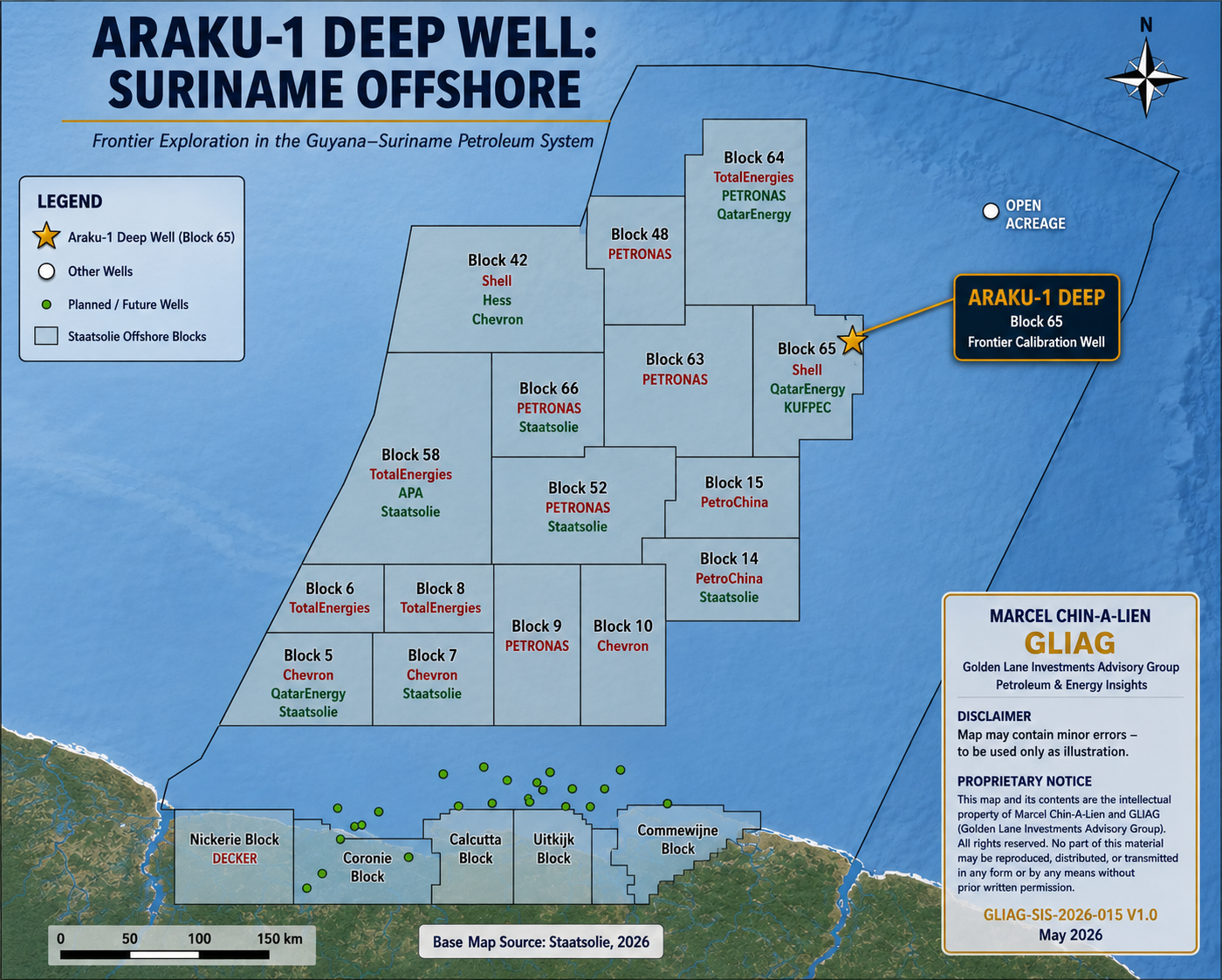
Document ID: GLIAG-SIS-2026-015
Araku Deep-1 and the Geography of Uncertainty
From Discovery Basin to Learning Basin in the Guyana-Suriname Petroleum System
Marcel Chin-A-Lien
Golden Lane Investments Advisory Group (GLIAG)
Petroleum & Energy Insights
15 June 2026
Disclaimer
This publication has been prepared by the Golden Lane Investments Advisory Group (GLIAG) for informational, educational, research, and strategic-analysis purposes only.
The observations, interpretations, and conclusions presented herein represent the views of the author and do not necessarily reflect the views of any government, regulator, operator, partner company, national oil company, financial institution, or other organization.
Nothing contained in this publication should be construed as investment advice, legal advice, reserve certification, technical certification, regulatory guidance, or a recommendation to invest in any company, asset, project, or jurisdiction.
Petroleum exploration is inherently uncertain. Geological interpretations and basin-scale assessments remain subject to revision as additional information becomes available.
Proprietary Notice
Copyright 2026 Golden Lane Investments Advisory Group (GLIAG). All rights reserved.
Citation and academic referencing are encouraged provided full attribution is given to the author and GLIAG.
Recommended citation: Chin-A-Lien, M. (2026). Araku Deep-1 and the Geography of Uncertainty: From Discovery Basin to Learning Basin in the Guyana-Suriname Petroleum System. GLIAG Strategic Intelligence Series. GLIAG-SIS-2026-015.
A Note on Evidence and Interpretation
At the time of writing, relatively little detailed technical information concerning Araku Deep-1 has been publicly disclosed by either the license holders or the relevant authorities.
Beyond limited public statements, industry reporting, regulatory filings, and selected technical commentary, most subsurface information remains confidential.
Consequently, this publication should not be interpreted as a technical well-result report.
Rather, it represents an independent basin-intelligence assessment developed using publicly available information, historical exploration results, regional petroleum-system understanding, industry publications, and geological reasoning.
Throughout this publication, a distinction is maintained between facts, interpretations, and insights.
Facts are publicly disclosed information. Interpretations are geological and strategic reasoning derived from available evidence. Insights are broader implications arising from those interpretations.
The objective is not to determine whether Araku Deep-1 was successful or unsuccessful, but to explore what the well may contribute to understanding the evolving Guyana-Suriname petroleum system.

Executive Summary
Few wells attract attention because of what they reveal. Fewer still attract attention because of the questions they leave behind. Araku Deep-1 may ultimately belong to the latter category.
Araku Deep-1 occupies an unusual position within the exploration history of the Guyana-Suriname Basin.
Unlike many of the discoveries that have defined the basin’s modern success story, Araku Deep-1 may not ultimately derive significance from reserve estimates, development plans, or production forecasts. Its long-term importance may instead lie in the information it generated and the uncertainty it helped define.
This distinction matters because the basin itself is changing.
During the past decade, the Guyana-Suriname Basin evolved from a frontier exploration province into one of the most successful petroleum systems of the modern offshore era. A succession of discoveries demonstrated the effectiveness of regional source rocks, migration pathways, reservoirs, seals, and trapping mechanisms.
Those discoveries answered a fundamental question: Does the petroleum system work? The answer was unequivocally yes.
Today, however, exploration increasingly faces a different challenge.
The question is no longer whether hydrocarbons exist. The question is where geological confidence begins to diminish, where petroleum-system behaviour changes, and where uncertainty becomes the dominant exploration variable.
Araku Deep-1 appears to have been drilled within that frontier of uncertainty.
At the time of writing, limited public information prevents definitive conclusions regarding the well’s geological outcome. Nevertheless, the well’s location, timing, and broader exploration context suggest that it may have been testing concepts extending beyond the basin’s most heavily de-risked discovery trends.
This paper argues that Araku Deep-1 should be viewed primarily as a calibration well within a maturing petroleum province. It further argues that the Guyana-Suriname Basin is increasingly transitioning from a discovery basin toward a learning basin, where understanding uncertainty may become as strategically important as identifying opportunity.
In that context, Araku Deep-1 may ultimately derive significance not from what it discovered, but from what it contributes to understanding the evolving geography of uncertainty within the Guyana-Suriname petroleum system.
Key Takeaways
- Relatively little detailed technical information concerning Araku Deep-1 has been publicly disclosed.
- Araku Deep-1 appears to have been drilled within a frontier portion of the basin where important questions regarding petroleum-system continuity remain unresolved.
- The well may derive significance not only from commercial outcomes but also from the information it contributes to basin understanding.
- The Guyana-Suriname Basin is increasingly transitioning from proving hydrocarbons toward understanding uncertainty.
Part I – The End of the Discovery Era
The phrase ‘end of the discovery era’ should not be interpreted literally.
The Guyana-Suriname Basin is likely to deliver additional discoveries for many years to come. Exploration activity remains substantial, operators continue to evaluate frontier acreage, and multiple geological concepts remain incompletely tested.
Rather, the phrase reflects a shift in the dominant geological question confronting the basin.
During the early years of modern exploration, uncertainty centred on whether a working petroleum system existed.
For decades, the basin was regarded as promising but largely unproven. Geological models suggested significant potential, seismic interpretations indicated attractive prospectivity, and analogies with other Atlantic Margin provinces encouraged optimism. Yet until major discoveries were made, substantial uncertainty remained.
The discoveries that followed fundamentally changed that situation.
The basin demonstrated working source rocks. It demonstrated migration. It demonstrated effective reservoirs. It demonstrated sealing capacity. It demonstrated commercial hydrocarbon accumulations.
The cumulative significance of discoveries such as Liza, Payara, Snoek, Sapakara, Krabdagu, and ultimately Gran Morgu extends beyond their individual resource volumes. Collectively, they established the credibility of the petroleum system itself.
The result was a profound reduction in geological uncertainty.
Yet exploration success creates a paradox. As uncertainty decreases in one area, attention inevitably shifts to another.
Once the existence of a petroleum system is proven, the next challenge becomes understanding its variability.
Where does the system remain effective? Where does it weaken? Where does it change? Where do geological risks begin to increase?
These questions increasingly define the modern exploration landscape of the Guyana-Suriname Basin.
Consequently, frontier wells today often serve a different function than frontier wells of the past.
They are no longer required merely to prove the existence of hydrocarbons. They are increasingly required to define the boundaries of understanding.
In this context, wells that fail to deliver commercial discoveries can still generate substantial value.
Their contribution lies in calibration. They refine models. They challenge assumptions. They constrain possibilities. And in doing so, they improve future decision-making.
This broader role appears particularly relevant to Araku Deep-1.
Part II – Araku and the Geography of Uncertainty
Every petroleum basin contains a geography of opportunity.
Less frequently discussed is the existence of a geography of uncertainty.
Yet uncertainty, like hydrocarbons, is not distributed evenly.
Some areas benefit from numerous wells, extensive seismic coverage, production history, and decades of geological analysis. Other areas remain comparatively poorly understood.
The result is a shifting landscape in which confidence varies from one region to another.
Understanding that landscape is increasingly important in mature exploration provinces.
The concept of a geography of uncertainty provides a useful framework for examining Araku Deep-1.
Within the Guyana-Suriname Basin, the most heavily de-risked exploration trends are associated with areas where multiple discoveries have confirmed the effectiveness of the petroleum system.
These areas benefit from direct evidence. Operators possess better calibration. Reservoir behaviour is more predictable. Migration pathways are better understood. Geological risk remains, but uncertainty is reduced.
Frontier regions are different. Data density decreases. Calibration decreases. Competing geological models become more difficult to distinguish. Exploration decisions increasingly rely on inference rather than direct confirmation.
This does not mean frontier areas lack potential. Indeed, some of the world’s largest discoveries have emerged from poorly understood regions. It simply means that uncertainty becomes a larger component of exploration risk.
Araku Deep-1 appears to have occupied precisely such a position.
Its significance therefore extends beyond the prospect itself.
The well sits within a broader exploration effort aimed at understanding how far the proven petroleum system extends and how its behaviour may change outside the basin’s most established discovery corridors.
Instead of asking, ‘Did this prospect contain commercial hydrocarbons?’ the more important question becomes, ‘What does this well tell us about the petroleum system?’
That distinction lies at the heart of basin maturity.
In frontier provinces, exploration seeks discoveries. In mature provinces, exploration increasingly seeks understanding.
Araku Deep-1 appears to belong to the latter category.
Its long-term value may therefore depend less on immediate commercial outcome and more on its contribution to defining the geography of uncertainty that surrounds the proven petroleum system.
Part III – The Frontier Beyond the Golden Lane
One of the defining characteristics of successful petroleum provinces is that they eventually force explorationists to move beyond their most comfortable assumptions.
The Guyana-Suriname Basin is no exception.
Much of the basin’s modern success has been associated with what is commonly described as the Golden Lane trend. Although the term should not be interpreted as a rigid geological boundary, it serves as a useful shorthand for the broad corridor within which multiple discoveries validated the effectiveness of the regional petroleum system.
Within that corridor, confidence increased with every successful well. Charge was demonstrated. Migration was demonstrated. Reservoir quality was demonstrated. Trap effectiveness was demonstrated. As discoveries accumulated, geological uncertainty declined.
Yet success creates its own challenge.
As the most attractive prospects are tested and proven, exploration naturally begins to move outward from the areas of highest confidence. Operators start asking different questions.
What lies beyond the proven fairway? Do migration systems extend farther than currently understood? Can new play concepts emerge outside the established trend? Are there overlooked petroleum-system elements that remain underappreciated?
It is within this context that Araku Deep-1 becomes particularly interesting.
The well appears to have occupied a position beyond the basin’s most heavily de-risked discovery corridor and within a region where important geological uncertainties remain.
Industry observers increasingly viewed exploration activity in this broader area not merely as prospect testing but as an effort to evaluate the continuity of petroleum-system processes themselves.
GeoExPro highlighted growing interest in frontier concepts associated with the Demerara Plateau and adjacent exploration domains. In particular, GeoExPro described Macaw-1 and Araku Deep-1 as part of a regional effort to test Aptian carbonate concepts and a possible northern migration pathway beyond the main proven kitchen area.
These discussions reflected an industry-wide recognition that the next phase of exploration may require a better understanding of how petroleum-system behaviour evolves away from the most established discovery trends.
Importantly, the objective is not necessarily to prove that the petroleum system stops at a particular location.
Nature rarely operates through sharp boundaries.
Petroleum systems typically evolve gradually. Migration efficiency may decline. Reservoir quality may vary. Trap styles may change. Charge timing may become more uncertain.
Consequently, the challenge is often not identifying where a system ends, but understanding how its behaviour changes through space and time.
This distinction is critical.
Araku Deep-1 therefore should not be viewed solely as a test of a single geological structure.
It may also be interpreted as part of a broader effort to understand the transition between areas of high geological confidence and areas where uncertainty remains significant.
That transition zone may ultimately become one of the most important exploration frontiers in the basin.
The significance of Araku Deep-1 therefore lies not merely in its location, but in the questions its location was designed to address.
The broader implication extends beyond a single prospect.
Every successful basin eventually encounters a point where exploration ceases to be a search for obvious opportunities and becomes a search for understanding. The future of exploration in the Guyana-Suriname Basin may increasingly depend upon the industry’s ability to identify where existing models remain robust and where entirely new concepts are required.
Araku Deep-1 appears to sit precisely at that intersection.
In this respect, the well may represent more than a frontier test. It may represent a test of the industry’s own understanding of basin-scale petroleum-system continuity.
Part IV – Revisiting the Porcellanite Clue
The story of Araku Deep-1 does not begin with Araku Deep-1.
Its intellectual origins can be traced, in part, to the earlier Araku-1 well and the questions that emerged from its results.
When Tullow reported the outcome of Araku-1 in 2017, the well was ultimately classified as non-commercial. Yet the story did not end there.
Tullow reported that Araku-1 reached a total depth of 2,685 metres, encountered no significant reservoir-quality rocks, and was plugged and abandoned. However, logging and sampling proved the presence of gas condensate. Tullow later noted that the result, in combination with high-quality 3D seismic data, helped de-risk deeper plays in the acreage.
That observation remains important.
Not because it proves the existence of a commercial accumulation. Not because it guarantees future success. But because it demonstrates that petroleum-system processes were active.
This distinction formed the basis of the earlier Petroleum & Energy Insights article, ‘Exploring the Porcellanite Clue in Araku-1’.
The article did not argue that porcellanite constituted evidence of a discovery.
Rather, it explored whether the observation might provide insight into migration history, charge access, and petroleum-system complexity.
That question remains relevant today.
One of the challenges in petroleum exploration is that hydrocarbons can be generated, migrate, and even enter geological structures without ultimately creating commercially recoverable accumulations.
Charge alone is not sufficient. Reservoir quality matters. Trap integrity matters. Timing matters. Preservation matters. Commerciality requires multiple geological conditions to align simultaneously.
Consequently, evidence that hydrocarbons interacted with a geological system does not necessarily answer the commercial question.
It does, however, contribute to understanding the petroleum-system question.
Viewed through this lens, the significance of the porcellanite discussion lies less in the specific lithology itself and more in what it may suggest regarding basin processes.
It reminds us that petroleum systems are rarely simple. They are dynamic. They evolve over geological time. They respond to changes in sedimentation, burial history, tectonics, pressure, temperature, and migration pathways.
The presence of hydrocarbon-related indications in a non-commercial well therefore can still provide valuable information.
Such observations may reveal where petroleum systems have operated, where migration has occurred, and where future exploration models may require refinement.
This is precisely why Araku-1 remains relevant to the broader Araku story.
The well contributed information.
Araku Deep-1 appears to represent a continuation of the effort to better understand what that information means within a larger basin context.
The relationship between the two wells is therefore not simply chronological. It is interpretive.
Together, they form part of an ongoing attempt to understand a complex and evolving petroleum system.
This continuity matters.
Too often, non-commercial wells disappear from public discussion once drilling operations conclude. Yet petroleum provinces are built not only on discoveries, but also on lessons.
Every discovery reveals what works. Every unsuccessful well reveals what may not. Both contribute to understanding.
Araku-1 provided a clue. Araku Deep-1 appears to represent an attempt to better understand that clue.
Whether the answer ultimately confirms or challenges existing interpretations remains uncertain.
But the question itself remains valid.
And in exploration, good questions frequently prove as valuable as immediate answers.
Part V – Calibration Wells and the Economics of Learning
The petroleum industry traditionally evaluates exploration wells through the lens of commercial success.
This is entirely understandable.
Exploration exists to discover resources that can ultimately be developed and produced.
From a corporate perspective, commercial discoveries generate value. Dry holes consume capital.
Yet this perspective, while economically important, does not tell the entire story.
Exploration also generates information.
And information has value.
This distinction becomes increasingly important as petroleum provinces mature.
In the earliest stages of basin exploration, a discovery may dramatically increase understanding because very little is known.
As more wells are drilled, however, the nature of value begins to evolve.
Some wells create value through resources. Others create value through learning.
The concept of a calibration well emerges from this reality.
A calibration well is valuable not primarily because of what it produces, but because of what it teaches.
It helps distinguish between competing geological interpretations. It constrains uncertainty. It improves future decision-making. It refines exploration strategy.
Viewed from this perspective, a well can reduce prospect value while simultaneously increasing basin value.
This distinction is often overlooked outside technical circles.
A prospect may fail. Yet the information generated may improve the probability of success elsewhere.
The result is a transfer of value from the individual prospect to the broader geological understanding of the basin.
This concept is particularly relevant to frontier exploration.
When operators drill beyond established fairways, they are not simply searching for hydrocarbons. They are also testing geological assumptions.
Each result contributes to model improvement. Each result reduces uncertainty. Each result helps define what is likely and what is unlikely.
The cumulative effect can be substantial.
Over time, the basin becomes better understood. Prospects become better ranked. Capital allocation improves. Exploration efficiency increases.
In this sense, learning itself becomes an economic asset.
The significance of Araku Deep-1 should therefore be considered within this broader framework.
Whether the well ultimately proves commercially important remains uncertain.
What appears more certain is that the well contributes information.
And in a maturing exploration province, information may be one of the most valuable resources of all.
The industry often celebrates discoveries because discoveries are visible. Learning is less visible.
Yet every major petroleum province has been shaped by a series of calibration points that gradually improved understanding.
Some were discoveries. Some were not.
What they shared was an ability to reduce uncertainty and improve future decisions.
Araku Deep-1 may ultimately belong within that category.
Its greatest contribution may not be measured in barrels. It may be measured in understanding.
And as the Guyana-Suriname Basin moves from proving hydrocarbons toward understanding uncertainty, that distinction becomes increasingly important.
Part VI – From Discovery Basin to Learning Basin
The distinction between a Discovery Basin and a Learning Basin is subtle, yet important.
In a Discovery Basin, success is measured primarily through discoveries. Exploration seeks confirmation. The objective is to prove the existence of a working petroleum system and establish commercial resource potential.
The Guyana-Suriname Basin spent decades in this phase.
Geologists debated source-rock quality, migration pathways, reservoir distribution, trap integrity, and hydrocarbon charge. The basin was regarded as promising, but much remained uncertain. Geological models existed, yet they lacked the validation that only drilling could provide.
The discoveries that followed transformed that reality.
One well became several. Several discoveries became a trend. The trend became a province. And the province became one of the most important offshore petroleum success stories of the modern era.
The significance of this transformation extends beyond resource volumes. It fundamentally altered the nature of geological uncertainty.
The basin no longer requires proof that hydrocarbons exist. The basin no longer requires proof that source rocks work. The basin no longer requires proof that migration occurs.
Those questions have largely been answered.
Instead, exploration increasingly seeks to understand variation.
How does the petroleum system behave away from established fairways? Where do geological assumptions remain valid? Where do they begin to fail? Where do new play concepts emerge?
These are the defining questions of a Learning Basin.
Importantly, Learning Basins still produce discoveries. Indeed, some of their largest discoveries may still lie ahead.
The difference is that discoveries increasingly occur within a framework shaped by accumulated knowledge.
Information becomes a strategic asset. Calibration becomes valuable. Understanding uncertainty becomes a competitive advantage.
This observation has implications beyond Araku Deep-1.
It applies to the basin as a whole.
The future of exploration in the Guyana-Suriname Basin may depend less on proving that hydrocarbons exist and more on understanding where they occur, why they occur, and how geological risk changes across space and time.
Araku Deep-1 appears to sit within that transition.
Its significance may therefore derive from its role in improving understanding rather than simply expanding resources.
The distinction may seem subtle. In reality, it represents a profound shift in exploration maturity.
A basin reaches a new stage of development when learning itself becomes an objective.
The Guyana-Suriname Basin increasingly appears to be entering that stage.
Part VII – What Araku Deep-1 May Ultimately Be Remembered For
History rarely evaluates exploration wells in the same way that contemporaries do.
When a well is drilled, attention naturally focuses on immediate outcomes.
Was a discovery made? Were hydrocarbons encountered? Is commercial development possible?
These questions are important. But they are not always the questions that determine long-term significance.
Some wells become famous because of what they discovered. Others become important because of what they revealed.
Araku Deep-1 may ultimately belong to the latter category.
At the time of writing, public information remains limited. Consequently, caution is essential.
The objective of this publication is not to assign significance where significance has not yet been demonstrated.
Rather, it is to recognize that certain wells occupy strategically important positions within the evolution of a petroleum province.
Araku Deep-1 appears to be one of those wells.
Its location, timing, and broader exploration context suggest that it formed part of an effort to better understand frontier petroleum-system behaviour beyond the basin’s most heavily de-risked areas.
Whether that effort ultimately proves successful will depend on future information and future exploration results.
Nevertheless, the well already contributes something valuable.
It contributes knowledge.
Every exploration well narrows uncertainty. Every exploration well improves understanding. Every exploration well helps distinguish between competing geological interpretations.
This contribution should not be underestimated.
Modern exploration is increasingly a process of learning.
As the easiest opportunities are identified and tested, the remaining opportunities become more complex. The role of information therefore increases.
In such an environment, the value of a well extends beyond the hydrocarbons it may contain.
It extends to the questions it helps answer.
Araku Deep-1 appears to have been drilled precisely where important questions existed.
That alone makes it relevant.
Whether future historians of the basin ultimately regard the well as pivotal remains impossible to determine today.
What can be stated with confidence is that it forms part of the continuing process through which the Guyana-Suriname Basin is being understood.
And understanding remains one of the most valuable outcomes exploration can produce.
Conclusion
Araku Deep-1 may ultimately be remembered as a well that generated more questions than answers.
At first glance, that may appear disappointing. Exploration is often viewed through the binary lens of success and failure, discovery and dry hole, commercial and non-commercial outcome.
Yet petroleum exploration has never been solely about discoveries. It is also about understanding.
At the time of writing, relatively little detailed technical information concerning Araku Deep-1 has entered the public domain. Consequently, any assessment of the well must remain appropriately cautious and firmly anchored in publicly available evidence.
What can be stated with confidence is that Araku Deep-1 was drilled in a part of the basin where important geological questions remain unresolved. It occupied a position beyond the most heavily de-risked discovery fairways and formed part of a broader effort to better understand petroleum-system continuity, migration architecture, and frontier exploration potential.
In that sense, the well should not be viewed exclusively through the narrow lens of commercial outcome.
Its broader significance may lie in the information it generated and the uncertainty it helped define.
This distinction matters because the Guyana-Suriname Basin is evolving.
The basin’s early exploration history was dominated by a fundamental question: does the petroleum system work? A succession of discoveries provided a compelling answer.
Today, the challenge is different.
The basin increasingly seeks to understand where the petroleum system changes, where geological risk begins to increase, and where future opportunities may still exist beyond proven fairways.
Araku Deep-1 appears to belong to this new phase of exploration.
Whether the well ultimately proves significant in the long term will depend not only on its own results, but on how the information it generated contributes to future geological understanding, prospect evaluation, and exploration strategy.
Viewed in this context, Araku Deep-1 may be interpreted less as an isolated drilling event and more as a calibration point within the continuing evolution of the Guyana-Suriname petroleum system.
The broader lesson extends beyond a single well.
As petroleum provinces mature, competitive advantage increasingly depends on the ability to convert information into understanding and understanding into insight.
Discoveries remain important. But so do the wells that define boundaries. So do the wells that challenge assumptions. So do the wells that refine models.
Every discovery proves a petroleum system. Every calibration well helps define its limits.
Araku Deep-1 may ultimately be remembered as one of those calibration wells.
Not because it changed the basin by itself. But because it contributed to the larger process through which one of the world’s most important emerging petroleum provinces continues to be understood.
In the end, the significance of Araku Deep-1 may not lie in what it produced. It may lie in what it taught.
Final Insight
The first phase of exploration seeks to discover hydrocarbons.
The second phase seeks to understand uncertainty.
The Guyana-Suriname Basin is increasingly entering that second phase.
Araku Deep-1 stands at that transition.
About GLIAG
The Golden Lane Investments Advisory Group (GLIAG) is an independent boutique advisory group operating at the intersection of subsurface science, exploration, reservoirs, commercial strategy, petroleum economics, energy systems, Production Sharing Contracts, infrastructure, and sovereign development. Its focus is on the Guyana Suriname Super Basin, with specifically Suriname.
GLIAG fluently integrates geological understanding with commercial and strategic analysis, recognizing that successful petroleum provinces are shaped not only by rocks and reservoirs, but also by infrastructure, contracts, institutions, markets, capital discipline, and long-term development choices.
With more than a century of combined successful expertise across the global petroleum industry and the Suriname energy landscape, GLIAG seeks to transform information into understanding and understanding into actionable strategic insight.
The Group’s operating philosophy is simple: facts first, interpretation second, insights third.
The objective is not merely to report developments. The objective is to understand their significance.
References and Source Architecture
Tier 1 – Primary Sources
Staatsolie Maatschappij Suriname N.V. – official offshore exploration, licensing, and petroleum-sector information. https://www.staatsolie.com
Staatsolie – Macaw-1 first of five offshore exploration wells in 2025. https://www.staatsolie.com/en/news/macaw-1-first-of-five-offshore-exploration-wells-in-2025/
Shell plc – public corporate disclosures and offshore exploration context. https://www.shell.com
QatarEnergy – international upstream portfolio and Suriname participation context. https://www.qatarenergy.qa
Tullow Oil plc – Araku-1 Well Update, 27 October 2017. https://www.tullowoil.com/media/press-releases/araku-1-well-update/
Tullow Oil plc – November Trading Update, 8 November 2017. https://www.tullowoil.com/media/press-releases/november-trading-update-2/
Reuters – Shell to submit offshore drilling plan in Suriname for environmental approval, 17 December 2024. https://www.reuters.com/markets/commodities/shell-submit-offshore-drilling-plan-suriname-environmental-approval-2024-12-17/
Tier 2 – Industry Intelligence
GeoExPro – Back on the Shelf, 16 June 2025. https://geoexpro.com/back-on-the-shelf/
GeoExPro – Wildcat Activity in the Latin American Atlantic Margin, 11 November 2025. https://geoexpro.com/wildcat-activity-in-the-latin-american-atlantic-margin/
GeoExPro – Suriname: Demerara Plateau Oil and Gas Potential, 18 August 2021. https://geoexpro.com/suriname-demerara-plateau-oil-and-gas-potential/
OilNOW – Shell to kick off Suriname exploration campaign with Araku Deep-1 well, 18 February 2025. https://oilnow.gy/featured/shell-to-kick-off-suriname-exploration-campaign-with-araku-deep-1-well-rystad/
OilNOW – New play concept targets Aptian carbonates in Suriname’s Demerara High, 18 November 2025. https://oilnow.gy/featured/new-play-concept-targets-aptian-carbonates-in-surinames-demerara-high/
Caribbean Energy Week – Suriname’s Offshore Oil Momentum Builds as IOCs Eye 2026 Opportunities, 11 March 2026. https://www.caribbeanenergyweek.com/news/surinames-offshore-oil-momentum-builds-iocs-eye-2026-opportunities
Wood Mackenzie / Brazil Energy Insight – Suriname’s 2025 exploration wells targeting 900 million boe of resources, 28 May 2025. https://brazilenergyinsight.com/2025/05/28/surinames-2025-exploration-wells-targeting-900-million-boe-of-resources-wood-mac/
Westwood Global Energy Group. https://www.westwoodenergy.com
Rystad Energy. https://www.rystadenergy.com
S&P Global Commodity Insights. https://www.spglobal.com/commodityinsights
Tier 3 – Geological Context
United States Geological Survey (USGS). https://www.usgs.gov
American Association of Petroleum Geologists (AAPG). https://www.aapg.org
Additional geological context is drawn from published Atlantic Margin and Guyana-Suriname Basin petroleum-system literature, including regional source-rock, migration, maturation, and basin-evolution studies.
Tier 4 – GLIAG / Petroleum & Energy Insights Research Continuity
Chin-A-Lien, M. – Araku Deep-1: A Calibration Well for Suriname’s Oil Future. https://petroleumenergyinsights.com/araku-deep-1-a-calibration-well-for-surinames-oil-future/
Chin-A-Lien, M. – Exploring the Porcellanite Clue in Araku-1. Petroleum & Energy Insights Guyana-Suriname Basin archive. https://petroleumenergyinsights.com/category/guyana-suriname-basin-gsb/
Recommended Citation
Chin-A-Lien, M. (2026). Araku Deep-1 and the Geography of Uncertainty: From Discovery Basin to Learning Basin in the Guyana-Suriname Petroleum System. GLIAG Strategic Intelligence Series. GLIAG-SIS-2026-015.
WordPress Metadata
Title: Araku Deep-1 and the Geography of Uncertainty: From Discovery Basin to Learning Basin in the Guyana-Suriname Petroleum System
Category: Basin Intelligence
Tags: Araku Deep-1, Araku-1, Suriname Offshore, Guyana-Suriname Basin, Demerara Plateau, Golden Lane, GeoExPro, Calibration Wells, Petroleum Systems, Exploration Strategy, GLIAG
SEO Meta Description: A GLIAG flagship essay examining Araku Deep-1 as a calibration well in the Guyana-Suriname Basin and what it may teach about frontier uncertainty, petroleum-system continuity, and the basin’s transition from discovery basin to learning basin.
End of Manuscript
GLIAG-SIS-2026-015
Araku Deep-1 and the Geography of Uncertainty
Marcel Chin-A-Lien
Golden Lane Investments Advisory Group (GLIAG)
Petroleum & Energy Insights
Araku Deep-1 may ultimately be remembered not for resolving uncertainty, but for helping define it.