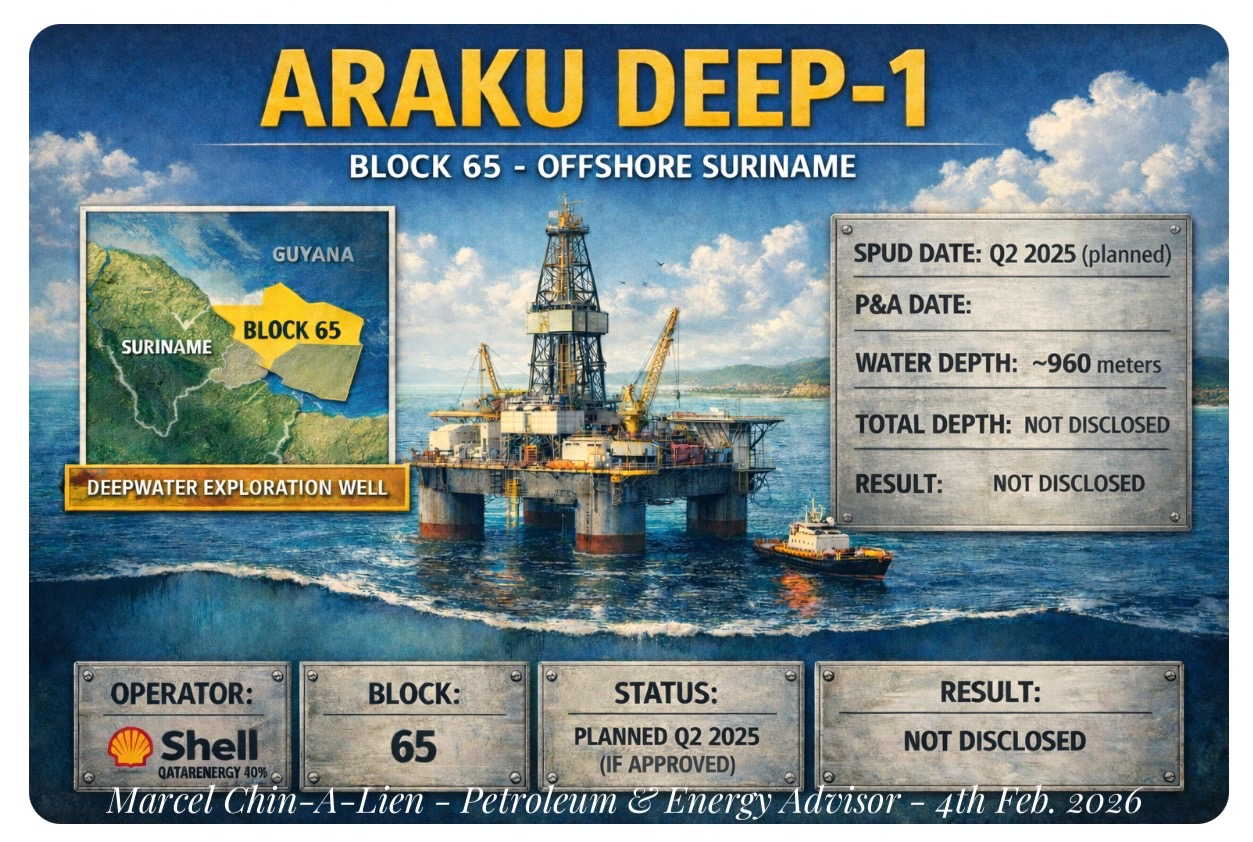
Written by Marcel Chin-A-Lien – Petroleum & Energy Insights Advisor • Offshore Suriname
The Araku Deep-1 well is often framed as a simple exploration outcome.
In reality, it is a high-value calibration point: it refines basin-scale charge and migration understanding, constrains fairway limits, and improves capital discipline for the next cycle.
Key takeaways
- Araku Deep-1 is best understood as a basin-calibration well, not a referendum on Suriname’s prospectivity.
- The central lesson is charge access and plumbing—not simply reservoir presence.
- Results help sharpen focus on structurally connected Cretaceous fan systems aligned with proven kitchens.
- Strategic “negative calibration” improves portfolio quality by closing doors decisively.
Why Araku Deep-1 matters far more than its headline result
Araku Deep-1 has too often been reduced—incorrectly—to a binary exploration narrative.
In practice, Araku functions as one of the most strategically informative wells for offshore Suriname because it tests how far the deepwater petroleum system remains commercially accessible beyond the proven fairways.
Suriname is now progressing from exploration momentum to development reality.
In that transition, the most valuable wells are not only those that find hydrocarbons, but those that sharpen the playbook: what works, where it works, and why.
In short: Araku is a data well that improves future decision-making—especially around migration efficiency and trap access.
1) Geological context: why Araku was drilled
Araku Deep-1 targeted/targets a deepwater setting within the broader Guiana Basin petroleum framework.
At basin scale, the system is underpinned by:
(i) world-class Cretaceous source rock deposition linked to global anoxic events,
(ii) long-lived structural inheritance from Atlantic rifting phases, and
(iii) deepwater accommodation shaped by post-rift subsidence and sediment loading.
The strategic intent was to test three critical uncertainties that define step-out risk:
- Source rock effectiveness at depth (presence, richness, and maturity context)
- Timing and efficiency of charge into ultra-deepwater traps
- Reservoir development and sand delivery beyond the proven fairway
These are precisely the questions that separate an “exciting basin” from a basin with repeatable, scalable commercial outcomes.
“Where Araku sits in the basin framework” ?
2) What Araku Deep-1 actually tests/tested (and why that matters)
2.1 Source rock presence: confirmed regionally, not disproven locally
Araku Deep-1 should not be interpreted as “the source doesn’t work.”
Offshore Suriname sits within a regional petroleum system in which Cretaceous source intervals are laterally extensive at basin scale.
What Araku tests/tested was whether charge is effectively delivered into a particular deepwater structural–stratigraphic configuration.
That distinction is essential: a basin can be prolific, but still selective—where commercial success depends on connectivity between kitchen, carrier, and trap.
2.2 Migration: the real lesson of Araku
The most important learning from Araku is best framed as a migration and trap-access calibration.
Deep offshore systems commonly operate under different pressure and migration behavior than onshore to nearshore systems.
In practical terms, the deepwater charge story is often dominated by episodic expulsion and vertical migration components—yet commercial fills still require effective carrier pathways and trap access.
Interpretive takeaway: It’s entirely plausible for the kitchen to be effective while the plumbing to a specific trap is not.
In proven fairways, stacked discoveries frequently reflect a fill-and-spill architecture—vertical expulsion into connected carrier systems, up-dip charging, and progressive trap filling.
A more isolated deepwater position can fail not because the basin “doesn’t work,” but because: carrier systems are discontinuous, the trap is bypassed, or timing mismatches reduce trap access during peak expulsion.
2.3 Reservoir: present, but not decisive
Deepwater fan systems are inherently heterogeneous: sand delivery and distribution are controlled by routing, slope gradients, confinement, and local structural relief.
Araku underscores that sand presence alone is not decisive in distal settings without robust charge access.
That negative calibration is valuable because it prevents later capital misallocation.
3) Why Araku strengthens—not weakens—the Suriname story
Exploration maturity is not defined by success rates alone, but by how efficiently outcomes are converted into knowledge.
Araku provides clarity by:
- Constraining fairway limits and improving step-out discipline
- Differentiating viable deepwater traps from traps with structural isolation/charge-access risk
- Refining migration concepts (pathways, pressure behavior, and timing)
- Increasing confidence in prioritizing connectivity over mere amplitude/chance of reservoir
Put simply: Araku closes certain doors—decisively—so the industry can allocate more attention and capital to the doors that remain most geologically defensible.
4) Strategic implications for operators and investors
4.1 Exploration strategy
- Prioritize structurally connected Cretaceous fan systems aligned with proven kitchens.
- Apply higher charge-risk weighting to distal, isolated deepwater traps.
- Elevate migration/carrier continuity as the primary discriminator in step-out prospect ranking.
4.2 Capital discipline
- Araku reduces the probability of repeated ultra-deepwater step-outs without system connectivity.
- Portfolio balance improves when “negative calibration” is captured early and applied consistently.
4.3 Basin narrative
- Offshore Suriname behaves as a selective petroleum system—prolific where the plumbing and timing align.
- Selectivity can be a strength: it concentrates commercial volumes into fewer, larger developments.
Final assessment
Araku Deep-1 should be remembered as a calibration well. At this moment the status has not been released, so we do not know if it is a failure or a well that discovered substantial reserves..
Its value lies in refining migration and trap-access understanding, tightening fairway focus, and enabling better capital discipline as Suriname’s offshore story advances into development.
In mature basins, the most valuable wells are often those that close doors decisively—so that attention and investment flow toward the opportunities that the geology can truly support.
One-line conclusion: Araku improved the playbook—especially around charge access—making future exploration smarter.
Disclosure/Note: This article is a basin-scale geological interpretation intended for technical and investment audiences. It does not rely on confidential data and should not be read as a substitute for operator well reports or regulatory filings.
Sources & framework
- Staatsolie — GeoAtlas of Suriname. (Used here as the regional geological and petroleum-system framework.)