GLIAG ESSAY · GUYANA–SURINAME BASIN · 23 SEPTEMBER 2026
Cretaceous Microfossils and Petroleum Systems Across the Equatorial Atlantic Margin
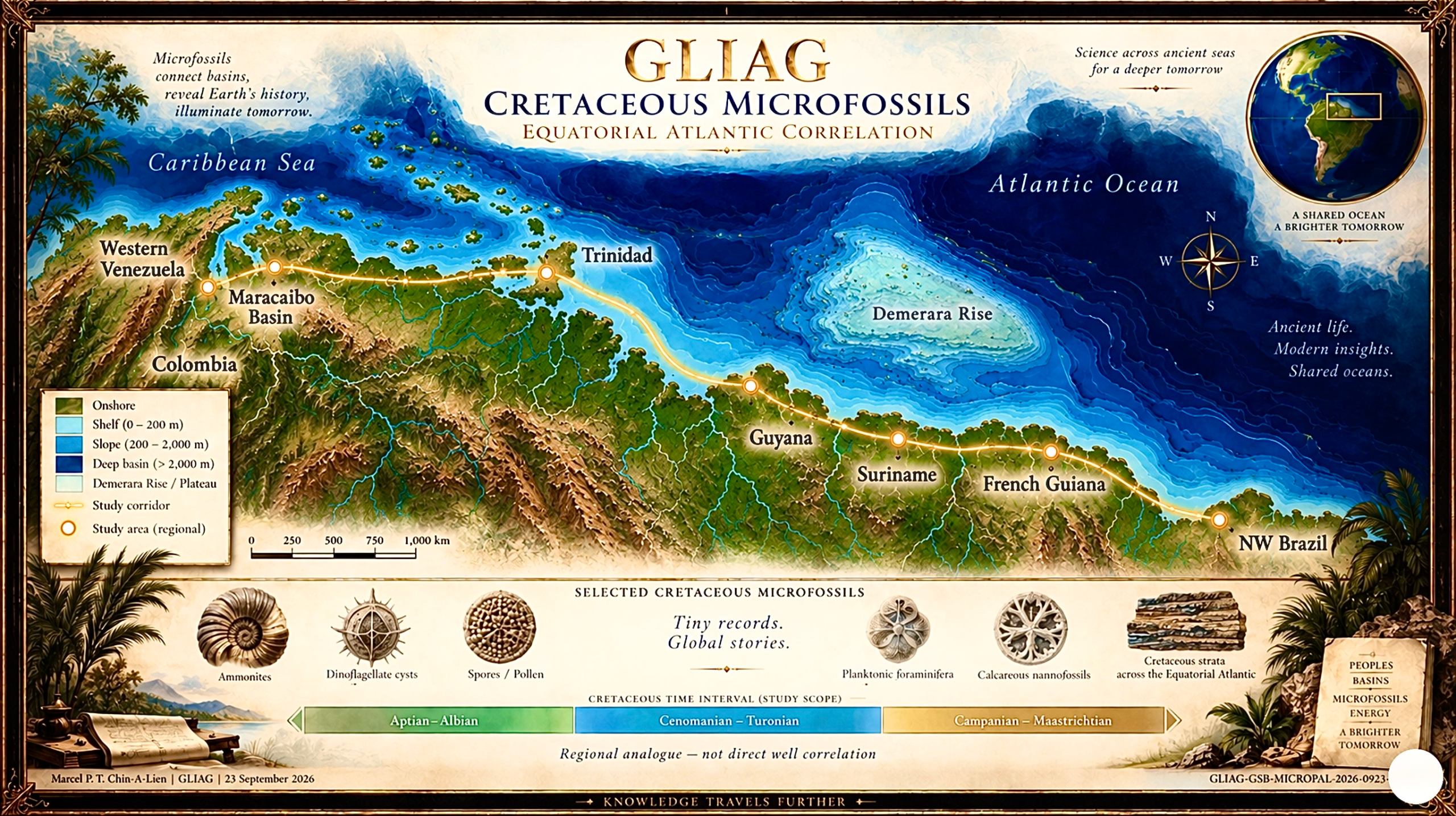
Western Venezuela, Colombia, Trinidad, Guyana–Suriname, French Guiana, Demerara Rise and northwestern offshore Brazil
A short independent GLIAG essay with Socratic audit and test programme
Drs. M.P.T. Chin-A-Lien, MBA, M.Sc., Ing. Geologist
AAPG Certified Professional Geologist Nr. 5201-1996 · EFG Chartered European Geologist Nr. 92-1996 · AIEN Energy Negotiator (June 2021)
Principal Founding Partner, Golden Lane Investments Advisory Group B.V. (GLIAG) · 23 September 2026
Converting bare headlines into deep strategic, added value
Document ID GLIAG-GSB-MICROPAL-2026-0923-04 · IOC-archive and congress revision 4 · Web edition
THE CONCLUSION IN ONE SENTENCE
The Venezuelan assemblages strengthen a regional process analogue—terrestrial influx on a humid tropical margin alternating with open-marine, commonly oxygen-stressed deposition—but they do not establish a fossil-by-fossil chronostratigraphic tie to the GSB; that requires reworked, taxonomically modern, well-calibrated GSB cuttings and cores.
Independent GLIAG working interpretation. Public-domain evidence only. Discovery is not development; analogy is not correlation; a fossil occurrence is not proof of source-rock richness, reservoir quality, maturity or charge.
Executive finding
Funkhouser’s 1960 report is valuable less as a ready-made zonation than as an early demonstration of how acid-insoluble palynomorphs can separate depositional systems across northern South America. Its Lower Cretaceous Maracaibo samples contain spores and pollen—including Classopollis, Cicatricosisporites, Concavisporites and Zonalasporites—together with marine dinoflagellate cysts such as Odontochitina and gonyaulacoid forms. That mixed signal is compatible with a vegetated continental hinterland feeding a marginal-to-open marine basin. Its Upper Cretaceous Barinas assemblages are dinocyst-rich and broadly track Aguardiente-, La Luna- and Colón-equivalent packages. The Maastrichtian Mito Juan assemblage is instead pollen/spore dominated with sparse, poorly preserved marine forms, supporting brackish to marginal-marine deposition.
For the GSB, the match is strongest at the scale of basin evolution and environmental alternation: Early Cretaceous post-rift/passive-margin accommodation; Aptian–Albian restricted to increasingly marine conditions; Albian and Cenomanian–Turonian oxygen-deficient source-rock windows; and Late Cretaceous deep-water clastic systems receiving large volumes of craton-derived sediment. The match is weakest at species level because the 1960 names are partly informal, ranges were provisional, preservation and reworking were recognized problems, and palaeogeographic connectivity between western Venezuela and the equatorial Atlantic margin was indirect and time-dependent.
GLIAG therefore recommends a GSB Cretaceous Micropalaeontology and Palynofacies Pilot, not a paper correlation exercise. Reprocess selected public or released wells with modern taxonomy, integrate dinocyst/pollen/spore counts with palynofacies, Rock-Eval, biomarkers, elemental redox proxies, sedimentology and seismic sequence boundaries, and preserve every determination with sample depth, preparation method, confidence and reworking flag in GIP HERKOMST.
1 Scope and source audit
The anchor source is John W. Funkhouser, Studies on Cretaceous Acid-Insoluble Microfossils in Western Venezuela, Jersey Production Research Company report GLA-68-60, May 1960, prepared for Creole Petroleum Corporation. The available copy is a 71-page scan. The report was confidential at issue and uses many manuscript names or informal quotation-mark taxa. This essay treats its observations as historical primary evidence, not as a modern taxonomic authority.
“Acid-insoluble microfossils” here chiefly means organic-walled palynomorphs remaining after mineral dissolution: dinoflagellate cysts, spores, pollen, acritarch-like forms and organic debris. The preparation preferentially removes carbonate and silicate matrix. It therefore does not capture the whole micropalaeontological system: calcareous nannofossils, foraminifera and other acid-soluble groups require separate workflows.
| Evidence class | What is retained | What is not warranted |
| Observed in the 1960 report | Named assemblages, sample/well context, relative abundance comments, barren intervals, suspected reworking and fault repetition. | Modern species concepts, calibrated numerical ages or quantitative palaeoenvironmental indices. |
| Public GSB synthesis | Staatsolie describes proven Cretaceous source rocks, with Albian–Coniacian the most prolific, overlain by an Early Tertiary progradational wedge; high-quality Cretaceous and Tertiary sandstone reservoirs are proven. | Public proof of exact fossil assemblages in proprietary deep-water wells. |
| GLIAG interpretation | Regional depositional-process analogues and a falsifiable sampling strategy. | A direct Venezuela–GSB well tie, source attribution of any particular oil, or reservoir prediction from fossils alone. |
2 What the western Venezuela fossils show
2.1 Aptian–Albian Maracaibo Basin
The report’s Lower Cretaceous control came from SVSX-1 and P-114 wells and the Cañada La Ge and Quebrada Santa Rosa surface sections. The author judged the Aptian and Albian assemblages broadly typical, but explicitly warned that productive samples were too few for a comprehensive separation.
| Interval | Reported palynomorph signal | Defensible environmental reading |
| Aptian | Classopollis 2; gonyaulacoid dinocyst 3; informal Palaeoperidinium “caudatum” and “spinulosum”. | Conifer-dominated terrestrial input plus marine water-column productivity. Relative proportions—not presence alone—would constrain shoreline distance and marine influence. |
| Aptian–Albian | Cicatricosisporites, ?Liliacidites, Zonalasporites and Hystrichosphaeridium tubiferum “longum”. | Warm terrestrial vegetation and freshwater runoff mixed with marine palynomorphs. Compatible with marginal marine to shelf deposition; not uniquely diagnostic. |
| Albian | Concavisporites, Classopollis 1, Odontochitina, gonyaulacoid form 1 and several informal peridinioid taxa. | Stronger marine component with continued land-derived input. Odontochitina is potentially useful biostratigraphically after modern taxonomic review. |
The principal lesson is facies mixing. Classopollis and spores arrive from land; dinocysts record marine plankton. Their co-occurrence can reflect a shelf receiving substantial fluvial input, differential transport and preservation, or redeposition. A high terrestrial-to-marine ratio may indicate proximity to shore or increased runoff, but oxidation, maturation and laboratory recovery can mimic ecological change.
2.2 Upper Cretaceous Barinas Basin
Three broad assemblages were recognized. Assemblage C, the lowest, includes Gonyaulax, Odontochitina, Cicatricosisporites, Lycopodiacidites and other pollen/spores and was considered Albian or low in the studied Cretaceous succession. Assemblage B contains marine dinocysts including Palaeohystrichophora and Deflandrea-like forms and was linked broadly to the La Luna interval. Assemblage A includes brown-pigmented peridinioid dinocysts and was regarded as Campanian–Maastrichtian/Colón-equivalent. The report says the fossil succession and electric-log/lithostratigraphic picture show a fair, not exact, coincidence.
This marine dinocyst dominance is consistent with shelf to basinal marine conditions, but dinocysts alone do not demonstrate anoxia. Oxygen deficiency and source-rock effectiveness require independent sedimentological and geochemical evidence. The report itself questioned whether abundance peaks might be environmental rather than chronological.
2.3 Maastrichtian Mito Juan and the value of contrast
Six Mito Juan samples yielded distinctive, predominantly terrestrial spore–pollen assemblages. Sparse, poorly preserved dinoflagellates and hystrichosphaerids led the author to infer brackish conditions. This contrast is strategically useful: it shows why “Upper Cretaceous” cannot be treated as one marine source-rock package. A marginal/brackish Colón–Mito Juan system may overlie or laterally replace deeper, more marine La Luna-type facies.
2.4 Failure modes already visible in 1960
• Reworking: Cretaceous dinocysts occurred in younger strata in Rosalia-1 and Apure-2; Masparro-1 also suggested recycled La Luna material.
• Cavings: a deeper ditch sample in Burgua-3 could contain material fallen from above.
• Structural repetition: scrambled assemblages in Burgua-3 were interpreted as possible fault repetition.
• Barren samples: many nominal control samples yielded no acid-insoluble fossils; “barren” in this method is not biologically barren.
• Range revision: the report expanded ranges after seeing more material, demonstrating that early local ranges were unstable.
3 Does this match the Staatsolie GeoAtlas model?
At system scale, yes; at taxon level, not yet. Staatsolie’s public geology summary describes the Suriname–Guyana Basin as an Early Jurassic to Early Cretaceous passive margin, with several proven Cretaceous source rocks. It identifies the Albian–Coniacian package as the most prolific and notes Cretaceous and Tertiary sandstone reservoirs, with stratigraphic trapping by onlap, pinch-out and lateral facies change. Public GeoAtlas descriptions likewise frame the basin through exploration history, evolution, stratigraphy and petroleum-system elements.
| Question | Venezuela evidence | GSB public model | GLIAG judgement |
| Aptian–Albian setting | Mixed terrestrial palynomorphs and marine dinocysts in Maracaibo; carbonate–clastic shelf context regionally. | Lower Cretaceous post-rift margin; Aptian/Albian restricted-marine and Albian source potential publicly recognized. | Process analogue: moderate. Direct correlation: unproven. |
| Cenomanian–Turonian | Marine dinocyst assemblages broadly associated with La Luna-equivalent strata. | Cenomanian–Turonian oceanic-anoxic-event source interval and deep-water petroleum system widely invoked. | Strong age-process analogue; depositional geometry and sediment routing differ. |
| Upper Cretaceous reservoirs | Western Venezuela record contains marine basin to marginal/brackish upward/lateral transitions. | Berbice canyon/fan system and Cretaceous turbidite/fan reservoirs in deep water. | Fossils can constrain marine flooding and proximity trends, not sand-body presence by themselves. |
| Seal and preservation | Fine-grained marine packages; local low-oxygen deposition known from La Luna. | Regional marine shales and younger progradational burial/seal architecture. | Plausible analogue, but redox and seal capacity require local measurement. |
The most consequential mismatch is palaeogeography. Maracaibo/Barinas lay on the northwestern South American–Caribbean realm, affected by evolving Caribbean plate interactions. The GSB lay on the equatorial Atlantic passive margin, with sediment routing from the Guiana Shield and large cross-shelf canyon/fan systems. Similar fossils can reflect broadly similar tropical marine conditions without proving continuous water masses, synchronous depositional surfaces or identical source kitchens.
4 Regional transect and correlation logic
| Province | Lower to mid Cretaceous signal | Upper Cretaceous signal | Use for GSB |
| Colombia Catatumbo and northern basins | Aguardiente and Capacho palynology supports Albian–early Cenomanian ages; Cogollo carbonates record shelf conditions. | La Luna equivalents: organic-rich marine carbonate–shale deposited during major transgression and oxygen stress. | Nearest published bridge to western Venezuela; useful for taxonomic modernization and facies calibration. |
| Maracaibo and Barinas, Venezuela | Aptian–Albian mixed terrestrial/marine palynomorphs; carbonate–siliciclastic shelf. | La Luna marine source system, overlain by Colón–Mito Juan more marginal systems. | Strong analogue for environmental succession; tectonic history limits one-to-one mapping. |
| Eastern Venezuela | Cretaceous dinocyst/palynofacies work links passive-margin stratigraphy with sequence architecture; Querecual is a La Luna age/process analogue. | Organic-rich marine rocks and later clastics. | Intermediate northern South American reference, but not a physical bridge to every GSB horizon. |
| Trinidad | Cretaceous passive-margin and deep-marine packages; local structural overprint. | Naparima Hill/Gautier source rocks are regional La Luna–Querecual age/facies analogues. | Useful end member for distal, low-oxygen marine deposition; Caribbean deformation complicates original geometry. |
| Guyana–Suriname Basin | Public fossil lists are sparse; Aptian post-rift marginal marine and Albian source concepts are documented. | Cenomanian–Turonian source rocks and enormous Cretaceous deep-water fan systems; Albian–Coniacian source package in Staatsolie synthesis. | Target, not proof. Must be tested from GSB samples and calibrated to seismic sequences and geochemistry. |
5 Petroleum-system implications for the GSB
5.1 Aptian–Albian source and reservoir questions
A mixed terrestrial–marine palynological signal is compatible with restricted shelves, embayments, delta-influenced margins and marine ramps. In the GSB, that creates two distinct hypotheses. First, restricted or stratified Aptian–Albian waters may have preserved Type II or mixed II/III organic matter in local depocentres. Second, coeval coarse clastics may form marginal-marine or lowstand reservoir fairways, while carbonate development may occur where siliciclastic dilution was limited. These hypotheses can coexist laterally; a single fossil list cannot decide between them.
The operational implication is to map palynofacies ratios and redox/organic richness separately. High dinocyst abundance may identify marine influence; high amorphous organic matter, low benthic activity, redox-sensitive enrichment and oil-prone kerogen are needed to elevate a source-rock interpretation. Terrestrial phytoclasts may indicate proximity to sediment entry and potential reservoir delivery but can also dilute marine organic matter.
5.2 Cenomanian–Turonian and younger Upper Cretaceous
The La Luna–Querecual–Naparima family is a compelling regional analogue for widespread Late Cretaceous marine oxygen stress. The GSB’s Cenomanian–Turonian petroleum system fits that global and regional framework, but local effectiveness depends on palaeobathymetry, productivity, preservation, sedimentation rate, thickness and subsequent maturity. Fossil assemblages should be used to locate flooding surfaces, marine restriction and water-mass shifts; they should not substitute for TOC, Rock-Eval, kerogen typing or oil–source correlation.
Upper Cretaceous pollen/spore increases may signal progradation, shallowing or greater river influence. In the GSB, such changes could bracket sand delivery into slope and basin-floor systems. Yet the direction of causality must be tested: transported pollen can travel far offshore, and reworked Cretaceous palynomorphs can falsely imply older sediment or a nearby shoreline.
6 Socratic independent audit
| Socratic question | Independent answer | What would falsify or revise it |
| Are the Venezuela fossils the same age as the GSB target? | Only at broad stage level in this assessment. Many 1960 taxa are informal and ranges were provisional. | Modern taxonomic revision and independent nannofossil/foraminiferal or radiometric calibration produce different ages. |
| Does a dinocyst-rich sample prove open marine deposition? | It supports marine influence. Assemblage composition, diversity, terrestrial ratio and taphonomy determine how open or restricted. | Dominant reworked cysts, cavings, condensed lag, or contradictory sedimentology. |
| Does marine deposition prove source rock? | No. Source quality requires organic richness, kerogen type, preservation and maturity. | Low TOC/HI, oxidized palynofacies, inertinite dominance or ineffective maturity/expulsion. |
| Does Classopollis prove aridity and proximity to land? | It indicates cheirolepidiacean input and can be common in warm seasonally dry settings; transport and ecology complicate distance inference. | Quantitative assemblage and sediment-routing evidence show distal transport or humid source vegetation. |
| Can western Venezuela be correlated directly through Trinidad to Suriname? | A regional chronostratigraphic framework is possible; direct bed-to-bed correlation is not demonstrated. | Diachronous facies, provincialism, tectonic reworking or inconsistent sequence boundaries. |
| What is the highest-value unknown? | The composition, preservation, reworking rate and quantitative palynofacies of released GSB Aptian–Coniacian samples. | A verified modern public dataset already provides those measurements at suitable well and depth resolution. |
7 Recommended GSB programme
Phase 1 — Public evidence register
• Create a GIP fossil occurrence table with accepted name, original name, age range, palaeoecology, sample type, well/section, depth, preservation, abundance, reworking/cavings flag, analyst, source and confidence.
• Transcribe the 1960 plates but do not normalize informal taxa automatically. Route each name through a modern dinocyst/pollen taxonomic authority and retain the original label in HERKOMST.
• Separate true public GSB fossil data from regional analogues. Use red provenance labels: GSB observation; amber: operator/ministry synthesis; grey: external analogue; red outline: GLIAG hypothesis.
Phase 2 — Sample pilot
• Select 30–50 samples across one Lower Cretaceous and one Cenomanian–Coniacian transect, prioritizing cores or sidewall cores; use cuttings only with disciplined cavings control.
• Run organic-walled palynology, palynofacies counts, TOC/Rock-Eval, vitrinite/solid-bitumen reflectance where applicable, biomarkers/isotopes, XRF redox proxies, carbonate content and routine sedimentology.
• Add calcareous nannofossils and planktonic/benthic foraminifera where preservation permits. Acid-insoluble residues alone create a designed blind spot.
• Calibrate fossil events to seismic maximum-flooding surfaces, sequence boundaries, wireline motifs and chemostratigraphic excursions. Record uncertainty envelopes rather than one deterministic pick.
Phase 3 — Decision tests
| Decision | Metric | Minimum evidence before use |
| Age and correlation | Consistent first/last occurrences plus independent fossil/chemostratigraphic tie. | At least two independent chronometers and explicit reworking assessment. |
| Depositional environment | Marine/terrestrial ratio, dinocyst diversity, amorphous organic matter, phytoclast character, benthic signal. | Replicated vertical trend supported by sedimentology and log/seismic context. |
| Source potential | TOC, HI, kerogen, maturity, thickness and lateral continuity. | Geochemical measurements and basin model; fossils supply context only. |
| Reservoir fairway | Progradation/river-influence trends integrated with grain size, provenance and seismic geomorphology. | Direct sand evidence and mapped depositional body; pollen does not predict porosity. |
8 GLIAG lessons learned
• The strongest analogue is a repeated environmental rhythm—continental input, marine flooding, oxygen stress, renewed progradation—not a shared species checklist.
• The Aptian–Albian deserves two simultaneous maps in GIP: source-preservation potential and reservoir-delivery potential. Their optima need not overlap.
• The Upper Cretaceous should be segmented into source, seal, reservoir-delivery and marginal/brackish packages. “ACT” is a useful shorthand but too coarse for decisions.
• Barren residues, reworked fossils and contradictory ages are information. They can diagnose oxidation, thermal destruction, erosion, fault repetition, cavings and sediment recycling.
• Public-domain scarcity is not permission to fill gaps with confident analogies. It is a reason to define a small, auditable acquisition programme.
RECOMMENDED GIP STATEMENT
Western Venezuela provides a credible process analogue for Cretaceous marine flooding, terrestrial influx and oxygen-stressed source-rock development across northern South America. It does not yet provide a calibrated fossil zonation for the Guyana–Suriname Basin. GIP should carry the analogue as a testable hypothesis and require local GSB sample evidence before it is promoted to correlation, depositional model or petroleum-system input.
9 Staatsolie GeoAtlas fossil and stratigraphic evidence
The 2025 Staatsolie GeoAtlas was reviewed directly, including its chronostratigraphic chart, Cretaceous EOD and facies plates, source-rock chapter, well-penetration panels and references. The atlas is an authoritative integrated synthesis, but it is not a taxonomic monograph. It does not publish lists of fossil species by sample, depth or well. Its fossil-related content is expressed mainly through age control, sequence boundaries, depositional maps and a cited internal report: Cole, Bull, Miles, Murphy, Stark and Braim (2023), Integrated Biostratigraphy and Sequence Stratigraphy of 25 wells from Suriname, Biostrat JV report BJV22-001, prepared for Staatsolie. Because that report and the raw occurrence charts are not public, individual fossil events cannot be independently audited from the GeoAtlas alone.
| GeoAtlas element | Published evidence | Micropalaeontological meaning | E&P use and limitation |
| Chronostratigraphic chart, atlas p. 27 | Triassic–Recent lithostratigraphy; Top Jurassic, Top Aptian, mid/late Albian, Cenomanian, Santonian, Campanian and Maastrichtian surfaces; OAE and relative sea-level context. | Age framework is evidently integrated with well biostratigraphy, but fossil events are not printed. | Regional well tie and sequence framework. Do not convert the chart into an undocumented local biozonation. |
| General stratigraphy, atlas pp. 27–28 | Caledonia Formation equated with Canje; includes Aptian pre-unconformity strata. Galibi Formation on Demerara Plateau is Hauterivian–Barremian. Demerara Formation is Sinemurian–Valanginian carbonate. | Age assignments constrain where palynology, nannofossils and foraminifera should be diagnostic or preservation-limited. | Separates pre-BUC carbonate/rift targets from post-BUC clastic/source systems. |
| EOD and facies plates, atlas pp. 52–65 | Maps for Tithonian, Berriasian–Valanginian, Barremian, Early Aptian, Late Aptian–mid Albian pre-BUC, late Albian post-BUC, CT, Coniacian–Santonian, Campanian and Maastrichtian. | Fossil assemblages must be interpreted within strong lateral facies variability; one taxon range cannot define the entire basin. | Predicts preservation, reworking, terrestrial/marine ratios and sampling priorities by palaeogeographic province. |
| Source-rock chapter, atlas pp. 66–81 | Proven ACT and late Aptian–early/mid Albian sources; OAE1a, OAE1b/1d, OAE2 and locally OAE3/Coniacian context; CT richness increases basinward. | Microfossils date and contextualize organic-rich intervals; they do not quantify TOC, HI, maturity or expulsion. | Use fossils to constrain age/facies, then geochemistry and basin modelling to quantify charge. |
| Atlas reference list, p. 93 | Internal 25-well biostratigraphy; peer-reviewed Tacutu palynology; DSDP 367 analogue; modern margin stratigraphy. | Confirms a professional multi-proxy basis while exposing the public-data gap. | GIP should label atlas interpretation as MINISTRY/COMPANY synthesis and occurrence-level data as unavailable. |
The atlas model is more nuanced than the shorthand ACT source rock. It shows a Jurassic–Aptian carbonate-dominated transgressive margin, a break-up unconformity during Aptian–Albian time, and a post-BUC clastic-dominated system. OAE1a is associated with Aptian source deposition; OAE1b and OAE1d with early and late Albian source intervals; OAE2 with the principal Cenomanian–Turonian source; and OAE3 with a more local Coniacian–Santonian black-shale opportunity. The Coniacian then marks major sand-prone turbidite delivery, first strongly from the Berbice system and later increasingly from Suriname and the eastern hinterland. This is the stratigraphic architecture into which any fossil evidence must fit.
10 Demerara Rise as the public fossil calibration laboratory
ODP Leg 207 Sites 1257–1261 on Demerara Rise provide the most important openly documented Cretaceous micropalaeontological calibration close to the GSB. Unlike proprietary exploration wells, these cores have published palynology, calcareous nannofossils, radiolarians, benthic foraminifera, ostracods, sedimentology and chemostratigraphy. They do not sample every shelf, slope or fan facies in the producing fairways, but they provide a defensible offshore reference section for age, OAE expression and palaeoceanography.
| Proxy / publication family | What it establishes | GSB application | Critical caution |
| Albian palynostratigraphy, Krauspenhar et al. 2014 | Dinocyst-based subdivision of ODP holes 1257A, 1258C and 1260B; marine and terrestrial palynomorph trends. | Modernizes the 1960 Venezuelan dinocyst framework and supplies equatorial Atlantic events closer to Suriname. | Events may be facies-controlled or absent across hiatuses; calibrate with nannofossils and carbon isotopes. |
| Albian and CT nannofossils, Hardas and Mutterlose; related Leg 207 studies | Independent ages for organic-rich Albian and Cenomanian–Turonian sections and direct calibration of the OAE2 carbon-isotope excursion. | Constrains timing of source-rock intervals and condensed sections. | Carbonate dissolution and low-oxygen preservation affect abundance; deep-basin events may not transfer unchanged to shelf wells. |
| Radiolarians across OAE2, Musavu-Moussavou and Danelian | Siliceous-plankton response and water-column change during OAE2. | Adds productivity and water-mass evidence independent of palynology. | Silica preservation is highly diagenetic and geographically selective. |
| Benthic foraminifera and inoceramid colonization studies | Bottom-water oxygenation/anoxia and episodic recolonization during black-shale deposition. | Tests whether a “source interval” reflects persistent euxinia or fluctuating dysoxia. | Absence of benthos may reflect dissolution or sampling as well as anoxia. |
| Maastrichtian nannofossils and K–Pg sections | Late Cretaceous age control, palaeoecology and boundary response at Sites 1258/1260. | Calibrates uppermost Cretaceous seals, condensed intervals and post-reservoir stratigraphy. | Not a direct predictor of turbidite sand distribution. |
The chief insight is methodological: a robust GSB biochronology should be multi-proxy. Palynology is often the only productive tool in non-calcareous or organic-rich cuttings, but nannofossils and foraminifera provide independent marine ages; radiolarians may constrain siliceous high-productivity intervals; carbon-isotope stratigraphy can tie OAE events across facies. The confidence of a horizon should rise only when independent systems converge.
11 French Guiana and Demerara Plateau lessons
French Guiana lies within the same Guyanas equatorial margin, and the Zaedyus discovery demonstrated charge and reservoir presence without establishing a simple eastward continuation of the Guyana success trend. Published structural and provenance studies show that the Demerara Plateau sits at the Central Atlantic–Equatorial Atlantic junction, with inherited topography, transform tectonics, inversion and post-rift tilting. Early Cretaceous dredged sandstones record source-to-sink systems involving the Guiana Shield and syn-rift margin. Consequently, French Guiana is a high-value calibration for plateau and transform-margin plays, but not a simple depositional twin of the Stabroek–Block 58 fan fairway.
• Plateau interiors and margins may preserve Jurassic–Lower Cretaceous carbonates, syn-rift clastics and older source intervals absent or deeply buried in the western depocentre.
• Transform relief and inversion create local hiatuses, condensed sections and reworking; fossil first/last occurrences must be screened against unconformities.
• Aptian–Albian marine flooding may be locally expanded in accommodation zones and truncated on structural highs. This controls both source preservation and the reliability of bioevents.
• The best E&P transfer is not a “Zaedyus analogue” label but a play-element matrix: source age and maturity, reservoir delivery, seal continuity, trap timing and migration access.
12 Northwestern offshore Brazil and the eastern continuation test
The Foz do Amazonas, Pará–Maranhão and Barreirinhas basins form the eastern continuation of the equatorial South American margin but developed distinct rift geometries, sediment entry points and Cenozoic loading histories. The most relevant analogue is the Cretaceous, not the Neogene Amazon Fan. Published work identifies Aptian–Albian syn-rift to transitional fluvial, lacustrine, deltaic and shallow-marine systems, followed by Albian–Turonian marine source intervals and Late Cretaceous–Paleocene Limoeiro/Travosas deep-water systems.
| Brazilian analogue | Transferable insight | What must not be transferred directly |
| Foz do Amazonas Limoeiro source and fan system | Cenomanian–Turonian OAE-related marine source potential; Late Cretaceous shelf-to-basin sediment transfer; possible lateral and fault-assisted migration. | Type III-rich intervals and local maturity cannot be assumed for GSB; Amazon loading and gravity tectonics are different. |
| Cassiporé and associated Aptian–Albian rift fill | Lacustrine/fluvial-deltaic reservoirs and local source potential in grabens; strong facies compartmentalization. | GSB Aptian carbonates and Demerara Plateau architecture may dominate where Brazilian graben analogues do not. |
| Pará–Maranhão and Barreirinhas Travosas systems | Deep-water Cretaceous fan/channel targets and conjugate-margin comparisons. | Reservoir provenance, burial and trap timing differ by segment and transform zone. |
| OAE geochemical studies across the Brazilian Equatorial Margin | Shows that nominally coeval OAE source rocks vary markedly in kerogen type, TOC and depositional setting. | Do not infer “world-class source” from age alone. |
The Brazil comparison sharpens the GSB risk model. The same global OAE clock can produce different source quality where clastic dilution, water depth, circulation and sedimentation rate differ. Conversely, poor source quality at one shelf well does not condemn a basinward equivalent. Fossil/chemostratigraphic correlation must therefore be combined with palaeogeographic position and depositional rate.
13 The IOC fossil archive: what was done, what became public, and what remains hidden
THE CENTRAL HISTORICAL FINDING
The apparent scarcity of public Venezuelan fossil data is not evidence that little work was done. Lorente’s documented history of Venezuelan palynology shows that Caribbean Petroleum/Shell and Lago Petroleum/Standard Oil–Creole/Exxon built geological and palaeontological capability immediately after the Second World War because microfossils had direct competitive value. Mene Grande Oil and Texas Oil added laboratories in the 1950s. After nationalization, Lagoven, Maraven, Corpoven and INTEVEP maintained active laboratories into the 1980s. Much of the operational output remained confidential technical reporting; only a selected fraction migrated into journals, congress memoirs, stratigraphic lexicons and museum collections. Public silence is therefore an archive-access problem, not a defensible proxy for absence of analysis.
Corporate and institutional lineage
| Legacy organization | Publicly demonstrable contribution | Likely archive path | GSB lesson |
| Shell de Venezuela → Maraven | Shell field collections and locality control underpinned Otto Renz’s ammonite synthesis; Maraven commissioned and financed the 1979–1980 revision and retained casts. Maraven personnel later published palynology, nannofossils and sequence-stratigraphic applications. | PDVSA/Maraven technical reports and fossil catalogues; Renz specimen casts; Venezuelan universities; Basel and other museums; retired staff bibliographies. | A corporate collection can outlive the original operator and become the backbone of regional chronostratigraphy when specimens, labels and measured sections remain linked. |
| Lago Petroleum/Standard Oil → Creole → Lagoven/Exxon lineage | Funkhouser’s 1960 Jersey Production Research report for Creole is direct evidence of corporate palynological study of drilled Cretaceous sections. Lagoven authors later contributed basin synthesis and nannofossil work. | ExxonMobil predecessor records where preserved; PDVSA/Lagoven and INTEVEP collections; the 1960 report and referenced slide/sample catalogues. | Reprocess historical slides and residues before recollecting: the decisive asset may be depth-controlled material plus original preparation notes. |
| Mene Grande Oil/Gulf lineage → Meneven | Lorente documents a Mene Grande geological/palaeontological laboratory. The public search located far fewer Cretaceous taxonomic publications explicitly carrying Meneven or Gulf authorship than for Maraven/Lagoven. | Mene Grande/Gulf and later Meneven transfer inventories; PDVSA corporate archives; Venezuelan Geological Congress author indexes. | Do not convert a sparse web footprint into “no data.” Treat this as a targeted archival workstream with chain-of-custody and rights review. |
| CVP/Llanoven/Mobil and other assets → Corpoven | Corpoven and sister companies maintained active geological-palaeontological laboratories. Public basin papers and field summaries reveal use of palynological core analysis, while later syntheses cite internal Corpoven reports. | PDVSA/Corpoven well files, Léxico Estratigráfico source folders, INTEVEP and conference memoirs. | Internal reports should be indexed as evidence leads, not quoted or redistributed without authority. |
| Trinidad Leaseholds Ltd → Trinidad Oil Co./Texaco → Petrotrin | TLL established a Pointe-à-Pierre palaeontology laboratory in 1929. Kugler, Bolli, Brönnimann, Saunders and colleagues turned Trinidad material into globally important Cretaceous and Cenozoic foram frameworks. | National Hydrocarbon Archives/Ministry; Heritage Petroleum/Petrotrin legacy records; Natural History Museum Basel; published TLL/Texaco papers. | Trinidad offers the strongest public calibration bridge east of Venezuela: curated reference slides, residues, type localities and published zonations can be audited together. |
The “Shell ammonite book” correctly identified
Otto Renz’s The Cretaceous Ammonites of Venezuela (1982) is best described as a Maraven-sponsored monograph built substantially on a Shell legacy collection—not simply as a Shell publication. The project was initiated through Maraven Exploration in 1978 and supported by Maraven field campaigns in 1979–1980. It incorporated Shell de Venezuela specimens collected by H. A. Guillaume, J. D. de Jong, O. Renz and G. H. Voorwijk, including La Luna material from Trujillo and Lara and Aptian material from eastern Venezuela. This provenance matters: the monograph demonstrates how corporate field notebooks, fossil lots and later national-company sponsorship can be reunited into a regional standard. The accessible online copy is a reading lead; plates and text remain copyrighted and are not reproduced here.
| Public fossil framework | Interval / fossil group | What it contributes to a Suriname–Trinidad–Venezuela comparison | Transfer limit |
| Rod & Maync, AAPG Bulletin (1954) | Lower Cretaceous lithostratigraphy and macrofaunal control | Durable formation architecture for Río Negro–Cogollo/Apón–Aguardiente and eastern equivalents; anchors later fossil work. | A formation name is not a time line; diachroneity and facies migration must be tested. |
| Sinanoglu (1984), Zuata | Early Cretaceous spores and pollen from a Maraven well | Rare published window into nonmarine eastern Venezuelan Lower Cretaceous vegetation and age control. | Single-area assemblages require modern taxonomic revision and independent marine calibration. |
| Renz (1982) | Aptian–Maastrichtian ammonites and molluscan framework | High-value macrofossil control for marine flooding, open-marine connectivity and interbasinal correlation. | Ammonites are facies- and preservation-sensitive and cannot alone resolve continental or deep-water barren intervals. |
| Kugler & Bolli; Bolli; Beckmann, Trinidad | Cretaceous planktonic and benthic foraminifera, including Maastrichtian records | A curated, published Caribbean reference system and physical collection spanning formations and classic localities. | Taxonomic concepts and datums need recalibration to current time scales. |
| Farias et al.; Luna et al., INTEVEP/Maraven/Lagoven | Upper Cretaceous nannofossils in La Luna equivalents and eastern Venezuela | Independent marine age control complementary to organic-walled palynomorphs and foraminifera. | Conference abstracts disclose less method and occurrence data than full papers or reports. |
| Helenes and colleagues; Rull/PDVSA | Upper Cretaceous palynology, sequence stratigraphy and “high-impact palynology” | Shows that palynology was used operationally for maximum-flooding surfaces, missing sections, trap/charge timing and reservoir correlation—not merely fossil listing. | Published case studies are demonstrations, not substitutes for GSB well-specific calibration. |
Trinidad as the eastern calibration bridge
Trinidad’s industrial record is unusually recoverable because papers and collections were transferred into the public scientific system. The Natural History Museum Basel inventory documents a systematic Upper Jurassic–Quaternary collection of rocks, fossils, washed residues and microfossils, including Cretaceous material; it also records Kugler and Bolli’s 1956 Trinidad Oil Company report, published in 1967 as Cretaceous Biostratigraphy in Trinidad. Bolli’s 1959 monograph on Cretaceous planktonic foraminifera, Beckmann’s Cretaceous–basal Tertiary taxa, and the Naparima Hill/Gautier literature jointly constrain marine age, water depth, oxygenation and source-rock setting. This is a better model for GSB archive stewardship than isolated PDF accumulation: retain the sample, residue, slide, taxonomic determination, stratigraphic position, publication and later synonymy as one linked object.
Congress proceedings: high value, incomplete discovery
The Venezuelan Geological Congress memoirs and Caribbean Geological Conference transactions are essential grey-literature reservoirs. They contain field guides, short papers, abstracts, formation revisions and early fossil ranges that may never have reached journals. Examples located in this review include Quevedo Member palaeoenvironment work in the Fifth Venezuelan Geological Congress, the Muller–Di Giacomo–van Erve northern South America palynological zonation in the Sixth Congress, material in the Ninth Venezuelan Geological Congress, and Fourth/Fifth Caribbean Conference contributions catalogued in the Trinidad bibliography. Discovery remains imperfect: many volumes are scanned without searchable text, bibliographic records omit corporate affiliations, and identical work may appear first as an internal report, then a congress paper, then a journal article.
Archive recovery protocol for GIP
• Build a corporate-lineage authority file: operator, successor, laboratory, authors, report numbering system, storage location, rights holder and access status. Search Shell/Maraven, Creole–Jersey/Exxon/Lagoven, Mene Grande–Gulf/Meneven, CVP/Corpoven, INTEVEP and TLL–Texaco/Petrotrin as linked entities.
• Create a publication-to-specimen graph: every paper or congress abstract should point to wells, measured sections, samples, slide numbers, repositories, preparation method and taxonomic revisions. A citation without recoverable material receives lower evidence weight.
• Request finding aids and catalogues before requesting documents. Seek fossil registers, slide/residue inventories, internal-report indexes, congress author indexes, transfer lists made at nationalization and records of donated collections.
• Digitize lawfully and minimally: capture metadata first; reproduce copyrighted reports or plates only with permission. Store checksum, source, licence, permitted uses and confidentiality status in GIP HERKOMST.
• Recalibrate, do not merely transcribe: reconcile old names to current taxonomy, flag reworking/caving, tie datums to the current geological time scale, and preserve the original identification alongside the revised one.
INDEPENDENT INFERENCE FOR THE GSB
The Venezuelan and Trinidad record changes the GSB exploration question from “are fossils available?” to “which corporate collections and unpublished determinations can be recovered, rights-cleared and recalibrated?” The most valuable near-term analogue is methodological. Venezuela demonstrates mixed terrestrial–marine palynology across Lower Cretaceous shelves and highly effective Upper Cretaceous source intervals; Trinidad demonstrates how planktonic and benthic foraminifera turn deep-marine mudstones into auditable age–environment frameworks. In the GSB, an integrated palynology–nannofossil–foraminiferal programme should target the late Aptian–Albian break-up interval, the Cenomanian–Turonian Canje source system and Campanian–Maastrichtian turbidite fairways. The expected prize is not a one-to-one fossil “match,” but tighter ages, recognition of condensation or erosion, separation of in-situ from recycled organic matter, and better timing of reservoir delivery relative to source maturation and trap formation.
14 Clyde Griffith 2015 ultra-deepwater thesis
Bibliographic and access status
Clyde Griffith’s MSc thesis, Evaluation of the Hydrocarbon Potential of the Ultra-Deep Offshore Area of Suriname, was completed at Anton de Kom University of Suriname in 2015. A peer-reviewed Netherlands Journal of Geosciences paper cites the thesis explicitly, and Griffith subsequently published its principal workflow and results in an AAPG Europe conference abstract in 2018. No authorized public full-text thesis copy or university download record was located during this review. Accordingly, this revision does not reproduce or claim to have examined the full thesis. It incorporates only results disclosed in attributable public sources. The thesis remains an unpublished or restricted primary source until an authorized copy and its reuse terms are obtained.
Recoverable content and method
The study evaluated a previously data-poor ultra-deepwater sector using seismic acquired by Staatsolie in 2013. Its stratigraphic scope was the post-rift Mid-Cretaceous-to-Quaternary succession. A regional depositional model was used to predict reservoir occurrence; lead porosity and permeability were estimated as functions of burial beneath the mud line; a simple migration model connected two interpreted petroleum systems or source kitchens to thirteen leads; and the leads were ranked using P50 volume, geological chance of success, water depth and burial depth below seabed.
| Publicly disclosed thesis result | Interpretation for GIP | Confidence and limitation |
| Two petroleum systems/source kitchens | The ultra-deepwater area should not be represented by one undifferentiated ACT charge system. Separate charge families and maturity domains must be tested. | Moderate. Public abstract confirms the result but does not expose maps, kinetics, geochemical calibration or uncertainty ranges. |
| Thirteen mapped leads | The thesis moved the area from basin-scale possibility to a lead inventory suitable for comparative risking. | Moderate-low. Lead geometries, locations, closures and seismic examples are unavailable in the public record. |
| Geological COS 5.04–18.14 percent | The portfolio was explicitly frontier-risked; even the leading opportunity retained substantial geological uncertainty. | Moderate for the stated range; low for independent audit because risking components and dependencies are not published. |
| Ranking by P50, COS, water depth and burial | The method integrated resource, geology and drilling-access variables rather than ranking volume alone. | Moderate. Economic assumptions, recoverability, fluid phase, development concept and cost basis are not public. |
| Need for a fuller petroleum-system study | The original work itself treated migration pathways and kitchen effectiveness as unresolved. | High as a statement of recommended follow-up; it is not evidence that charge was proven. |
Independent GLIAG assessment
The thesis is important because it anticipates the modern GSB view that play risk changes sharply across the Demerara Plateau and adjacent depocentres. Its two-system conclusion is consistent with later public evidence for a proven Albian–Cenomanian–Turonian marine system and a possible older Jurassic-to-Lower-Cretaceous terrestrial or lacustrine contribution. Yet “two petroleum systems” must not be converted into two proven effective kitchens. A kitchen requires source presence, richness, kerogen type, maturity, expulsion timing and migration access; the public thesis summaries do not disclose all six.
The peer-reviewed regional synthesis that cites Griffith reports a Cenomanian–Turonian section more than 500 m thick on the Demerara Plateau, with intervals reaching up to 7 percent TOC and Type II marine organic matter. It also cites Griffith for structural depressions bounded by faulted and folded pre-Albian highs that may pond slope and channel turbidites and restrict lateral migration. Those observations support a petroleum-system framework in which inherited relief can focus reservoir deposition and compartmentalize charge. They do not demonstrate that every mapped lead is charged or that reservoir quality survives deep burial.
What the thesis adds to the fossil essay
Griffith’s public results are not a fossil inventory, but they sharpen where micropalaeontology adds value. Bio- and chemostratigraphy should distinguish the older source candidate from the Albian–Coniacian Canje system, test truncation across the break-up unconformity, and date the ponded turbidites within structural lows. Palynofacies and biomarkers should then determine whether the older signal is genuinely Jurassic–Lower Cretaceous or represents reworked organic matter mixed into younger sediments.
• For source rocks: sample both interpreted kitchens and quantify TOC, Rock-Eval, kerogen, biomarkers, maturity and expulsion timing on the same depth framework as the fossil data.
• For reservoirs: recalibrate depth-based porosity and permeability estimates with analogue compaction trends, provenance, petrography and diagenetic scenarios; burial depth alone is insufficient.
• For leads: store the thirteen-lead concept in GIP only as historical professional evidence until geometries and risking inputs can be inspected; do not reproduce unpublished maps or volumes.
• For portfolio ranking: separate geological chance, discovery volume and commercial chance. Water depth is a development and cost discriminator, not a geological probability component.
• For hindsight validation: compare the thesis depositional predictions with post-2020 discoveries and dry holes without retrofitting the original model. Record which elements were genuinely predicted before drilling.
SOCRATIC AUDIT
If the thesis correctly identified two kitchens, which public oils, shows or biomarker families independently distinguish them? If the thirteen leads depend on the same source, seal or migration assumption, were their probabilities treated as correlated rather than independent? Were P50 volumes conditional on success or risked volumes? Did porosity estimates account for facies and diagenesis, or only depth? Which leads lie on effective migration pathways at the time of trap formation? Until these questions can be answered from an authorized full text or underlying data, GIP should preserve the thesis as an influential pre-discovery hypothesis, not as audited prospect inventory.
15 Revised E&P insights for the GSB
| E&P question | Micropalaeontological test | Decision impact |
| Where is the late Aptian–Albian source preserved below or across the BUC? | Dinocyst–spore/pollen zonation tied to nannofossils, δ13C and palynofacies above and below erosional surfaces; quantify reworked older material. | Maps source presence versus truncation; reduces charge risk in Demerara Plateau, shallow-offshore and older deep-water plays. |
| Where did CT source quality peak? | High-resolution OAE2 bio- and chemostratigraphy, terrestrial/marine palynomorph ratios, benthic suppression and productivity proxies. | Separates true basinward source sweet spots from condensed but lean or clastically diluted intervals. |
| Do Coniacian–Santonian strata add charge or mainly reservoir? | Test OAE3 age, organic matter type and continuity while mapping first major sand influx. | Avoids double-counting source and reservoir in the same heterolithic package; refines migration timing. |
| Which Upper Cretaceous surfaces organize turbidite fairways? | Identify maximum flooding, condensed intervals, hiatuses and reworked fossil peaks; calibrate to seismic geomorphology. | Improves chronostratigraphic slicing of Campanian–Maastrichtian fan and channel complexes. |
| Is an apparent age reversal structural, reworked or caved? | Compare core/SWC with cuttings, preservation/colour, abundance spectra and multiple fossil groups. | Prevents false fault picks, missed repetitions and incorrect net-sand correlation. |
| Can fossils predict reservoir quality? | Only indirectly through depositional position, sediment starvation, carbonate content and provenance shifts. | Use as context for sediment routing; porosity/permeability still require petrography, diagenesis and rock physics. |
HIGHEST-VALUE EXPLORATION THESIS
The GSB should be modelled as at least four partly overlapping Cretaceous petroleum systems rather than one ACT package: a Jurassic–early Aptian carbonate and deeper-source system; a late Aptian–Albian syn-break-up system affected by the BUC; a Cenomanian–Turonian OAE2 marine source system; and a Coniacian–Maastrichtian sand-delivery and locally source-prone system. Micropalaeontology is the temporal and environmental stitching between these systems. It becomes decision-grade only when integrated with geochemistry, seismic stratigraphy, provenance and burial history.
16 Publication inventory and evidence grading
The bibliography below was assembled from AAPG Bulletin and Memoirs, AAPG Search and Discovery, Palynology and Revue de Micropaléontologie literature, ODP publications, peer-reviewed basin and petroleum-geology journals, Staatsolie, Brazilian Journal of Geology and government/academic repositories. “All available” cannot be claimed literally because commercial databases, internal operator reports and some paywalled papers are inaccessible. The inventory is designed to be broad, reproducible and expandable; each source is linked to a DOI, publisher, institutional repository or official page wherever available.
| Evidence grade | Use in this essay |
| A — primary peer-reviewed or official core data | Taxonomy, bioevents, OAE calibration, stratigraphic architecture and measured geochemistry. |
| B — authoritative integrated synthesis | Staatsolie GeoAtlas, AAPG Memoir chapters, government basin summaries and ODP synthesis. |
| C — professional abstract or conference paper | Play concepts and leads; requires verification before numeric or well-level use. |
| D — secondary discovery source | Used only to locate primary material; not relied on for central conclusions. |
Annex A Clickable source set
2. Staatsolie — Geology of the Suriname–Guyana Basin
3. Staatsolie — GeoAtlas of Suriname overview
4. Staatsolie — Shallow Offshore License Round synopsis
5. Griffith — Phenomenon of the Albian–Cenomanian–Turonian Source Rock in Suriname
6. Griffith 2018 — Public AAPG abstract of the 2015 ultra-deepwater MSc thesis
7. Kelly et al. 2016 — Peer-reviewed regional synthesis citing Griffith 2015
8. Griffith and Khun 2014 — Cretaceous deep-water sediment opportunities in Suriname
9. Raghoenath and Sontohartono — Overview of Cretaceous Petroleum Systems of the Suriname–Guyana Basin
10. Schwarzer and Krabbe — Source Rock Geochemistry and Petroleum System Modeling offshore Suriname
11. Roberson — Canje–Saramacca Cretaceous Petroleum System
12. AAPG 2019 — Hydrocarbon System and Major Tectonic Events of the Guyana Basin
13. AAPG 2019 — Berbice Valley and Canyon System and giant Cretaceous fans
14. USGS — Guyana Basin geological and petroleum assessment
15. USGS 2026 — South America and Caribbean petroleum assessment and regional source-rock references
16. Cedeño et al. 2021 — Source rocks in the Guyana Basin, AAPG Memoir 123 DOI
17. Helenes and Somoza 1999 — Palynology and sequence stratigraphy of Cretaceous eastern Venezuela
18. Lorente 2023 — History of petroleum laboratories and palynology in Venezuela
19. Rull 2002 — High-impact palynology in petroleum geology: Venezuelan applications, AAPG Bulletin
20. Rull 1997 — Sequence analysis of western Venezuelan Cretaceous–Eocene sediments using palynology
21. Erlich et al. 1999 — Upper Cretaceous palaeoecology and depositional environments, western Venezuela
22. Rod and Maync 1954 — Revision of Lower Cretaceous stratigraphy of Venezuela, AAPG Bulletin
23. Sinanoglu 1984 — Early Cretaceous palynomorphs from the Zuata area, eastern Venezuela
24. Renz 1982 — The Cretaceous Ammonites of Venezuela, bibliographic catalogue
25. Renz 1982 — Accessible reading copy of The Cretaceous Ammonites of Venezuela (copyright retained)
26. Farias et al. 1996 — Nannofossils of La Luna and lateral equivalents, INTEVEP/Maraven
27. Luna et al. 1996 — Nannofossils, Santa Anita–Merecure, INTEVEP/Lagoven
28. Lugo and Mann 1995 — Jurassic–Eocene tectonic evolution of Maracaibo Basin, AAPG Memoir 62
29. Lugo and Audemard 2021 — Northern Venezuela petroleum systems, AAPG Memoir 123
30. Natural History Museum Basel — Trinidad micropalaeontology bibliography
31. Natural History Museum Basel — H. G. Kugler Trinidad stratigraphic collection
32. Natural History Museum Basel — H. M. Bolli publication list and collections
33. Geological Society of Trinidad and Tobago — formations and depositional descriptions
34. Caribbean Journal of Earth Science — conference and journal back-issue index
35. UCV Léxico Estratigráfico de Venezuela — searchable formation and reference corpus
36. Yepes 2001 — Maastrichtian–Danian dinocyst biostratigraphy Colombia and Venezuela
37. Rodríguez-Forero et al. — Palynology of Aguardiente and Capacho formations, Catatumbo Colombia
38. Trinidad and Tobago Ministry of Energy — Petroleum geology and Naparima Hill source rock
39. Van der Hammen 1964 — Tertiary and Upper Cretaceous palynology of British Guiana
40. Staatsolie 2025 — Full GeoAtlas of Suriname PDF
41. Yang and Escalona 2011 — Tectonostratigraphic evolution of the Guyana Basin, AAPG Bulletin
42. Cedeño et al. 2021 — Source Rocks in the Guyana Basin, AAPG Memoir 123
43. Delhaye-Prat et al. 2024 — Tectono-sedimentary evolution of the Suriname margin
44. Casson et al. 2021 — Segmented post-rift architecture of the Guyanas margin
45. Casson et al. 2024 — Integrated stratigraphic re-evaluation of Central Atlantic DSDP sites
46. Krauspenhar et al. 2014 — Albian palynostratigraphy of ODP Leg 207 Demerara Rise
47. Hardas and Mutterlose 2006 — CT boundary nannofossils, Demerara Rise
48. Thibault and Gardin 2006 — Maastrichtian nannofossils, ODP Hole 1258A
49. Musavu-Moussavou and Danelian 2006 — Radiolarian response to OAE2, Demerara Rise
50. Jiménez Berrocoso et al. 2008 — Bottom-water anoxia and inoceramid colonization, Demerara Rise
51. Nederbragt et al. 2007 — Mid-Cretaceous sediment composition and cyclicity, ODP Leg 207
52. ODP Leg 207 official publication and citation index
53. IODP Expedition 207 — Demerara Rise official portal
54. Girault et al. 2023 — Detrital-zircon provenance, Demerara Plateau
55. Rouby et al. 2023 — Sediment routing to the Atlantic rifted margin
56. Castro et al. 2021 — Facies, petrography and palynology of the Pirara Formation, Tacutu Basin
57. Pellegrini et al. 2021 — Exploratory plays of Foz do Amazonas Basin
58. Brazilian Journal of Geology — Pará–Maranhão and Barreirinhas deep-water plays
59. AAPG — Foz do Amazonas and Pará–Maranhão compared with Guyana success
60. AAPG — Seismic characterization of Foz do Amazonas Cretaceous systems
61. AAPG — Late Cretaceous Foz do Amazonas fan versus Neogene Amazon Cone
62. AAPG — Berbice submarine canyon and deep-water delivery system
63. AAPG — 2D and 3D delineation of Guyana–Suriname submarine fans
64. Pross et al. 2025 — Organic-walled dinoflagellate cyst biostratigraphy state of the art
65. AAPG Explorer 2024 — Staatsolie basin studies workflow and stratigraphic/GDE integration
66. AAPG 2026 Suriname Technical Symposium programme — emerging source and reservoir studies
Source hierarchy note
Official geological-survey/ministry material and peer-reviewed papers carry the greatest evidential weight. AAPG Search and Discovery abstracts are useful professional leads but are commonly abbreviated and may not expose full methods or datasets. The 1960 report is primary historical evidence with obsolete/informal taxonomy. Secondary summaries are discovery aids only and should not be the final basis of a GIP decision.
About the author and GLIAG
Drs. M.P.T. Chin-A-Lien, MBA, M.Sc., Ing. Geologist is Principal Founding Partner, Managing Partner and Chief Architect of Golden Lane Investments Advisory Group B.V. (GLIAG). AAPG Certified Professional Geologist Nr. 5201-1996; EFG Chartered European Geologist Nr. 92-1996; AIEN Energy Negotiator (June 2021).
GLIAG — Golden Lane Investments Advisory Group B.V.· Zoetermeer/Delft, the Netherlands and Paramaribo, Suriname · petroleumenergyinsights.com · info@gliag.com
Disclaimer and legal notice
1. No advice. This essay is provided for professional discussion and decision support only. It is not investment, legal, regulatory, tax, engineering, reserves-certification or securities advice. Readers must conduct their own technical, commercial, legal and regulatory due diligence. GLIAG and the author make no representation or warranty, express or implied, as to completeness or accuracy, and accept no liability, to the maximum extent permitted by law, for any loss arising from use of or reliance on this essay.
2. No offer or solicitation. Nothing in this essay constitutes an offer, invitation or solicitation to buy, sell or subscribe for any security, licence, asset or interest, nor a recommendation to enter into any transaction.
3. Independence of analysis. This is an independent technical interpretation prepared solely from identified public-domain and cited sources. It does not claim access to confidential operator subsurface data, and it has not been commissioned, reviewed or endorsed by any operator, government, national oil company or institution named in it. Third-party publications, data, names and trademarks remain the property of their owners and are cited for scholarship, criticism and professional analysis.
4. Forward-looking statements. Regional analogies, depositional models, petroleum-system interpretations and E&P suggestions are hypotheses subject to revision as new well, seismic, biostratigraphic, geochemical or production evidence becomes available. Analogy is not correlation; a fossil occurrence does not by itself establish age, source-rock richness, reservoir presence or quality, maturity, charge, reserves, resources, commerciality or development viability. Actual outcomes may differ materially.
Copyright and intellectual property. Copyright © 2026 Marcel P. T. Chin-A-Lien and GLIAG. All rights reserved. The GLIAG name, GIP concepts, analytical architecture, interpretations, original text, comparative frameworks, tables, classifications, conclusions and the selection and arrangement of material are proprietary intellectual property, except for properly attributed third-party material. No reproduction, republication, translation, redistribution or derivative use without prior written permission. Text and data mining reservation: pursuant to Article 4(3) of Directive (EU) 2019/790 and its implementation in Dutch law (Article 15o Auteurswet), GLIAG expressly reserves all rights to text and data mining of this work. Use of this essay or any part of it for training, fine-tuning, evaluating or grounding artificial-intelligence or machine-learning systems is prohibited without prior express written permission.
Converting bare headlines into deep strategic, added value
GLIAG · Where Information Becomes Intelligence
Soso Lobi
Marcel
© 2026 GLIAG · GLIAG-GSB-MICROPAL-2026-0923-04 · page