Conjugate-margin organic geochemistry, petroleum systems architecture, and exploration–production implications from the Guyana & Suriname margin to West & SW Africa
Written by Marcel Chin-A-Lien – Petroleum & Energy Advisor – 2 Feb. 2026
Companion paper. This article is a companion and pan-Atlantic extension to: “A World-Class ACT Marine Source Rock System: Petroleum Systems and Exploration Implications for the Guyana–Suriname Basin” (Marcel Chin-A-Lien; earlier PetroleumEnergyInsights.com publication).
It broadens the ACT framework from the Guyana–Suriname Basin into a conjugate-margin Atlantic synthesis, with emphasis on molecular oil “genetics” and operational exploration implications.
Abstract
Upper Cretaceous marine source rocks deposited during the Albian–Cenomanian–Turonian (ACT) interval constitute one of the most laterally extensive and oil-prone petroleum generation systems along the Atlantic margins.
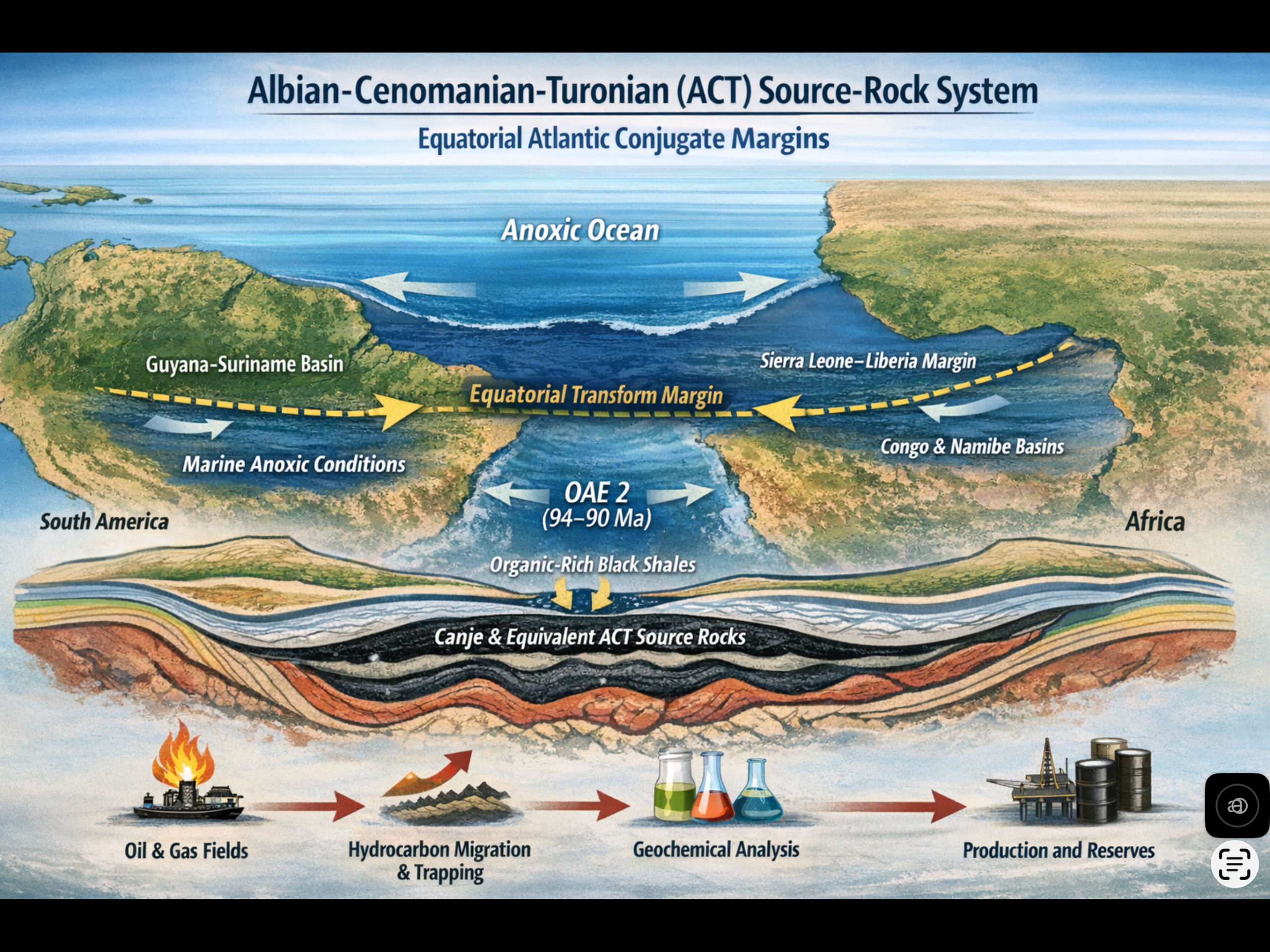
Recent deep-water discoveries in the Guyana–Suriname Basin have drawn attention to the Canje Formation, but ACT-age marine source rocks represent a broader conjugate-margin system developed along both South American and West African margins, particularly within the Equatorial Atlantic transform domain.
This review synthesizes stratigraphic framework, paleoceanographic controls, organic geochemistry, and petroleum systems evidence to evaluate the regional expression and effectiveness of ACT source rocks across
(i) the Equatorial transform margin (Guyana–Suriname, Trinidad, Ghana, Côte d’Ivoire, Togo, Benin),
(ii) the Gulf of Guinea/Niger Delta domain (Nigeria), and
(iii) the SW African volcanic–salt margin (Congo–Angola–Namibia). I propose a hierarchical classification in which ACT source rocks act as primary charge engines along the Equatorial transform margin, secondary contributors in deltaic systems where younger source rocks dominate, and subordinate systems along margins dominated by pre-salt lacustrine kitchens.
A conservative first-order mass-balance approach suggests ACT source rocks may have generated a massive amount of oil equivalent (Bboe)
Keywords: Albian–Cenomanian–Turonian (ACT); Canje Formation; La Luna; Querecual; marine source rocks; OAE-2; Equatorial Atlantic; conjugate margins; petroleum systems; biomarkers; GC/MS; basin analysis
1. Introduction
Upper Cretaceous marine source rocks of ACT age recur across broad sectors of the Atlantic realm, yet their petroleum systems role is frequently discussed basin-by-basin rather than within a conjugate-margin framework.
A central observation motivating this synthesis is that high-quality, oil-prone marine shales of ACT age recur across both South American and West African margins, but their “system dominance” varies predictably with tectonic segmentation, basin restriction, heat-flow history, sediment routing, and competition with other major source systems (notably Paleogene deltaic systems in the Niger Delta and pre-salt lacustrine systems along the SW African salt margin and SE Brazil).
This contribution responds to and is further to a very valuable commentary that the ACT story is incomplete unless framed as a pan-Atlantic petroleum system anchored in molecular organic geochemistry.
I therefore:
(i) place Canje in a conjugate-margin context;
(ii) extend the ACT framework to include classic ACT-equivalent source rocks in northern South America (notably La Luna and Querecual);
(iii) explicitly integrate GC/MS biomarker evidence that captures the “genetic signature” (ADN) of oils; and (iv) provide an annotated reference map intended as an actionable navigation tool for scientists and exploration teams.
2. Stratigraphic and paleoceanographic context
2.1 The ACT window and black-shale expression
The Late Albian through Cenomanian into Turonian–early Coniacian interval coincided with high eustatic levels, reorganized circulation in the evolving Atlantic, elevated productivity, and recurrent dysoxia/anoxia.
These conditions produced organic-rich deposits ranging from
(i) laminated black shales and condensed sections to
(ii) broader dysoxic marine mudstone packages, depending on local restriction and sedimentation rate. OAE-2 is a global reference horizon, but “OAE-like” source development can be broader than a single event bed.
2.2 Transform segmentation, restriction, and source–reservoir coupling
Transform-margin segmentation can promote partial restriction and compartmentalized subsidence, enhancing organic matter preservation and source-rock continuity.
The same structural segmentation may also control sediment routing and canyon–turbidite delivery, locally optimizing source–reservoir coupling where mature kitchens lie updip of basin-floor reservoirs.
3. Organic geochemistry: what is robust in the public domain (and what remains proprietary)
3.1 Bulk screening data (TOC, Rock-Eval, kerogen type)
Public-domain and synthesis literature supports the interpretation that many ACT packages are dominated by oil-prone marine organofacies (Type II to Type II–I) with TOC commonly in the few-percent range and locally higher.
In the Guyana Basin, book-level syntheses based on onshore Suriname and regional constraints describe Cretaceous marine source-rock end members relevant to Canje-equivalent kitchens.
In Venezuela and Colombia, the Upper Cretaceous La Luna Formation and related intervals constitute a classic marine source system with extensive geochemical documentation (chemostratigraphy, organic facies, and trace-element/redox proxies).
The Querecual Formation (Guayuta Group) in eastern Venezuela has likewise been studied as a prolific Cretaceous marine source interval.
3.2 Molecular geochemistry and correlation logic
Where biomarker and isotope constraints are available, they commonly indicate marine algal affinity, reduced terrestrial dilution, and deposition under sub-oxic to anoxic conditions during key ACT packages.
However, a persistent limitation across several frontier provinces is that decisive oil–source correlation datasets (full GC/MS panels, CSIA, quantitative extended biomarkers, kinetic datasets) are often proprietary.
This asymmetry should be treated explicitly as a reproducibility gap rather than a basis to discount ACT conjugate correlation.
3.3 Molecular biomarkers and the ACT “genetic signature” of Atlantic oils: the Bristol–Brazil school
A major advance in Atlantic margin organic geochemistry derives from the work of Marcio Rocha Mello, whose doctoral research at the University of Bristol under Geoffrey Eglinton established a biomarker-based genetic framework for correlating Brazilian oils with source rocks and defining depositional environments.
Using GC and GC/MS, Mello and co-authors demonstrated that molecular fossils in crude oils retain robust information on source-rock depositional environment, redox conditions, and organic matter input.
In a series of seminal publications, Mello et al. showed that Brazilian oils could be systematically correlated to their source rocks and palaeoenvironments using steranes, hopanes, isoprenoids, and related biomarkers.
This is directly relevant to ACT systems because it demonstrated that oils generated from Upper Cretaceous marine source rocks commonly carry consistent molecular “genetic signatures” that persist despite differences in basin architecture, burial history, or subsequent alteration.
3.4 Comparative table: biomarker signatures and oil “super-families” (ACT vs lacustrine vs mixed)
Table 1 summarizes a practical, exploration-oriented comparison of commonly used biomarker and bulk-geochemical indicators for
(i) ACT-type marine anoxic/dysoxic systems (including Canje / La Luna / Querecual equivalents), (ii) lacustrine pre-salt systems, and
(iii) mixed marine–terrigenous/delta-influenced systems.
The table is intended as a workflow guide; individual basins may show mixtures, overprints, or biodegradation effects that require multi-parameter interpretation.
| Genetic “super-family” (Mello-style) | Source-rock depositional setting | Typical bulk indicators | Key biomarker tendencies (examples) | Common complications | ACT relevance |
|---|---|---|---|---|---|
| Marine anoxic/dysoxic (ACT-type) | Outer shelf–slope marine; restricted sub-basins; OAE-like intervals | TOC commonly few % (locally higher); Type II/II–I; sulfur may be elevated in carbonate-rich settings; oils often moderate wax | Low Pr/Ph (often <1, basin dependent); marine sterane dominance; elevated C35 homohopanes in reducing settings; anoxia/salinity proxies may include gammacerane (where stratified waters); sterane/hopane patterns consistent with marine algal OM | Biodegradation can create UCM and 25-norhopanes; mixing of oil families; maturity shifts Ts/Tm, sterane isomerization | Direct (core ACT target: Canje, La Luna, Querecual, conjugate Equatorial Atlantic) |
| Lacustrine (pre-salt / rift) | Rift lakes; stratified lacustrine basins; algal-dominated OM | Type I/II; waxy oils common; sulfur generally lower than marine carbonates (not universal) | Abundant algal/lacustrine markers; distinctive sterane distributions; pristane/phytane patterns may differ from marine; lacustrine-specific suites (basin dependent) | Marine overprint in sag/drift; mixing with marine charges; strong facies variability in rift systems | Contrast (often dominates SE Brazil/SW Africa pre-salt; not ACT-driven) |
| Mixed marine–terrigenous (deltaic / marginal marine) | Delta-influenced marine; shelf to slope with higher terrestrial OM input | Type II–III mixtures; higher wax possible; gas-prone tendencies increase with Type III contribution | Increased higher-plant input proxies (e.g., oleanane where angiosperm-rich influences apply); higher Pr/Ph may reflect oxic input; sterane patterns may shift to more terrestrial signal | Strong mixing; biodegradation; maturity gradients; variable facies and sedimentation rate | Conditional (ACT may contribute basinward, but younger/deltaic sources often dominate) |
Table 1. Comparative biomarker and bulk-geochemical tendencies for major petroleum genetic families relevant to Atlantic margins. Apply as multi-parameter workflows, not single-ratio rules.
4. A hierarchical pan-Atlantic ACT framework
4.1 Class I: Equatorial transform margin — ACT as a primary charge engine
The strongest case for ACT dominance is along the Equatorial transform margin and conjugate basins: South America (Guyana–Suriname; along-strike toward Trinidad) and West Africa (Ghana, Côte d’Ivoire, and the Dahomey margin toward Togo/Benin).
In these basins, three factors reinforce one another: high-quality ACT marine source rocks, efficient deep-water reservoir delivery, and trap–seal configurations available during peak charge.
4.2 Class II: Gulf of Guinea / Niger Delta — ACT as a secondary contributor (testable hypothesis)
In the Niger Delta domain, younger deltaic petroleum systems are widely recognized as dominant; ACT marine shales may occur basinward and can plausibly contribute locally to deep-water oils where younger source influence diminishes, but should be treated as a testable hypothesis requiring oil-family discrimination and basin modeling rather than assumed dominance.
4.3 Class III: SW Africa volcanic–salt margin (Congo–Angola–Namibia) — ACT generally subordinate
In West-Central Coastal Africa and SW Africa, prolific provinces are commonly controlled by syn-rift/sag lacustrine source rocks and salt tectonics.
ACT marine sources are nevertheless documented in several basins (e.g., Cenomanian–Turonian marine clastics in the Lower Congo post-salt section), but their petroleum systems role is commonly subordinate to pre-salt kitchens and varies spatially with burial history and migration access.
5. Petroleum systems efficiency: why ACT can be exceptionally effective where dominant
- Oil-prone source: Type II/II–I marine organofacies with high expellable potential.
- Timing: generation during post-rift thermal subsidence in many settings.
- Migration efficiency: short pathways from kitchens to slope and basin-floor reservoirs where carrier systems are continuous.
- Reservoir delivery: canyon-fed turbidite systems concentrate high-quality reservoirs near charge.
- Trap–seal integrity: regional seals and large traps remaining available during peak charge.
6. Volumetrics: how much petroleum has ACT likely generated and produced?
6.1 A transparent first-order “mass-balance bracket” (methods)
Because proprietary basin models are not publicly available for many provinces, we apply a deliberately conservative first-order approach designed to bracket plausible volumes rather than assert precision.
Generated petroleum is scaled as a function of effective source area, net source thickness, TOC, kerogen quality, and transformation ratio attained within mature pods over geological time. Using working assumptions (net effective thickness 20–40 m; TOC 3–5 wt% in effective pods; transformation 10–20% averaged over effective pods) yields a pan-Atlantic ACT generated volume on the order of ~???? Bboe.
These estimates are intended to bracket plausible system-scale magnitudes rather than provide field-level precision.
6.2 Public production and resources anchors (reality checks)
- Guyana (Stabroek Block): operator-reported gross recoverable resource ~11 Bboe (block-scale). Public reporting indicates 2025 crude output of ~261.1 million barrels and cumulative production >500 million barrels by late 2024.
- Suriname offshore: public reporting notes Gran Morgu contains >750 million barrels recoverable (project-scale).
- Angola Block 17: public operator statements indicate CLOV >500 million barrels P2; Girassol base-case commonly reported ~630 million barrels recoverable.
6.3 Best-estimate ACT-attributed produced volumes (with attribution uncertainty stated)
Attribution of produced volumes to a specific source interval is inherently uncertain without published oil-family correlation datasets. Nevertheless, given the dominant Cretaceous marine charge interpretation widely applied to the Guyana–Suriname deep-water province and the biomarker-based oil–source linkage demonstrated in multiple Atlantic margin studies, a pragmatic best-estimate places cumulative ACT-sourced production across Atlantic margins at ~??? Bboe (order-of-magnitude), with the Guyana–Suriname province already contributing >??? Bbo and accelerating.
7. A practical field catalogue: major Atlantic-margin petroleum accumulations (ACT context)
Table 2 provides a concise, practical catalogue of major Atlantic-margin fields and developments, emphasizing
(i) reservoir setting (including deep-water fans where applicable),
(ii) public resource/reserve anchors where available, and
(iii) likely dominant source system (ACT-type marine vs pre-salt lacustrine vs mixed).
Values are indicative and based on publicly available statements and summaries; field-level numbers change with appraisal, redevelopment, and reporting standards.
| Margin / Basin | Field / Development (examples) | Reservoir setting | Dominant source system (working interpretation) | Public scale anchor | Geochemical notes (ACT relevance) |
|---|---|---|---|---|---|
| Guyana–Suriname (Equatorial Atlantic) | Liza / Payara / Yellowtail (Stabroek Block fairway) | Deep-water turbidite systems (fan/channel–lobe) | Marine Cretaceous system consistent with ACT/Canje | Stabroek gross recoverable resource ~11 Bboe (block scale) | ACT-type marine “genetic family”; short migration distances and strong source–reservoir coupling |
| Suriname offshore | Gran Morgu (Block 58) | Deep-water turbidite reservoirs | Marine Cretaceous system (ACT/Canje-style, working) | >700 million barrels recoverable (project scale) | Conjugate-margin ACT logic; representative oil-family data would further strengthen correlation |
| Ghana (Tano / transform margin) | Jubilee (plus TEN / Sankofa regionally) | Deep-water turbidites / channelized reservoirs | Marine Cretaceous source intervals incl. Turonian–Albian packages | Large discovered resource base (public summaries vary by definition) | Published biomarker/isotope links support ACT-consistent oil “genetics” |
| Côte d’Ivoire | Baleine | Deep-water development | Cretaceous marine source (working; basin-specific calibration ongoing) | Fast-growing development (public reporting on ramp-up) | Key test case for ACT-type vs mixed systems; biomarker panels critical |
| Nigeria (Niger Delta deep-water) | Egina / Bonga (examples) | Deep-water turbidite systems | Deltaic systems dominant; ACT contribution conditional basinward | World-class deep-water developments | Quantify ACT vs younger sources via oil-family discrimination and modeling |
| Angola (Lower Congo / Block 17) | Girassol / Dalia / Pazflor / CLOV (examples) | Deep-water turbidites; salt tectonics influences | Pre-salt lacustrine commonly dominant; post-salt marine/ACT conditional | CLOV >500 MMbbl P2; Girassol ~630 MMbbl (public summaries) | Mixed systems; ACT relevance increases where post-salt marine kitchens connect to reservoirs |
| Brazil (Santos Basin) | Lula / Búzios (examples) | Pre-salt carbonates (Aptian sag) plus post-salt plays | Pre-salt lacustrine/sag systems dominate; ACT marine drift systems present variably | Very large resource/production base (public Petrobras summaries) | Mello super-families: lacustrine vs marine anoxic/dysoxic vs mixed — crucial for Atlantic comparisons |
| Venezuela (Maracaibo; Eastern Venezuela) | Maracaibo province; Orinoco heavy oil belt province | Multiple reservoir types; biodegraded heavy oils | Upper Cretaceous marine sources: La Luna (W), Querecual (E) | Province-scale giant accumulations | Classic marine anoxic/dysoxic biomarker signatures; biodegradation alters but does not erase genetic signal |
Table 2. Practical catalogue (representative examples) of major Atlantic-margin fields/developments. Values are indicative anchors; apply field-specific technical reports for detailed numbers.
8. ACT conceptual figure (WordPress companion figure)
9. Conclusions
- ACT marine source rocks constitute a pan-Atlantic petroleum system with strongest dominance along the Equatorial transform margin and its conjugate basins.
- The Canje Formation is a key expression of this system, but ACT significance varies systematically by tectonostratigraphic setting and competition with other source systems.
- Biomarker-based genetic classification (Bristol–Brazil school) provides molecular-scale evidence (“oil ADN”) that strengthens conjugate-margin correlation of ACT-type systems.
- A conservative generated-volume bracket (~30–50 Bboe) exceeds current ACT-attributed production (~3–5 Bboe), implying substantial remaining potential.
- Closing the public-domain calibration gap (representative biomarker panels, kinetics, oil-family summaries) would strengthen reproducibility and improve exploration performance.
Annotated Reference Map
This annotated reference map is designed as a practical navigation tool: each entry specifies (i) what the source provides (data type / method), and (ii) which petroleum system element(s) it constrains (Source, Maturity/Timing, Charge/Migration, Reservoir/Delivery, Trap/Seal, Regional Framework).
Legend: Petroleum System Elements
- S = Source rock (TOC/HI/kerogen, facies, thickness, quality)
- M = Maturity/Timing (thermal history, kinetics, TR, burial)
- C = Charge/Migration (carriers, pathways, oil-family logic)
- R = Reservoir/Delivery (turbidites, fairways, routing, quality)
- T = Trap/Seal (trap styles, seals, risk, preservation)
- F = Framework (regional tectonostratigraphy, conjugate context)
A. Authoritative petroleum systems & regional frameworks
- Brownfield, M.E., & Charpentier, R.R. (2006). USGS Bulletin 2207-B.
Provides: Total petroleum system definitions and regional frameworks for West-Central Coastal Africa.
Constrains: F, S, M, C.
Link: USGS PDF - Beglinger, S.E., Doust, H., & Cloetingh, S. (2012). Marine and Petroleum Geology.
Provides: Basin evolution–petroleum system linkage for West African South Atlantic basins.
Constrains: F, S, M, C, R/T.
B. Guyana–Suriname and Equatorial Atlantic ACT context
- GeoscienceWorld/AAPG chapter (2021). “Source Rocks in the Guyana Basin: Insights from Onshore Suriname.”
Provides: Regional source-rock synthesis relevant to Canje-equivalent kitchens.
Constrains: S, F.
Link: Chapter PDF - ODP Leg 207 (Demerara Rise) Preliminary Report and datasets.
Provides: Expanded Cretaceous black shale records; OAE-related geochemical context.
Constrains: F, S (process-level).
Link: ODP PDF
C. Venezuela & northern South America ACT-equivalents: La Luna & Querecual
- Rangel, A. (2000). Organic Geochemistry.
Provides: La Luna chemostratigraphy and organic facies characterization.
Constrains: S, F.
Link: Record - Alberdi, M., López, C., & Galarraga, F. (1993). Organic Geochemistry.
Provides: Vertical OM variations for Querecual/San Antonio (Guayuta Group).
Constrains: S, F.
Link: Record - GeoscienceWorld chapter: “Source Rocks of the La Luna Formation.”
Provides: Synthesis of La Luna organic geochemistry and petroleum system relevance.
Constrains: S, F.
Link: Chapter PDF
D. Molecular “oil ADN” evidence: Cassani–Eglinton and Schiefelbein (GC/MS emphasis)
- Cassani, F., & Eglinton, G. (1986). Chemical Geology.
Provides: Venezuelan extra-heavy oils: pyrolysis/asphaltene correlation and maturity logic; method lineage for biomarker-based genetic classification.
Constrains: C, M (methodological), S (correlation logic).
Link: Record - Schiefelbein, C.F. (selected publications; Geochemical Solutions International).
Provides: Applied petroleum geochemistry workflows; GC/MS-driven oil family discrimination; “DNA fingerprint” concept in petroleum geochemical forensics.
Constrains: C, F (workflow).
Link: Publication list
E. Bristol–Brazil school: Marcio Rocha Mello
- Mello, M.R., Gaglianone, P.C., Maxwell, J.R., & Eglinton, G. (1988). Organic Geochemistry 13, 51–72.
Provides: Whole-oil biomarker datasets; depositional environment assessment; genetic grouping logic.
Constrains: S, C, F.
Link: Record - Mello, M.R., Telnaes, N., Gaglianone, P.C., et al. (1988). Organic Geochemistry 13, 31–45.
Provides: Oil–source palaeoenvironment characterization across Brazilian marginal basins.
Constrains: S, C, F. - Mello, M.R., & Maxwell, J.R. (1990). Geological Society Special Publication 50, 261–281.
Provides: Molecular genetic classification of Brazil’s sedimentary marginal basins.
Constrains: F, C, S. - Mello, M.R., Mohriak, W.U., Koutsoukos, E.A.M., & Bacoccoli, G. (1994). AAPG Memoir 60, 499–512.
Provides: Selected petroleum systems in Brazil: integrated geochemistry + tectonostratigraphy.
Constrains: F, S, M, C, R/T. - Mello, M.R., & Katz, B.J. (eds.) (2000). AAPG Memoir 73.
Provides: Petroleum Systems of South Atlantic Margins (core reference volume).
Constrains: All.
F. Public production / resource anchors (volumetric reality checks)
- ExxonMobil Guyana project overview (Stabroek ~11 Bboe): Link
- ExxonMobil (Nov 2024) “500 million barrels produced”: Link
- Reuters (Jan 2026) Guyana 2025 output (~261.1 MMbbl): Link
- Reuters (Jun 2025) Gran Morgu >700 MMbbl recoverable: Link
- TotalEnergies (Jun 2014) CLOV >500 MMbbl P2: Link
- Offshore Technology Girassol ~630 MMbbl (public summaries): Link
About the Author
Marcel Chin-A-Lien is a petroleum geoscientist and energy advisor with more than four decades of professional experience in subsurface petroleum science, petroleum systems analysis, and integrated exploration–production strategy. His work has focused on basin-scale evaluation of source rocks, charge systems, and exploration risk, combined with applied support to exploration portfolio development, asset valuation, and fiscal and contractual frameworks in both mature and frontier basins.
His professional activities include advisory roles related to exploration strategy, upstream mergers and acquisitions, production sharing contract (PSC) design, bid-round structuring, and government–industry negotiations. He has worked across Europe, Asia, Africa, and the Americas, advising national oil companies, independent operators, and international oil companies on basin evaluation and petroleum system risk.
He holds postgraduate degrees in petroleum geology, engineering geology, international business, and management, and is a Certified Petroleum Geologist (AAPG) and Chartered European Geologist (EFG). His experience integrates geoscience, engineering, and commercial perspectives, supporting system-level interpretation of petroleum provinces and exploration outcomes.