GLIAGSTRATEGIC BASIN INTELLIGENCEGLIAG-SIS-2026-GTS-001 · REVISION 38 SEPTEMBER 2026
The Sovereign Gas Conversion
Turning the Guyana–Suriname Basin’s offshore molecules into reliable power, productive industry and resilient states
A macroeconomic, energy-security, infrastructure and investment strategy for Suriname and Guyana — written for the narrow window that closes before Final Investment Decision.
GOVERNING THESIS
Gas-to-Shore is not a pipeline project. It is a sovereign conversion system. Export monetises molecules; domestic conversion can lower structural costs, protect foreign exchange, improve reliability and create productive capacity. The winning architecture is neither FLNG-only nor domestic-only, but a phased hybrid with enforceable domestic optionality and hard investment gates.
Marcel P.T. Chin-A-Lien
Drs. M.P.T. Chin-A-Lien, MBA, M.Sc., Ing. Geologist
Principal Founding Partner, Managing Partner & Chief Architect
Golden Lane Investments Advisory Group N.V. (GLIAG N.V.)
AAPG CERTIFIED PROFESSIONAL GEOLOGIST NR. 5201-1996 · EFG CHARTERED EUROPEAN GEOLOGIST NR. 92-1996 · AIEN ENERGY NEGOTIATOR, JUNE 2021
ZOETERMEER / DELFT · PARAMARIBO · PETROLEUMENERGYINSIGHTS.COM
Executive decision
THE DECISION IN ONE SENTENCE
Suriname and Guyana should use offshore gas as a flexible bridge from imported liquid-fuel dependence to a renewables-rich, reliable and industrial power system — while refusing oversized assets, open-ended sovereign guarantees and LNG-price optimism.
The strongest case for Gas-to-Shore (GtS) is not that gas will always be cheap, or that gas is “clean.” It is that a correctly sized domestic gas stream can create four simultaneous forms of value: avoided liquid-fuel imports, reliable electricity, investable industrial capacity and strategic optionality. That value is national, not merely upstream-project value.
The case is urgent but conditional. Guyana is already building its 300 MW Gas-to-Energy system. Suriname has a declared commercial field at Sloanea-1 and a selected FLNG development concept, with first gas indicated for around 2030. The architecture fixed before FID may determine for decades whether domestic gas is a contractual right or only a political aspiration.
| Question | Independent GLIAG judgment |
|---|---|
| Why? | Reliability, foreign-exchange retention and productive power can be worth more nationally than the marginal export netback. |
| How? | Hybrid FLNG plus enforceable, expandable domestic allocation; modular CCGT; grid reinforcement; measured industrial demand; methane MRV. |
| When? | Secure rights and interfaces before upstream FID; build enabling institutions now; phase capacity against verified demand through 2030–2045. |
| What not? | Do not finance on a one-week spot price, confuse resources with reserves, guarantee fictional demand, or socialise every risk. |
| Bankable? | Only as a ring-fenced system with creditworthy offtake, transparent tariffs, completion support, deliverability evidence and capped public exposure. |
1. The Socratic correction: the same gas does not have one value
A widely circulated market graphic — Henry Hub near US$2.94/MMBtu against Asian spot LNG near US$25.70/MMBtu during a single volatile week — illustrates geographic price fragmentation. It does not demonstrate the value available to Suriname or Guyana. Henry Hub is a pipeline benchmark; Asian spot LNG is a delivered market price. Between wellhead and buyer lie treatment, liquefaction, shipping, boil-off, regasification, financing, availability and basis risk.
THE NET NATIONAL VALUE TEST
Domestic value = avoided fuel + avoided outage losses + productive output + retained foreign exchange + fiscal and skills option value − full shore-system cost.
Export value = realised LNG revenue − upstream, liquefaction, shipping, financing and contractual costs.
Compare both on the same molecule, the same date, the same risk basis and the same carbon boundary. Any other comparison is advocacy, not analysis.
A second lesson follows. Permits, land rights, community consent and institutional coordination are part of project economics. A technically sound pipeline that spends years at the permitting window destroys value through delay and uncertainty. State capacity is therefore an economic asset, not administrative overhead.
2. Global gas after 2025: opportunity, competition and price discipline
The IEA reports that global gas demand reached a record in 2024, with emerging and developing economies providing more than three-quarters of the growth. Its Gas 2025 base case projects demand rising by about 380 bcm between 2024 and 2030, while roughly 300 bcm per year of new LNG export capacity — led by the United States and Qatar — enters by 2030. This supports gas demand, but it also creates formidable supply competition and potential pressure on margins.
For a new Atlantic exporter the message is double-edged. LNG markets remain deep enough to monetise major resources, but no lender should underwrite a project using crisis-era spot prices as permanent assumptions. The strategic response is portfolio value: export scale plus a domestic outlet whose economics derive partly from avoided costs rather than from global commodity prices.
| Structural force | GtS implication |
|---|---|
| LNG supply surge | Use conservative long-run netbacks and stress-test low-price years. |
| Emerging-market demand | Preserve export access without surrendering domestic optionality. |
| Renewables and batteries | Design gas as flexible firm capacity, not a permanent baseload monopoly. |
| Methane scrutiny | Measure, verify and contract emissions from reservoir to burner tip. |
| Climate-finance constraints | Package grids, storage, renewables and reform as separable eligible layers. |
| Geopolitical volatility | Value physical security and diversification, not only expected price. |
3. The basin evidence: powerful charge is not commercial gas
GLIAG’s Hidden Petroleum Arithmetic begins with the official Suriname petroleum-system indication of more than 300 billion barrels of liquids generated. That is evidence of a powerful petroleum engine — not a reserve, a discovery or a bankable cash flow. The GLIAG discipline is unchanged: generated ≠ expelled ≠ migrated ≠ trapped ≠ recoverable ≠ commercial; and petroleum revenue ≠ national wealth.
The gas-condensate case rests on differentiated evidence. Haimara-1 remains the strongest public Guyana gas-condensate calibration; Sloanea-1 has reached commercial-field declaration; SAC-1 reportedly demonstrated gas deliverability; other discoveries require careful fluid-label discipline. The southeast basin is best treated as a dual oil and gas-condensate system — but every hub must still prove volume, composition, deliverability, plateau and decline.
| Evidence | What may be said | What may not be said |
|---|---|---|
| Official basin model | A world-class generation system exists. | That the generated volume is recoverable or available to GtS. |
| Sloanea declaration | A commercial field and an FLNG concept were approved. | That domestic allocation or final public reserves are guaranteed. |
| GLIAG 2.45 Tcf P50 case | A planning scenario exists to test architecture. | That it is a PETRONAS-certified reserve. |
| Guyana GtE build | Infrastructure may transform power economics. | That final cost, tariff and utilisation are proven. |
4. Two countries, one strategic learning system
Guyana and Suriname should not copy each other mechanically. Guyana’s project is an execution laboratory; Suriname’s later timing is an option to learn. Guyana can measure actual delivered gas cost, CCGT heat rate, availability, losses, tariff pass-through, demand response and industrial uptake. Suriname can incorporate those observations before committing full-scale capital.
The 2026 IMF mission to Guyana expects Gas-to-Energy to reduce reliance on liquid-fuel generation by 2027 and to lower energy costs. That is supportive — it is not a performance certificate. The decisive proof will be operating data after commissioning.
| Dimension | Guyana | Suriname | Regional opportunity |
|---|---|---|---|
| Timing | First mover; 300 MW system. | Pre-FID Sloanea design window. | Shared operating-data protocol. |
| Supply | Associated Stabroek gas. | Commercial field; FLNG concept. | Complementary supply profiles. |
| Primary gain | Power cost and reliability. | Import substitution, firm power, industry. | Berbice–Nickerie corridor. |
| Principal risk | Cost, schedule, utilisation. | Lost option or oversized build. | Duplicate infrastructure. |
5. Captured value: transparent planning arithmetic
What follows is an indicative sovereign screen, not a feasibility study. It converts 0.10–0.15 Bcfd of domestic gas into annual energy and tests value per MMBtu. One thousand cubic feet is approximated as 1.037 MMBtu. Results are pre-tax and before financing, CAPEX, O&M, losses and upstream allocation costs.
| Input / result | Low | Central | High |
|---|---|---|---|
| Domestic gas rate | 100 MMscfd | 125 MMscfd | 150 MMscfd |
| Annual gas | 36.5 Bcf | 45.6 Bcf | 54.8 Bcf |
| Annual energy | 37.9m MMBtu | 47.3m MMBtu | 56.8m MMBtu |
| Import-equivalent value | US$8/MMBtu | US$12/MMBtu | US$16/MMBtu |
| Delivered gas cost | US$5/MMBtu | US$6/MMBtu | US$7/MMBtu |
| Gross spread | US$3/MMBtu | US$6/MMBtu | US$9/MMBtu |
| Annual gross spread | US$114m | US$284m | US$511m |
| 20-year undiscounted | US$2.27bn | US$5.68bn | US$10.22bn |
ARITHMETIC: annual MMBtu = MMscfd × 1,000 × 365 × 1.037. Annual gross spread = annual MMBtu × (import-equivalent value − delivered domestic gas cost). This spread is not NPV, not profit and not fiscal revenue. A bankable model must subtract pipeline, processing, generation, grid, financing, carbon and operating costs, and must model ramp-up, outages and decline.
INTERPRETATION
The central case explains why domestic conversion can be material without claiming that every MMBtu yields US$6 of benefit. It establishes an auditable threshold: the integrated shore system must deliver below the reliability-adjusted alternative, with adequate downside cover.
5A. The finite sovereign window: the production–depletion clock
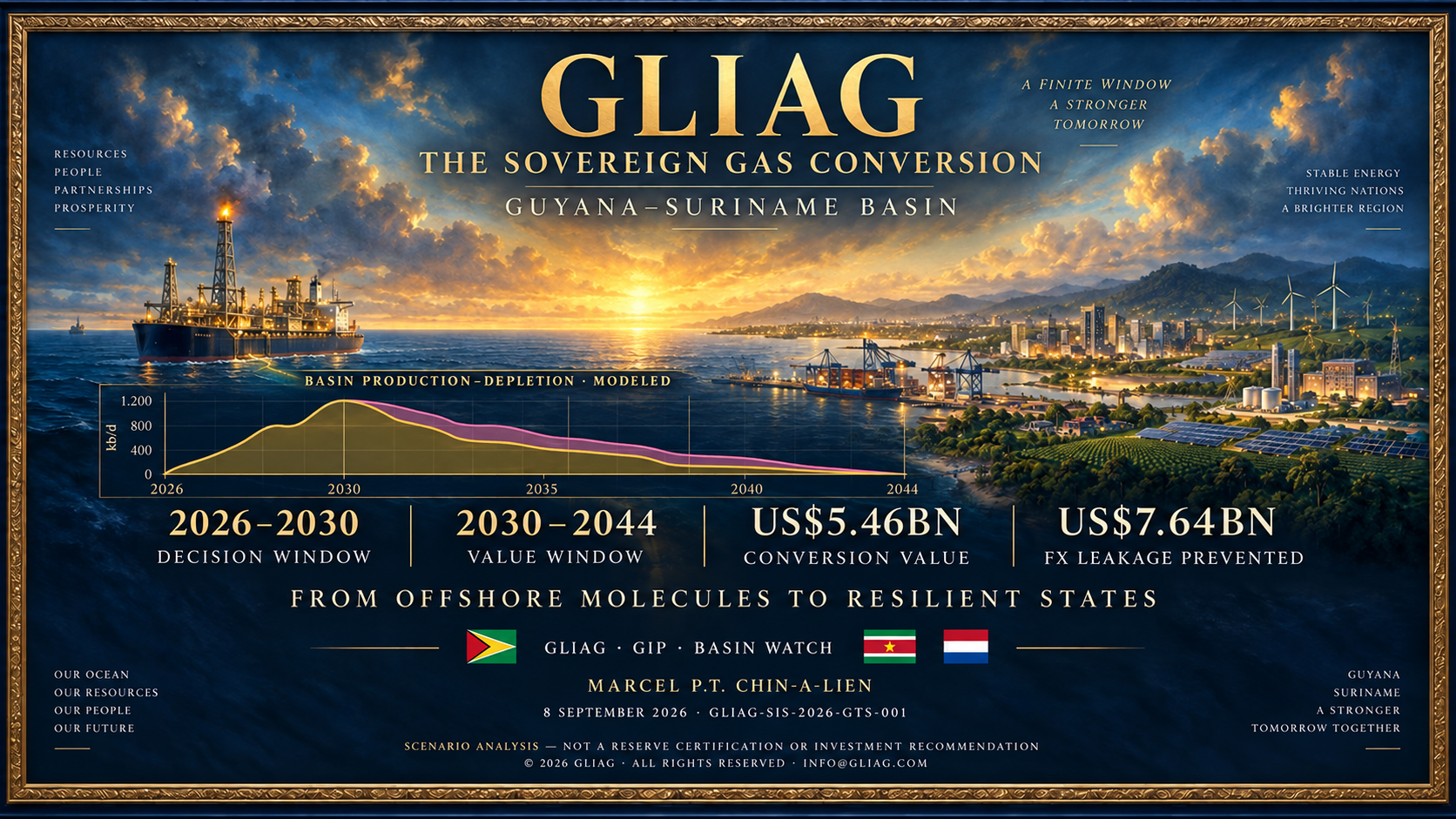
The GLIAG Intelligence Platform (GIP) treats the basin as a time system, not a static resource map. GranMorgu first oil is targeted for 2028 at 220 kb/d against more than 750 million barrels of resources. Sloanea first gas is indicated around 2030, but no public certified reserve, final plateau, domestic tranche, Field Development Plan or pipeline route yet supports a bankable forecast.
The GLIAG central planning case therefore assumes — it does not predict — 125 MMscfd for domestic conversion from 2030 through 2044, followed by 10% annual decline through 2050. It uses 876.8 Bcf, or 35.8% of a 2.45 Tcf GLIAG planning resource. This is a decision scenario. It is never a reserve booking.
| Window | Strategic task | Value at risk |
|---|---|---|
| 2026–2027 Design sovereignty | Secure domestic allocation, expansion rights, metering, tie-in and pricing before export architecture hardens. | The right to land molecules at all. |
| 2028–2030 Build readiness | Use GranMorgu-era institutional and fiscal capacity to complete appraisal, FEED, grid, route, E&S, tariffs and procurement. | First-gas delay and interface lock-out. |
| 2030–2044 Conversion plateau | Commission power first; add industry only against proven gas and offtake; reinvest cash in grids, skills, renewables and diversification. | About US$284m annual core spread and US$398m annual eligible FX leakage in the central screen. |
| 2045–2050 Depletion transition | Manage decline, replace supply, reduce gas intensity and shift firming toward storage, renewables and regional balancing. | Stranded demand and expensive replacement molecules. |
TIMING CONCLUSION
The decisive investment window is 2026–2030, before FID and long-term export contracts close optionality. The principal value-harvest window is 2030–2044. After 2045, depletion turns expansion into a replacement-supply decision. Delay is not neutral: one lost plateau year represents roughly US$284m of gross conversion value and US$398m of eligible foreign-exchange outflow in the central screen — before any wider reliability and industrial effects.
5B. Quantified sovereign value — and the discipline against double counting
The companion GLIAG GtS Sovereign Value Model is formula-driven and source-labelled. Under the central production–depletion case, domestic conversion through 2050 produces a gross fuel-switch value pool of US$5.46bn; its present value at 10% from 2026 is US$1.78bn. At a 70% eligibility factor applied to the US$12/MMBtu import-equivalent alternative, it prevents an estimated US$7.64bn of foreign-exchange leakage. A phased US$9bn midpoint system with 20% domestic procurement, wages and services creates US$1.80bn of gross domestic capital activity.
DO NOT ADD THESE NUMBERS
The US$5.46bn core spread, the US$7.64bn avoided FX outflow and the US$1.80bn domestic capital activity measure different economic channels and they overlap. They are not additive, they are not GDP and they are not project NPV. Outage reduction, new exports, tax-base effects and broad multipliers remain deliberately excluded until dispatch, input–output and bankability evidence exists.
| Quantified channel | Central result | Decision use |
|---|---|---|
| Core gross conversion value, 2030–2050 | US$5.46bn undiscounted; US$1.78bn PV at 10% from 2026 | Ceiling for integrated economic rent before remaining CAPEX, O&M, finance and fiscal allocation. |
| Eligible FX leakage avoided | US$7.64bn | Balance-of-payments resilience screen; validate against customs, fuel-mix and central-bank data. |
| Domestic capital activity | US$1.80bn on US$9bn midpoint × 20% | Procurement and skills target; not automatically value added. |
| 20-year constant-rate sensitivity | US$2.27bn low; US$5.68bn central; US$10.22bn high | Shows exposure to rate and spread; it is not a forecast. |
5C. The national development anchor and the spillover ladder
Energy independence is not autarky. It is the capacity to maintain affordable essential services and productive output when oil prices, shipping lanes, weather, grids or geopolitics fail. Gas-to-Shore should therefore anchor a diversified system — gas, hydro where viable, solar, storage, resilient grids and regional balancing — rather than create a new single-fuel dependency.
| Sequence | Conversion platform | Gate before capital |
|---|---|---|
| 1. Firm power | Efficient CCGT, grid reinforcement, loss reduction, hospitals, water and digital infrastructure. | 8,760-hour dispatch, tariff reform, creditworthy utility and resilience KPIs. |
| 2. Immediate molecules | LPG/NGL and condensate or refinery integration where composition supports recovery. | Assays, yields, market netback and logistics. |
| 3. Productive sectors | Cold chain, food processing, cement, mining services, ports, data and manufacturing heat. | Signed demand, internationally competitive delivered energy and sponsor equity. |
| 4. Chemical conversion | Ammonia/urea or methanol, only at sufficient scale and carbon performance. | Feedstock security, offtake, water, logistics, emissions and downside DSCR. |
| 5. Regional option | Berbice–Nickerie and Caribbean energy and industry links, after domestic proof. | Intergovernmental rules, redundancy value and a non-duplication test. |
6. The national value ledger
| Value channel | Measurement | Bankable evidence |
|---|---|---|
| Fuel imports | Net volumes and landed cost avoided. | Audited customs data; dispatch model; hedging. |
| Reliability | SAIDI/SAIFI, unserved energy, reserve margin. | 8,760-hour model; independent engineer. |
| Industry | Incremental output, exports, tax, jobs. | Signed offtake; competitiveness; sponsor equity. |
| Foreign exchange | USD outflows avoided and inflows retained. | Central-bank balance-of-payments cases. |
| Fiscal value | Taxes and dividends less guarantees and subsidies. | Sovereign cash waterfall and stress test. |
| Carbon | Lifecycle CO₂e and methane intensity. | MRV, LDAR, covenants and disclosure. |
| Capability | Certified skills and institutions. | Costed, time-bound, verified targets. |
7. The financeable architecture
| Layer | Purpose | Investment rule |
|---|---|---|
| 1. Molecule rights | Reservation, expansion, specification, price. | Executed before design lock-in and FID. |
| 2. Offshore interface | Metering, tie-in, redundancy, decline. | Independent certification. |
| 3. Shore backbone | Pipeline, processing, LPG/NGL if economic. | Proven base load plus modular expansion. |
| 4. Firm power | Efficient CCGT and system services. | Cost-reflective tariff; capacity valued separately. |
| 5. Grid and renewables | Networks, solar, storage, demand response. | Integrated resource plan. |
| 6. Industry | Heat, fertiliser, processing, cold chain. | Credible offtake and competitiveness. |
| 7. Regional option | Berbice–Nickerie and Caribbean links. | Only after the domestic tests pass. |
8. Lender-grade risk allocation
| Risk | Best bearer | Mitigation |
|---|---|---|
| Subsurface | Upstream sponsors | Appraisal, DST, certification, decline covenant. |
| Completion and interface | EPC and sponsors | Integrated schedule, liquidated damages, completion support. |
| Demand ramp | Utility and industrial sponsors | Modularity; credible take-or-pay only. |
| Tariff and collection | Regulator and utility | Cost trajectory, targeted support, loss reduction. |
| FX and convertibility | Shared and capped | Escrow, reserves, indexation, liquidity. |
| Political and regulatory | State | Stable rules, independent regulation, clean procurement. |
| Methane and carbon | Operators and owners | MRV, LDAR, thresholds, retrofit space. |
| Cost overrun | EPC and sponsors first | Contingency and independent engineer. |
Sovereign support must be specific, capped, time-limited and disclosed. A guarantee is a contingent liability and belongs in the fiscal-risk statement. Concessional finance can improve affordability; it cannot cure an oversized plant, a weak utility or a fictional offtake.
9. IMF and World Bank compatibility
The strategy becomes credible when it is framed around macro stability, least-cost reliability, transparent public investment and diversification — not around an entitlement to finance. Suriname’s IMF surveillance emphasises debt sustainability, fiscal discipline, governance and preparation for prospective resource revenues. Guyana’s IMF surveillance supports infrastructure-led transformation while urging strong project appraisal and absorptive-capacity management.
A development-finance-compatible package separates: commercial upstream and delivery assets; utility reform, grids and loss reduction; renewables and storage; targeted affordability; and institutional, environmental and social capacity. Different financiers can then support eligible layers without forcing every component onto one balance sheet.
THE TEST FOR PUBLIC MONEY
Public participation is justified only where a measured public benefit — reliability, access, resilience, emissions reduction or enabling infrastructure — cannot be captured commercially, and where fiscal exposure is transparent, capped and demonstrably superior to the alternatives.
10. Climate integrity and stranded-asset defence
Gas emits CO₂; methane can materially worsen lifecycle performance; long-lived assets can lock in emissions. The answer is design: displace higher-emission liquid fuels, maximise efficiency, measure methane, minimise flaring, integrate renewables and storage, allow declining gas utilisation, and avoid pay-for-unused-gas structures.
- Publish lifecycle emissions boundaries and methane intensity, not only stack emissions.
- Procure plant flexibility and part-load efficiency; value capacity separately from energy.
- Reserve interfaces for storage, renewables and future fuels; do not claim CCS before storage, liability and economics are proven.
- Stress-test carbon prices, lower utilisation, cheaper batteries and tighter finance.
11. Timeline: rights before concrete
| Period | Actions | Gate |
|---|---|---|
| 2026–2027 | Domestic framework; resource plan; demand audit; grid, route and E&S studies; delivery unit; Guyana benchmark. | No irrevocable interface without a domestic option. |
| 2027–2030 | Appraisal; FEED; tariff and utility reform; procurement; modular works; workforce. | FID only with deliverability, offtake, capped support and downside DSCR. |
| 2030–2035 | Commission base load; measure; expand renewables and storage; industrial tranches. | Expand only after reliability, utilisation, cost and methane KPIs pass. |
| 2035–2045 | Nickerie and Berbice options; higher-value conversion; depletion management. | Scale follows demonstrated competitiveness. |
12. Twelve conditions precedent to a sovereign “yes”
- Independent reserves, deliverability, composition, contaminants, plateau and decline evidence.
- Binding domestic-gas allocation plus expansion and non-extinguishment rights.
- A transparent gas-price formula tied to project economics and alternatives — not to spot headlines.
- An integrated 8,760-hour power-system model and least-cost plan.
- A verified demand ladder: existing power, then committed growth, then option loads.
- Creditworthy offtake, enforceable payment security and utility-loss reduction.
- Complete CAPEX, schedule, interface and completion-risk allocation.
- Separate reporting of project IRR, fiscal take and national ROI.
- Capped, disclosed sovereign support and a contingent-liability stress test.
- Environmental and social licence, route rights and a community benefit framework.
- Lifecycle carbon and methane MRV with enforceable thresholds.
- An open performance dashboard and annual independent review.
13. The GLIAG verdict
YES — WITH CONSTITUTIONAL DISCIPLINE
Yes to Gas-to-Shore, because firm productive energy can convert offshore success into national capability. Yes to LNG, because export scale can support economics and foreign exchange. Yes to renewables and storage, because the objective is a resilient lower-carbon system.
But no to a pipeline without enforceable molecules; no to capacity without demand; no to hidden guarantees; no to spot-price financing; and no to calling revenue wealth before it has become productive state capacity.
The historic choice is not export or development. It is whether the export architecture is designed to finance development — or allowed to foreclose it. Guyana’s first-mover experience and Suriname’s pre-FID window create a rare regional advantage: one country can generate operating evidence while the other preserves design optionality.
Exploration discovers molecules. Infrastructure delivers energy. Institutions convert energy into sovereignty.
14. From intelligence to execution: the GLIAG proposition
This essay demonstrates the integrated GLIAG decision architecture. GLIAG is the author, the strategic interpreter and the intellectual owner. The GLIAG Intelligence Platform (GIP) connects maps, source-controlled evidence, subsurface interpretation, scenarios, economics and decision gates. Basin Watch — Guyana–Suriname Basin detects developments that alter basin decisions; Basin Watch — South America tests those signals against continental markets, policy, capital and geopolitical change. The complete, sourced GLIAG essay remains the enduring analytical record.
| GLIAG product | Decision function |
|---|---|
| GLIAG | Independent strategic analysis, doctrine, integration and senior advisory. |
| GIP | Integrated basin and country decision intelligence: evidence, maps, models and auditable scenarios. |
| Basin Watch — Guyana–Suriname Basin | Daily detection of subsurface, project, regulatory and investment signals that change a GSB decision. |
| Basin Watch — South America | Daily regional intelligence on energy, policy, capital allocation, markets and geopolitical risk. |
| GLIAG flagship essays | Complete, sourced and durable analysis connecting geology to bankability and sovereign value. |
COMMERCIAL ENGAGEMENT
Decision-makers may request a decision-focused GIP briefing, institutional access to the two Basin Watch intelligence services, or commissioned GLIAG advisory work. Commercial enquiries: info@gliag.com.
15. Commercial offer: the proprietary GLIAG 5-Pack
GLIAG’s completed proprietary Gas-to-Shore bankability package is commercially available for acquisition, licensing or commissioned adaptation for Guyana, Suriname or a coordinated Guyana–Suriname Basin platform. Together the five deliverables convert the sovereign vision into an auditable investment file for governments, sponsors, DFIs, export-credit agencies, major banks, lenders and investors.
| Deliverable | Purpose |
|---|---|
| 1. Bankable GtS Terms of Reference | Defines scope, standards, interfaces, evidence requirements, workstreams, governance and acceptance criteria. |
| 2. GtS Pre-Feasibility Study for Bankability | Tests resource and deliverability, configuration, demand, location, infrastructure, E&S, institutions, economics and commercial feasibility. |
| 3. Dynamic Integrated Financial Model | Makes depletion, utilisation, tariffs, CAPEX, OPEX, financing, fiscal take, NPV, IRR, DSCR and downside sensitivities transparent and falsifiable. |
| 4. Bankable Investor & Lender Deck | Presents funding needs, returns, risks, mitigations, sovereign value and milestones to banks, DFIs, ECAs, lenders and qualified investors. |
| 5. Executive Investment Summary | Provides the decision thesis, quantified case, conditions precedent, critical risks and the immediate next action in one senior-executive view. |
The 5-Pack does not represent financing approval, a securities offering, reserve certification or lender commitment. Its purpose is to organise the evidence and decision logic required to approach bankability. Scope, licence, permitted users, jurisdictional adaptation and commercial terms are available on request.
ACQUISITION, LICENSING AND ADAPTATION
For the GLIAG GtS 5-Pack, GIP briefings, Basin Watch access or commissioned institutional adaptation, contact info@gliag.com. Pricing is intentionally not published: commercial terms are provided by confidential proposal once scope, users, licence rights, jurisdiction and intended decision purpose are established.
Annex A. GLIAG/GIP integration protocol
Permanent GIP modules
- Resource & Deliverability Confidence — public facts, GLIAG cases and certified volumes kept strictly separate.
- Domestic Gas Rights Register — reservation, pricing, interface, expansion and change control.
- 8,760-Hour Reliability Model — dispatch, renewables, storage, outages and unserved energy.
- National Value Ledger — project ROI, fiscal take and national ROI reported separately.
- GtS Bankability Gate — DSCR, downside prices, delay, overrun, demand and contingent liabilities.
- Methane & Carbon Ledger — lifecycle boundaries, MRV, LDAR and intensity trend.
- Guyana–Suriname Learning Loop — planned versus actual cost, schedule, tariff, availability and utilisation.
Basin Watch — Guyana–Suriname Basin
Maintain a recurring Sloanea / SAC-1 / Guyana GtE Sovereign Conversion Watch. Format: signal → Socratic question → verified fact → competing interpretation → GLIAG judgment → model variable changed → bankability consequence → next watch.
Basin Watch — South America
Track LNG competition, domestic reservation policy, Trinidad gas-industry utilisation, Brazil gas and power integration, interconnection, methane rules, finance terms and industrial power demand. Never reproduce spot-price graphics without benchmark definition, timestamp, delivery point and a comparability warning.
Annex B. The GLIAG research chain
- How to Monetise Sloanea? — FLNG, GtS and hybrid pathways.
- The Sloanea Gas Development Decision Framework — the hybrid sovereign framework.
- Unleashing Suriname’s Energy Potential — power, Nickerie and industry.
- Block 52: A Dual-Hydrocarbon Revolution — oil and gas architecture.
- Block 52: Over 1 Billion BOE — resource and deliverability context.
- Block 52: Upper Cretaceous Petroleum System — subsurface framework.
- The Emerging Gas-Condensate System of the GSB — the dual-basin thesis.
- Suriname’s Gas-Era PSC — contractual architecture.
INTERNAL COMPANIONS: GLIAG_GSB_Hidden_Petroleum_Arithmetic_2026 (GLIAG-GSB-2026-0819-001); TFCCWV_GSB_GAS_CONDENSATE_MASTER_V1; the GLIAG Gas-to-Shore scenario model. Internal scenarios are not certified reserves.
Annex C. Trusted primary and institutional sources
- IEA — Gas 2025: medium-term demand, supply security and LNG outlook.
- IEA — Gas 2025 Executive Summary: approximately 300 bcm/year of LNG capacity addition.
- IEA — Global Energy Review 2025: Natural Gas: 2024 demand and EMDE growth.
- IEA — LNG Emissions and Abatement: lifecycle emissions.
- IMF — Guyana 2026 Article IV mission; Guyana 2025 Article IV; Suriname 2025 Article IV.
- World Bank — Energy; Scaling Up to Phase Down.
- Staatsolie — Sloanea commercial field declaration and FLNG concept; 2025 results, FID and first-gas indications.
- GHG Protocol — Corporate Standard.
Annex D. The auditable value model
CONTROLLED ACCESS
The complete GLIAG_GtS_Sovereign_Value_Model_2026.xlsx is proprietary GLIAG intellectual property. It contains the source-labelled inputs, the annual 2030–2050 production–depletion case, the sovereign value bridge, the sensitivity table, formula checks and the evidence register. It is an auditable planning model — not a reserve certification, a feasibility study, a financing approval or an investment recommendation. Institutional requests: info@gliag.com.
Soso Lobi
Converting bare headlines into deep strategic, added value
GLIAG · Where Information Becomes Intelligence
Method and limitations
This paper integrates public primary and institutional sources with the author’s prior GLIAG research and explicitly labelled planning scenarios. Facts, interpretations and scenarios are not interchangeable. Published market price values are treated as a dated illustrative signal, never as long-run assumptions. The captured-value table is arithmetic screening — it is not an engineering estimate, a reserves report, a tariff forecast, an investment recommendation, a credit opinion or an assurance. References accessed 8 September 2026; third-party rights remain with their owners.
No advice
Nothing in this publication constitutes legal, tax, accounting, engineering, reserves, environmental, investment, securities, lending or credit advice. Financing requires full technical, environmental, social, legal, fiscal and macroeconomic due diligence, independently certified reserves and deliverability, power-system modelling, FEED or class-appropriate costs, binding offtake and lender-grade downside cases. Readers and decision-makers must obtain independent professional advice and verify all inputs before acting.
No offer or solicitation
This publication is not an offer, an invitation or a solicitation to buy, sell or subscribe for any security, interest, licence, concession or participation; it is not a fairness opinion; and it is not a promise or representation that financing, permits, supply, offtake, tariffs, returns or public benefits will be achieved.
Independence of analysis
The analysis, doctrine, judgments and scenarios are those of GLIAG and of the author alone. They were prepared independently, without instruction, sponsorship, review or approval by any government, operator, licensee, contractor, lender or investor. Where public statements by state or corporate parties are cited, they are reported as statements — not endorsed as verified fact.
Forward-looking statements
Forward-looking statements, scenarios and calculated ranges are inherently uncertain and may differ materially from actual outcomes. They depend on subsurface performance, cost, schedule, demand, prices, currency, policy, regulation, financing conditions and events beyond GLIAG’s control. GLIAG accepts no duty of care to an unauthorised recipient and, to the maximum extent permitted by applicable law, excludes liability for decisions made solely in reliance on this publication.
Copyright, database rights and AI/ML training opt-out
© 2026 Golden Lane Investments Advisory Group N.V. (GLIAG N.V.). All rights reserved. This essay, its architecture, terminology, tables, calculations, scenarios, graphics, decision logic, GIP-derived intelligence, Basin Watch synthesis and associated models constitute proprietary GLIAG intellectual property. Publication on a website permits reading only; it does not place the work in the public domain and does not grant a licence to reproduce, scrape, extract, redistribute, republish, translate, adapt, sell, populate a database with, create derivative work from, or commercially exploit the material.
Express reservation of rights under Article 4(3) of Directive (EU) 2019/790. GLIAG N.V. expressly reserves all rights in this work and in the underlying data for the purposes of text and data mining, including but not limited to the training, fine-tuning, evaluation, grounding, retrieval-augmentation or development of any artificial-intelligence or machine-learning system, model or dataset. This machine-readable reservation applies to the entire work and to every extract of it, and it applies whether access is obtained by human reading, by crawler, by API, by archive, by mirror or by any other means. No implied licence arises from public accessibility.
Trademarks. Golden Lane™, GLIAGOGRAPH™, Sovereign Molecule™, Sovereign Conversion Capacity™ and Caribbean Gas Arc™ are trademarks of Golden Lane Investments Advisory Group N.V.
Permitted and prohibited use
A reader may view the publicly published essay for personal, internal and non-commercial evaluation and may cite short, properly attributed passages where permitted by applicable law. Broader institutional circulation, classroom use, republication, systematic extraction, commercial reliance, model use or incorporation into another advisory, banking, government, investment or data product requires GLIAG’s prior written permission and, where applicable, a separate licence. Prohibited conduct includes copying or redistributing the complete essay or substantial extracts, tables, calculations, figures or model outputs; removing or obscuring the GLIAG name, author attribution, document identifier, watermark, copyright notice, source links or limitations; automated scraping, text or data mining, bulk downloading, mirroring, indexing for resale, database ingestion or AI/model training; reverse engineering or adapting the GIP analytical architecture, the GtS 5-Pack, the financial model, the assumptions structure or the decision-gate methodology; representing GLIAG material as independent verification, certified reserves, a credit opinion, a financing commitment, investment advice or the recipient’s own work; and circumventing access controls, watermarks, download restrictions, copy controls or monitoring.
The Excel model, GIP datasets, Basin Watch archives, unpublished calculations, data-room materials, commissioned studies and the GLIAG GtS 5-Pack remain confidential and proprietary when supplied under controlled access. Access does not transfer ownership. Use is limited to the named recipient, organisation, purpose, territory, term and number of users stated in the applicable written licence, non-disclosure agreement or engagement letter. Unauthorised use may result in suspension of access, takedown demands, claims for injunctive relief, damages, an account of profits and costs. All rights not expressly granted are reserved. Requests for permission, licensing or correction: info@gliag.com.
GOLDEN LANE INVESTMENTS ADVISORY GROUP N.V. — GLIAG N.V.
STRATEGIC PETROLEUM INTELLIGENCE & ADVISORY
ZOETERMEER / DELFT, THE NETHERLANDS · PARAMARIBO, SURINAME
PETROLEUMENERGYINSIGHTS.COM · INFO@GLIAG.COM
DOCUMENT GLIAG-SIS-2026-GTS-001 · REVISION 3 · 8 SEPTEMBER 2026 · © 2026 GLIAG