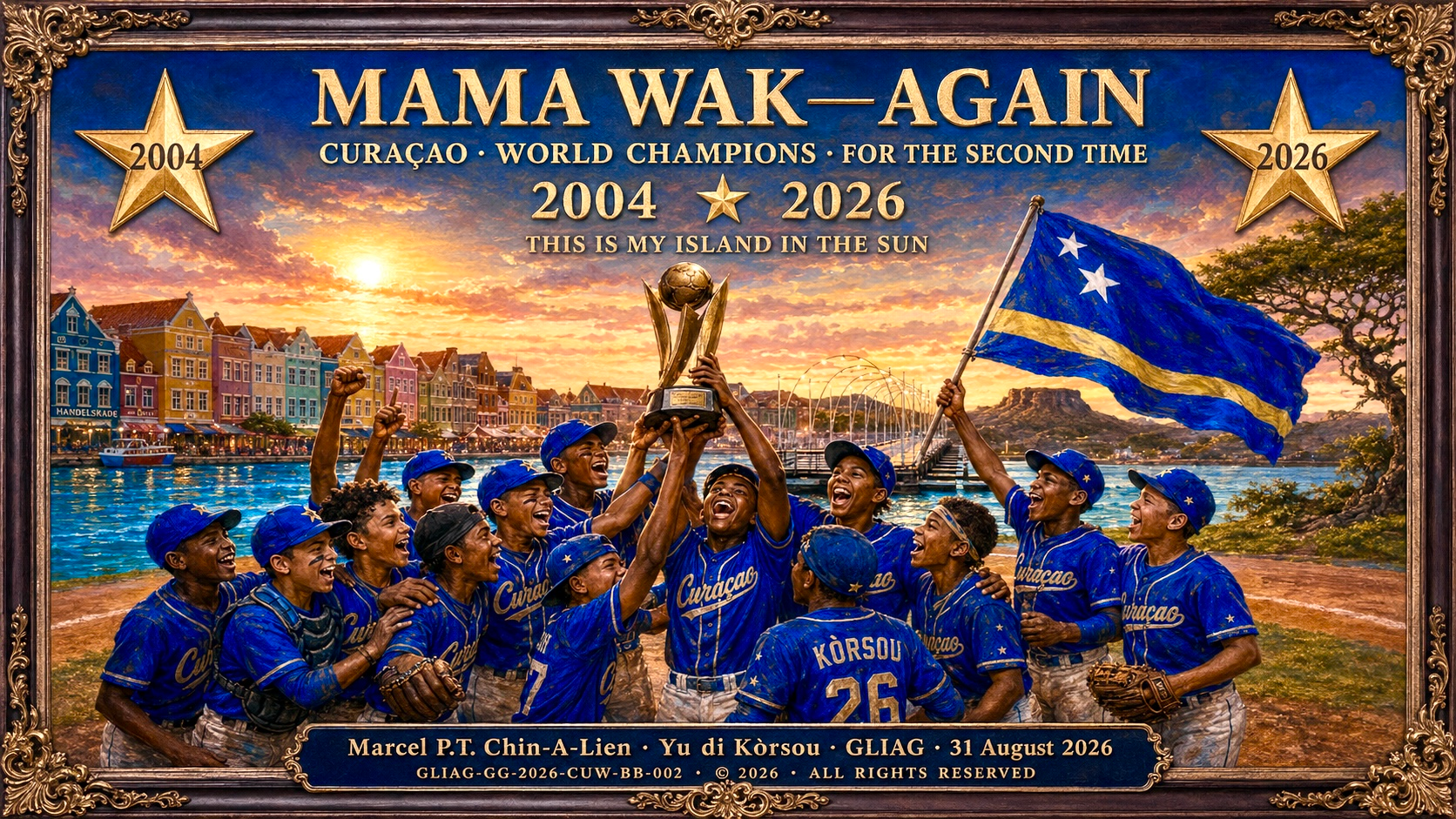
MAMA WAK—AGAIN
Curaçao: World Champions for the Second Time
From the Blue Wave to the baseball diamond, a little island continues to defy the dimensions assigned to it.
By Marcel P.T. Chin-A-Lien — Yu di Kòrsou
GLIAG | 31 August 2026 | GLIAG-ESSAY-2026-CUW-BB-001
For most of the world, it was a baseball final.
For Curaçao, it was history returning home.
On 30 August 2026, Pariba Little League of Willemstad defeated the United States champion from Henderson, Nevada, by an overwhelming 11–2. Curaçao became Little League Baseball World Champion—not for the first time, but for the second time.
2004.
2026.
Two generations. Two championships. Two golden stars above one small Caribbean island.
First Japan. Then the United States.
To reach the world final, Curaçao first defeated Japan 4–0 in the International Championship. Japan has approximately 123 million inhabitants—nearly 780 times the population of Curaçao.
Against this baseball superpower, Curaçaoan pitcher Jaymiëll Martina delivered an extraordinary performance: 12 strikeouts in 5⅔ innings, while allowing only two hits.
Twelve strikeouts. On the international stage. With a place in the world championship game at stake.
Then came Nevada—the champion of the United States. The United States has approximately 342 million inhabitants, more than 2,160 times Curaçao’s population.
Yet Curaçao did not merely survive the final. Curaçao dominated it.
Eleven runs to two.
This was not a sentimental victory awarded to a courageous little island. It was earned through pitching, hitting, discipline, intelligence, preparation and confidence.
Curaçao did not ask the world to admire its smallness. It compelled the world to respect its greatness.
A First Championship Can Be a Miracle
Curaçao first became Little League World Champion in 2004. That victory showed what was possible. The second championship, twenty-two years later, reveals something deeper.
A first title may be described as a miracle. A second title establishes a tradition.
It proves that Curaçao’s baseball achievement is not an accident of one exceptional generation. It is the product of a living sporting culture—passed from player to player, coach to coach, neighbourhood to neighbourhood and family to family.
The island has already given international baseball Hensley “Bam-Bam” Meulens, Andruw Jones, Kenley Jansen, Ozzie Albies, Jurickson Profar, Andrelton Simmons, Jonathan Schoop, Didi Gregorius, Ceddanne Rafaela and many others. Now a new generation has written its own chapter.
Curaçao can defeat anyone.
From the Blue Wave to the Baseball Diamond
Only weeks earlier, Curaçao had already forced the sporting world to reconsider what a small nation could achieve. At the 2026 FIFA World Cup, the smallest nation ever to qualify stood against Ecuador and refused to surrender.
The match ended 0–0. For Ecuador, it was a draw. For Curaçao, it was the first World Cup point in its history. The Blue Wave had arrived among the giants.
Then August came, and baseball completed the sentence football had begun.
In football, Curaçao stood among giants.
In baseball, Curaçao defeated them.
These were different achievements, in different sports and on different fields. Yet they arose from the same national character. Both proved that population is not destiny. Both demonstrated that preparation can overcome scale. Both told the children of Curaçao that the horizon is not a boundary. It is an invitation.
This Is My Island in the Sun
For me, this victory is deeply personal. Curaçao is the island where I first learned to look beyond the visible horizon. Its rocks taught me to read deep time. Its people taught me that identity can travel across oceans without disappearing.
My professional journey carried me across continents and petroleum basins. But Curaçao remained home—the point from which every journey was measured and the place to which memory always returned.
When I see these young champions lifting the trophy, I do not see only a baseball team. I see Willemstad. I see our neighbourhoods and playing fields. I see parents, grandparents, coaches and volunteers. I see those who remember 2004 standing beside children who will forever remember 2026.
This is my island in the sun.
My little island. Our twice-crowned island.
An island born from fire, carried across an ancient ocean, shaped by many peoples and languages—and forever unwilling to be defined by its dimensions.
Mama Wak—Again
After Curaçao earned its historic World Cup point against Ecuador, we said:
Mama wak. Look, Mama.
Your little island has touched the stars.
Today, we may say it again. But now there are two stars.
One for 2004. One for 2026.
The first told us it was possible. The second tells the world who we are.
Curaçao did not become larger on 30 August 2026. The map did not change. The island remained exactly where it had always been, beneath the Caribbean sun. What changed was the world’s measure of it.
Mama wak, unda nos a yega?
World Champions. Again. Nos ta bria.
Official Sources
• Little League — Official Curaçao 2026 results and championship record
• Little League — 2026 World Series coverage
• MLB — Curaçao wins the 2026 Little League World Series
• FIFA — Ecuador 0–0 Curaçao: official report and highlights
• Central Bureau of Statistics Curaçao — Population and general facts
Independent personal tribute essay. Little League, FIFA, team names and results are cited solely for factual and editorial purposes. GLIAG is not affiliated with or endorsed by the cited organisations.
© 2026 Marcel P.T. Chin-A-Lien / GLIAG. All rights reserved.