GLIAG · PETROLEUM & ENERGY INSIGHTS
G L I A G
P E T R O L E U M & E N E R G Y I N S I G H T S
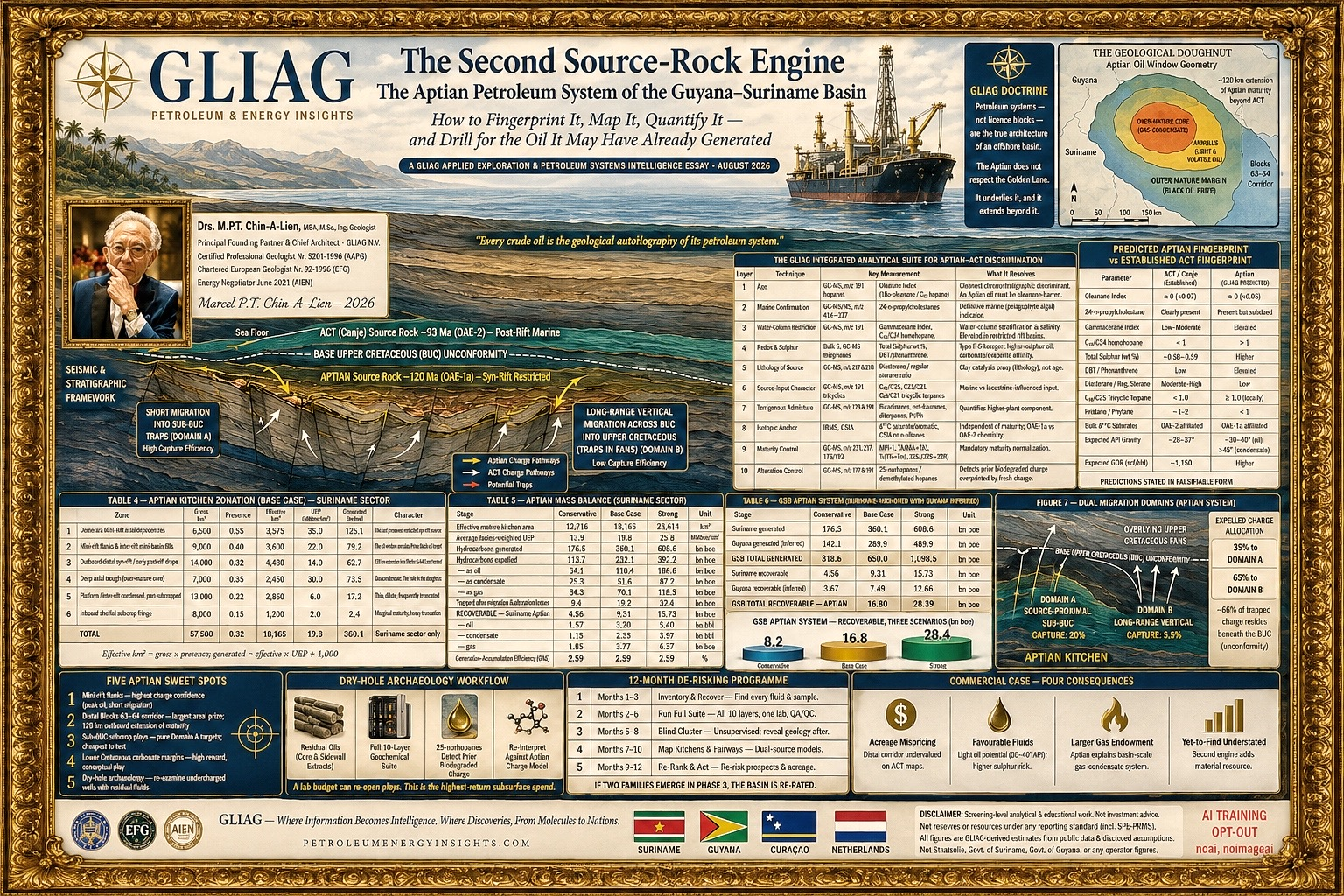
The Second Source-Rock Engine
The Aptian Petroleum System of the Guyana–Suriname Basin
How to Fingerprint It, Map It, Quantify It — and Drill for the Oil It May Have Already Generated
A GLIAG APPLIED EXPLORATION & PETROLEUM SYSTEMS INTELLIGENCE ESSAY · AUGUST 2026
Drs. M.P.T. Chin-A-Lien, MBA, M.Sc., Ing. Geologist
Principal Founding Partner & Chief Architect · GLIAG N.V.
Certified Professional Geologist Nr. 5201-1996 (AAPG) · Chartered European Geologist Nr. 92-1996 (EFG) · Energy Negotiator June 2021 (AIEN)
“Every crude oil is the geological autobiography of its petroleum system.”
The Guyana–Suriname Basin has been explored, mapped, celebrated and re-rated on the strength of a single source-rock story. That story is the Albian–Cenomanian–Turonian marine shale — the ACT system, the Canje, the Guyanese analogue of La Luna and Naparima Hill. It is a magnificent story and it is substantially correct. It has also become a monoculture.
This essay is about the other engine. Beneath the ACT, below the Base Upper Cretaceous unconformity, sits a second organic-rich interval of Aptian age — restricted, rift-controlled, patchy, deeper, hotter, and almost entirely uncalibrated. Suriname’s own national data platform lists it as proven. Almost nobody is exploring for it as a distinct system.
My argument is not that the Aptian exists. That is settled. My argument is fourfold, and each part is designed to be actionable inside an exploration department within one budget cycle:
1. Aptian-derived oil is chemically distinguishable from ACT-derived oil — but not by the tools most operators are currently running, and not by the ratio most people reach for first.
2. The Aptian kitchen is not co-located with the ACT kitchen. It is deeper, it is offset, and critically it is wider — mature across ground where the ACT is immature or absent.
3. The Aptian has already generated at basin-changing scale, and I present here a facies-weighted, maturity-partitioned mass balance that puts numbers on it.
4. Much of that charge has been drilled past, not drilled out. Several dry and sub-commercial wells in the region are, on this reading, not charge failures but fingerprint failures — wells that tested the wrong horizon above a live kitchen.
GLIAG DOCTRINE
Petroleum systems — not licence blocks — are the true architecture of an offshore basin. The Aptian does not respect the Golden Lane. It underlies it, and it extends beyond it.
Contents
1. The Critical Distinction: ACT Is Not Aptian
2. The GLIAG Proposition: Search for the Fingerprint Before Searching for Another Liza
3. How Do We Distinguish Aptian-Derived Oil? The Integrated Analytical Suite
4. What an Aptian Fingerprint Should Actually Look Like
5. Why the La Luna–Machiques Analogue Matters — and Where It Does Not
6. GeoAtlas and the Geological Doughnut: Where Should We Actually Explore?
7. The Volume Question: A Facies-Weighted Aptian Mass Balance
8. Five Aptian Sweet Spots I Would Test
9. Dry-Hole Archaeology: Re-Reading the Undercharged Wells
10. The Commercial Case: What Is Being Left Untested
11. A Twelve-Month Programme to De-Risk the Aptian
12. Two Corrections to the Received Wisdom
13. Annex A — GLIAG Source Corpus
14. Annex B — External References by Section
15. Annex C — Model Parameters and Provenance Labels
1. The Critical Distinction: ACT Is Not Aptian
Begin with a discipline problem. In a great deal of regional literature, promotional material and investor commentary, “Cretaceous source rock” in the Guyana–Suriname Basin is used as a single undifferentiated term. It is not one thing. It is at minimum four things, and Staatsolie’s own GeoAtlas says so explicitly: four candidate source intervals, of which the ACT and the Late Aptian are classified as proven, while the broader Early Cretaceous and the Jurassic remain unproven.
That single classification line does more work than most readers give it credit for. It means the operator of record for the Surinamese subsurface has already accepted that there are two demonstrated source engines in this basin, not one. Almost the entire exploration effort of the last decade has been directed at one of them.
The stratigraphic and thermal separation
The two systems differ along every axis that matters for exploration:
TABLE 1 — STRUCTURAL CONTRAST BETWEEN THE ACT AND APTIAN SOURCE SYSTEMS
| Attribute | ACT system (Canje and equivalents) | Aptian system |
| Age | Albian–Cenomanian–Turonian; acme at OAE-2 (~93 Ma) | Late Aptian; acme at OAE-1a (~120 Ma) with an Albian OAE-1b overprint (~113 Ma) |
| Tectonic setting at deposition | Established post-rift drift margin; open marine, broadly continuous drape | Late syn-rift to earliest post-rift; restricted, silled, depocentre-confined |
| Geometry | Laterally extensive sheet; up to ~550 m thick at the shelf break | Patchy, half-graben and mini-rift confined; thick where preserved, absent on paleohighs |
| Preservation risk | Low — sits above the Base Upper Cretaceous unconformity | High and mappable — truncated beneath the BUC across the platform |
| Organofacies | Type II marine, open-ocean, oxygen-minimum-zone driven | Type II to Type II-S, hypersaline to brackish-restricted, with variable terrigenous and possibly lacustrine-influenced admixture |
| Thermal state today | Oil window across the Golden Lane; gas-condensate in the deep axis | Oil window displaced outboard; over-mature across much of the inboard axis |
| Migration architecture | Short to moderate; charges Upper Cretaceous fans directly | Bifurcated — short into sub-BUC subcrop traps, or long and vertical across the unconformity |
SOURCED Ages and OAE ties from the Cogollo Group OAE-1a/1b study; Canje thickness and TOC from Oil & Gas Journal; source-interval classification from the Staatsolie GeoAtlas. The migration-architecture row is a GLIAG interpretation.
Why the difference is commercially decisive
Consider the consequence of the “thermal state” row. Because the Aptian sits several hundred metres to a kilometre deeper than the ACT, its maturity contours are displaced outboard and downdip relative to the ACT’s. Where the ACT is at peak oil generation, the Aptian is typically at or past late oil. Where the ACT is barely mature — further east and north, out on the distal margin — the Aptian is squarely in the oil window.
This is not a theoretical inference. Work under the University of Houston’s Caribbean Basins, Tectonics and Hydrocarbons Phase VIII programme by Shipper, Mann and Pepper mapped precisely this offset, and the resulting charge picture was summarised by GeoExPro in July 2026: the Aptian oil-expulsion window extends roughly 120 kilometres further east and north than the ACT window, reaching into Blocks 63 and 64, and the combined A3CT source stack reaches ultimate expulsion potentials of up to 126 MMboe/km² with TOC values to 15.8% and hydrogen indices to 730.
THE CORE SPATIAL INSIGHT
There exists a wide corridor along the distal eastern and northern margin of the basin where the ACT is not a viable charge source but the Aptian is. Any prospect in that corridor evaluated on ACT charge maps will be assessed as high-risk or uncharged. That assessment is an artefact of using the wrong source layer.
I have argued a related point in my own work on facies control. In Why Facies Matter in the Guyana–Suriname Basin’s Petroleum Systems I set out the governing relation that underlies everything quantitative in this essay:
GLIAG FACIES-WEIGHTED EXPULSION LAW
Effective UEP(x,y,t) = UEP(acme,t) × Ffacies(x,y)
Ultimate expulsion potential is never spatially uniform. The acme value — the best-developed, best-preserved organofacies — is a ceiling, not an average. Applying a ceiling value across a whole kitchen is the single most common way basin-scale volumetrics are inflated.
For the ACT I established facies-weighted tiers in that essay: distal Demerara Plateau at roughly 10 MMboe/km², slope shale belts near 2, and shelf-to-delta facies at 0.4–0.7 MMboe/km², against a world-class benchmark of 30–60+ MMboe/km². The Aptian demands the same treatment — with the added complication that its presence, not merely its quality, varies across the map.
2. The GLIAG Proposition: Search for the Fingerprint Before Searching for Another Liza
The dominant exploration mode in this basin since 2015 has been analogue-driven: find another Liza. Map another Upper Cretaceous slope fan, find another combination stratigraphic-structural trap, drill it, and rely on the Canje to have filled it.
That mode has produced spectacular results and it is not exhausted. But it is a trap-first method, and trap-first methods systematically under-discover second source systems, because a second source system does not announce itself through trap geometry. It announces itself through molecules.
I have made this argument before in Petroleum Without a Public Fingerprint: the Guyana–Suriname Basin has produced billions of barrels of discovered resource and remarkably little publicly available, standardised crude geochemistry. We have an enormous volumetric literature sitting on a very thin molecular foundation.
The GLIAG workflow, inverted
The workflow I advocate reverses the conventional sequence. It begins with the produced fluid, not the seismic amplitude:
THE GLIAG INVERTED EXPLORATION WORKFLOW
Oil → Fingerprint → Source Family → Kitchen → Migration Fairway → Prospect → Commercial Decision
Each arrow is a falsifiable step:
● Oil → Fingerprint. Run a full chromatographic and isotopic suite on every available fluid, including sub-commercial shows, cores, sidewall samples and seep extracts. Not a screening suite. A full suite.
● Fingerprint → Source Family. Cluster the oils statistically and blind. This is the step almost everyone gets wrong, and I return to it below.
● Source Family → Kitchen. Only once families exist do you ask which mapped interval, at which maturity, in which depocentre could have produced each family.
● Kitchen → Migration Fairway. Build the drainage geometry from the kitchen outward, honouring the Base Upper Cretaceous unconformity as a first-order carrier and a first-order diverter.
● Fairway → Prospect. Now, and only now, rank traps — by their position on a charge fairway that has been derived from evidence rather than assumed from analogy.
● Prospect → Commercial Decision. Attach expected fluid type, API, GOR, sulphur and contaminant risk from the fingerprint, because those determine development cost and netback long before they determine geology.
GLIAG DOCTRINE — BLIND CLUSTERING
Cluster the oils independently before imposing geological ages upon them. If you begin by labelling a sample “Canje-sourced” because it came from an Upper Cretaceous reservoir, you have destroyed the experiment before running it. Reservoir age is not source age. In a basin with vertical migration across a regional unconformity, that conflation is not a minor error — it is the error.
There is already published evidence that blind clustering yields more than one family here. Cedeño, Ohm, Escalona, Narain and de Jager, in AAPG Memoir 123, Chapter 24, analysed fifteen Suriname oils and resolved them into two distinct groups: a Group A in Cenozoic reservoirs with a distal marine, Canje-type signature, and a Group B in Upper Cretaceous reservoirs carrying a proximal marine plus terrestrial signature that they attributed to a Late Jurassic to Early Cretaceous source. That Group B attribution is, in my reading, the most important underexploited sentence in the basin’s public geochemical literature.
Independently, Brunings and Narain’s New Opportunities in the Shallow Offshore of Suriname presented cluster analysis by A. Motta based on fourteen facies-dependent biomarker ratios, and reported two results that bear directly on this essay: the GVN-1 oil carries high gammacerane, pointing by African conjugate-margin analogy to a Late Aptian to Early Albian source; and GLO-1 indicates a second active source facies at the Aptian/Albian level.
Two independent studies, using different sample sets and different methods, both find a second family that is not the Canje. That is not noise. That is a system.
3. How Do We Distinguish Aptian-Derived Oil? The Integrated Analytical Suite
Before presenting the diagnostic table, one negative instruction, because it saves money and prevents false confidence.
GLIAG DOCTRINE — THE STERANE WARNING
Do not classify Aptian versus ACT using C27/C28/C29 steranes alone. The regular sterane ternary is a coarse organofacies indicator with enormous overlap between marine source rocks of different ages. Both the Aptian and the ACT in this basin are marine Type II. They will plot in overlapping fields. A sterane ternary will not separate them, and a decision made on one will be a coin toss dressed as science.
What does work is a layered suite in which no single parameter is asked to carry the classification. Each layer answers a different question.
TABLE 2 — THE GLIAG INTEGRATED ANALYTICAL SUITE FOR APTIAN–ACT DISCRIMINATION
| Layer | Technique | Key measurement | What it resolves |
| 1. Age | GC-MS, m/z 191 hopanes | Oleanane index (18α-oleanane / C30 hopane) | Cleanest chronostratigraphic discriminant. <0.07 for Berriasian–Cenomanian sources; ~0.15 Turonian–Maastrichtian; >0.2 Paleogene+. An Aptian oil must be oleanane-barren. |
| 2. Marine confirmation | GC-MS/MS, m/z 414→217 | 24-n-propylcholestanes | Definitive marine (pelagophyte algal) indicator. Robustly present in open-marine ACT oils; low but non-zero in restricted Aptian oils. The ratio contrast is the discriminator. |
| 3. Water-column restriction | GC-MS, m/z 191 | Gammacerane index, C35/C34 homohopane ratio | Water-column stratification and salinity. Elevated gammacerane is the expected Aptian signature in a silled, restricted rift basin. Supported by the GVN-1 result. |
| 4. Redox & sulphur | Bulk S, GC-MS thiophenes | Total sulphur wt %, DBT/phenanthrene | Type II-S kerogen generates earlier and yields higher-sulphur, often carbonate- or evaporite-associated crude. |
| 5. Lithology of source | GC-MS, m/z 217 & 218 | Diasterane / regular sterane ratio | Clay catalysis proxy. Low diasteranes = clay-poor carbonate/evaporitic source; high = clay-rich siliciclastic. Separates lithology, not age. |
| 6. Source-input character | GC-MS, m/z 191 tricyclics | C26/C25, C23/C21, C24/C21 tricyclic terpanes | Marine vs lacustrine-influenced input. Congo–Angola calibration: C26/C25 above ~1.0–1.1 indicates lacustrine affinity. |
| 7. Terrigenous admixture | GC-MS, m/z 123 & 191 | Bicadinanes, ent-kauranes, diterpanes, Pr/Ph | Quantifies higher-plant component. Where Cedeño et al.’s Group B “terrestrial” signature lives. |
| 8. Isotopic anchor | IRMS bulk and CSIA | δ¹³C saturate/aromatic; CSIA on n-alkanes and isoprenoids | Independent of maturity effects. OAE-1a chemistry should leave a systematically distinct bulk δ¹³C from OAE-2. Strongest single evidence for mixed charge. |
| 9. Maturity control | GC-MS, m/z 231, 217, 178/192 | MPI-1, TA/(MA+TA), Ts/(Ts+Tm), 22S/(22S+22R) | Mandatory. Without maturity normalisation, a highly mature ACT oil and a moderately mature Aptian oil can mimic each other. |
| 10. Alteration control | GC-MS, m/z 177 & 191 | 25-norhopanes / demethylated hopanes | Detects a prior biodegraded charge overprinted by fresh charge — the classic multi-phase filling signature. |
SOURCED Oleanane index thresholds after Moldowan et al. (1994); gammacerane–GVN-1 tie from Brunings & Narain (2023); tricyclic lacustrine thresholds from Congo–Angola conjugate calibration.
GLIAG The ten-layer architecture, the ordering, and the assignment of each layer to a specific decision are GLIAG’s.
Layer 10 deserves special emphasis because it is the layer I have personally worked on. In Tracing Ancient Oils: De-methylated Hopanes in the Maracaibo Basin I described how 25-norhopanes preserve the record of an earlier, biodegraded charge even after a later, fresh charge has re-filled the trap. That work builds on the integrated basin study I co-authored with Talukdar and Gallango, Generation and migration of hydrocarbons in the Maracaibo Basin, Venezuela, published in Organic Geochemistry in 1986.
The relevance to the Aptian is direct. If the Aptian charged traps early — and being deeper and hotter, it must have charged earlier than the ACT — then in any trap that received both, the Aptian contribution is the older, more altered, more easily masked component. It will be the minority signal in a mixed fluid. Layers 8 and 10 are the ones that will find it.
GLIAG DOCTRINE — THE FINGERPRINT LIBRARY
The GSB needs a full chromatographic fingerprint library: a standardised, quality-controlled, cross-operator geochemical database covering every fluid ever recovered in the basin, including the failures. No individual operator can build it and every operator would benefit. This is a national-data-custodian function, and it is the highest-return, lowest-cost subsurface investment available to Suriname and Guyana today.
4. What an Aptian Fingerprint Should Actually Look Like
The following table is a predicted fingerprint. It is a hypothesis stated in falsifiable form: this is what GLIAG expects an Aptian-sourced GSB crude to look like, set against the well-established ACT signature. Publishing it as a prediction is the point. If the first properly clustered Aptian family in this basin does not look like this, the model is wrong and should be revised in public.
TABLE 3 — PREDICTED APTIAN FINGERPRINT VERSUS ESTABLISHED ACT FINGERPRINT
| Parameter | ACT / Canje (established) | Aptian (GLIAG predicted) | Discriminating power |
| Oleanane index | ≈ 0 (<0.07) | ≈ 0 (<0.05) | Low between the two — but both must be near zero. Any oleanane rules out both and indicates a younger source. |
| 24-n-propylcholestane (m/z 414) | Clearly present; open-marine values | Present but subdued | High when used as a ratio to C30 hopane |
| Gammacerane index | Low to moderate | Elevated | High — the primary restriction signal |
| C35/C34 homohopane | Moderate (<1) | >1, anoxic-hypersaline | High |
| Total sulphur | ~0.58–0.59 wt % (Liza-type) | Higher; Type II-S affinity | Moderate to high; cheap to measure |
| DBT / phenanthrene | Low — siliciclastic marine shale | Elevated — carbonate/evaporitic affinity | High; classic Hughes lithology plot |
| Diasterane / regular sterane | Moderate to high (clay-rich shale) | Low (carbonate/evaporitic, clay-poor) | High for lithology; must not be read as age |
| C26/C25 tricyclic terpane | <1.0, marine | Approaching or exceeding 1.0 where rift-lake influence exists | High, and underused in this basin |
| Pristane/phytane | ~1–2, marine dysoxic | <1, strongly reducing / hypersaline | Moderate; standard and cheap |
| Bicadinanes, diterpanes | Low | Variable, locally elevated near rift-margin clastic input | Moderate; explains Group B “terrestrial” note |
| Bulk δ¹³C saturates | OAE-2 affiliated | Systematically distinct, OAE-1a affiliated | High — independent of biomarkers |
| Expected API gravity | ~28–37° offshore | Bimodal: ~30–40° in the annulus; condensate >45° over the deep axis | Commercially decisive |
| Expected GOR | ~1,150 scf/bbl (Liza-type) | Higher; markedly higher over the over-mature core | Commercially decisive |
SOURCED Liza fluid properties and Suriname API ranges from Staatsolie and public operator disclosures.
GLIAG PREDICTED The entire Aptian column is a stated, falsifiable GLIAG hypothesis, not a measurement.
THE SINGLE STRONGEST AVAILABLE DISCRIMINANT
Work on the Río Negro–La Luna petroleum system in western Venezuela found that oleananes and diahopanes are detectable in Machiques Formation (Aptian–Albian) extracts but absent in La Luna-sourced oils. If that contrast transfers to the GSB conjugate setting — and the depositional analogy is strong — then a trace but non-zero oleanane and diahopane signal in a GSB crude, in a sample otherwise free of younger-source indicators, becomes a positive Aptian marker rather than a contaminant to be discarded.
I stress the practical implication, because it is a laboratory instruction, not a philosophical one: do not integrate trace oleanane peaks to zero. In routine commercial processing, a peak below a threshold is often reported as “not detected.” In this basin, that threshold may be discarding the diagnostic signal.
5. Why the La Luna–Machiques Analogue Matters — and Where It Does Not
The Maracaibo Basin is the correct analogue for the GSB Aptian question, and I say that with some personal investment: my published geochemical work is on Maracaibo crudes, both the 1986 integrated basin study with Talukdar and Gallango and the earlier 1985 VI Venezuelan Geological Congress paper on the characteristics of marine crudes in the Maracaibo Basin.
Where the analogue holds
Maracaibo contains exactly the stratigraphic pairing the GSB has: a world-famous Cenomanian–Turonian marine source (La Luna, OAE-2) sitting above an older, less-celebrated Aptian–Albian restricted source (the Machiques Member of the Cogollo Group, OAE-1a, with the Piché Member at OAE-1b). The Machiques carries TOC of roughly 1–5.5% as a Type II kerogen in a restricted, carbonate-dominated setting. It is not a world-beater by La Luna standards, and for decades it was treated as volumetrically irrelevant. It is not irrelevant. Alberdi-Genolet and Tocco demonstrated in Chemical Geology in 1999 that Machiques and La Luna are separable on trace-metal and organic-geochemical grounds, and the Río Negro work shows the two systems charged different accumulations.
The structural parallel is close: an older, restricted, carbonate-influenced Aptian source, deeper and hotter, partially overshadowed by a younger, cleaner, more prolific marine source above it. In Maracaibo the older system was recognised only after the younger one had been thoroughly exploited. That is the exact position the GSB occupies today.
Where the analogue breaks
Three ways, and each matters for how the analogue should be used:
5. Maracaibo’s Aptian is carbonate-platform restricted; the GSB’s is rift-basin restricted. The Cogollo Group formed in an intra-shelf silled basin on a carbonate platform. The GSB Aptian formed in syn-rift half-grabens on a young, opening Atlantic margin. Both are restricted, but the GSB setting permits a genuinely lacustrine to brackish rift-lake component that Maracaibo does not have. This is why Layer 6 in the analytical suite — the tricyclic terpanes calibrated on the Congo–Angola conjugate rather than on Venezuela — is essential.
6. Maracaibo is a foreland-inverted basin; the GSB is a passive margin. Maracaibo’s Aptian was buried, then uplifted and tectonically reorganised, giving late generation and complex remigration. The GSB Aptian has been on a monotonic subsidence curve for 120 million years. Its generation history is simpler, its critical moment older, and its charge more likely to have been emplaced early and then either preserved or lost — not recycled.
7. Maracaibo’s traps are structural and shallow; the GSB’s are stratigraphic and deep. The Machiques charge in Maracaibo had short migration into obvious structures. The GSB Aptian charge faces the Base Upper Cretaceous unconformity as an intervening surface. This is the single largest difference and it drives the entire risking framework in Section 7.
GLIAG DOCTRINE — ANALOGUE DISCIPLINE
Use Maracaibo to calibrate what the molecules should look like. Use the West African conjugate — Congo, Kwanza, and the Aptian-to-Barremian systems that generate roughly 90 per cent of offshore Brazil’s oil — to calibrate how much a rift-restricted Aptian can generate. Using one analogue for both questions is how basins get mis-ranked.
On the West African and Brazilian side, the calibration numbers are worth stating plainly, because they establish that rift-restricted Aptian sources are not marginal players. In northeastern Brazil, the Anhangá well encountered Aptian–Albian evaporitic marine shales with maximum TOC of 21%. The Codó Formation, a Late Aptian closed-lacustrine unit, covers roughly 170,000 km² with TOC of 0.6–8.2% and an average of 2.6%. The Pendência Formation in the Potiguar Basin reaches TOC of 7% with hydrogen indices to 950. And the summary judgement from the Brazilian literature is unambiguous: the Aptian–Barremian petroleum system is responsible for approximately 90 per cent of the oil generated offshore Brazil.
The GSB’s conjugate is the same age, the same tectonic phase, and the same restricted-basin physiography. The prior probability that its Aptian is volumetrically trivial is low.
6. GeoAtlas and the Geological Doughnut: Where Should We Actually Explore?
Everything to this point has been about recognition. This section is about location.
The Staatsolie GeoAtlas is the most important public exploration dataset in the basin, and it is under-read. It supplies mapped source-interval distribution, facies, thickness and maturity, and — crucially — it does so for the Late Aptian as a separately classified proven interval, not merely as part of an undifferentiated Cretaceous.
Read the Aptian maturity map alongside the ACT maturity map and a specific geometry emerges. I call it the geological doughnut, and it is the organising spatial concept of this essay.
THE GEOLOGICAL DOUGHNUT
Centre (the hole): the deep axial trough. The Aptian here is past the oil window. It is generating and has generated gas and condensate. Drilling here for black oil is a category error.
Middle annulus: the Aptian is at late oil to early condensate maturity. Expect volatile oil and light oil, high API, high GOR. Commercially excellent if the trap and seal hold pressure.
Outer mature margin: the Aptian is at peak to mid oil maturity while the ACT above it is immature or absent. Expect conventional black oil. This is the exploration prize, and it is the least drilled ground in the basin.
GLIAG DOCTRINE — THE KITCHEN RULE
Do not drill the hottest part of the Aptian kitchen for oil. The instinct to move toward the thickest, richest, deepest source is correct for gas and wrong for oil. For Aptian oil, drill the annulus and the outer margin, and accept that the best oil ground sits over source that is thinner and less impressive on a TOC map.
Why the doughnut is displaced relative to the ACT doughnut
The ACT system has its own concentric maturity geometry, which I set out in SE Golden Lane: A Dual Oil and Gas-Condensate Basinand in The Emerging Gas-Condensate System of the Guyana–Suriname Basin. The Aptian doughnut is the same shape, expanded and shifted outboard, for two independent reasons operating in the same direction:
8. Depth offset. The Aptian is stratigraphically deeper everywhere, so every maturity contour migrates basinward relative to its ACT equivalent.
9. Crustal and heat-flow offset. The Demerara Plateau sits on thickened, partly volcanic crust; the basin margin thins outboard. The Aptian’s greater age means it has integrated more of the margin’s thermal history, including the elevated syn-rift and early post-rift heat flow that the ACT never experienced.
Reference points for the oil window from the published work: Nibbelink and co-authors placed the oil window at roughly 2,500–3,000 m below mudline and the gas window at 4,000–4,800 m, and noted a major contribution from a Lower Albian OAE-1 source — a further independent signal that the pre-ACT interval is charging accumulations. The GeoExPro summary of the CBTH work places the A3CT kitchen only about 40 km north of the Golden Lane, and the Aptian expulsion window a further 120 km east and north.
THE TARGETING CONSEQUENCE, STATED BLUNTLY
The Aptian outer mature margin — the black-oil annulus — lies substantially outboard and east of the established Golden Lane, in acreage that has been screened using ACT charge maps and consequently down-ranked. The ground with the best Aptian oil prospectivity is, on current industry maps, some of the worst-ranked ground in the basin.
7. The Volume Question: A Facies-Weighted Aptian Mass Balance
Numbers now. This section presents an original GLIAG screening mass balance for the Aptian system. It follows the same methodology I applied to the ACT in Quantifying Hydrocarbon Generation in the Guyana–Suriname Basin, Estimating Petroleum Generation in the Guyana–Suriname Basin and, in its fullest form, SE Golden Lane.
PROVENANCE STATEMENT — READ BEFORE USING ANY NUMBER BELOW
Every figure in this section is a GLIAG-derived screening estimate built from publicly available parameters. These are not reserves, not contingent resources, and not Staatsolie, operator or government figures. They are a transparent, reproducible order-of-magnitude framework whose purpose is to establish whether the Aptian merits dedicated exploration capital. The input parameters and the calculation code are disclosed in Annex C so that any reader can substitute their own assumptions.
7.1 Why the Aptian requires a presence factor the ACT does not
The ACT is a laterally continuous drape. Its mass balance can be built as area × facies-weighted UEP, because within the mapped extent the source is essentially always there.
The Aptian cannot be treated this way. It is depocentre-confined at deposition and truncated beneath the Base Upper Cretaceous unconformity afterwards. Within the gross thermally mature footprint, the source is present in some places and absent in others. The model therefore introduces a second spatial term:
GLIAG APTIAN KITCHEN EQUATION
Effective kitchen area = Gross thermally-mature area × Ppresence(x,y)
Generated volume = Effective kitchen area × UEP(acme) × Ffacies(x,y)
Where Ppresence combines depositional occurrence in a rift depocentre with survival beneath the BUC unconformity. Omitting Ppresence overstates the Aptian by a factor of roughly three.
7.2 The zonation
Six zones, each carrying a gross mature area, a presence factor, a facies-weighted UEP, an expulsion efficiency and a phase split. Base case shown; conservative and strong cases scale presence and UEP by 0.70 and 1.30 respectively.
TABLE 4 — BASE CASE: APTIAN KITCHEN ZONATION, SURINAME OFFSHORE AND DEMERARA SECTOR
| Zone | Gross mature km² | Ppresence | Effective km² | UEP MMboe/km² | Generated bn boe | Character |
| Demerara Mini-Rift axial depocentres | 6,500 | 0.55 | 3,575 | 35.0 | 125.1 | Thickest preserved restricted syn-rift source |
| Mini-rift flanks & inter-rift mini-basin fills | 9,000 | 0.40 | 3,600 | 22.0 | 79.2 | The oil-window annulus. Prime black-oil target |
| Outboard distal syn-rift / early post-rift drape | 14,000 | 0.32 | 4,480 | 14.0 | 62.7 | The 120 km extension into Blocks 63–64. Least tested |
| Deep axial trough (over-mature core) | 7,000 | 0.35 | 2,450 | 30.0 | 73.5 | Gas-condensate. The hole in the doughnut |
| Platform / inter-rift condensed, part-subcropped | 13,000 | 0.22 | 2,860 | 6.0 | 17.2 | Thin, dilute, frequently truncated |
| Inboard shelfal subcrop fringe | 8,000 | 0.15 | 1,200 | 2.0 | 2.4 | Marginal maturity, heavy truncation |
| TOTAL | 57,500 | 0.32 | 18,165 | 19.8 | 360.1 | Suriname sector only |
SOURCED Zone areas, presence factors and facies-weighted UEP values are GLIAG estimates informed by the GeoAtlas source-interval and maturity mapping and by the CBTH-derived A3CT combined UEP ceiling of 126 MMboe/km². The Aptian is assigned a maximum single-interval UEP of 35 MMboe/km², well below the combined A3CT ceiling. Conversion: Effective km² = gross × presence; generated = effective × UEP ÷ 1,000.
7.3 The dual-migration-domain loss cascade
Here the Aptian model departs most sharply from the ACT model, and this is the original contribution of this section.
ACT charge migrates a short to moderate distance into overlying Upper Cretaceous fans. One plumbing system, one efficiency. Aptian charge does not have one plumbing system. It has two, with radically different capture efficiency, and they must be modelled separately:
● Domain A — the source-proximal sub-BUC domain. Charge migrates a short distance updip into subcrop traps directly beneath the unconformity, into Lower Cretaceous carbonate and paleohigh margins, and onto rift-flank highs. Short path, few intervening carriers, source-proximal architecture. High capture: 20% of expelled charge retained.
● Domain B — the long-range vertical domain. Charge must cross the BUC and climb into Upper Cretaceous fan systems. Long path, many intervening carriers and seals, extensive lateral diversion along the unconformity surface. Low capture: 5.5% of expelled charge retained.
I assign 35% of expelled Aptian charge to Domain A and 65% to Domain B. Post-trapping downgrades of 8% for biodegradation — lower than for the ACT, because Aptian charge is emplaced deeper and largely below the pasteurisation threshold — and 15% for inaccessible or sub-resolution accumulations. Recovery factors of 35% oil, 55% condensate, 65% gas.
THE MOST EXPLORATION-RELEVANT SINGLE OUTPUT OF THIS MODEL
Roughly 66% of all trapped Aptian charge sits in the source-proximal sub-BUC domain — beneath the unconformity, not above it. Yet essentially all Aptian-charge exploration to date has been incidental, occurring in Upper Cretaceous targets drilled for ACT charge. The industry has been fishing in the low-efficiency domain by accident while the high-efficiency domain went untested by design.
7.4 Results
TABLE 5 — APTIAN MASS BALANCE: SURINAME SECTOR, THREE SCENARIOS
| Stage | Conservative | Base | Strong | Unit |
| Effective mature kitchen area | 12,716 | 18,165 | 23,614 | km² |
| Average facies-weighted UEP | 13.9 | 19.8 | 25.8 | MMboe/km² |
| Hydrocarbons generated | 176.5 | 360.1 | 608.6 | bn boe |
| Hydrocarbons expelled | 113.7 | 232.1 | 392.2 | bn boe |
| — as oil | 54.1 | 110.4 | 186.6 | bn boe |
| — as condensate | 25.3 | 51.6 | 87.2 | bn boe |
| — as gas | 34.3 | 70.1 | 118.5 | bn boe |
| Trapped after migration & alteration losses | 9.4 | 19.2 | 32.4 | bn boe |
| RECOVERABLE — Suriname Aptian | 4.56 | 9.31 | 15.73 | bn boe |
| — oil | 1.57 | 3.20 | 5.40 | bn bbl |
| — condensate | 1.15 | 2.35 | 3.97 | bn bbl |
| — gas | 1.85 | 3.77 | 6.37 | bn boe |
| Generation–accumulation efficiency (GAE) | 2.59 | 2.59 | 2.59 | % |
GLIAG-DERIVED Screening estimate. Full parameter set and code in Annex C.
Two observations on these numbers.
First, on the expelled figures. My base case of 232 bn boe expelled sits somewhat above the 150 bn boe I had previously carried as an indicative base-case Aptian expellable capacity, and my conservative case of 114 bn boe sits above the 50 bn boe conservative figure. The difference is entirely attributable to the zonation: assigning 35 MMboe/km² to the rift-axis depocentres, rather than a spatially uniform 5–15 MMboe/km², concentrates a large fraction of the generation into a small, high-quality area. That is the correct physical treatment, and it is the same asymmetry that makes the ACT’s Demerara Plateau facies dominate the ACT budget. Readers who prefer the flatter assumption should use the conservative column.
Second, on GAE. The generation–accumulation efficiency of 2.59% is invariant across scenarios because it is set by the plumbing, not by the charge volume. That invariance is itself the finding. For comparison, my SE Golden Lane ACT model returned 73.3 bn boe recoverable from 1,455 bn boe generated — a GAE of approximately 5.0%. The Aptian’s GAE is therefore roughly half the ACT’s, which is exactly what the longer, more obstructed migration path predicts. The Aptian is a less efficient system per barrel generated. It is not a less important one, because it generates against a large area at high specific yield.
7.5 Extending to Guyana
The Guyanese deepwater has essentially no public Aptian penetration, so a Guyana figure must be an inference and must be labelled as one. The basis is that the Guyana margin shares the same Jurassic rifted passive-margin architecture and the same Aptian restricted-source acme, developed on somewhat thinner, non-volcanic crust rather than the thickened Demerara Plateau. I apply an area ratio of 1.15 for the prospective Aptian footprint and a confidence discount of 0.70 to reflect the absence of direct calibration.
TABLE 6 — BASIN-WIDE GSB APTIAN SYSTEM, SURINAME-ANCHORED WITH GUYANA INFERRED
| Stage | Conservative | Base | Strong | Unit |
| Suriname generated | 176.5 | 360.1 | 608.6 | bn boe |
| Guyana generated (inferred) | 142.1 | 289.9 | 489.9 | bn boe |
| GSB TOTAL GENERATED | 318.6 | 650.0 | 1,098.5 | bn boe |
| Suriname recoverable | 4.56 | 9.31 | 15.73 | bn boe |
| Guyana recoverable (inferred) | 3.67 | 7.49 | 12.66 | bn boe |
| GSB TOTAL RECOVERABLE — APTIAN | 8.23 | 16.80 | 28.39 | bn boe |
GLIAG-DERIVED Guyana figures carry a 0.70 confidence discount and are explicitly an inference from Suriname-anchored parameters, not an independent Guyana model.
To place these against something recognisable: the base case of roughly 17 bn boe of recoverable Aptian-sourced hydrocarbons across the GSB is of the same order as the entire discovered Stabroek Block resource base to date, and it sits alongside — not inside — the ACT endowment. Staatsolie’s own published position is that the Type II system in Suriname has generated over 300 billion barrels of liquids, much of it within the last five million years, with 6.8 bn boe estimated in undrilled open acreage. My Aptian base case does not compete with those figures. It adds to them a second, separately sourced, separately located inventory.
GSB APTIAN SYSTEM — RECOVERABLE, THREE SCENARIOS (bn boe)
| Conservative | Base Case | Strong |
| 8.2 | 16.8 | 28.4 |
8. Five Aptian Sweet Spots I Would Test
Concept without addresses is not intelligence. These are the five plays I would fund, in the order I would fund them.
A. Flanks of the Demerara Mini-Rift system
Thesis. The mini-rift axes hold the thickest and richest preserved Aptian, but the axes themselves are in or past late oil. The flanks — the rotated fault blocks, footwall crests and hangingwall drape closures on the margins of each half-graben — sit over source at peak oil and are directly source-proximal.
Why it ranks first. It is the only play where Domain A capture efficiency, peak-oil maturity, and short migration all coincide. On my model, Domain A retains roughly four times the fraction of expelled charge that Domain B does. This is the highest charge-confidence Aptian play in the basin.
Trap. Rotated fault-block crests and syn-rift wedge pinchouts; drape closures over footwall highs.
Expected fluid. Black to volatile oil, 30–40° API, elevated sulphur relative to Liza, elevated gammacerane, low diasteranes.
Key risk. Reservoir. Syn-rift clastic quality on a young Atlantic margin is uncertain and must be the primary de-risking focus, not charge.
B. The distal eastern corridor — Blocks 63 and 64
Thesis. This is the 120 km outboard extension where the Aptian is mature and the ACT is not. Block 63 covers about 5,422 km² and Block 64 about 6,256 km². The CBTH Phase VIII work identifies precisely this ground as where Aptian maturity extends beyond the ACT, and notes that it offers an explanation for Keskesi East-1.
Why it ranks second. Largest areal prize in the model — 62.7 bn boe generated in the base case from this zone alone — and the cleanest test of the central hypothesis. If this corridor is charged, the Aptian system is confirmed as basin-scale.
Trap. Distal slope and basin-floor fan systems; stratigraphic pinchouts against the distal margin.
Expected fluid. Light oil to volatile oil grading to condensate toward the axis.
Key risk. Trap definition at distal margin positions, and the depth of the objective. Notably, oil in Aptian sands has already been recovered at Keskesi-1, which materially reduces the “Aptian reservoir does not exist” objection.
C. Sub-Base-Upper-Cretaceous unconformity subcrop plays
Thesis. The BUC unconformity is treated in most GSB workflows as a seismic marker and a stratigraphic boundary. In an Aptian-charge framework it is a play. Wherever a porous Lower Cretaceous or Aptian unit subcrops beneath the unconformity and is sealed by transgressive Upper Cretaceous shale, a trap exists that is charged directly from below by short migration.
Why it ranks third. This is the purest expression of the Domain A insight, and it is genuinely untested as a deliberate objective. It is also cheap to map from existing 3D — the subcrop geometry is already in every operator’s interpretation, simply not coloured as a play.
Trap. Subcrop truncation against the unconformity, sealed by overlying transgressive shale.
Expected fluid. Black oil, potentially with an older biodegraded component detectable as 25-norhopanes.
Key risk. Top seal integrity across the unconformity surface, and reservoir preservation through subaerial exposure.
D. Lower Cretaceous carbonate and paleohigh margins
Thesis. A restricted, hypersaline to brackish Aptian basin implies carbonate build-ups and evaporitic margins on the intervening highs. On the Brazilian conjugate this is not speculative — it is where the pre-salt and Aptian-associated reservoirs sit. Carbonate margins flanking Aptian depocentres are both a reservoir target and a corroborating indicator of the restricted depositional model.
Why it ranks fourth. Very high reward if present; genuinely uncertain whether the necessary platform geometry developed on this margin. This is a conceptual play requiring seismic facies work before it can be ranked properly.
Expected fluid. Higher-sulphur oil; low diasterane ratios; elevated DBT/phenanthrene. The molecular signature of this play is the most distinctive of the five.
E. “Undercharged” Upper Cretaceous prospects above deeper Aptian kitchens
Thesis. Discussed in full in the next section. Prospects that were mapped correctly, had valid traps and reservoir, and came in with sub-commercial or residual columns are candidates for re-evaluation — not as charge failures, but as wells that tested a horizon above a live Aptian kitchen with an intervening diverting surface.
Why it ranks fifth despite being conceptually most interesting. It requires access to well data that is largely proprietary. Its value is highest to the operators who already hold that data, which makes it the play most likely to be executed and least likely to be published.
TABLE 7 — COMPARATIVE RANKING OF THE FIVE APTIAN PLAYS
| Play | Charge confidence | Reservoir risk | Trap risk | Areal scale | Cost to de-risk | GLIAG rank |
| A. Mini-rift flanks | High | High | Moderate | Moderate | Moderate | 1 |
| B. Blocks 63–64 corridor | Moderate–High | Moderate | Moderate–High | Very high | High | 2 |
| C. Sub-BUC subcrop | Very high | Moderate | Moderate | Moderate | Very low | 3 |
| D. Lower Cretaceous carbonate margins | Moderate | Very high | Low | Low–Moderate | Moderate | 4 |
| E. Dry-hole archaeology | Moderate | Known | Known | Variable | Very low | 5 |
GLIAG-DERIVED Ranking integrates charge confidence, cost to de-risk and areal scale. Plays C and E are ranked below A and B on absolute prize but are by a wide margin the cheapest to test — for an operator with existing 3D and well data they are near-zero-marginal-cost work.
9. Dry-Hole Archaeology: Re-Reading the Undercharged Wells
This section makes the most commercially consequential claim in the essay, so I state its logic carefully and its limits honestly.
A well that finds good reservoir, a valid trap, an intact seal, and only residual or sub-commercial hydrocarbon is normally recorded as a charge failure. The post-well analysis asks whether the kitchen was mature, whether the migration path connected, whether the timing worked. Almost always, that analysis is conducted against the ACT charge model, because that is the model the well was drilled on.
Now consider the same well in an Aptian framework. Three things change:
10. Timing. The Aptian is deeper and older. It reached generation earlier than the ACT — potentially tens of millions of years earlier. A trap that formed late may have missed the Aptian pulse entirely while catching the ACT pulse, or vice versa. Timing failure against one source is not timing failure against the other.
11. Geography. The Aptian kitchen is offset outboard. A well sitting off the edge of the ACT drainage area may sit squarely within the Aptian drainage area, or the reverse.
12. Plumbing. The BUC unconformity diverts. Aptian charge arriving at the unconformity may travel a long way laterally along it before finding a vertical route. The well may be structurally correct and hydraulically bypassed.
GLIAG DOCTRINE — DRY-HOLE ARCHAEOLOGY
Re-examine every sub-commercial and residual-column well in the basin against the Aptian charge model, using the residual fluid itself as the evidence. In several cases these may not be charge failures. They may be fingerprint failures — wells that recovered a real Aptian signal and reported it as a disappointing ACT result because nobody ran the analysis that would have distinguished them.
The specific test, and why it is nearly free
The test does not require new drilling. It requires re-analysis of material that already exists in operator and national archives:
● Residual oil in core and sidewall samples. Extract and run the full ten-layer suite from Table 2. A residual column is a geochemical sample, not a failure.
● Mud-gas and cuttings gas isotopes. δ¹³C on methane through butane distinguishes charge sources independently of any liquid recovery.
● Fluid inclusions in reservoir cements. Palaeo-charge that has since leaked is still recorded in inclusions. This is the technique that detects an accumulation that existed and was lost — a completely different exploration message from an accumulation that never formed.
● 25-norhopane screening. The presence of demethylated hopanes proves an earlier charge episode that was biodegraded. In a trap with a later fresh charge, this is direct evidence of multi-phase filling from more than one source pulse.
The last point connects to the framework I have developed as Dual-Phase Charge, Column and Seal within the Guyana–Suriname Petroleum System Architecture™, and to the mosaic-of-overlapping-systems doctrine: this basin is not one system with one fill history. It is a mosaic of overlapping charge episodes from stacked sources at different maturities, arriving at different times, into traps with different histories. A single-source interpretation of a mixed accumulation will always look like a partial failure of that single source, because it is being asked to explain a fluid it did not entirely produce.
COST ASYMMETRY
A deepwater exploration well in this basin costs on the order of tens of millions of dollars. A comprehensive ten-layer geochemical re-analysis of every archived residual fluid, core extract and gas sample in the Surinamese national dataset costs a small fraction of one such well. If that programme reclassifies even one previously abandoned play fairway as charged, the return on the analytical spend is measured in orders of magnitude. This is the highest expected-value subsurface expenditure available in the basin today.
10. The Commercial Case: What Is Being Left Untested
Translate the geology into a commercial statement.
The resource statement
On the GLIAG base case, the Aptian system across the Guyana–Suriname Basin has generated on the order of 650 bn boe and holds an estimated 16.8 bn boe recoverable, of which roughly 40% is oil, 25% condensate and 35% gas. Approximately two-thirds of the trapped volume sits beneath the Base Upper Cretaceous unconformity, in a structural domain that current exploration practice does not target.
The four commercial consequences
1. Acreage mispricing. Blocks in the distal eastern and northern corridor have been valued on ACT charge maps that show them as marginal or uncharged. If the Aptian is live there — and the CBTH mapping and the Keskesi observations both point that way — those blocks are mispriced. This is the clearest arbitrage in the basin, and it has a limited shelf life, because it closes the moment the first well confirms Aptian charge in the corridor.
2. Fluid-type risk is different, and mostly favourable. Aptian-sourced fluids in the outer annulus should be light oil at 30–40° API — comparable to or better than the 28–37° API range Staatsolie reports for offshore Suriname, and far better than the 16–18° API onshore crude or the 14–17° API, 650–1,100 cP Tambaredjo oil I described in Tambaredjo Revisited. The offsetting risk is sulphur: a Type II-S restricted source implies higher sulphur than Liza’s 0.58–0.59%, with consequences for refining netback and for any FPSO metallurgy specification. This must be screened before development sanction, not after.
3. The gas-condensate implication is larger than the oil implication in volume terms. The over-mature Aptian core generates 70 bn boe as gas in the base case. That is the deeper structural cause of the gas-condensate province I described in The Emerging Gas-Condensate System and in SE Golden Lane. An Aptian framework does not merely add oil targets; it provides a mechanism for the basin’s gas endowment that a single-ACT model has to strain to explain. For Suriname’s gas monetisation strategy, that mechanism matters: it implies the gas resource is larger and more areally distributed than an ACT-only model predicts.
4. Yet-to-find is understated. My work on yet-to-find volumes in Estimating Yet-to-Find Oil and Gas in Suriname Blocks 58 and 52 and the SE Golden Lane analysis was built on the ACT system. Staatsolie’s published estimate of 6.8 bn boe in undrilled open acreage is, as far as can be determined from public statements, similarly ACT-anchored. If the Aptian contributes even the conservative case, the basin’s true yet-to-find is materially larger than the number currently used in national planning and in investor materials.
GLIAG POSITION
The commercial risk in the Guyana–Suriname Basin is no longer principally that the next well is dry. It is that the basin’s second source engine is being systematically excluded from resource estimates, acreage valuations, national planning assumptions and investor disclosures — not because it has been tested and found wanting, but because it has never been given its own analytical programme.
11. A Twelve-Month Programme to De-Risk the Aptian
Everything above resolves into a work programme that can be executed within one budget cycle, largely with existing data.
TABLE 8 — GLIAG TWELVE-MONTH APTIAN DE-RISKING PROGRAMME
| Phase | Timing | Activity | Decision gate |
| 1 | Months 1–3 | Inventory and recover. Catalogue every fluid, core extract, sidewall sample, residual show and archived gas sample in the basin, public and proprietary. Identify what physically still exists. | Is there enough surviving material for a statistically meaningful cluster analysis? Target: ≥40 samples. |
| 2 | Months 2–6 | Run the full suite. All ten layers of Table 2 on every recovered sample, single laboratory, single protocol, full quality control. Explicitly instruct the laboratory to report trace oleanane and diahopane rather than truncating to zero. | Analytical completeness and inter-run reproducibility. |
| 3 | Months 5–8 | Blind cluster. Multivariate clustering on facies-dependent ratios with reservoir age and well name withheld from the analyst. Only after clusters are fixed, reveal geological context. | Critical gate. Do two or more genetically distinct families emerge? Does a second family match the Table 3 prediction? |
| 4 | Months 7–10 | Map the kitchens. Build separate Aptian and ACT maturity, expulsion and drainage models. Treat the BUC as a carrier and diverter. Map the sub-BUC subcrop play from existing 3D. | Does the Aptian drainage geometry connect the second family to a mapped kitchen? |
| 5 | Months 9–12 | Re-rank and act. Re-risk the full prospect inventory against a dual-source charge model. Re-examine sub-commercial wells. Screen acreage in the distal corridor for mispricing. | Investment gate. Does any prospect move materially up the ranking on Aptian charge alone? Is any acreage acquisition justified before the market reprices? |
Phases 1 through 3 are analytical, cost a small fraction of a single deepwater well, and answer the central question definitively. Phase 3 is the gate that matters. If blind clustering returns a single family, the Aptian hypothesis is falsified for the sampled population and the programme stops there, cheaply. If it returns two, the basin has been re-rated on a laboratory budget.
Follow the facies and the expulsion pulses — ignore the adjectives. They model. GLIAG models, mass-balances, and proves.
12. Two Corrections to the Received Wisdom
Intellectual honesty requires that I record two points where I have had to correct working assumptions during the preparation of this essay, including one of my own.
12.1 The m/z 259 correction
CORRECTION
m/z 259 is not a marine-versus-lacustrine discriminator. The m/z 259 fragment ion is the characteristic ion of diasteranes — rearranged steranes. Its diagnostic value is as a proxy for clay content and source lithology: clay-rich siliciclastic sources catalyse sterane rearrangement and yield high diasterane ratios; clay-poor carbonate and evaporitic sources yield low ones. This is confirmed in the AAPG Wiki biomarker treatment, the Norwegian offshore directorate’s geochemical guidance (which specifies the 259.2426 ion), and the Tasmanian Mineral Resources organic geochemistry protocols.
This correction does not weaken the Aptian case. It strengthens and sharpens it. Diasteranes remain highly diagnostic here — they are Layer 5 of Table 2 — but for the right reason. If the GSB Aptian is a restricted, carbonate-and-evaporite-influenced rift facies and the ACT is an open-marine clay-rich shale, then diasterane ratios should separate them cleanly as a lithology contrast. Deployed as a lithology proxy, m/z 259 does real work. Deployed as a marine-versus-lacustrine proxy, it would have produced a wrong answer with high confidence, which is the worst kind of answer. The correct tool for the marine-versus-lacustrine question is the tricyclic terpane suite of Layer 6, calibrated on the Congo–Angola conjugate, supported by 24-n-propylcholestanes at m/z 414 in Layer 2.
12.2 Two attributions I could not verify
UNVERIFIED ATTRIBUTIONS — RECORDED, NOT ASSERTED
Two specific attributions carried in my working notes could not be substantiated against any locatable primary or secondary source during preparation of this essay:
● A body of work attributed to Gary Cole concerning m/z 259 discrimination, a hybrid Aptian–Neocomian source family, and a 2.5–3‰ carbon-isotope separation between GSB source families.
● A body of work attributed to Andrew Dyson concerning Lower Cretaceous rift basins offshore eastern Suriname.
I record these as unverified rather than removing them silently, because the underlying propositions may well be sound and may exist in conference material, proprietary reports or presentations that are not publicly indexed. Any reader holding those references is invited to supply them. In the meantime, every load-bearing claim in this essay rests instead on sources I have been able to verify and cite directly: the CBTH Phase VIII programme, the GeoExPro synthesis of the Shipper, Mann and Pepper mapping, Brunings and Narain with Motta’s cluster analysis, Cedeño and co-authors in AAPG Memoir 123, and the Staatsolie GeoAtlas.
Similarly, the figure of roughly 30–40 MMboe/km² sometimes quoted for outboard Late Aptian ultimate expulsion potential could not be located verbatim in a primary source. I have therefore built the model on a maximum single-interval Aptian UEP of 35 MMboe/km² as an explicitly GLIAG-assigned value, bounded above by the verified combined A3CT ceiling of 126 MMboe/km², and I have labelled it as such in Table 4 and Annex C.
GLIAG SOURCE DISCIPLINE
Every number in a GLIAG document is labelled as one of three things: a direct source value, a conversion of a source value, or a GLIAG-derived estimate. Provenance before visual precision. A defensible order of magnitude with a clean audit trail is worth more than a precise number no one can trace.
Closing: The Basin Below the Basin
The Guyana–Suriname Basin is the most successful frontier exploration story of the last two decades, and it has been told almost entirely as a single-source story. The Canje charged the fans; the fans made the fields; the fields made the province.
Underneath that story there is a second one that has not been told, because nobody has run the analysis that would tell it. The Aptian is present. It is mapped. Suriname’s own national data platform calls it proven. It is thermally mature across a footprint that is wider than the ACT’s and displaced outboard from it. Its molecules are distinguishable from ACT molecules by a suite of measurements that already exist and cost a rounding error against a well. On a transparent, conservative, facies-weighted mass balance it has generated hundreds of billions of barrels of oil equivalent, and it plausibly holds an accumulated inventory of the same order as everything discovered in the basin so far.
And roughly two-thirds of that inventory sits beneath the unconformity that the industry has treated as the floor of the play.
The question this essay poses to every operator, every national oil company and every ministry in the basin is therefore not geological. It is procedural, and it has an uncomfortable answer:
THE QUESTION
How much commercial value is being left untested beneath the established Golden Lane, not because the industry looked and found nothing, but because the industry has been searching for another Liza when it should have been searching for a fingerprint?
The Aptian will not announce itself with a 30-metre net pay column in a bright amplitude. It will announce itself as an anomalous gammacerane index in an archived residual oil from a well that everybody has already written off.
Someone should go and look.
Annex A — GLIAG Source Corpus
Prior GLIAG work drawn on in this essay, published at petroleumenergyinsights.com, with the sections each informs.
ANNEX A.1 — GLIAG ESSAYS CITED
| Publication | Contribution to this essay | Sections |
| Why Facies Matter in the Guyana–Suriname Basin’s Petroleum Systems | The facies-weighted expulsion law; UEP tier framework | 1, 7 |
| SE Golden Lane: A Dual Oil and Gas-Condensate Basin | The zone-by-zone mass-balance cascade replicated here for the Aptian; ACT GAE benchmark of ~5% | 6, 7, 10 |
| Quantifying Hydrocarbon Generation in the Guyana–Suriname Basin | Generation-volumetrics methodology | 7 |
| Estimating Petroleum Generation in the Guyana–Suriname Basin | UEP and expulsion-efficiency framework | 7 |
| A World-Class ACT Marine Source-Rock System | The ACT baseline against which the Aptian is contrasted | 1, 4 |
| ACT Petroleum Systems: Insights from the Guyana–Suriname Basin | ACT organofacies and kitchen geometry | 1, 6 |
| The Emerging Gas-Condensate System of the Guyana–Suriname Basin | Phase-partitioned maturity geometry; the gas-condensate province | 6, 10 |
| Petroleum Without a Public Fingerprint | The geochemical-data deficit; the case for a basin fingerprint library | 2, 3 |
| Tracing Ancient Oils: De-methylated Hopanes in the Maracaibo Basin | 25-norhopanes as evidence of prior biodegraded charge; multi-phase filling | 3, 9 |
| Petroleum System Efficiency: Myths and Realities in Exploration | Generation–accumulation efficiency as a diagnostic | 7 |
| Estimating Yet-to-Find Oil and Gas in Suriname Blocks 58 and 52 | YTF framework shown here to be ACT-anchored and therefore understated | 10 |
| Tambaredjo Revisited: Anatomy of a World-Class Shallow Onshore Petroleum System | Onshore fluid-quality benchmark for API and viscosity comparison | 10 |
Peer-reviewed publications by the author
● Talukdar, S., Gallango, O. & Chin-A-Lien, M. (1986). Generation and migration of hydrocarbons in the Maracaibo Basin, Venezuela: An integrated basin study. Organic Geochemistry, 10(1–3), 261–279. doi:10.1016/0146-6380(86)90028-8
● Gallango, O., Talukdar, S. & Chin-A-Lien, M. (1985). Características de los crudos marinos en la Cuenca de Maracaibo. VI Congreso Geológico Venezolano.
Annex B — External References by Section
ANNEX B.1 — VERIFIED EXTERNAL SOURCES
| Source | What it establishes | Sections |
| Staatsolie GeoAtlas | Four source intervals; ACT and Late Aptian classified proven; Early Cretaceous and Jurassic unproven | 1, 6, 7 |
| Staatsolie — Geology | Type II system generated >300 bn bbl liquids; offshore 28–37° API, onshore 16–18°; 6.8 bn boe in undrilled open acreage | 4, 7, 10 |
| GeoExPro — Spatial Variation in Charge Risk along the Guyana–Suriname Margin (Pyteraf, July 2026) | Aptian oil-expulsion window extends ~120 km east/north into Blocks 63–64; A3CT kitchen ~40 km north of the Golden Lane; TOC to 15.8%, HI to 730; combined A3CT UEP to 126 MMboe/km² | 1, 6, 7, 8 |
| CBTH Phase VIII Proposal — Shipper, Mann & Pepper, University of Houston | Aptian maturity extends farther east and north than ACT; offers an explanation for Keskesi East-1 | 1, 6, 8, 12 |
| Brunings & Narain (2023), New Opportunities in the Shallow Offshore of Suriname — incl. A. Motta (2022) cluster analysis | Clustering on 14 facies-dependent biomarker ratios; GVN-1 high gammacerane → Late Aptian–Early Albian source; GLO-1 → second active source facies at Aptian/Albian | 2, 3, 4, 12 |
| Cedeño, Ohm, Escalona, Narain & de Jager (2021), AAPG Memoir 123, Ch. 24 | 15 Suriname oils resolve into Group A (Cenozoic reservoirs, distal marine, Canje) and Group B (Upper Cretaceous reservoirs, proximal marine + terrestrial, Late Jurassic–Early Cretaceous source) | 2, 3, 12 |
| Nibbelink et al. (2019), AAPG GTW Suriname | Oil window 2,500–3,000 m BML; gas window 4,000–4,800 m; major contribution from Lower Albian OAE-1 source | 6 |
| Oil & Gas Journal — Suriname deepwater blocks | Canje Formation up to 550 m thick; TOC 4–7% at shelf break, to 30% in deepwater; equivalent to La Luna and Naparima Hill | 1 |
| ODP Leg 207 Initial Reports, Demerara Rise | Site 1257 TOC to 15.8% (avg 6.6%); Site 1258 avg 7.9%, range 0.1–28.3%; Type II. Note: Cenomanian–Santonian (ACT), not Aptian | 1 |
| Cogollo Group and OAE-1a/1b, Maracaibo Basin | Machiques Member TOC 1–5.5%, Type II, OAE-1a ~120 Ma; Piché Member OAE-1b ~113 Ma; La Luna OAE-2 ~93 Ma | 1, 5 |
| The La Luna–Río Negro Petroleum System | Oleananes and diahopanes detected in Machiques extracts but absent in La Luna-sourced oils — the key Aptian-vs-ACT analogue discriminant | 4, 5 |
| Alberdi-Genolet, M. & Tocco, R. (1999). Chemical Geology, 160, 19–38 | Trace-metal and organic-geochemical separation of Machiques (Aptian–Albian) from La Luna | 5 |
| Integrated Geochemical Interpretation — age-diagnostic biomarkers | Oleanane index thresholds after Moldowan et al. (1994): <0.07 Berriasian–Cenomanian; to 0.15 Turonian–Maastrichtian; >0.2 Paleogene+ | 3, 4 |
| GeoExPro — southern MSGBC / Keskesi reference | Oil recovered in Aptian sands at Keskesi-1 | 8 |
| Staatsolie / Suriname Energy Ops 2023 presentation | Demerara AOI: ~195 bn stb oil expelled; >40 bn bbl mean unrisked recoverable. Block areas: 63 ≈ 5,422 km²; 64 ≈ 6,256 km²; 58 ≈ 5,833 km²; 52 ≈ 4,750 km²; 66 ≈ 3,390 km² | 7, 8 |
Annex C — Model Parameters and Provenance Labels
The mass balance in Section 7 is fully specified by the parameters below. Substituting any of them reproduces a different, equally traceable result.
ANNEX C.1 — ZONE PARAMETERS (BASE CASE)
| Zone | Gross km² | Ppres | UEP | Expulsion eff. | Phase split (oil/cond/gas) |
| Demerara Mini-Rift axial depocentres | 6,500 | 0.55 | 35.0 | 0.70 | 0.55 / 0.22 / 0.23 |
| Mini-rift flanks & inter-rift mini-basins | 9,000 | 0.40 | 22.0 | 0.60 | 0.62 / 0.20 / 0.18 |
| Outboard distal syn-rift drape (63–64) | 14,000 | 0.32 | 14.0 | 0.55 | 0.58 / 0.22 / 0.20 |
| Deep axial trough (over-mature core) | 7,000 | 0.35 | 30.0 | 0.75 | 0.15 / 0.25 / 0.60 |
| Platform / inter-rift condensed | 13,000 | 0.22 | 6.0 | 0.40 | 0.60 / 0.20 / 0.20 |
| Inboard shelfal subcrop fringe | 8,000 | 0.15 | 2.0 | 0.20 | 0.75 / 0.15 / 0.10 |
Scenario multipliers. Conservative: presence × 0.70, UEP × 0.70. Base: × 1.00. Strong: presence × 1.30, UEP × 1.30 (presence capped at 0.85).
Migration domains. Source-proximal sub-BUC domain: 35% of expelled charge, trap efficiency 0.20. Long-range vertical domain: 65% of expelled charge, trap efficiency 0.055.
Post-trapping downgrades. Biodegradation loss 8% (lower than ACT: Aptian charge is emplaced largely below the pasteurisation threshold). Inaccessible or sub-resolution 15%.
Recovery factors. Oil 0.35; condensate 0.55; gas 0.65.
Guyana inference. Prospective-area ratio 1.15 relative to Suriname; confidence discount 0.70. The confidence discount is an epistemic adjustment for the absence of direct Aptian penetration in the Guyanese deepwater, not a geological factor.
Provenance labelling used throughout. SOURCED — value taken directly from a cited source · CONVERSION — arithmetic transformation of a sourced value · GLIAG — GLIAG-derived estimate or interpretation.
A B O U T
Drs. M.P.T. Chin-A-Lien, MBA, M.Sc., Ing. Geologist
Principal Founding Partner & Chief Architect · GLIAG N.V. (Golden Lane Investments Advisory Group)
Certified Professional Geologist Nr. 5201-1996 (AAPG) · Chartered European Geologist Nr. 92-1996 (EFG) · Energy Negotiator June 2021 (AIEN)
Petroleum systems analysis, subsurface characterisation, project feasibility, bankability assessment and petroleum fiscal architecture across the Guyana–Suriname Basin and the wider Caribbean–Atlantic margin.
GLIAG — Where Information Becomes Intelligence. Where Discoveries Become Strategy. From Molecules to Nations.
DISCLAIMER
This essay is an independent analytical and educational work prepared by GLIAG N.V. It is not investment advice, not a solicitation, and not a reserves or resources report prepared under any recognised petroleum reporting standard, including SPE-PRMS. All volumetric figures presented herein are screening-level GLIAG-derived estimates constructed from publicly available data and disclosed assumptions. They are not reserves, not contingent resources, and not prospective resources as those terms are formally defined. They are not the figures of Staatsolie Maatschappij Suriname N.V., of the Government of Suriname, of the Government of Guyana, or of any operator, and no endorsement by any such party is implied or should be inferred.
Predicted geochemical signatures presented in Table 3 are explicitly stated hypotheses offered in falsifiable form, not measurements. Attributions recorded as unverified in Section 12.2 are recorded precisely so that they are not relied upon. Readers making commercial, investment or licensing decisions must conduct their own independent technical and commercial due diligence. GLIAG N.V. accepts no liability for any decision taken in reliance on this document.
INTELLECTUAL PROPERTY
© 2026 GLIAG N.V. and Drs. M.P.T. Chin-A-Lien. All rights reserved. The analytical frameworks, terminology and derived models presented herein — including the Guyana–Suriname Petroleum System Architecture™, the Dual-Phase Charge, Column and Seal framework, the mosaic-of-overlapping-systems doctrine, the GLIAG facies-weighted expulsion law, the dual-migration-domain Aptian mass-balance model, the geological doughnut targeting concept, and the ten-layer integrated analytical suite — are proprietary GLIAG intellectual property. Reproduction, redistribution or derivative use in whole or in part requires prior written permission. Citation with attribution and a link to the original publication is welcomed.
AI TRAINING OPT-OUT
The author and GLIAG N.V. expressly withhold consent for the use of this document, in whole or in part, for the training, fine-tuning, evaluation or retrieval-augmented grounding of any machine learning or artificial intelligence system, including large language models, by any party. This reservation is made under Article 4(3) of Directive (EU) 2019/790 and any equivalent text-and-data-mining reservation available under applicable national law. Machine-readable reservation: noai, noimageai.
CONTACT
GLIAG N.V. — Golden Lane Investments Advisory Group
Petroleum & Energy Insights · petroleumenergyinsights.com
GLIAG · Petroleum & Energy Insights · The Second Source-Rock Engine · August 2026
Soso Lobi.
The Second Source-Rock Engine · Page