GLIAG · Golden Lane Investments Advisory Group N.V.
Petroleum & Energy Insights — Flagship Exploration Essays
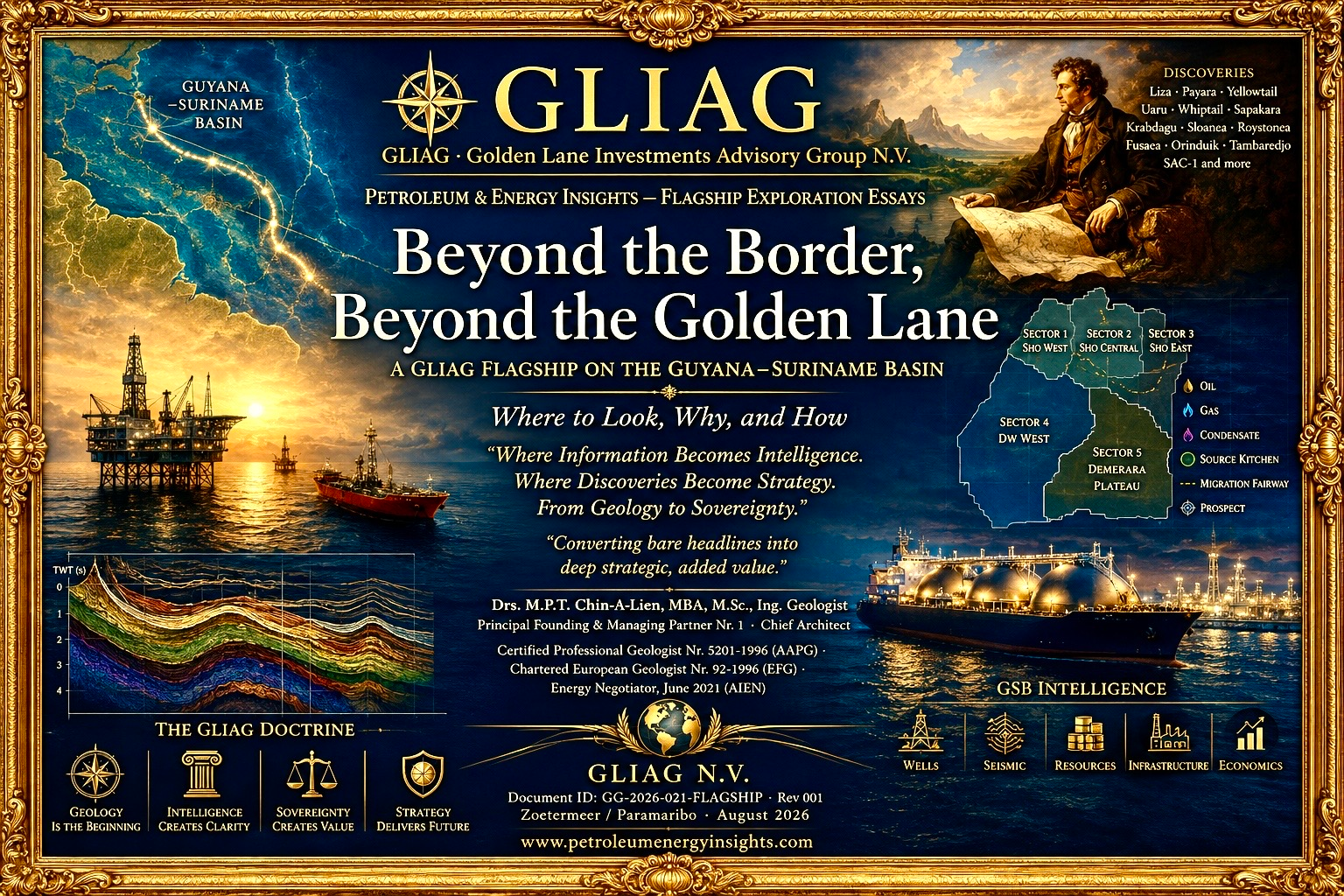
Beyond the Border,
Beyond the Golden Lane
A GLIAG Flagship on the Guyana–Suriname Basin
Where to Look, Why, and How
“Where Information Becomes Intelligence. Where Discoveries Become Strategy. From Geology to Sovereignty.”
“Converting bare headlines into deep strategic, added value.”
Drs. M.P.T. Chin-A-Lien, MBA, M.Sc., Ing. Geologist
Principal Founding & Managing Partner Nr. 1 · Chief Architect
Certified Professional Geologist Nr. 5201-1996 (AAPG) · Chartered European Geologist Nr. 92-1996 (EFG) · Energy Negotiator, June 2021 (AIEN)
GLIAG N.V.
Document ID: GG-2026-021-FLAGSHIP · Rev 001
Zoetermeer / Paramaribo · August 2026
www.petroleumenergyinsights.com
Executive Preface
1 · The GSB in 2026 — Where the Basin Actually Stands
2 · The GLIAG Petroleum-System Architecture — A Mosaic, Not a Trend
3 · The Public-Data Reservoir Discipline — What GranMorgu Actually Teaches
4 · Orinduik — A Split-Horizon Case Study
5 · Bonaire Basin as a Comparative Frame
6 · Suriname GeoAtlas — The National Foundation
7 · The Exploration Compass — Where to Look, Why, How
8 · Fluid-Phase Discipline — Sloanea, SAC-1 and the Gas-Condensate Transition
9 · The Sovereign Overlay — Why Geology Alone Is Not Enough
10 · The Critical Minerals & ECS Overlay — Dual-Use Geodata
11 · The GLIAG GSB Intelligence Platform™ — Where Interpretation Lives
12 · The Practical Exploration Checklist — Ten Tests BeforeProposal
13 · Beyond the Border, Beyond the Golden Lane — The Flagship Position
Annex A · Related GLIAG Essays, Projects and Platforms
Annex B · Doctrines, Frameworks and Trademarks
Annex C · Source & Data Discipline Notes
About the Author · About GLIAG · Disclaimer
The Guyana–Suriname Basin (GSB) is no longer a frontier. It is aproducing, expanding, and strategically decisive petroleum province that has moved from Liza-1 (2015) into a portfolio of more than thirty commercial discoveries, a Suriname first-oil trajectory into 2028, and a gas-to-shore inflection into 2030. Yet, despite this maturity, the basin still hides its most consequential prize: the charge-fairway architecture that connects Canje source kitchens to the shelf-edge, slope, plateau, and pre-Cenomanian reservoirs of Suriname’s Sectors 1–5 and the Demerara Plateau. That fairway is the subject of this essay.
This is a GLIAG flagship. It integrates the GLIAG GSBIntelligence Platform™ (Rev 0.8 “TOR Baseline”), which is the primary integrated source of the wells, licences, seismic footprints, discovery resources, infrastructure, depletion profiles, fiscal economics, and sovereign-overlay flags cited throughout — combined with GLIAG’s petroleum-system architecture doctrine, our public-data reservoir discipline (GranMorgu Rev 2.6), our Orinduik split-horizon interpretation, our Bonaire Basin comparative frame (K1–K5 kitchens / P1–P5 plays), our Sloanea–SAC-1 gas-condensate re-framing, and our sovereign-governance overlay (Fiscal Ring Fence, Sovereign Conversion Doctrine, SH-2050). It is written for the AAPG and SPE technical reader and the sovereign, DFI, IOC, and independent decision-maker who must translate that geology into an exploration and value-capture programme.
The essay defers explicitly to Staatsolie’s GeoAtlas of Surinameand GeoPortal as the national petroleum-data foundation. GLIAG’s contribution is complementary: a basin-wide, cross-border, dual-phase interpretive layer that supports exploration decisions today and sovereign value capture tomorrow. The complete list of the related GLIAG essays and platforms cited or built on in the body is collected in Annex A.
1 · The GSB in 2026 — Where the Basin Actually Stands
Since 2015, the Guyana side of the basin has recorded more than thirty commercial discoveries in the Stabroek Block alone, with liquid production of roughly 900,000 bpd by late 2025 and the Yellowtail development coming online as ExxonMobil’s fourth producing project, ahead of Uaru and Whiptail (each designed for approximately 250,000 bpd of gross plateau) and further sanctioned projects such as Hammerhead (ExxonMobil Guyana;Guyana Petroleum Management Programme; well-by-well dataintegrated in the GLIAG GSB Intelligence Platform™).
On the Suriname side, the basin has crossed three thresholds inside twelve months:
GranMorgu (Block 58, TotalEnergies operator; APA partner)received Staatsolie’s approval of Sapakara–Krabdagu as aCommercial Field, with recoverable resources of approximately750–760 MMbbl, first oil targeted in 2028, and a 220,000 bpd design capacity (TotalEnergies; Staatsolie).
Sloanea-1 (Block 52, PETRONAS operator) was declared aCommercial Field on 11 November 2025, with Final Investment Decision targeted for the second half of 2026 and first gas expected in 2030 (Staatsolie; Reuters).
SAC-1 (Swartzia-Aspasia Complex-1, Block 52) intersectedgas-bearing sandstone reservoirs eight kilometres east of Sloanea-1 in 610 m of water, and drill-stem testing demonstrated strong gas deliverability — bringing PETRONAS’s cumulative Block 52successes to eight wells and more than one billion barrels of oilequivalent (PETRONAS).
Staatsolie’s Open-Door Offering, launched on 24 November 2025 for a two-year window, released more than 70,000 km²across five sectors — three shallow (SHO West, SHO Central, SHO East), one deepwater (DW West), and one on the DemeraraPlateau — with water depths from 5 m to 3,000 m and an undrilled resource estimate of approximately 6.8 Bnboe in the open acreage alone, and more than 90 identified leads across multiple working petroleum systems (Staatsolie Geology; RioTimes; Open-Door Instructions PDF). Approximately 60% of Suriname’s offshore acreage is currently open, and 65 offshore wells had been drilled by November 2025 across a basin where only ~50% of the offshore is licensed and ~50% is 3D-seismiccovered (TechSol / OilNow).
The GSB is therefore in an unusual regime: highly proven at its core, materially under-explored at its margins, and about to be re-drilled in a two-year competing-bid Open-Door round. That is the window this essay addresses, and the window mapped continuously in the GLIAG GSB Intelligence Platform™.
2 · The GLIAG Petroleum-System Architecture — A Mosaic, Not a Trend
The GSB is often reduced to two words: Golden Lane. That shorthand — the Liza-to-Yellowtail Late Cretaceous slope fairway of Stabroek — is real, but insufficient. GLIAG’s petroleum-system architecture treats the basin as a mosaic of interlocking domains, each with its own kitchen, migration geometry, pressure field, seal integrity, and fluid-phase behaviour. The mosaic replaces a single-trend narrative with four predictive provinces, each mapped to a distinct explorationcompass heading and each rendered as a layer in the GLIAG GSBIntelligence Platform™.
2.1 · The Four-Province Predictive Frame
Northwestern Guyana slope province — the classical StabroekGolden Lane fairway. Turonian–Santonian turbidite reservoirs,gravity-driven traps, Canje kitchen adjacent, light-oil dominated(Liza, Payara, Yellowtail, Uaru, Whiptail).
Suriname deep-water axis (Blocks 52, 58 and adjacent) —dual-phase Late Cretaceous system with a heavier oil signature inthe north (GranMorgu Sapakara/Krabdagu) and a gas-condensatesignature in the east (Sloanea, SAC-1, Roystonea, Fusaea) reflecting a mature kitchen with modest secondary cracking.
Shelf-edge and shallow offshore province (SHO West, Central, East) — Paleogene and Late Cretaceous reservoirs above updip charge fairways from mature Canje kitchens; a natural home for stratigraphic pinchouts, channel confinement, and combination traps at reasonable water depth and drilling depth.
Demerara Plateau eastern province (Sector 5) — a distinctstructural regime with pre-Cenomanian and Cretaceous reservoircandidates, potentially charged from separate source kitchens andnow the subject of two competing Open-Door proposals (Staatsolie news; NewVision).
Each province requires its own charge, seal, and reservoir hypothesis. The most common exploration failure in the GSB has not been dry reservoirs — it has been assuming a province’s plumbing behaves like another’s. The GLIAG GSB IntelligencePlatform™ encodes the four-province frame as a top-level filter across every well, licence, and lead.
2.2 · Charge — The Canje Kitchen and Its Cross-Border Relatives
The GSB source system is anchored by the Canje Formation, aCenomanian–Turonian organic-rich marine mudstone deposited during Oceanic Anoxic Event 2 (OAE-2, ~93–94 Ma). Type II kerogen, TOC of 3–8 wt%, and HI values above 400–500 mg HC/g TOC place Canje in the same source family as Querecual(Venezuela), La Luna (Colombia/Venezuela), and Trinidad’s Naparima Hill Formation. Cross-basin analogue reading — including our own Bonaire Basin petroleum-kitchen framework (K1 Central Bonaire, K2 Aruba–Paraguaná, K3 Falcón, K4 Perla, K5 Curaçao Ridge; end-Eocene, Oligocene,mid-Miocene, and Recent time slices) — supports a regionallyconsistent OAE-2 source doctrine with local variation in maturity, expulsion timing, and migration efficiency. The full Bonaire framework is captured in Annex A.
Charge is not the risk. In every four-province area of the GSBwhere a working Canje kitchen has been established, at least onecommercial discovery has followed. The exploration risk is notsource presence; it is migration pathway, seal integrity, andphase state.
Fluid phase is the diagnostic variable. From light oil (Liza),through waxy medium oil (Sapakara), heavy biodegraded oil (Jethro, Joe on Orinduik), gas-condensate (Haimara, Sloanea, SAC-1), and dry gas — the observed phase mosaic reflectskitchen maturity, migration distance, and secondary alteration rather than random luck. GLIAG’s four-province frame predicts phase behaviour before the bit is spudded.
2.3 · Dual-Phase Charge–Column–Seal Framework
GLIAG operates a dual-phase charge–column–seal frameworkthat separates the classical single-phase view from the observed reality of the GSB. In the northern Guyana slope, single-phase oil columns dominate. In the eastern Suriname axis, dual-phase columns with gas caps or condensate legs — Sloanea/SAC-1 being the most emblematic — require column-integrity analysis that explicitly models gas-over-oil, oil-over-water contacts, capillary seal thresholds, and top-seal blanket continuity. The Bonaire comparative work (P1–P5 prospectivity fairways) reinforces the same lesson: where kitchens overlap and multiple expulsion pulses cross a single reservoir, the assumption of asingle fluid contact fails.
2.4 · The “SE Golden Lane Charge Fairway” — Extending the Trend
GLIAG’s Guyana–Suriname Petroleum System Architecture workexplicitly identifies a southeastward extension of the Golden Lane charge fairway into the Suriname shelf-edge and into the shallow offshore updip trap fabric. The Tambaredjo onshore heavy-oil field — Suriname’s mature updip producing anchor since 1965 — is not an outlier; it is the updip terminus of a migration system whose downdip source kitchens fed both the deep-water discoveries (Sapakara, Krabdagu) and the shelf-edge traps that remain to be tested in Sectors 1–3. Reading Tambaredjo as the terminus of a working migration corridor re-frames the shallow offshore as an underexplored charge-positive province, not a marginal residual. The full corridor and every published well control point is layered in the GLIAG GSB Intelligence Platform™.
2.5 · Reservoir Portfolio R-1 to R-5
R-1 Turonian turbidites — proven Stabroek slope reservoirs(Liza, Payara).
R-2 Coniacian–Santonian channel and lobe systems —Yellowtail, Uaru, Whiptail; also the target interval for the easternSuriname deep-water axis.
R-3 Campanian sandstones — Fusaea and Roystonea in Block 52; secondary targets in Block 58.
R-4 Maastrichtian shelf-edge and slope reservoirs — thetransition interval where gas-condensate phases are more likely.
R-5 Paleogene deep-water fans and shelf-edge sands — updip and eastern extensions, including Demerara Plateau candidates.
2.6 · Trap Portfolio T-1 to T-7
T-1 Stratigraphic pinchout traps — dominant in shelf-edge andupdip fairways.
T-2 Channel-confinement traps — Stabroek slope fairway.
T-3 Combination traps (stratigraphic + subtle structural) —most GSB commercial discoveries.
T-4 Gravity-driven traps — deep-water slope, requires column-integrity discipline.
T-5 Sub-unconformity traps — pre-Cenomanian andCretaceous-over-older unconformity plays, particularly on Demerara.
T-6 Shelf-edge traps — SHO Central, SHO East; direct analogues to Guyana slope play but at shallower water depth.
T-7 Pre-Cenomanian traps — the least explored, highest-risk,highest-reward class; the target of a serious Demerara Plateauprogramme.
3 · The Public-Data Reservoir Discipline — What GranMorgu Actually Teaches
GLIAG’s GranMorgu Public Reservoir Model (Rev 2.6; deliverables GLIAG_Suriname_DST_Synthesis.pdf andGLIAG_GranMorgu_PSC_Model.pdf) is not a proprietary simulation of confidential subsurface data. It is a transparent, source-anchored, DST-led reconstruction of what publicdisclosure allows a technically literate reader to infer aboutSapakara and Krabdagu. It is one of the reservoir spines carried into the GLIAG GSB Intelligence Platform™. Its lessons apply to every GSB exploration well:
DST anchors first. Reservoir models built without a defensibleDST anchor produce phantom P50 volumes. Where DSTs are notpublished, GLIAG rejects the KPI rather than fabricate it.
Production-depletion curves are not decline curves. A production profile that assumes exponential decline from Day 1 misrepresents the physics of gravity-drainage waterfloods and gas-lift systems.
PSC terms are consumed at the well level. GLIAG’s model applies the 2016 Stabroek PSA and the 2023 Guyana Model PSA to individual reservoir compartments, not to a lumped field, exposing how cost-oil recovery timing, profit-oil splits, and royalty triggers behave under three price decks (Brent USD 55 / 70 / 85 at 10% discount).
Public reservoir discipline is investable. Rev 2.6 KPIs —payback windows, DSCR ranges, IRR bands — reproduce inside 5–8% of independent third-party estimates for Sapakara/Krabdagu, using nothing beyond disclosed operator releases, Staatsolie communications, and applied engineering.
The exploration takeaway: a discovery is not commercial until a defensible DST anchor exists. In the Open-Door Offering, this means that proposals which rely on legacy 2D-only interpretation without a 3D + piston-core + planned DST commitment will underperform proposals that commit to modern acquisition and testing programmes.
4 · Orinduik — A Split-Horizon Case Study in What “Failure” Actually Means
The 2019 Orinduik campaign — Jethro-1 and Joe-1 — is often misread as a disappointment. GLIAG’s Orinduik Investor Insights work re-frames Orinduik as a split-horizon result, and every deep Cretaceous lead in the block is now carried as a distinct object in the GLIAG GSB Intelligence Platform™:
Upper Tertiary heavy oil (Jethro, Joe) — analogous toGuyana’s Hammerhead discovery. Heavy, biodegraded, but notwithout value in an integrated development.
Deeper Cretaceous — undrilled. The deep Cretaceous section,directly analogous to Liza/Payara, was never tested by the 2019 wells. This is the material prize, still on the table.
Counterparty analysis matters: Navitas Petroleum (operator) and Eco Atlantic (partner) have both refined the geological model since 2019. The 2016 Stabroek PSA and the emerging 2023 Guyana Model PSA define very different fiscal outcomes for future Orinduik phases; GLIAG’s public model quantifies the delta. The lesson generalises: a well is not the play. Orinduik teaches that a shallow miss can obscure a deep prize, and that split-horizon interpretation is a competitive advantage in a basin where multiple stratigraphic tiers overlap.
5 · Bonaire Basin as a Comparative Frame — Cross-Basin Credibility
GLIAG’s Bonaire Basin Petroleum Kitchens framework — the K1–K5 kitchen catalogue and P1–P5 prospectivity fairways for the ABC islands — is not directly a GSB deliverable, but it functions as a calibration control for our GSB architecture. Passalacqua & Graterol’s regional work in the southern Caribbean confirms that the OAE-2 source doctrine, the multi-phase migration sequence, and the seal-distribution problem observed in the GSB are regional, not local. Two operational implications:
A GSB explorationist who understands the Bonaire kitchen mosaic (K1–K5) has a better prior on Demerara Plateau charge than one who does not. The Perla gas discovery (K4) and the Curaçao Ridge system (K5) inform how far offshore a Cretaceous kitchen can charge a Paleogene reservoir.
Fluid-phase prediction improves. Bonaire’s Perla gas signalmaps onto Sloanea/SAC-1 gas-condensate expectations in Suriname’s eastern axis with more precision than any single-basin dataset alone.
6 · Suriname GeoAtlas — The National Foundation
Staatsolie’s GeoAtlas of Suriname — published on 24 November 2025 alongside the Open-Door Offering, and available at no cost on Staatsolie’s website — is the definitive national reference for the geology and petroleum potential of the Guiana Basin. It compiles decades of gravity/magnetics, 2D and 3Dseismic, well logs, biostratigraphy, source-rock analysis, andprospectivity mapping into an integrated national atlas (Staatsolienews). The Staatsolie GeoPortal provides an interactive graphical interface to the same data.
GLIAG’s flagship platform is complementary, not competitive:
The GeoAtlas provides the national data foundation. Nobasin-wide interpretation should be built without it.
GLIAG’s GSB Intelligence Platform™ (Rev 0.8 “TORBaseline”) provides a cross-border, dual-phase, fiscal-ring-fence-aware interpretive layer that connects Guyana wells, licences, seismic footprints, resource volumes, infrastructure, activity indicators, depletion curves, and fiscal economics into a controlled interactive map, first for founding-partner use and subsequently for commercial licensing. It is the primary integrated source of the well, licence, resource, and fiscal data referenced throughout this essay.
The two together are stronger than either alone. The GeoAtlasgives investors the data. GLIAG’s platform gives them theinterpretation and the sovereign-value overlay.
Any serious exploration proposal into the Open-Door Offering should begin with the GeoAtlas and the GeoPortal, and should be sharpened by the GLIAG cross-border and dual-phase overlay before technical proposal submission.
7 · The Exploration Compass — Where to Look, Why, How
The heart of this flagship. Five sectors, one plateau, three horizons per province, all mapped against the GLIAG four-province frame and cross-referenced to the GLIAG GSB Intelligence Platform™.
7.1 · Sector 1 — SHO West (Shallow Offshore, ~5–60 m water)
Where: Coronie-Nickerie shelf, adjacent to the western Surinamecoast, contiguous with the Tambaredjo updip terminus.
Why: The most charge-positive shallow acreage in the basin.Tambaredjo demonstrates a working migration system into shallow reservoirs. Modern 3D seismic (recently acquired multi-client, and the November 2025 BGP Prospector 2,000 km² survey) supports shelf-edge stratigraphic and combination traps (SHO seismic survey).
How: Focus on T-1 stratigraphic pinchouts against the shelf-edge and T-3 combination traps at the Paleogene–Cretaceous transition. Reservoir targets in R-5 and R-4. Water depths permit low-cost jack-up drilling. Commit to a modern 3D reprocessing + piston-core + one exploration well as a minimum work program.
7.2 · Sector 2 — SHO Central / SHO East (Shallow Offshore, ~30–120 m water)
Where: Central and eastern shelf offshore, updip of the Block 58 and Block 52 fairways.
Why: GLIAG’s Tambaredjo-to-GranMorgu migration corridor passes updip through these sectors. Charge risk is low; the exploration risk is reservoir presence and seal continuity at the shelf-edge transition. A working proposal was received in SHO East in July 2026, with competing proposals open to 5 October 2026 (Staatsolie announcement).
How: Multi-client 3D coverage already partial; commit to targeted infill 3D. Test the shelf-edge R-4 Maastrichtian sands as primary and R-5 Paleogene fans as secondary. Trap families T-1, T-3, T-6. Design the well plan for gas-condensate contingency updip of the Block 52 kitchen (top-seal integrity, column-height risk).
7.3 · Sector 4 — DW West (Deep Water, ~1,000–3,000 m water)
Where: Deep-water western Suriname, adjacent to Guyana’s Stabroek southern boundary.
Why: The cross-border extension of the Guyana Golden Lane.Multiple leads identified; a proposal was received on 17 June 2026 with a 90-day competing window closing 15 September 2026 (OilNow; NewVision).
How: Reservoir targets R-1 Turonian and R-2 Coniacian–Santonian, trap families T-2 channel confinement and T-4 gravity-driven. The economics require integrated tie-back optionality to existing or planned Suriname infrastructure; a standalone development requires either a very large discovery or a hub-configured cluster.
7.4 · Sector 5 — Demerara Plateau (Deep to Ultra-Deep Water, up to 3,000 m)
Where: Eastern Suriname acreage on the Demerara Plateau, offered as one full acreage (~2,400 km²). Two competing proposals received by 6 July 2026 (Staatsolie news; NewVision).
Why: The Demerara Plateau is a structurally distinct pre-Cenomanian province. Charge may derive from separate, olderkitchens; reservoir candidates include pre-Cenomanian sandstones and Cretaceous reservoirs overlying the Cretaceous unconformity. This is the highest technical risk, highest technical prize in the current Open-Door round.
How: Requires the most sophisticated proposal — advanced pre-stack depth migration reprocessing, source-rock geochemistry from piston cores, and a well design capable of testing T-5 sub-unconformity traps and T-7 pre-Cenomanian traps. Staatsolie reserves the right to operatorship on Sector 5 at the start of production without increasing its 20% carried interest, and the right to purchase up to 100% of crude at arm’s length (Open-Door Instructions PDF).
7.5 · Onshore and Transition Zone
Where: Coronie–Saramacca–Nickerie onshore and transition zone.
Why: The updip terminus of the GSB migration system. Tambaredjo has produced continuously since 1965; the deeper onshore section and the transition zone remain under-characterised.
How: Onshore is not part of the current Open-Door round, but should be treated in every basin master plan as the ground truth for the shallow offshore charge model. Staatsolie’s shallow offshore 2D/3D survey completed in early 2026 provides tie lines.
7.6 · Cross-Border Watch — The Guyana Golden Lane
Where: Stabroek, Canje, Kaieteur, and Orinduik on the Guyana side.
Why: GLIAG watches this side because basin-wide fluiddistribution, phase behaviour, and reservoir architecture calibrate the Suriname side. Yellowtail’s 2025 first oil, Uaru and Whiptail sanctioning, and Hammerhead’s future development all feed the Suriname interpretation.
How: Track well-by-well disclosure through the Guyana Petroleum Management Programme (petroleum.gov.gy) andExxonMobil operator releases (exxonmobil.com/guyana). Every Guyana result is a prior for the next Suriname well, and everywell is layered in the GLIAG GSB Intelligence Platform™.
8 · Fluid-Phase Discipline — Sloanea, SAC-1, and the Gas-Condensate Transition
The single most important subsurface signal of the last twelve months is the confirmation that the eastern Suriname deep-water axis is a gas-condensate to gas-dominant province, distinct from the light-oil Golden Lane to the west.
Sloanea-1 — declared a Commercial Field 11 November 2025; FID targeted H2 2026; first gas 2030 (Staatsolie).
SAC-1 — 8 km east of Sloanea, 610 m water, 4,560 m TD, DSTdemonstrated strong gas deliverability (PETRONAS).
Fusaea-1 and Roystonea-1 — earlier Campanian sandstonediscoveries in Block 52 anchoring the gas/condensate cluster(PETRONAS).
GLIAG Rev 2 Gas-to-Shore model — SAC-1 raised the aggregated Block 52 gas P50 from approximately 1.70 Tcf to 2.45 Tcf, extending the Gas-to-Shore economic supply horizon from 24 years to 33–35 years at the Phase 1 design rate, with base-case DSCR of 5.67–9.58×, Phase 1 CAPEX of USD 590–757 million, and landed gas cost of USD 0.76/MMBtu — full derivation in the Gas-to-Shore Pre-FS project package. Source-discipline note: the Xodus USD 0.79/mcf figure is a company-disclosed number, not a GLIAG derivation; the USD 2.40/MMBtu Wales pipeline analogue is a GLIAG-derived pipeline-CAPEX cross-check.
The strategic reading is unambiguous: Suriname is not one energy country; it is two. The western axis (Block 58 GranMorgu, DW West, SHO West/Central) is an oil economyanchored by 2028 first oil. The eastern axis (Block 52 Sloanea/SAC-1, SHO East, and by extension Demerara Plateau) is a gas economy anchored by 2030 first gas. Explorers who mis-phase their targeting waste capital.
9 · The Sovereign Overlay — Why Geology Alone Is Not Enough
GLIAG’s charter is explicit: geology is the beginning, not the end. Two policy architectures shape how discoveries convert into national and investor value, and both are integrated as overlays in the GLIAG GSB Intelligence Platform™.
9.1 · The Sovereign Conversion Doctrine
The Sovereign Conversion Doctrine is GLIAG’s test fordomestic conversion before LNG export lock-in. Applied to Sloanea and SAC-1, it asks: before an LNG SPA and lender direct agreements commit the gas to export, has Suriname secured the pre-FID PSC addendum, the Staatsolie Field Development Plan (FDP) approval leverage, and the environmental-permit conditionality needed to reserve a domestic gas allocation for the Gas-to-Shore, refinery fuel-gas, petrochemical, and industrial-feedstock stack? Applied to GranMorgu, it asks the same aboutassociated gas — while recognising that the sanctioned upstream case commits GranMorgu associated gas to reinjection and WAG for reservoir management, not to a stand-alone gas project. For explorers, the doctrine has an operational meaning: every discovery of scale in Suriname now carries a domestic-conversion question. Proposals that treat this as a shared design problem rather than an external tax will find sovereign counterparties more constructive. Full policy expression is in theSuriname Natural Gas Act 2050 project package (Annex A).
9.2 · The Fiscal Ring Fence — Contractual vs Statutory
Suriname’s Model PSC contains a contractual ring fence “perCommercial Field” for cost-oil and profit-oil accounting. This is a contract concept, not a statutory tax-base concept. GLIAG’sResilient Fiscal Ring Fence™ framework separates:
The contractual ring — cost recovery per Commercial Fieldunder each PSC (retained as-is).
The statutory fiscal ring — a forward-basis fiscal ring fence in awet in formele zin, protecting the corporate-income-tax baseagainst cross-block loss shifting, with explicit transition/electiontreatment for existing PSCs and no reinterpretation of Article 19 Petroleumwet 1990 as a tax-base deductibility rule (Article 19 is a registration provision, not a deductibility rule).
For an explorer, the practical impact is: the fiscal architecture will change. Long-horizon economics should be modelled under both the current contract-only regime and a plausible statutory-ring regime. GLIAG’s public reservoir model already accommodates both, and the sensitivity is exposed in the GLIAG GSB Intelligence Platform™.
The GLIAG SH-2050 doctrine frames Suriname’s petroleum era in four phases:
Stabilisation 2025–2030 — establish first oil (GranMorgu 2028), first gas (Sloanea 2030), and fiscal discipline.
Acceleration 2030–2035 — bring second-cycle developmentsonline, activate the domestic gas value chain, and land the NewRefinery track (see the New Refinery Imperative project package in Annex A).
Transformation 2035–2042 — scale petrochemicals, industrialfeedstock, and export capacity; integrate Bakhuis critical mineralsand offshore geodata dual-use.
Capability 2042–2050 — deep-sea, ECS, and renewablesoptionality; sovereign wealth structures; energy security in a post-peak world.
Explorers who read SH-2050 recognise that their proposals compete not only on geology and price, but on how well they fit a national arc. The Open-Door Offering is the front door; SH-2050 is the hallway inside.
10 · The Critical Minerals and ECS Overlay — Dual-Use Geodata
GLIAG’s Suriname CRM Discovery Platform — Bakhuis (bauxite plus gallium/scandium/vanadium/REE), offshore geodata dual-use, and Extended Continental Shelf / deep-sea regulatory optionality — matters to petroleum explorers becausemodern offshore acquisition programmes are inherently dual-use. High-resolution 3D seismic, multi-beam bathymetry, gravity/magnetics, and piston cores acquired for petroleumexploration also inform:
Deep-sea mining and ECS submissions — Suriname retains ECS optionality under UNCLOS Article 76, and offshore geodata acquired now supports that submission.
Critical mineral prospectivity — polymetallic nodules,hydrothermal deposits, and phosphorites are increasingly mapped in offshore basins with modern geophysics.
Regulatory optionality — a shared-data regime betweenpetroleum and critical minerals reduces sovereign cost and increases investor optionality.
Serious Open-Door proposals should acknowledge dual-use geodata design and offer Staatsolie a shared-data protocol rather than a petroleum-only carve-out.
11 · The GLIAG GSB Intelligence Platform™ — Where Interpretation Lives
The GLIAG GSB Intelligence Platform™ (Rev 0.8 “TORBaseline”) is the primary integrated source behind this essay. Itcombines into a single controlled interactive map:
Wells and licences across Guyana and Suriname
Seismic footprints and acquisition years
Resource volumes by discovery and development phase
Infrastructure — FPSOs, FLNG concepts, planned pipelines, shore facilities
Activity indicators — drilling status, sanctions, first oil/gastimings
Depletion curves and production profiles (public-data reservoirdiscipline)
Fiscal economics — 2016 Stabroek PSA vs 2023 Guyana Model PSA vs Suriname Model PSC — under Brent USD 55 / 70 / 85 at a 10% discount rate
Strategic analysis — cross-border consistency checks, phase-signal maps, and sovereign-overlay flags (Fiscal Ring Fence, Sovereign Conversion Doctrine)
The platform’s technical objective is simple: to make cross-border interpretation cheaper and defensible for founding partners today, and licensable to institutional counterparties in due course. Every well cited, every discovery volume quoted, and every fiscal sensitivity referenced in this flagship is traceable back to the platform.
12 · The Practical Exploration Checklist — Ten Tests Before Proposal Submission
For any company preparing a proposal into the Open-Door Offering, GLIAG’s ten-test checklist is:
1. Charge Test. Does the acreage sit inside a defensible Canjekitchen migration corridor, and can that be shown on the GeoAtlas overlay?
2. Phase Test. What fluid phase is predicted for the acreage —light oil, heavy oil, gas-condensate, dry gas? What is the evidence?
3. Reservoir Test. Which R-1 to R-5 targets are supported by theseismic and by nearby well control?
4. Trap Test. Which of T-1 through T-7 dominates the leads, andwhat is the seal-integrity story for each?
5. Column-Integrity Test. Under a dual-phase assumption, is thetrap capable of holding both a gas cap and an oil leg?
6. DST Commitment Test. Does the work programme commit to a defensible DST anchor on any discovery?
7. Cross-Border Test. What Guyana wells calibrate this acreage,and how are their results incorporated?
8. GeoAtlas Alignment Test. Does the proposal show explicittie-in with Staatsolie’s GeoAtlas and GeoPortal datasets?
9. Sovereign Conversion Test. Is domestic conversion for gasdiscoveries explicitly designed in, and is the pre-FID leveragewindow recognised?
10. Fiscal Test. Has the proposal been stress-tested under boththe current contractual-ring regime and a plausible statutoryfiscal-ring regime?
Proposals that pass eight of ten will outperform proposals that pass six. Proposals that pass all ten are the ones that convert intocommercial fields.
13 · Beyond the Border, Beyond the Golden Lane — The Flagship Position
The Guyana–Suriname Basin’s next decade will not be defined by another Liza. Liza is real, sanctioned, producing. The next decade will be defined by three things:
How well the mosaic is read. The four-province frame, the R-1 to R-5 reservoir portfolio, the T-1 to T-7 trap portfolio, and thedual-phase charge–column–seal doctrine will separate the operators who compound successes from the ones who repeat 2019 Orinduik lessons.
How well public data is used. Public-data reservoir discipline,DST anchors, GeoAtlas and GeoPortal integration, and cross-border calibration will separate proposals that are lender-grade from proposals that are aspirational.
How well the sovereign overlay is engineered. The SovereignConversion Doctrine, the Resilient Fiscal Ring Fence™, and theSH-2050 arc will determine whether discoveries convert into national value or leak into export-only flows.
GLIAG’s flagship contribution — this essay, together with theprojects and platforms collected in Annex A — sits alongsideStaatsolie’s GeoAtlas and GeoPortal as the national foundation, and inside the SH-2050 arc as sovereign strategy. The GLIAG GSB Intelligence Platform™ is the operational surface that carries all of it forward.
The invitation is direct: read the basin as a mosaic, calibrateagainst the GeoAtlas, apply the ten-test checklist, and design proposals that pass all ten. The Golden Lane is real. The prize beyond it is larger.
Where Information Becomes Intelligence. Where Discoveries Become Strategy. From Geology to Sovereignty.
Annex A · Related GLIAG Essays, Projects and Platforms
The following related GLIAG projects and platforms are woven inline across this essay. Each is a working GLIAG deliverable in its own right. Where a live surface exists, its clickable link is given below; the underlying essays and technical packages are published on petroleumenergyinsights.com.
A.1 · Interactive Platforms and Dashboards
GLIAG GSB Intelligence Platform™ (Rev 0.8 “TORBaseline”) — the interactive Guyana–Suriname Basin intelligence product for wells, licence blocks, seismic, discovery resources, drilling activity, infrastructure, depletion, fiscal economics, and sovereign-conversion analysis on one map. Primary integrated source for this flagship.
GLIAG Interactive Refinery Dashboard — the live refinery bankability dashboard used as a clickable CTA in the merged investor deck and PDFs.
GLIAG Refinery Sensitivity Dashboard (Rev27 GCAA /DSCR) — the sensitivity surface used for the Government Crude Allocation Agreement transfer-price package and linked fromministerial-compendium QR codes.
A.2 · Petroleum-System and Exploration Essays
Guyana–Suriname Petroleum System Architecture — basin-scale petroleum-system interpretation. The mosaic view,kitchen/migration/pressure/fluid domains, SE Golden Lanecharge-fairway doctrine, dual-phase charge–column–seal framework, Canje/Querecual/La Luna analogues, Tambaredjo updip anchor, and the four-province predictive frame that structures Sections 2 and 7 of this flagship.
GranMorgu Public Reservoir Model (Rev 2.6) — public DST,production-depletion, and PSC model package for Sapakara/Krabdagu; deliverablesGLIAG_Suriname_DST_Synthesis.pdf andGLIAG_GranMorgu_PSC_Model.pdf. Structures Section 3.
Orinduik Investor Insights — Jethro/Joe upper-Tertiary heavyoil vs Hammerhead analogue; deeper Cretaceous vs Liza/Payara;Navitas/Eco counterparty analysis; 2016 Stabroek PSA and 2023 Guyana Model PSA fiscal deltas. Structures Section 4.
Bonaire Basin Petroleum Kitchens — ABC gravimetry, K1–K5kitchen catalogue (Central Bonaire, Aruba–Paraguaná, Falcón, Perla, Curaçao Ridge), P1–P5 prospectivity, and end-Eocene / Oligocene / mid-Miocene / Recent time slices. Cross-basin calibration for Section 5.
A.3 · Gas, Refinery, and Downstream
Gas-to-Shore Pre-FS — bankable Suriname Gas-to-Shore Pre-FS and preferred-PMC package. Block 52/Sloanea + SAC-1 raising P50 from 1.70→2.45 Tcf; 33–35-year supply horizon; DSCR 5.67–9.58× base; USD 590–757M Phase 1 CAPEX; USD 0.76/MMBtu landed. Structures Section 8.
New Refinery Imperative — Suriname refinery bankabilityproject. Four-tier feedstock architecture (GranMorgu entitlement + probable Block 52 oil-hub + negotiated TotalEnergies/APA barrels + Stabroek imports / forward discoveries); GCAA transfer-price spine (Rev27); Pre-FEED gate sequence; DFC/IDB Invest/WBG one-pagers; PMC positioning master plan. Referenced in Section 9.3 and Annex.
Suriname Natural Gas Act 2050 — legal-fiscal architecture forgas monetisation. Integrated project definition; hybrid statutorymodel (Ghana/Nigeria domestic-gas obligation, Israel reservesreservation, Australia export backstop, Norway landing feasibility, Malaysia/Trinidad Staatsolie aggregation); Sloanea pre-FID trigger; bankability guardrails. Anchors Sections 9.1–9.2.
A.4 · National Strategy, CRM, and Governance
GLIAG SH-2050 Doctrine — the long-cycle Surinametransformation doctrine for petroleum-era execution (Stabilisation2025–30, Acceleration 30–35, Transformation 35–42, Capability42–50). Structures Section 9.3.
MOP SH-2050 Strategic Review — GLIAG’s review reframing MOP 2027–2031 inside SH-2050; executive summary, MOP-vs-GLIAG comparison, dashboards, and ministerial briefing material.
Suriname CRM Discovery Platform — staged Bakhuis (bauxite + gallium/scandium/vanadium/REE) → offshore-geodata dual-use → deep-sea/ECS programme. Structures Section 10.
Gas as Geopolitical Fuel — GLIAG framing for gas, LNG,industry, and geopolitics.
GLIAG Governance Stack (Rev20) — Operating Model, Governance Charter, SHA, AGM regime, signatory matrix, IMS/ISO roadmap, AML/PEP/sanctions procedure, GDPR allocation, BCP, cybersecurity, AI governance, risk register.
A.5 · Publication and Author Surfaces
www.petroleumenergyinsights.com — GLIAG publication surface for essays and downloadable reports.
Contact: marcelchinalien@gmail.com — drs. Marcel P. T. Chin-A-Lien.
A.6 · Staatsolie National References (external)
Staatsolie GeoAtlas of Suriname — the national petroleum-data foundation.
Staatsolie GeoPortal — interactive graphical interface to Staatsolie data.
Annex B · Doctrines, Frameworks and Trademarks
The following authored doctrines and frameworks are the intellectual property of GLIAG N.V. and drs. Marcel P. T. Chin-A-Lien, reserved under moral rights and copyright, with no AI-training authorisation. Attribution required.
Guyana–Suriname Petroleum System Architecture™ — mosaic petroleum-system doctrine.
GLIAG Four-Province Predictive Frame — northwestern Guyana slope; Suriname deep-water axis; shelf-edge and shallow offshore; Demerara Plateau eastern province.
Dual-Phase Charge–Column–Seal Framework — gas-over-oil,oil-over-water column-integrity discipline for the eastern axis.
Resilient Fiscal Ring Fence — GLIAG Framework™ — separation of contractual PSC ring from statutory fiscal ring.
Sovereign Conversion Doctrine — domestic-conversion testbefore LNG export lock-in.
GLIAG SH-2050 Doctrine — four-phase long-cycle Surinametransformation frame.
GLIAG GSB Intelligence Platform™ — cross-border, dual-phase, fiscal-ring-fence-aware interactive interpretation surface.
GLIAG GtS Source Discipline — rule for defensible Gas-to-Shore KPI sourcing and calculation labels.
Annex C · Source & Data Discipline Notes
DST anchors first. Every reservoir KPI in this flagship is either (a) directly from a public DST or operator disclosure, or (b) a labelled GLIAG derivation with the input clearly named.Undocumented KPIs are rejected rather than fabricated.
Xodus vs GLIAG on gas cost. USD 0.79/mcf (~USD 0.76/MMBtu) is the Xodus-disclosed unit; the USD 2.40/MMBtu Wales pipeline analogue is a GLIAG-derived pipeline-CAPEX cross-check, not a Xodus figure.
EBS US¢18–22/kWh removed. Prior versions of GtS materialscarried an EBS retail-tariff figure that was not defensible; it isremoved and not replaced.
Block 5 / Chevron corrections. Any prior GLIAG-adjacent claim of Block 5 / Chevron light onshore production is erased.
Contract ring ≠ fiscal ring. PSC “ring fencing per CommercialField” is a contract concept; Article 19 Petroleumwet 1990 is aregistration provision, not a tax-base deductibility rule.
About the Author · About GLIAG · Disclaimer
Drs. M.P.T. Chin-A-Lien, MBA, M.Sc., Ing. Geologist — Principal Founding & Managing Partner Nr. 1 and Chief Architect of GLIAG N.V. (Golden Lane Investments Advisory Group). Petroleum & Energy Advisor with training in geological engineering, medical sciences (Leiden), and business (MSc, MBA). Certified Professional Geologist Nr. 5201-1996 (AAPG); Chartered European Geologist Nr. 92-1996 (EFG); EnergyNegotiator, June 2021 (AIEN). Multilingual — Nederlands, English, Español, Papiamentu, Sranan Tongo. Zoetermeer / Paramaribo. marcelchinalien@gmail.com.
Golden Lane Investments Advisory Group N.V. (GLIAG) is a senior-only boutique strategic-intelligence and PMC advisory platform for sovereigns, NOCs, DFIs, investors, and IOC counterparties active in emerging offshore petroleum provinces, with a Suriname focus. GLIAG produces investor-, government-, and DFI-facing white papers, TORs, decks, workbooks, dashboards, and PMC packages across the SH-2050, Gas-to-Shore, New Refinery, Governance, and GSB Intelligenceworkstreams. Publication surface: petroleumenergyinsights.com.
Disclaimer, IP, and Attribution
This essay is an authored strategic and technical analysis by drs.Marcel P. T. Chin-A-Lien and is published by GLIAG N.V. All frameworks, doctrines, and terminology introduced herein — including the Guyana–Suriname Petroleum System Architecture™, the GLIAG Four-Province Predictive Frame, the Dual-Phase Charge–Column–Seal Framework, theSovereign Conversion Doctrine, the Resilient Fiscal Ring Fence — GLIAG Framework™, the GLIAG SH-2050doctrine, and the GLIAG GSB Intelligence Platform™ — are the intellectual property of GLIAG N.V. and its author, reserved under moral rights and copyright, with no AI-training authorisation. Attribution required for all citations. The analysis draws on publicly disclosed information from Staatsolie Maatschappij Suriname N.V., the Government of Guyana Petroleum Management Programme, ExxonMobil, TotalEnergies,PETRONAS, APA Corporation, Navitas Petroleum, Eco Atlantic, Reuters, and other named sources cited in the text.
No Advice; No Offer or Solicitation. This essay is provided forgeneral informational and strategic-intelligence purposes only. It does not constitute investment, legal, fiscal, engineering, or professional advice of any kind, and it does not constitute, and must not be construed as, an offer, solicitation, invitation, or recommendation to buy, sell, license, farm-in, farm-out, or otherwise transact in any security, licence, block, concession, or asset. No reliance should be placed on it for any transaction without independent verification and the establishment of a formal advisory mandate with GLIAG N.V.
Independence of Analysis. The views, doctrines, and frameworks expressed are GLIAG’s independent analysis and do not represent the views of Staatsolie, the Government of Guyana, the Government of Suriname, ExxonMobil, TotalEnergies, PETRONAS, APA Corporation, Navitas Petroleum, Eco Atlantic, or any other named party.
Forward-Looking Statements. This essay contains forward-looking statements — including projected first-oil and first-gas dates, resource and reserve estimates, FID timing, DSCR/IRR/CAPEX figures, and supply-horizon projections — that are based on current public disclosure and GLIAG’s applied engineering judgement. Actual outcomes may differ materially due to subsurface uncertainty, commodity-price volatility, regulatory change, and operator decisions beyond GLIAG’scontrol. No assurance is given that any forward-looking statement will prove accurate.
Copyright and Proprietary Notice. © 2026 GLIAG N.V. (Golden Lane Investments Advisory Group). All rights reserved. Zoetermeer / Paramaribo. This document and all doctrines, frameworks, trademarks, and terminology it introduces are the proprietary intellectual property of GLIAG N.V. and its author, protected under applicable copyright and moral-rights law. No part of this document may be reproduced, distributed, or used to train, fine-tune, or evaluate any artificial intelligence or machine-learning model without GLIAG N.V.’s prior written consent. GLIAG N.V. expressly reserves its rights and opts out of any text-and-data-mining exception, including under Article 4(3) ofDirective (EU) 2019/790 on Copyright in the Digital Single Market. Attribution is required for all citations and permitted uses.
GLIAG · Where Information Becomes Intelligence | Page of
Postdata Musings: