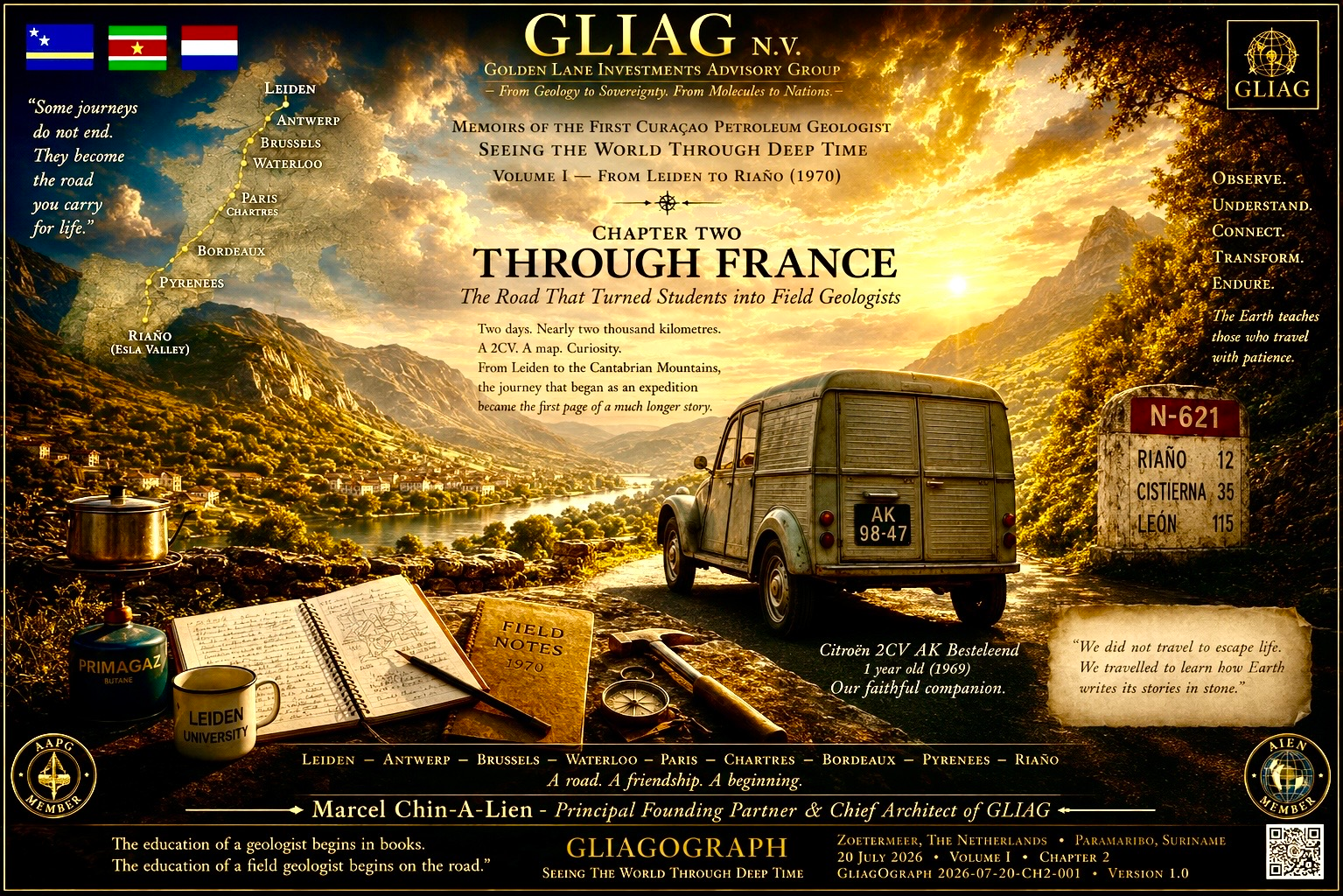
Memoirs of the First Curaçao Petroleum Geologist
Written by Marcel Chin-A-Lien – Yiu di Kòrsou, unda mi lombrishi ta derà –
Petroleum & Energy Advisor – Principal Founding Member & Chief Architect of GLIAG – Golden Lane Investments Advisory Group
Seeing the World Through Deep Time
Volume I — From Leiden to Riaño (1970)
Chapter Two
Through France
The Road That Turned Students into Field Geologists
Paris announced itself long before we saw it.
The traffic thickened almost imperceptibly. Lorries appeared in longer convoys, each carrying the names of distant cities painted across their trailers: Lyon, Marseille, Toulouse, Milano, Barcelona. Europe was already moving across its roads with an efficiency that ignored national frontiers. We were no longer driving through provinces but through the arteries of a continent.
For two students from Leiden, Paris possessed an almost mythical presence. We had grown up reading about it, seeing it in films, hearing professors refer to French scientists and philosophers with effortless familiarity. Yet neither Willem nor I had come to admire monuments. Spain awaited us. The Pyrenees awaited us. The Cantabrian Mountains awaited us. Paris was a passage rather than a destination.
Still, one cannot pass Paris without feeling its gravity.
The périphérique circled the city like a broad river of steel. Cars merged, diverged and merged again in a choreography that seemed chaotic only to newcomers. French drivers displayed a confidence that bordered on audacity. The little Citroën, built on French soil, appeared almost relieved to be home. Its modest engine never complained. It simply continued its patient rhythm while vehicles twice its power overtook us with theatrical urgency.
Cities reveal the ambitions of nations.
Roads reveal their character.
The French drove as though movement itself were an expression of freedom.
The Dutch, by comparison, drove with the discipline of engineers.
Neither was wrong.
They merely reflected different histories.
We caught occasional glimpses of Paris beyond the barriers. Apartment blocks stretched toward the horizon, interrupted here and there by church spires whose stones had witnessed more centuries than the Republic itself. Somewhere beyond our sight stood the Seine, Notre-Dame, the Sorbonne and the cafés where generations of artists, scientists and revolutionaries had argued over ideas that later travelled around the world.
We remained on the ring road.
Looking back, I have never regretted that decision.
Travelling teaches restraint as much as curiosity. One must sometimes accept that a place deserves its own journey. Paris could not be understood in a hurried afternoon. Better to acknowledge its presence with respect and continue towards the destination that had brought us this far.
By late afternoon the traffic loosened.
The city slowly released us.
The fields returned.
The sky widened again.
France seemed to breathe more deeply once Paris lay behind us.
The landscape south-west of the capital unfolded in broad agricultural plains where wheat, barley and sunflower fields alternated with small woodlands and villages clustered around ancient churches. The houses appeared built not to impress but to endure. Their limestone walls carried the colour of the land from which they had been quarried centuries earlier.
As the kilometres accumulated, the geologist within me became increasingly attentive.
Without consciously intending it, I began reading road cuts, embankments and freshly excavated ditches. Every exposure offered a brief lesson. Layers deposited in quiet seas long before mammals existed now supported vineyards, villages and highways. Farmers harvested crops above rocks whose history extended back more than a hundred million years.
Most travellers looked across the landscape.
A geologist also looks beneath it.
That habit, acquired almost unconsciously at Leiden, has never left me. Even today I rarely cross a country without wondering what lies below the asphalt: folded limestones, ancient deltas, buried faults, forgotten oceans.
The Earth never stopped telling its story.
One simply had to learn its language.
Towards evening we left the main highway for Chartres.
The cathedral announced itself long before we entered the town.
Its twin towers rose above the surrounding plain with such authority that they seemed less constructed than grown from the landscape itself. Medieval builders understood something modern architects sometimes forget: a great building should converse with its surroundings rather than dominate them.
We parked the Citroën and walked the remaining distance in silence.
Inside, the air was cool despite the warmth outside.
Light filtered through stained-glass windows whose colours had survived wars, revolutions and the passing of nearly eight centuries. The great columns rose like stone forests, drawing the eye upward until architecture dissolved into light.
Neither Willem nor I spoke.
There are places where conversation becomes unnecessary.
Standing there, I realised that geology and architecture share a common lesson.
Neither can be hurried.
Mountains require millions of years.
Cathedrals require generations.
Both demand patience beyond the lifespan of those who begin them.
When we stepped outside, the evening sun had already begun its descent across the Beauce plain. Long shadows stretched across the square. Somewhere nearby church bells marked the hour with the same sound that pilgrims had heard for centuries before two young geology students from Leiden happened to arrive in a modest grey Citroën on their way to northern Spain.
We returned to the car.
The road still called.
South lay Bordeaux.
Beyond Bordeaux, hidden beyond the horizon, stood the blue silhouette of the Pyrenees. And beyond those mountains waited Riaño, where geology would soon cease to be something studied in lecture halls and become a landscape to be walked, measured, debated and remembered for the rest of my life.
The sun was already leaning toward the western horizon when we left Chartres behind us. The cathedral remained visible in the rear-view mirror for several kilometres, diminishing so slowly that it seemed reluctant to release us. Eventually its towers dissolved into the haze above the plain, and only the memory of stone and coloured light accompanied us southward.
Neither Willem nor I suggested finding a hotel.
Students in 1970 rarely travelled that way. Our budget had been calculated with almost geological precision: fuel, food, maps, a few unavoidable expenses, and very little beyond that. Every guilder saved on accommodation could later be spent on books, thin sections, geological hammers or another excursion. Comfort belonged to another generation. Adventure belonged to ours.
The daylight lingered.
Northern Europe teaches one to appreciate long summer evenings. The sun does not disappear abruptly but withdraws with dignity, leaving the landscape suspended between day and night. Fields acquired a warmer colour. Poplar trees became silhouettes. The villages through which we passed seemed to settle quietly into the evening as shopkeepers closed shutters and families gathered for dinner.
At a small service station we filled the Citroën’s tank.
The attendant wiped his hands on a blue cloth before unscrewing the fuel cap. Petrol smelled different then, richer somehow, mixed with warm engine oil, rubber and dust from the road. The pump clicked rhythmically while Willem stretched his legs beside the car.
“She’s doing well,” he said, patting the front wing.
I nodded.
Machines deserve respect when they faithfully perform the task for which they were built. That little Citroën had no ambition beyond carrying two students and their equipment across Europe. It fulfilled that task without complaint.
We bought two bottles of mineral water, a baguette still warm from the bakery next door, a wedge of cheese, apples and a small tin of pâté. It was hardly a banquet, but hunger improves both appetite and gratitude.
As darkness approached, we began looking for a suitable place to spend the night.
In those days Europe felt more open than it would later become. Outside the larger towns one could still find quiet country roads leading to fields, small forests or abandoned gravel tracks. Eventually we turned onto such a lane, drove a few hundred metres and found a clearing bordered by tall trees.
The engine stopped.
For the first time that day there was complete silence.
One notices silence only after many hours of continuous movement.
The ticking of the cooling engine sounded almost alive. Somewhere in the distance an owl announced the coming night. A light breeze moved gently through the leaves overhead.
We unfolded our sleeping bags beside the car.
The canvas roof of the Citroën remained rolled back, allowing the interior to cool after the long day. Our Primagaz stove produced enough heat to boil water for coffee. Nothing tasted better than that simple cup after nearly a full day behind the wheel.
Darkness settled gradually.
The stars emerged one after another until the sky above central France became an immense dome of light.
Growing up on Curaçao, I had always known the night sky intimately. The Caribbean offered brilliant constellations framed by the sea. Yet here, in rural France, far from city lights, the heavens possessed another kind of clarity. The familiar stars seemed to accompany us, quietly reminding me that although countries change, the sky remains humanity’s oldest map.
Long before GPS satellites, sailors, explorers and travellers trusted those same stars.
Geologists, too, depend upon orientation.
Perhaps that is why I have always felt at home beneath an open sky.
Willem lay with his hands folded behind his head.
“For two students,” he said after a long silence, “this isn’t a bad hotel.”
I laughed.
“No.”
“It has the best ceiling in Europe.”
Neither of us spoke again for some time.
The older I become, the more I value those silences.
Young people often believe friendship is measured by conversation. Experience teaches otherwise. Real friendship allows silence without discomfort. Nothing needed to be explained. We were exactly where we wished to be: somewhere in France, halfway between Leiden and the Cantabrian Mountains, with youth still stretching before us like the road we would continue in the morning.
I did not know then that life would carry me across continents, into petroleum basins, offshore drilling campaigns, government negotiations and boardrooms. Nor did I know that decades later I would try to recover this single summer journey with words.
Memory is an unusual geologist.
It removes countless layers while preserving certain outcrops with astonishing precision.
I have forgotten the names of many villages we crossed that day.
I cannot remember what colour shirt I wore.
Yet I remember the sound of the cooling engine.
The smell of fresh bread.
The rough texture of the sleeping bag beneath my hands.
The stars above the French countryside.
And the quiet certainty, impossible to explain at twenty-three, that the world ahead was immeasurably larger than the one I had already seen.
Before sunrise the birds woke us.
The air carried the freshness that belongs only to the first hour of morning. Dew covered the grass. Mist hovered above the fields in thin white ribbons, slowly dissolving as the eastern sky brightened.
The Primagaz stove hissed once more.
Coffee.
Bread.
Butter.
Another glance at the Michelin map.
The Citroën started at the first turn of the key, as though she, too, understood that Spain was drawing nearer with every kilometre.
Ahead lay Bordeaux.
Beyond Bordeaux rose the first blue outlines of the Pyrenees.
And somewhere beyond those mountains, still hidden from our eyes, the Cantabrian Cordillera awaited two young geology students who believed they were travelling to study rocks, unaware that they were also beginning the long education that only life itself can provide.
The road bent gently southward as the first rays of sunlight spread across the French countryside. Mist floated above the fields like a thin white veil, slowly lifting as the warmth of the morning returned. Dew sparkled on the grass, and for a few fleeting moments the landscape seemed suspended between dream and reality.
The Citroën settled into its familiar rhythm.
Its small two-cylinder engine produced a sound that no modern automobile can imitate. It was neither powerful nor refined, but reassuring. Every kilometre it covered strengthened the confidence we had placed in it when we left Leiden. Machines, like people, reveal their character through endurance rather than appearance.
The traffic remained light.
Most vehicles we encountered belonged to farmers beginning their day’s work, delivery vans carrying fresh produce to nearby towns, or the occasional long-distance truck heading toward Spain. Tourism had not yet transformed European highways into endless streams of holidaymakers. The road still belonged to those who travelled because they had somewhere to go.
As the morning advanced, the land gradually changed.
The immense cereal plains gave way to vineyards.
Rows of vines stretched over gentle hills in precise parallel lines, following contours that generations of winegrowers had learned to respect. To an untrained eye they appeared merely beautiful. To a geologist they revealed another truth: agriculture follows geology more faithfully than politics ever has.
Different rocks create different soils.
Different soils create different wines.
Civilizations often owe more to the rocks beneath their feet than to the rulers who govern them.
That thought remained with me long after we had left France.
Years later, while working in petroleum exploration on several continents, I would repeatedly discover the same principle. Geology silently determines opportunities long before economics or politics begin to shape them. Resources are distributed by nature. Prosperity depends upon what societies choose to do with them.
At twenty-three I could not yet formulate those ideas.
I simply observed.
Observation is the beginning of every science.
Late in the morning we stopped beneath a line of plane trees beside a small village square. An elderly baker was removing fresh loaves from his oven. The aroma drifted across the street long before we reached the shop.
Our French was modest.
His English was almost nonexistent.
It did not matter.
Good bread requires no translation.
He smiled as he wrapped two baguettes in brown paper, nodded toward the Dutch registration plate on our Citroën and asked where we were going.
“Espagne.”
He raised his eyebrows.
“Très loin.”
Very far.
We smiled.
For him, perhaps it was.
For us, the journey had only just begun.
Back on the road, Willem unfolded the Michelin map across his knees.
“No autoroutes all the way,” he observed.
“Too expensive.”
We both laughed.
Toll roads belonged to travellers with thicker wallets than ours. The national roads might take longer, but they passed through villages, forests and landscapes that motorways deliberately avoided. Looking back, I have never regretted that choice. Slow travel teaches geography. Fast travel merely shortens distance.
Shortly after midday, the horizon changed once again.
At first they appeared only as faint blue shadows.
Clouds, I thought.
Then, gradually, their outlines sharpened.
The Pyrenees.
Far away, almost unreal, they stretched across the southern skyline like a wall separating two worlds. Beyond them lay Spain. Beyond Spain lay the Cantabrian Mountains. Beyond those mountains waited six weeks of geological fieldwork that none of us yet realized would become one of the defining experiences of our lives.
Neither Willem nor I spoke for several minutes.
Some landscapes deserve silence before they deserve words.
The mountains remained distant.
Yet from that moment onward every kilometre carried a different meaning.
We were no longer travelling across France.
We were approaching our destination.
The mountains remained on the horizon throughout the afternoon, never seeming to grow closer, as though they were testing the patience of every traveller who wished to cross them. Their blue silhouettes gradually acquired shape and texture. What had first appeared as a single wall slowly separated into ridges, valleys and distant summits.
For a geologist, mountains are never merely scenery.
They are history made visible.
Each ridge represents forces that once acted deep beneath ancient oceans. Every fold records compression that no human lifetime can truly comprehend. Rocks now standing thousands of metres above sea level were once deposited quietly on sea floors, layer upon layer, until the Earth itself decided to rearrange its own architecture.
At Leiden we had studied such processes from textbooks, diagrams and laboratory specimens.
Now they were rising before us.
The road climbed steadily.
The Citroën noticed the gradient before we did. Its little engine, cheerful all morning, now worked with determined persistence. We shifted frequently into lower gears. The familiar umbrella-handle gear lever moved almost continuously between third and second.
“Easy, old girl,” Willem said, smiling.
The little car answered with its characteristic steady hum.
There was never any temptation to hurry.
At forty or fifty kilometres an hour one begins to observe details that disappear at motorway speeds. Wildflowers lined the roadside. Small mountain streams crossed beneath ancient stone bridges. Shepherds watched their flocks from hillsides that had probably changed little since Roman times.
The villages became smaller.
The houses more compact.
Their roofs grew steeper, their walls heavier, adapting themselves to a climate far harsher than the plains we had left behind.
At a roadside viewpoint we stopped for several minutes.
Neither of us had planned the stop.
Some landscapes simply insist.
Below us the valleys stretched northward into France. Behind us lay nearly two thousand kilometres of road since leaving Leiden. Ahead lay Spain.
Borders, I reflected many years later, are political inventions.
Mountains are geological realities.
Long before France and Spain existed, the Pyrenees had already stood here, patiently separating climates, rivers, languages and cultures. Human maps change every generation. Geological maps endure for millions of years.
The customs post appeared almost unexpectedly.
In 1970 Europe was still divided by formal frontiers. Passports were examined. Questions were asked politely. The Dutch passport attracted little attention. Two young geology students carrying maps, camping equipment and university field gear were hardly considered suspicious travellers.
The customs officer looked briefly into the back of the Citroën.
Sleeping bags.
A Primagaz stove.
Boxes of geological equipment.
He smiled.
“Buenos días.”
Spain.
The barrier lifted.
It is curious how quickly one senses that another country has begun.
Road signs changed language.
The villages acquired a different rhythm.
Architecture altered almost immediately. Balconies appeared. Stone became warmer in colour. The air itself seemed drier, carrying a scent that reminded me, unexpectedly, of Mediterranean landscapes I had known during childhood in Curaçao.
Although geographically very different, sunlight has its own language.
I recognised it.
We descended gradually into northern Spain.
The roads narrowed, twisting confidently through valleys carved over immense stretches of geological time. Limestone cliffs rose beside us, exposing magnificent stratigraphic sections that neither Willem nor I could resist examining whenever an opportunity presented itself.
Our conversations became increasingly geological.
We debated bedding orientations, thrust structures and the sedimentary environments that had created these rocks millions of years before either of us existed. The lectures in Leiden suddenly became tangible. Theory acquired texture. Structural geology emerged from paper and stood before us in towering cliffs.
Without realizing it, we had crossed an invisible threshold.
We were no longer students travelling to a field course.
We had already begun thinking like field geologists.
Late in the afternoon the valleys widened.
Small rivers sparkled beside the road. Hayfields climbed gently toward wooded slopes. Farmhouses appeared with their characteristic red roofs and weathered stone walls, perfectly integrated into the landscape.
Somewhere ahead lay Riaño.
Not the reservoir that visitors know today.
The old Riaño.
The village that still occupied its valley, unaware that within little more than a decade its streets, houses, church and memories would disappear beneath the waters of a new reservoir.
In 1970 none of us knew that future.
We entered a landscape still complete.
Memory has preserved it exactly as it was.
That is one of the quiet privileges of age.
One remembers places not only as they are, but as they once existed before history altered them forever.
As evening approached, the first unmistakable outlines of the Cantabrian Mountains unfolded before us.
This was why we had come.
For weeks we would walk these mountains with geological maps folded beneath our arms, compasses hanging from our belts, notebooks filling steadily with observations. We would climb ridges, measure stratigraphic sections, trace faults, debate interpretations around evening tables and slowly discover that geology is learned as much with one’s boots as with one’s books.
Neither Willem nor I spoke.
We simply looked.
After nearly two days on the road, the journey from Leiden had come to its natural conclusion.
Another journey—far more important than either of us yet understood—was about to begin.
The road followed the Río Esla upstream.
Occasionally the river disappeared behind limestone ridges only to reappear several kilometres later, sparkling beneath the afternoon sun. The water moved with the confidence of a river that had patiently shaped its valley long before human beings arrived.
Geologists often say that water is the Earth’s greatest sculptor.
Standing beside that river many years later, I realised another truth.
Memory behaves much like a river.
It does not preserve every detail.
It erodes.
It deposits.
It reshapes.
Yet certain bends remain exactly as they were.
I can no longer remember every conversation Willem and I had during those hours.
But I remember the rhythm of the engine.
The smell of warm limestone after the afternoon sun.
The sound of cowbells drifting through the valley.
The first glimpse of old Riaño.
Those memories remain untouched.
Perhaps because they marked the end of youth’s first great journey.
Looking back now, I realise that this drive across Europe accomplished something neither of us had intended.
It taught independence.
No mobile telephones.
No satellite navigation.
No internet.
No instant reservations.
If the map proved wrong, we corrected our course.
If the car developed a problem, we solved it ourselves.
If we became lost, we asked.
Travel still demanded participation.
Perhaps that explains why journeys of that era remain so vivid.
We did not merely arrive.
We travelled.
There is an important difference.
Modern travel often compresses geography.
Our journey expanded it.
Every kilometre added another layer of understanding.
Belgium had introduced distance.
France had introduced history.
The Pyrenees had introduced geology.
Spain would introduce landscape as a living classroom.
Only much later would Suriname teach me petroleum systems.
Venezuela would teach me giant sedimentary basins.
The North Sea would teach me offshore exploration.
And eventually, after decades of observing how geology, economics, institutions and society continually influenced one another, GLIAG would emerge—not as the beginning of that intellectual journey, but as its natural consequence.
Looking back, I can trace a continuous line.
It does not begin in a boardroom.
Nor in an office.
It begins on a narrow mountain road, where two young geology students drove a modest grey Citroën toward a valley that no longer exists.
Perhaps every life contains such a road.
One only recognises it after travelling much farther.
The evening light slowly settled over the Cantabrian Mountains.
Ahead, unseen beyond the next bend, lay Riaño.
Ahead lay six weeks of climbing ridges, measuring strata, debating structures and discovering that the Earth is the greatest teacher a geologist could ever have.
Behind us lay nearly two thousand kilometres of road.
Before us lay a lifetime.
The Citroën continued quietly into the valley.
And without either of us saying a word, one chapter of life came gently to its end while another, far richer one, had already begun.
As twilight approached, the first houses of Riaño appeared.
There was nothing dramatic about our arrival.
No triumphant announcement.
No emotional declaration.
Only two tired geology students in a dusty grey Citroën entering a small mountain village after nearly two days on European roads.
Sometimes the most important arrivals are also the quietest.
They ask for no applause.
They simply open a new chapter.
Tomorrow we would unpack our geological hammers, compasses, notebooks and maps.
Tomorrow the mountains would become our professors.
Tomorrow the Earth itself would begin teaching lessons no classroom could ever equal.
Tonight, however, the journey from Leiden had reached its peaceful conclusion.
The engine fell silent.
Outside, evening settled gently over the Cantabrian Mountains.
Inside the little Citroën, Willem and I exchanged a brief smile.
We had arrived.
Neither of us knew that, more than half a century later, I would still be travelling that same road in memory, discovering that some journeys never truly end.
— End of Chapter Two —