GLIAG SLOANEA LEGAL SERIES — VOLUME II
GLIAG PUBLICATION NO. GLIAG-LS-2026-002 | VERSION 1.0 | PUBLIC EDITION | 16 JULY 2026
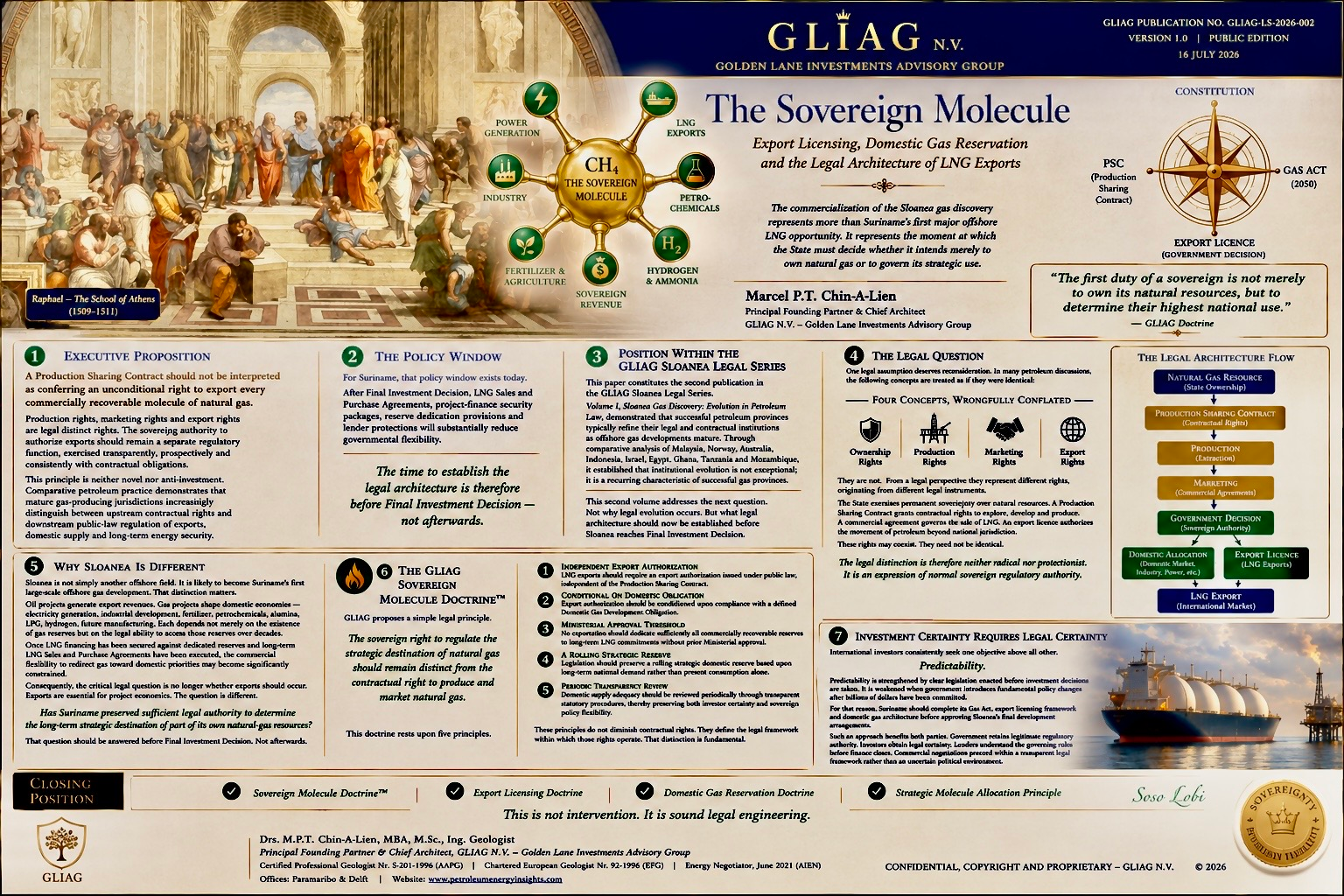
The Sovereign Molecule
Export Licensing, Domestic Gas Reservation and the Legal Architecture of LNG Exports
Marcel P.T. Chin-A-Lien – Principal Founding Partner & Chief ArchitectGLIAG N.V. — Golden Lane Investments Advisory Group – 16th July 2026
The commercialization of the Sloanea gas discovery represents more than Suriname’s first major offshore LNG opportunity. It represents the moment at which the State must decide whether it intends merely to own natural gas or to govern its strategic use.
Executive Proposition
This paper advances one central proposition.
A Production Sharing Contract should not be interpreted as conferring an unconditional right to export every commercially recoverable molecule of natural gas.
Production rights, marketing rights and export rights are legally distinct rights. The sovereign authority to authorize exports should remain a separate regulatory function, exercised transparently, prospectively and consistently with contractual obligations.
This principle is neither novel nor anti-investment. Comparative petroleum practice demonstrates that mature gas-producing jurisdictions increasingly distinguish between upstream contractual rights and downstream public-law regulation of exports, domestic supply and long-term energy security. Although each jurisdiction adopts its own constitutional and legislative approach, the underlying legal philosophy is remarkably consistent: governments preserve sufficient policy space to protect strategic domestic interests while maintaining a predictable investment environment.
THE POLICY WINDOW
For Suriname, that policy window exists today. After Final Investment Decision, LNG Sales and Purchase Agreements, project-finance security packages, reserve dedication provisions and lender protections will substantially reduce governmental flexibility.
The time to establish the legal architecture is therefore before Final Investment Decision — not afterwards.
Position Within the GLIAG Sloanea Legal Series
This paper constitutes the second publication in the GLIAG Sloanea Legal Series.
Volume I, Sloanea Gas Discovery: Evolution in Petroleum Law, demonstrated that successful petroleum provinces typically refine their legal and contractual institutions as offshore gas developments mature. Through comparative analysis of Malaysia, Norway, Australia, Indonesia, Israel, Egypt, Ghana, Tanzania and Mozambique, it established that institutional evolution is not exceptional; it is a recurring characteristic of successful gas provinces.
This second volume addresses the next question. Not why legal evolution occurs. But what legal architecture should now be established before Sloanea reaches Final Investment Decision.
The Legal Question
One legal assumption deserves reconsideration. In many petroleum discussions, the following concepts are treated as if they were identical:
FOUR CONCEPTS, WRONGLY CONFLATED
Ownership
Production
Marketing
Export
They are not. From a legal perspective they represent different rights, originating from different legal instruments.
The State exercises permanent sovereignty over natural resources. A Production Sharing Contract grants contractual rights to explore, develop and produce. A commercial agreement governs the sale of LNG. An export licence authorizes the movement of petroleum beyond national jurisdiction.
These rights may coexist. They need not be identical.
Nothing in comparative petroleum law requires a State to conclude that because a contractor may produce natural gas, it therefore possesses an irrevocable right to export every molecule throughout the life of the project. Indeed, numerous jurisdictions have adopted legislation that preserves governmental authority over domestic supply, export approvals or strategic allocation while fully respecting contractual rights and maintaining investment certainty.
The legal distinction is therefore neither radical nor protectionist. It is an expression of normal sovereign regulatory authority.
Why Sloanea Is Different
Sloanea is not simply another offshore field. It is likely to become Suriname’s first large-scale offshore gas development. That distinction matters.
Oil projects generate export revenues. Gas projects shape domestic economies — electricity generation, industrial development, fertilizer, petrochemicals, alumina, LPG, hydrogen, future manufacturing. Each depends not merely on the existence of gas reserves but on the legal ability to access those reserves over decades.
Once LNG financing has been secured against dedicated reserves and long-term LNG Sales and Purchase Agreements have been executed, the commercial flexibility to redirect gas toward domestic priorities may become significantly constrained.
Consequently, the critical legal question is no longer whether exports should occur. Exports are essential for project economics. The question is different.
Has Suriname preserved sufficient legal authority to determine the long-term strategic destination of part of its own natural-gas resources?
That question should be answered before Final Investment Decision. Not afterwards.
The GLIAG Sovereign Molecule Doctrine
GLIAG proposes a simple legal principle.
The sovereign right to regulate the strategic destination of natural gas should remain distinct from the contractual right to produce and market natural gas.
This doctrine rests upon five principles.
- Independent Export AuthorizationLNG exports should require an export authorization issued under public law, independent of the Production Sharing Contract.
- Conditional on Domestic ObligationExport authorization should be conditional upon compliance with a clearly defined Domestic Gas Development Obligation.
- Ministerial Approval ThresholdNo contractor should dedicate substantially all commercially recoverable reserves to long-term LNG commitments without prior Ministerial approval.
- A Rolling Strategic ReserveLegislation should preserve a rolling strategic domestic reserve based upon long-term national demand rather than present consumption alone.
- Periodic, Transparent ReviewDomestic supply adequacy should be reviewed periodically through transparent statutory procedures, thereby preserving both investor certainty and sovereign policy flexibility.
These principles do not diminish contractual rights. They define the legal framework within which those rights operate. That distinction is fundamental.
Investment Certainty Requires Legal Certainty
International investors consistently seek one objective above all others.
Predictability.
Predictability is strengthened by clear legislation enacted before investment decisions are taken. It is weakened when governments introduce fundamental policy changes after billions of dollars have been committed.
For that reason, Suriname should complete its Gas Act, export licensing framework and domestic gas architecture before approving Sloanea’s final development arrangements.
Such an approach benefits both parties. Government retains legitimate regulatory authority. Investors obtain legal certainty. Lenders understand the governing rules before financial close. Commercial negotiations proceed within a transparent legal framework rather than an uncertain political environment.
CLOSING POSITION
This is not intervention. It is sound legal engineering.
END OF PART I
Soso Lobi
Drs. M.P.T. Chin-A-Lien, MBA, M.Sc., Ing. Geologist
Principal Founding Partner & Chief Architect, GLIAG N.V. — Golden Lane Investments Advisory Group
Certified Professional Geologist Nr. 5201-1996 (AAPG) | Chartered European Geologist Nr. 92-1996 (EFG) | Energy Negotiator, June 2021 (AIEN)
GLIAG Publication No. GLIAG-LS-2026-002 · Sloanea Legal Series, Volume II · petroleumenergyinsights.com
About GLIAG N.V.
GLIAG N.V. — Golden Lane Investments Advisory Group — is an exclusive , high-level boutique advisory group domiciled in Paramaribo, Suriname, working exclusively through C-level Partners and senior Associates. Rooted in Suriname,
GLIAG combines more than a century of proven global petroleum expertise with decades of deep engagement in Suriname.
Its integrated capabilities span petroleum geology, exploration and development, gas and LNG, refining, project economics, fiscal systems, petroleum contracts, legal-regulatory architecture, strategy, capital markets, industrial policy, sovereign value capture and scenario intelligence.
GLIAG delivers confidential, bespoke advisory work for governments, national oil companies, investors, operators, lenders, development institutions and strategic industry partners.
Marcel P. T. Chin-A-Lien
email: marcelchinalien@gmail.com