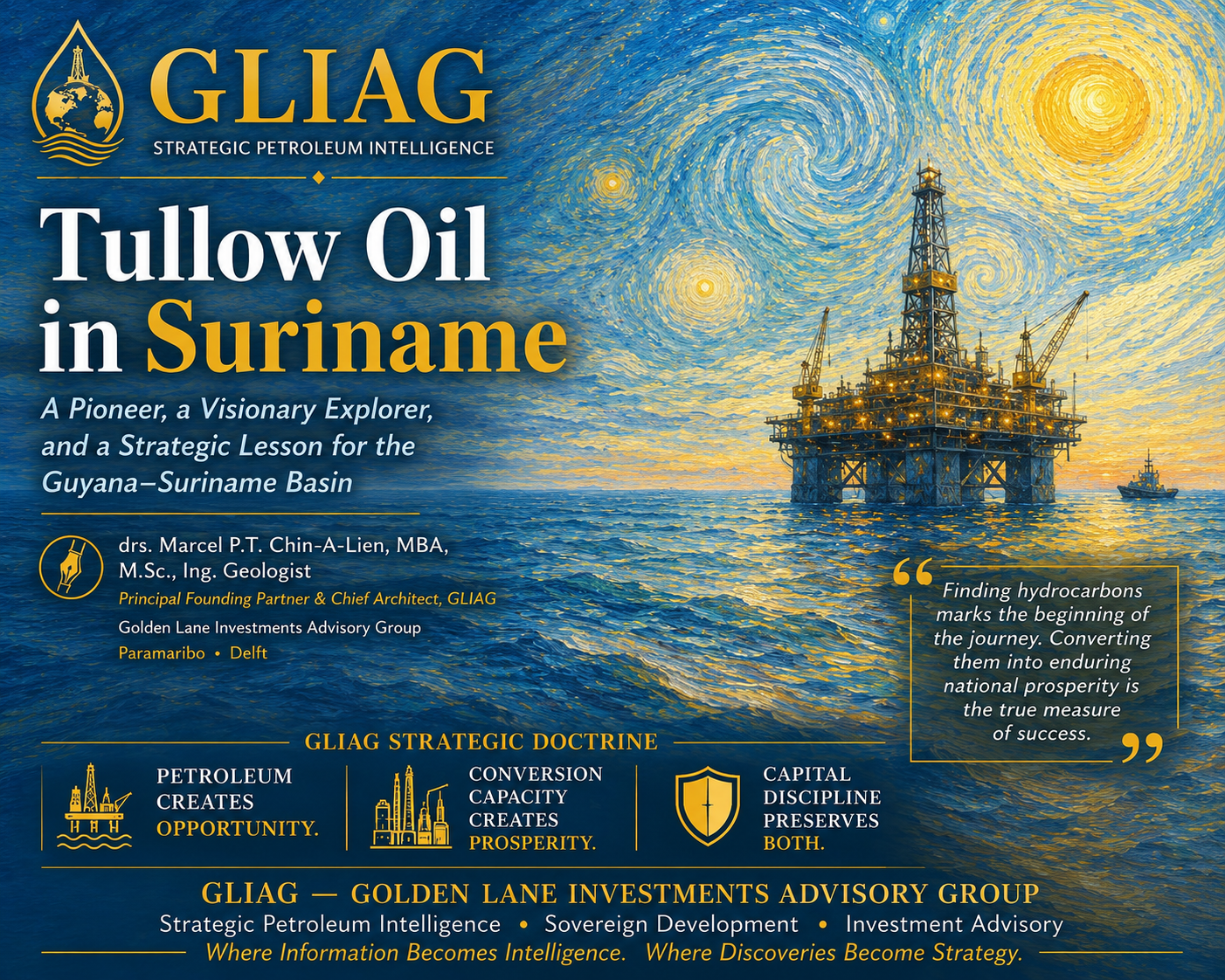
Tullow Oil in Suriname
A Pioneer, a Visionary Explorer, and a Strategic Lesson for the Guyana–Suriname Basin
drs. Marcel P.T. Chin-A-Lien, MBA, M.Sc., Ing. Geologist — Principal Founding Partner & Chief Architect, GLIAG
Golden Lane Investments Advisory Group · Paramaribo, Suriname & The Netherlands · 12 July 2026
History often remembers Tullow Oil for its spectacular petroleum discoveries in Uganda, Ghana and Kenya. Less frequently remembered is that Tullow also became one of the early explorers to recognise the geological promise of the Guyana–Suriname Basin (GSB), both onshore and offshore Suriname.
Tullow’s involvement in Suriname did not begin with the deep-water excitement surrounding the Demerara High. It first entered the country through cooperation with Paradise Oil Company N.V., the exploration subsidiary of Staatsolie. That early partnership reflected confidence in Suriname’s geological potential long before the basin attracted global attention following the major discoveries in neighbouring Guyana.
Subsequently, Tullow expanded its ambitions offshore, acquiring acreage near the Demerara High, where the industry sought to replicate the transformational success achieved in Ghana’s Jubilee Field and later stimulated by the Zaedyus discovery offshore French Guiana. Like several international explorers, Tullow recognised that the Atlantic conjugate margin represented one of the world’s most promising emerging petroleum provinces.
Although commercial success in Suriname ultimately proved elusive, Tullow’s presence contributed to the geological understanding of the basin and helped demonstrate that international capital was prepared to invest in what was then still considered a frontier exploration area.
Yet Tullow’s greatest lesson lies elsewhere.
The company became one of the world’s most successful exploration companies, opening entirely new petroleum provinces across Africa. However, outstanding exploration success alone did not guarantee long-term corporate resilience. Increasing development obligations, high capital requirements and a growing debt burden eventually forced the company to divest high-quality assets in order to preserve its financial position.
For Suriname, this distinction is fundamental.
Discoveries create opportunities. Sound capital allocation determines whether those opportunities become lasting national prosperity.
This lesson resonates strongly with GLIAG’s Suriname Horizon 2050 (SH-2050) development architecture.
Oil production alone does not create sustainable prosperity. Long-term national wealth depends on the ability to convert hydrocarbons into domestic economic value through refining, gas utilisation, industrial development, infrastructure, human capital, institutional strength and disciplined financial management.
Within SH-2050, the New Refinery for Suriname and the Gas-to-Shore Strategy are therefore not viewed as isolated energy projects. They are strategic conversion platforms designed to transform natural resources into broad-based economic development, industrial capacity, energy security and intergenerational national wealth.
Tullow’s history illustrates both the courage required to pioneer new petroleum provinces and the importance of maintaining a sustainable financial architecture once discoveries are made.
For Suriname, the message is clear:
Finding hydrocarbons marks the beginning of the journey. Converting them into enduring national prosperity is the true measure of success.
GLIAG STRATEGIC DOCTRINE
Petroleum creates opportunity. Conversion capacity creates prosperity. Capital discipline preserves both.
GLIAG — GOLDEN LANE INVESTMENTS ADVISORY GROUP
Strategic Petroleum Intelligence • Sovereign Development • Investment Advisory
Where Information Becomes Intelligence. Where Discoveries Become Strategy.