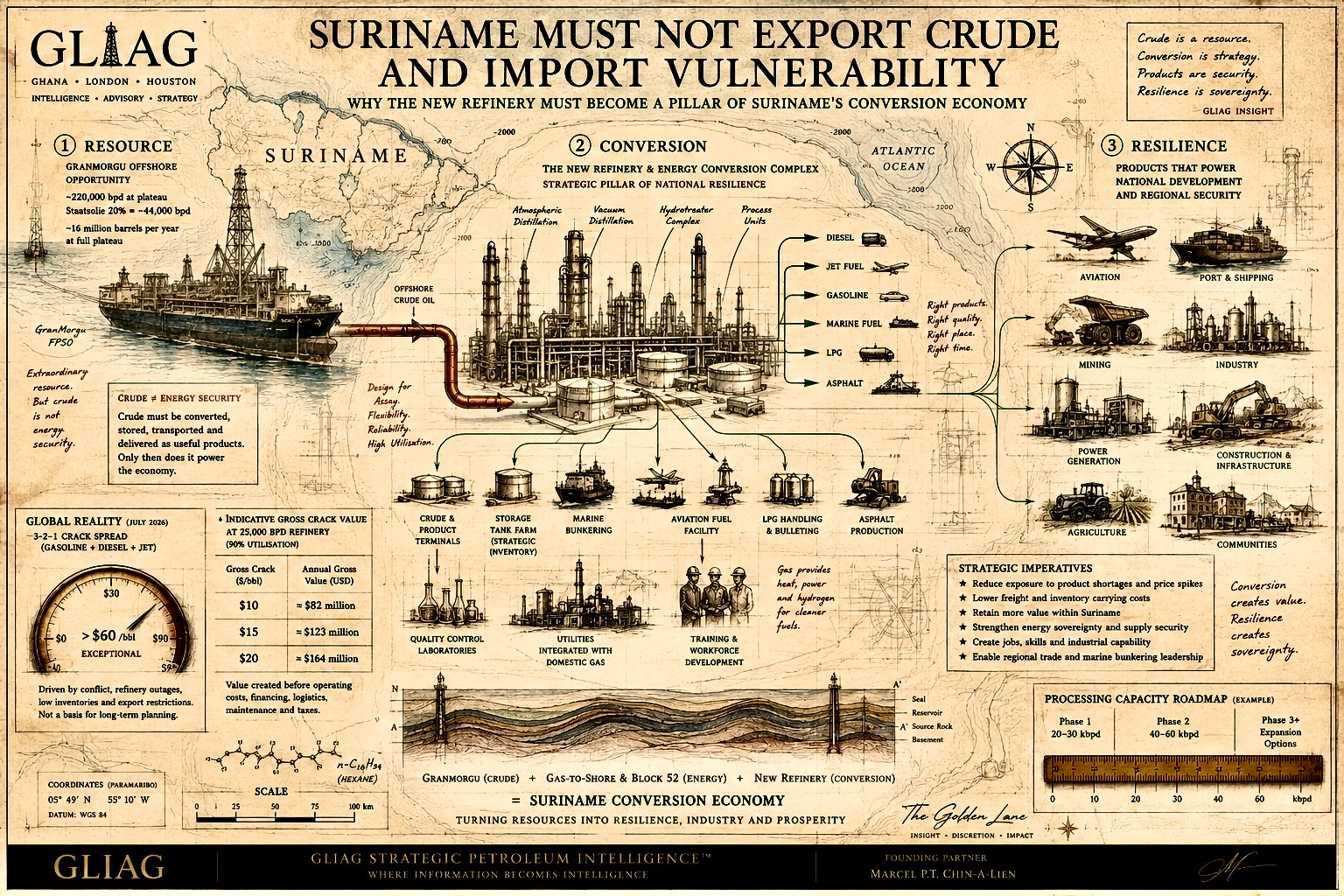
Why the New Refinery Must Become a Pillar of Suriname’s Conversion Economy
Written by Marcel Chin-A-Lien – Petroleum & Energy Advisor – Principal Founding Partner & Chief Architect – GLIAG N.V. – Golden Lane Investments Advisory Group . 10th July 2026.
Crude prices have retreated from their wartime peaks.
Yet the prices of gasoline, diesel and jet fuel continue to signal an altogether different physical reality.
In July 2026, the benchmark 3-2-1 crack spread—the theoretical value created by converting three barrels of crude into two barrels of gasoline and one barrel of distillate—rose above $60 per barrel.
The precise level is exceptional and should not be treated as permanent. But the message conveyed by the market is structural.
Crude oil and useful petroleum products are not interchangeable.
The world may possess sufficient crude while simultaneously suffering from a shortage of operational refineries, diesel, aviation fuel, gasoline, storage, tankers or secure product-trading routes.
Crude stranded behind a geopolitical chokepoint cannot fuel a truck in Paramaribo. Oil stored aboard an FPSO cannot directly power a mining excavator, aircraft, fishing vessel or emergency generator.
This is the strategic distinction upon which Suriname’s New Refinery proposition must be built.
Suriname is approaching an extraordinary moment.
GranMorgu, the country’s first major offshore oil development, is designed to produce approximately 220,000 barrels per day at plateau. Staatsolie’s 20% participating interest represents an economic position equivalent to approximately 44,000 barrels per day—about 16 million barrels per year at full plateau.
Yet Suriname’s existing Tout Lui Faut refinery is a comparatively small facility designed principally around Saramacca crude. It produces valuable diesel, gasoline, fuel oil and bitumen, but its configuration and scale were never intended to transform a significant share of Suriname’s future offshore production.
This creates the Suriname paradox.
The country may soon export large volumes of high-value crude while continuing to import part of the specification-compliant fuel required by its population, industries, mines, aircraft, ships and infrastructure projects.
That is not merely an economic inefficiency. It is a strategic vulnerability.
A producing country does not automatically possess energy security. Energy security exists only when molecules can be converted, stored, transported and delivered in the forms required by the economy.
GranMorgu therefore proves only the first half of Suriname’s petroleum opportunity.
The second half is conversion.
A New Refinery would allow Suriname to convert part of its offshore resource position into diesel, gasoline, jet fuel, marine gasoil, LPG, asphalt and other products required for national development. It could reduce exposure to product shortages, freight spikes, export restrictions and refinery outages elsewhere. It could retain additional segments of the petroleum value chain within Suriname and provide the industrial anchor for storage, shipping, testing, maintenance, engineering and petroleum trading.
The global refining market strengthens this case, but it must be interpreted carefully.
The present extraordinary crack spreads result partly from conflict, refinery damage, depleted inventories and restricted product exports. They cannot responsibly support a long-term financial model. Suriname should never approve a refinery that is viable only under wartime margins.
The correct question is not whether today’s $60 spread will continue.
The correct question is whether Suriname can design a refinery capable of surviving at conservative margins while creating additional national value through import substitution, supply security, regional trade and integration with domestic crude and gas.
A first phase of approximately 20,000 to 30,000 barrels per day appears strategically credible. At 25,000 barrels per day and 90% utilisation, such a facility would process approximately 8.2 million barrels per year. At an illustrative gross crack of $10 per barrel, it would create roughly $82 million of annual gross crack value before operating costs, financing, logistics, maintenance and taxes. At $15 per barrel, the figure rises to approximately $123 million; at $20, approximately $164 million.
These are not projected profits. They are an indication of the economic value available for conversion before costs.
The design must therefore achieve more than crude distillation. It must produce the product slate Suriname and its neighbours actually require. It must secure low-cost utilities, reliable storage and marine access. It must be capable of processing a defined offshore crude assay or a commercially optimised crude blend. It must achieve high utilisation, because small refineries are particularly vulnerable to prolonged shutdowns and low throughput.
This is why the New Refinery should be conceived not as an isolated processing plant but as a Suriname Energy Conversion and Product Security Complex.
The complex should combine refining, strategic fuel storage, crude and product terminals, marine bunkering, aviation-fuel capability, LPG handling, asphalt production, product blending, quality-control laboratories and petroleum workforce development. Its utilities should ultimately integrate with domestic gas, enabling gas to provide process heat, electricity and potentially hydrogen for cleaner fuel production.
Such integration would connect three of Suriname’s most important strategic propositions.
GranMorgu would supply the crude opportunity.
Gas-to-Shore and Block 52 could provide energy and industrial feedstock.
The New Refinery would perform the conversion.
Together, these assets could form the industrial nucleus of Suriname’s Conversion Economy: an economy that does not merely produce petroleum but transforms petroleum into energy security, infrastructure, technical capability, employment, services and exportable products.
The regional proposition is equally important.
Suriname’s domestic market alone cannot safely support an oversized refinery.
Future phases must therefore be tied to credible regional demand, including Guyana, French Guiana, selected Caribbean markets, Atlantic shipping, offshore-service vessels and aviation.
Geographic proximity can create value through lower freight, faster replenishment and reduced inventory requirements, even where very large international refineries retain lower unit-processing costs.
Nevertheless, Suriname must avoid the refinery trap.
Around the world, governments have built refineries as symbols of sovereignty, only to encounter cost overruns, political interference, inappropriate crude configurations, inadequate pipelines, poor maintenance and chronic underutilisation.
A national refinery can create sovereignty, but an undisciplined refinery can destroy sovereign capital.
The New Refinery must therefore be protected by an institutional decision gate.
No final investment decision should occur before independent studies establish the offshore crude assay, product yields, market demand, site and port requirements, environmental performance, capital cost, operating cost, financing structure, carbon exposure, product offtake and downside resilience.
It should be developed in phases.
It should contain expansion options rather than immediate overcapacity.
It should be professionally operated.
Feedstock should be transferred at transparent market value.
Product subsidies should not be hidden inside the refinery.
Government policy, Staatsolie’s upstream interests and the refinery’s commercial accounts must remain clearly distinguishable.
The central thesis is therefore neither simplistic nationalism nor narrow short-term profit.
It is strategic conversion.
Suriname’s offshore future should not consist only of crude exported from FPSOs and revenues transferred into government accounts. It should include the physical capability to convert part of that resource into the products, institutions, industries and skills upon which a modern economy depends.
The present global refining crisis reveals a truth that is easy to overlook during periods of abundance:
A barrel of crude is valuable.
A barrel of usable fuel, available inside the country during a global disruption, may be indispensable.
Suriname must therefore decide what kind of petroleum nation it intends to become.
Will it be merely a producer of crude?
Or will it become a country capable of converting its resources into national resilience, productive industry and long-term sovereign capability?
The New Refinery is the bridge between those two futures.
GLIAG conclusion: strategically indispensable, commercially conditional, modular by design and sovereignly protected.