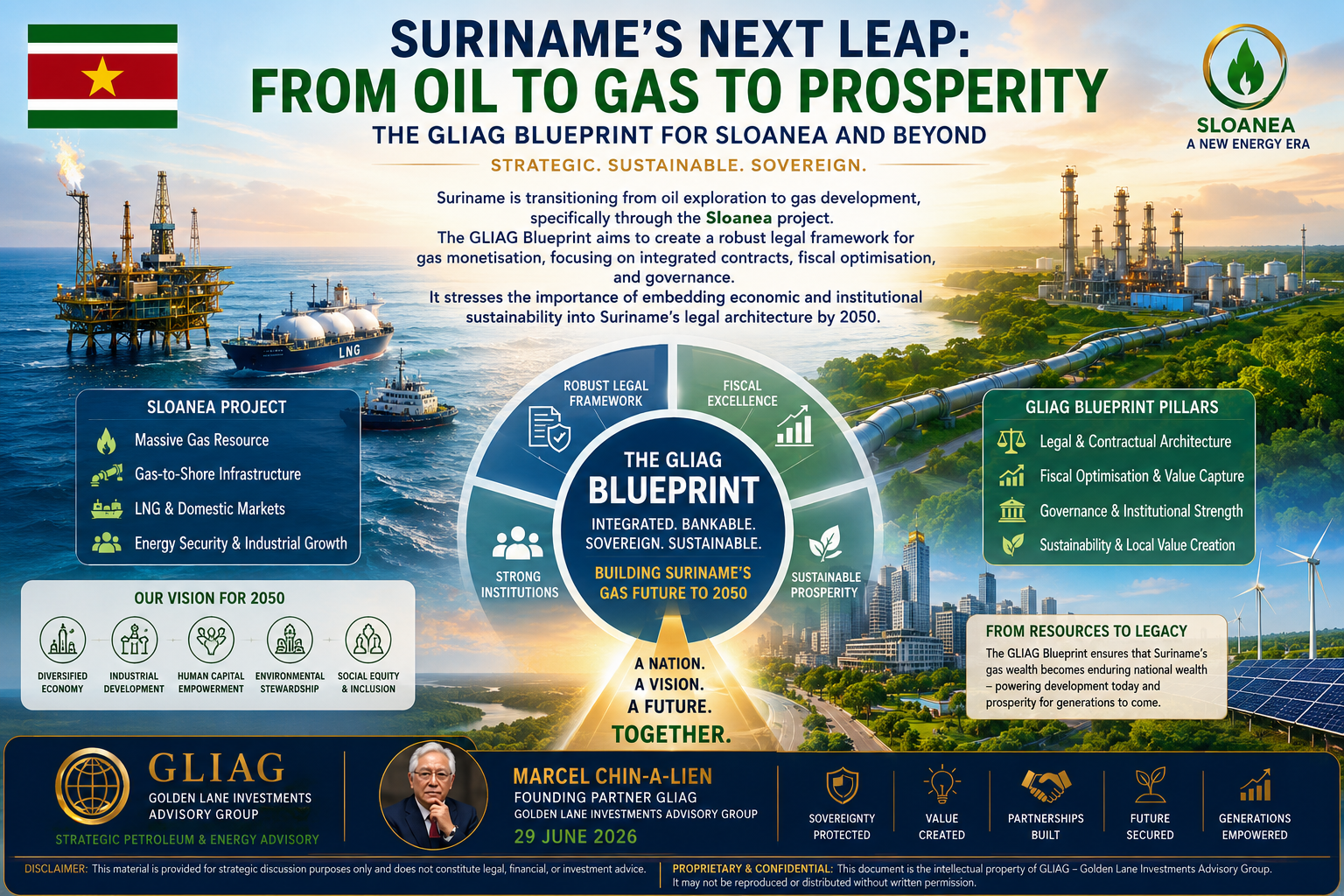
GLIAG | SURINAME HORIZON 2050 – LEGAL & CONTRACTUAL ARCHITECTURE SERIES
Designing Suriname’s
Gas-Era PSC and
Legal Architecture
A GLIAG Blueprint for Sloanea FLNG and Gas-to-Shore – 29 June 2026
Drs. M.P.T. Chin-A-Lien, MBA, M.Sc., Ing. Geologist
Principal Founding Partner & Chief Architect — Golden Lane Investments Advisory Group (GLIAG)
Certified Professional Geologist Nr. 5201-1996 (AAPG)
Chartered European Geologist Nr. 92-1996 (EFG)
Energy Negotiator June 2021 (AIEN)
petroleumenergyinsights.com
Executive Summary
Suriname is moving from exploration to execution in its offshore petroleum story, with GranMorgu oil and Sloanea gas marking the beginning of a long cycle of development that will run through 2050 and beyond. The central question is whether the country’s PSCs, gas addenda and related legal instruments are structured to turn this resource wave into durable national capability — energy security, industrial growth, institutional strength — rather than simply into fiscal flows.
This GLIAG Blueprint answers that question by setting out a coherent, gas-era legal architecture for Sloanea FLNG and gas-to-shore (GtS), anchored in the Suriname Horizon 2050 (SH-2050) strategic framework.
The report argues that Suriname must treat PSCs, Gas Addenda and Host Government Agreements (HGAs) as integrated conversion instruments, not isolated project contracts. For Sloanea, that means:
• Redesigning the Gas Addendum as a sovereign tool that explicitly embeds FLNG mobility safeguards, domestic gas allocation and alignment with the Execution Synchronization Timeline (EST);
• Building an HGA that defines a national gas infrastructure system and incorporates modern economic-equilibrium stabilization and reversion clauses;
• Calibrating fiscal terms — royalties, tax holidays, depreciation and investment allowances — so they are competitive for FLNG while preventing state-granted incentives from being capitalized as ‘developer value’ in future buyback scenarios.
An Addendum presents a GLIAG Gas-to-Shore Integration Playbook, offering concrete strategies for embedding GtS into existing PSC frameworks through gas addenda, HGAs, fiscal and stabilization architecture, and governance interfaces.
Together, the Blueprint and the Addendum provide Suriname with a contract-level roadmap for moving from Gas-to-Shore to Growth-to-State.
1. Purpose and Strategic Lens
Suriname stands at the threshold of a structural transition. Offshore discoveries in the Guyana-Suriname Basin — notably GranMorgu in Block 58 and Sloanea in Block 52 — are moving the country from geological potential to concrete development plans. The question is no longer whether Suriname will produce hydrocarbons offshore, but how it will convert this production into enduring national capabilities.
This GLIAG Blueprint sets out the production sharing contract (PSC), contractual and legal architecture Suriname should adopt for its gas era, with Sloanea FLNG and gas-to-shore (GtS) as the first real test case. The report is written at the level of international project finance, contract law and sovereign strategy, and is designed as a navigational document for policymakers, Staatsolie, project sponsors and legal counsel.
GLIAG’s lens is deliberately integrated: PSCs, gas addenda, host government agreements (HGAs), stabilization and reversion clauses, fiscal terms and governance provisions must be treated as a single, coherent system. Only in that configuration can Suriname align gas monetization, fiscal resilience and institutional development under the SH-2050 doctrine.
2. Suriname’s PSC Baseline: Attractive but Incomplete
Suriname’s PSC framework, grounded in the Petroleum Act and a series of contracts awarded since 2013, has successfully attracted major international operators to its deepwater acreage. The Block 52 PSC, signed in April 2013 between Staatsolie and PETRONAS Suriname E&P B.V., has delivered three discoveries, culminating in the Sloanea-1 gas find and the 2025 approval of the Commercial Field.
The March 2024 Letter of Agreement (LoA) between Staatsolie, PETRONAS and ExxonMobil for Block 52 marked a strategic inflection point. It extended gas exploration, explicitly considered floating liquefied natural gas (FLNG) as the development concept, and secured government approval for a ten-year tax-free period from first gas production. That LoA now forms the basis for a Gas Addendum to the PSC, which will define procedures and conditions for assessing, developing and producing Sloanea gas.
From GLIAG’s perspective, this evolution exposes a structural gap: the current PSC framework was designed chiefly for oil. It is now being asked to carry gas, FLNG, GtS and complex project finance, without a fully articulated sovereign architecture supporting it.
3. GLIAG Design Principles: From Contract to Conversion
GLIAG’s Horizon 2050 and ‘Suriname and the Conversion’ doctrine define petroleum contracts not as isolated documents, but as conversion instruments: they must help transform offshore resource flows into sustainable national capabilities. For gas and FLNG, this implies three design principles:
| Principle | Description |
| Sovereign Alignment | Every PSC, gas addendum and HGA must be explicitly aligned with SH-2050 and Suriname’s medium-term fiscal framework, ensuring that contractual decisions reinforce long-term development goals rather than short-term revenue maximization. |
| Integrated Architecture | PSCs, gas addenda, HGAs and project-company agreements must operate as a single system for gas and LNG, with clear interfaces and no critical gaps. Contracts that are individually sound but collectively incoherent will not deliver the required conversion. |
| Execution Discipline | Legal instruments must be built around the Execution Synchronization Timeline (EST): a sequenced pathway linking exploration, FID, FLNG delivery, gas-to-shore integration and downstream industrialization to the realities of Suriname’s institutional capacity and financing options. |
4. PSC and Gas Addendum: Upgrading the Core Contract
4.1 Gas Addendum as a Sovereign Design Tool
The Sloanea LoA envisages a Gas Addendum to the Block 52 PSC, which will govern assessment and development of the gas discovery. GLIAG recommends that this Gas Addendum be drafted as a sovereign design instrument, not merely as a technical annex.
Integrated Gas-to-Shore and Domestic Allocation Rights
The Gas Addendum should define Suriname’s right to allocate a portion of Sloanea gas to domestic power generation and industrial use. Pricing formulas should be transparent and linked to regional LNG netbacks, ensuring affordability without undermining project economics.
FLNG Mobility Safeguards
FLNG’s mobility is both a commercial advantage and a sovereign risk. The Gas Addendum must require that any redeployment of the FLNG unit outside Suriname’s jurisdiction is subject to explicit state consent, with predefined consequences for domestic gas supply and associated infrastructure.
Timeline Alignment with EST
Development milestones — appraisal, development plan submission, FID, first gas — should be mapped directly onto the EST, creating contractual discipline around synchronizing gas projects with Suriname’s wider infrastructure and institutional build-out.
4.2 Fiscal Architecture within PSCs
The ten-year tax-free period for Sloanea gas, granted in the LoA, has been highlighted as a critical factor enabling first gas by around 2031. GLIAG’s view is that PSC-linked fiscal architecture should now be systematically optimized:
• Calibrated royalty and tax structure: Royalty rates should reflect FLNG’s smaller scale and different risk profile, using sliding scales to share upside at higher price bands while protecting downside. Corporate tax after the holiday should be competitive regionally, with targeted incentives for domestic gas-to-power and industrial use.
• Accelerated depreciation and investment allowances: PSC fiscal annexes should allow accelerated depreciation for FLNG and GtS infrastructure, plus investment allowances to recognize high front-loaded capex and encourage technology and capacity build-out.
• Explicit exclusion of fiscal incentives from ‘developer value’: PSC and Gas Addendum language must state that state-granted tax holidays, reduced royalties and customs exemptions are not to be treated as ‘developer contribution’ in any future buyback or reversion valuation. This directly mitigates the Alaska LNG risk where tax breaks become monetizable value claims against the state.
5. Host Government Agreements: Turning Contracts into Systems
Energy Charter model agreements and global LNG practice show that Host Government Agreements (HGAs) are indispensable for large gas and LNG systems, providing a legal and governance umbrella for pipelines, terminals, FLNG units and related infrastructure.
For Suriname’s gas era, GLIAG recommends a Sloanea-anchored HGA that addresses four critical dimensions:
National Gas Infrastructure System
The HGA should treat Sloanea upstream facilities, subsea infrastructure, FLNG, gas-to-shore pipelines, power-generation assets and industrial connections as a single system, with clear coordination obligations and governance structures.
Economic-Equilibrium Stabilization
Rather than freezing law, the HGA should adopt economic-equilibrium stabilization clauses. Material changes in Suriname’s fiscal or regulatory framework trigger structured notification, impact assessment and negotiation to restore agreed economic balance, while allowing the state to update environmental and climate policy, including NDC 3.0 commitments.
Reversion and Early Buyback Mechanisms
End-of-term reversion of gas rights and in-country infrastructure, and early reversion triggers — failure to reach FID, sustained non-performance, insolvency, extended force majeure — should be clearly defined. Valuation methodologies for state buyback must be transparent and exclude the capitalization of fiscal incentives.
Investor-State Protections
HGA dispute resolution should be consistent with Suriname’s international commitments, including Energy Charter principles, providing access to international arbitration while maintaining domestic legal coherence.
In GLIAG’s framing, the HGA turns Sloanea from a project into the core of a national gas system.
6. Stabilization and Reversion: Legal Shock Absorbers
Long-cycle LNG projects are inherently exposed to changes in law, politics and markets. Stabilization and reversion clauses are the legal shock absorbers that determine whether Suriname can manage these changes without compromising project viability or sovereign control.
6.1 Economic Equilibrium Stabilization for Sloanea
GLIAG proposes an economic-equilibrium stabilization approach structured around three mechanisms:
• Defined Change in Law: The clause defines qualifying changes — tax, royalties, customs, petroleum and energy regulations, climate-related obligations — that materially affect Sloanea FLNG/GtS economics.
• Notification and Joint Assessment: PETRONAS and the Project Company notify Staatsolie and the Government of adverse changes. Both sides undertake a joint impact assessment, potentially drawing on the Gas Exploitation Study Group methodology.
• Targeted Adjustments and Arbitration Backstop: If economic equilibrium is disrupted, parties negotiate limited adjustments (tax corridors, tariff tweaks, term extensions, targeted credits). Failing agreement, international arbitration determines whether a disruption exists and prescribes corrective measures.
This model balances investor protection with Suriname’s sovereign right to evolve its legal and climate frameworks.
6.2 Reversion and Buyback Rights
Equally important are reversion and buyback mechanisms:
• End-of-term reversion: On PSC/HGA expiry, Sloanea gas rights revert to Suriname. Fixed assets in Suriname’s jurisdiction — subsea infrastructure, domestic pipelines, GtS facilities — transfer to the state, along with full technical and operational data sets.
• Early reversion triggers: Failure to reach FID, sustained non-performance, financial distress, extended force majeure and mutually agreed restructuring all serve as early reversion triggers, linked to Suriname’s execution timelines.
• Fair but protected compensation: Buyback valuation focuses on depreciated cost, net book value and independent fair market appraisal, with explicit exclusion of tax holidays and other state incentives from ‘developer value’ calculations.
These provisions ensure Suriname can regain control when necessary, without paying twice for its own policy decisions.
7. Governance and Transparency: Making Contracts Durable
Suriname’s EITI reports and governance assessments emphasize the need for a more transparent and effective framework to manage the upcoming resource wave. GLIAG’s doctrine is that durable PSC and HGA frameworks must embed governance and transparency at their core:
• Parliamentary Access and Oversight: Statutory rights for parliament and designated committees to access full PSCs, gas addenda, HGAs and project-company agreements under confidentiality should be codified, avoiding dependence on leaks to support oversight.
• EITI-Aligned Disclosure and Beneficial Ownership Transparency: Fiscal terms, stabilization arrangements and beneficial ownership in the gas value chain should be disclosed in line with EITI and Suriname-2050 governance objectives.
• Coordinated Institutional Roles: Legal instruments should clearly define roles and decision rights among Staatsolie, key ministries and regulators, aligned with the national target of fully harmonizing governance legislation with regional and international standards by 2040.
These measures give investors confidence, lower capital costs and strengthen domestic legitimacy.
8. Conclusion: PSCs as Instruments of Gas-to-State Conversion
Sloanea FLNG and gas-to-shore are more than technical projects; they are the first real test of whether Suriname can translate offshore gas into broad-based societal benefits and institutional strength. PSCs and related legal instruments sit at the center of this test.
GLIAG’s Blueprint can be summarized in four imperatives:
• Treat gas addenda and HGAs as sovereign design tools that integrate FLNG, gas-to-shore, domestic allocation and fiscal architecture into a single, coherent system.
• Use economic-equilibrium stabilization and carefully structured reversion clauses as legal shock absorbers, avoiding both investor insecurity and sovereign paralysis.
• Explicitly protect Suriname from the capitalization of its own fiscal incentives as developer ‘value’ in future buyback scenarios.
• Embed governance, transparency and execution discipline into every major contract, aligning them with SH-2050 and the Execution Synchronization Timeline.
GLIAG DOCTRINE
If Suriname follows this path, PSCs will cease to be mere legal gateways to resource extraction.
They will become conversion instruments, guiding the country from Gas-to-Shore to genuine Growth-to-State.
ADDENDUM A
GLIAG Gas-to-Shore Integration Playbook
Strategies for Embedding GtS in Suriname’s PSC and Legal Architecture
A1. Purpose
This Addendum outlines practical strategies for integrating gas-to-shore (GtS) into Suriname’s existing PSC framework, with Sloanea Block 52 as the anchor use case. It is intended to complement the main GLIAG Blueprint by providing a concise operational playbook for policymakers, Staatsolie, sponsors and legal teams who must translate conceptual ‘Gas-to-Shore to Growth-to-State’ ambitions into binding contract language.
A2. Design Principle: Treat GtS as a System, Not a Bolt-On
GLIAG’s doctrine is that GtS must be treated as part of a national gas system, not as a bolt-on project. Integration should therefore be:
• Contractual — reflected in PSC gas addenda, HGAs and midstream agreements;
• Institutional — aligned with SH-2050 governance and execution structures;
• Strategic — directly linked to Suriname’s goal of moving from Gas-to-Shore to Growth-to-State.
A3. Strategy 1 — Use the Gas Addendum as the Core Integration Vehicle
1. Explicitly define GtS within the Gas Project scope: The Gas Addendum for Sloanea should specify that gas-to-shore infrastructure — pipelines, landfall, gas reception, gas-to-power plants and industrial connections — is part of the Project’s monetization pathway, even when developed by third parties or national vehicles.
2. Clarify roles and obligations: The PSC contractor provides data, tie-in points and technical cooperation necessary for GtS design and operation. The State, via Staatsolie or a gas entity, leads or procures GtS infrastructure, ensuring non-discriminatory access and coordination with upstream operations.
3. Preserve upstream gas entitlement: Maintain PSC gas entitlement logic — cost gas, profit gas, royalty — while specifying how volumes allocated to domestic GtS uses are counted and priced, so that each party’s share is clearly understood.
A4. Strategy 2 — Anchor GtS in a Host Government Agreement
4. Define a National Gas Infrastructure System in the HGA: A dedicated HGA for Sloanea and future gas projects should define a national gas infrastructure system that includes FLNG, subsea, pipelines and GtS facilities under common rules for access, tariffs and permits.
5. Use cross-references from PSC to HGA: PSCs should reference the HGA as the legal instrument governing midstream and GtS, and confirm delivery conditions — pressure, quality, scheduling — and pricing principles for gas delivered into the GtS system.
6. Maintain contractual hierarchy and coherence: PSCs govern upstream rights; HGAs govern midstream and certain downstream aspects. Integration clauses must explicitly resolve conflicts and define priority, to avoid ambiguity and legal drift.
A5. Strategy 3 — Integrate GtS through Fiscal and Stabilization Architecture
7. Domestic gas allocation and pricing clauses: Gas addenda should reserve a defined share of PSC gas for domestic GtS uses, with pricing formulas based on transparent netback or cost-plus methods, balancing affordability with project viability.
8. Economic-equilibrium stabilization including GtS impacts: Stabilization clauses must cover fiscal and regulatory changes related to GtS — tariffs, domestic gas obligations, energy market reforms. Material changes that affect PSC gas economics should trigger economic-equilibrium adjustments, not automatic compensation or conflict.
9. Separate treatment of GtS-specific incentives: Tax or tariff incentives given to GtS infrastructure should be identified and kept separate from PSC contractor entitlements, to avoid later disputes over ‘developer value’ and state obligations.
A6. Strategy 4 — Embed Governance and Implementation Interfaces in PSCs
10. Data-sharing obligations for GtS planning: PSC clauses should require timely sharing of reservoir and production data, pressure and deliverability profiles, and subsea/flowline information required for GtS design, under appropriate confidentiality protections.
11. GtS-aware development plans: Field development plans submitted under PSCs should explicitly incorporate GtS assumptions — tie-in locations, capacity ranges, timing. Regulatory approvals thus become instruments of system integration, not just upstream milestones.
12. Institutional coordination mechanisms: PSC and HGA language should reference national coordination bodies, requiring structured engagement on GtS planning, investment sequencing and risk management.
A7. Strategy 5 — Align GtS Integration with Growth-to-State Doctrine
Every GtS integration decision should be evaluated against Suriname’s Gas-to-Shore to Growth-to-State doctrine. Three questions must be answered affirmatively:
• Does this integration choice help transform gas into reliable power, industrial capacity and employment, rather than simply into fiscal flows?
• Does it strengthen institutional capability and governance, consistent with SH-2050?
• Does it preserve Suriname’s ability to recalibrate gas usage as the energy transition unfolds?
If the answer is yes across all three dimensions, GtS integration is serving its strategic purpose. If not, the PSC and legal architecture must be revisited.
Disclaimer
This publication reflects the independent professional opinion of the author and GLIAG. It is intended to stimulate strategic discussion and does not constitute legal, fiscal or investment advice. All project schedules, commercial assumptions and development concepts remain subject to operator decisions, government approvals and market conditions.
© 2026 Golden Lane Investments Advisory Group (GLIAG). All Rights Reserved.
Drs. M.P.T. Chin-A-Lien, MBA, M.Sc., Ing. Geologist
Principal Founding Partner & Chief Architect — Golden Lane Investments Advisory Group (GLIAG)
Independent Strategic Opinion | petroleumenergyinsights.com
Suriname Horizon 2050 | GLIAG Blueprint | 2026Page