Petroleum-System Insights for Strategic Decision-Making · Basin Intelligence Series 2026
SCIENTIFIC PUBLICATION · BLOCK 52, OFFSHORE SURINAME · GUYANA–SURINAME BASIN
Upper Cretaceous Petroleum System —
Block 52, Suriname
Understanding the Geological Architecture of an Emerging Dual Oil-and-Gas Province
MC
Drs. M.P.T. Chin-A-Lien, MBA, M.Sc., Ing. Geologist
PRINCIPAL FOUNDING PARTNER & CHIEF ARCHITECT · GLIAG
Golden Lane Investments Advisory Group
Certified Professional Geologist Nr. 5201-1996 (AAPG) · Chartered European Geologist Nr. 92-1996 (EFG) · Energy Negotiator June 2021 (AIEN)
© 2026 · petroleumenergyinsights.com
ABSTRACT
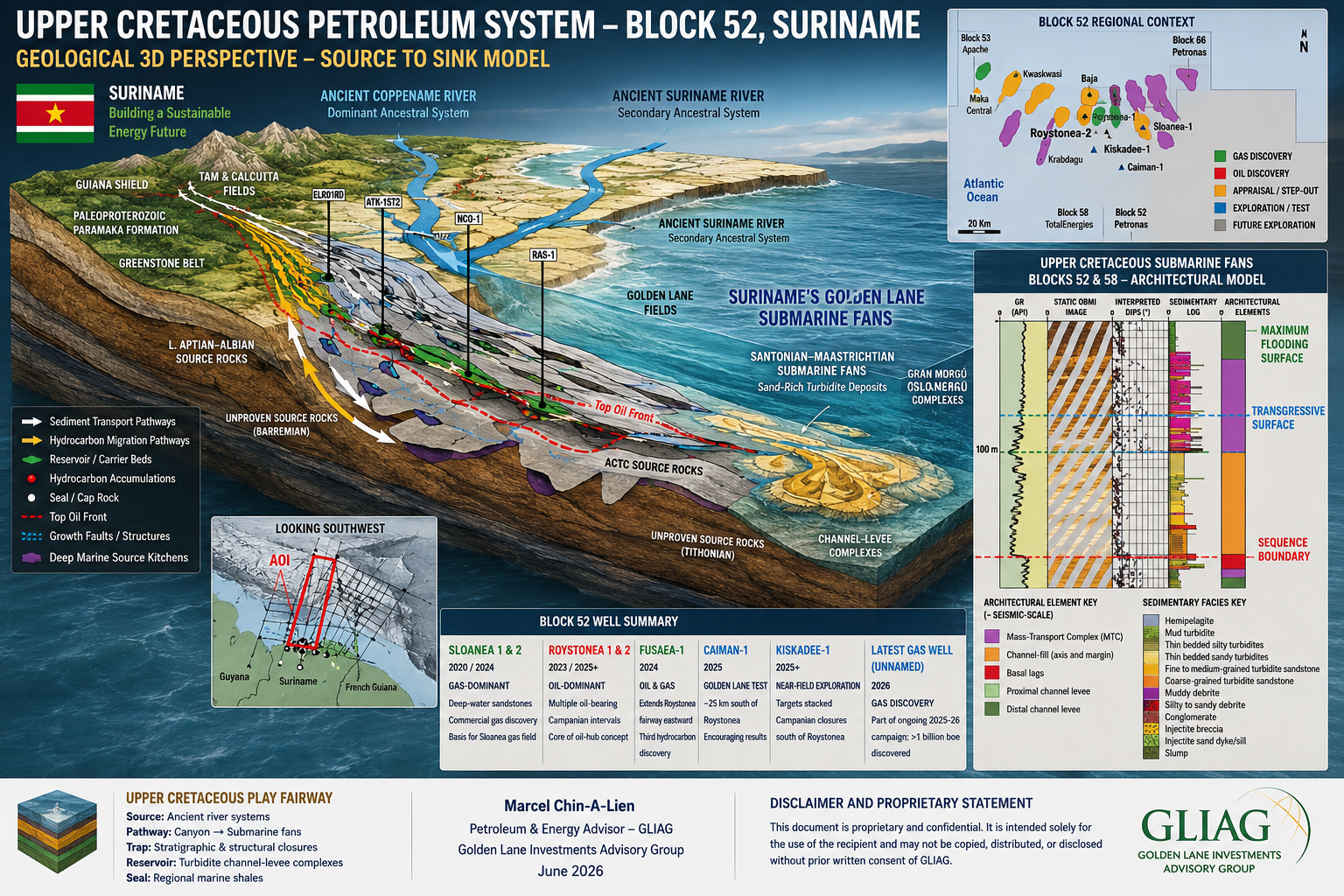
The recent exploration success of Block 52 has established the licence as one of the most important emerging hydrocarbon provinces offshore Suriname. Commercial oil discoveries at Roystonea and Fusaea, together with significant natural gas discoveries at Sloanea and the SAC-1 complex, demonstrate that the block contains a working Upper Cretaceous petroleum system capable of generating, migrating, trapping and preserving commercial hydrocarbons.
This publication examines the geological processes responsible for these discoveries from a petroleum-system perspective. Rather than analysing individual wells in isolation, it reconstructs the complete geological evolution of the system — beginning with the opening of the Equatorial Atlantic during the Early Cretaceous, following the deposition of organic-rich marine source rocks, the burial and thermal maturation that generated hydrocarbons, the erosion of the Precambrian Guiana Shield, the transport of quartz-rich sediment through ancient fluvial systems, the development of submarine canyons and basin-floor fans, hydrocarbon migration into Upper Cretaceous reservoirs, and the formation of structural and stratigraphic traps sealed beneath regional marine shales.
The principal conclusion is that Block 52 should be interpreted as a mature Upper Cretaceous petroleum system whose exploration history has progressed beyond proving the existence of hydrocarbons toward understanding the regional geological architecture controlling their distribution.
KEYWORDS
Block 52 · Offshore Suriname · Guyana–Suriname Basin · Upper Cretaceous · Petroleum System · Source-to-Sink · Deepwater Turbidites · Basin-Floor Fans · Source Rocks · Migration · Trap · Seal · Reservoir Architecture · Petroleum Geology · Turbidite Reservoirs · Petroleum Province
Category A
Direct Evidence
Supported directly by drilling, well data, laboratory measurements or published operator information. Includes commercial discoveries, lithological observations, hydrocarbon shows and fluid composition.
Category B
Regional Geological Evidence
Supported by published geological literature, basin studies, seismic interpretation, regional stratigraphy, analogue basins or peer-reviewed research.
Category C
Petroleum-System Interpretation
Scientific interpretation developed by integrating Categories A and B using established petroleum-system methodology. Includes migration pathways, system continuity and predictive exploration implications.
BLOCK 52 — KEY DISCOVERIES
| DISCOVERY | FLUID TYPE | RESERVOIR | SIGNIFICANCE |
|---|---|---|---|
| Roystonea | OIL | Upper Cretaceous | First commercial oil confirmation; proves source maturity, migration and seal integrity |
| Fusaea | OIL | Upper Cretaceous | Confirms lateral extent of favourable charge and reservoir conditions across the block |
| Sloanea | GAS | Upper Cretaceous | Reveals gas-prone kitchen segment; confirms dual oil-and-gas character of one integrated system |
| SAC-1 Complex | GAS | Upper Cretaceous | Additional calibration point; strengthens system continuity interpretation across Block 52 |
PETROLEUM SYSTEM — ESSENTIAL ELEMENTS
SOURCE
Organic-Rich Lower Cretaceous Marine Shales
GENERATION
Burial & Thermal Maturation
TRANSPORT
Guiana Shield → Turbidite Fans
MIGRATION
Carrier Beds & Fault Pathways
TRAP + SEAL
Structural & Stratigraphic Closures
TABLE OF CONTENTS
- 01 – Introduction: Before an Offshore Block Becomes an Energy Project
- 02 – Geological Setting: The Birth of a Passive Continental Margin
- 03 – The Source Rocks: Where Every Hydrocarbon Begins
- 04 – Burial History, Thermal Maturation and Hydrocarbon Generation
- 05 – The Source-to-Sink System: From the Guiana Shield to the Deep Atlantic
- 06 – From Rivers to Gravity Flows: Construction of the Deepwater Reservoirs
- 07 – Migration Pathways: The Invisible Journey of Hydrocarbons
- 08 – Trap Formation and Seal Integrity: Why the Hydrocarbons Stayed
- 09 – Geological Calibration Through Exploration
- 10 – From Exploration Block to Petroleum Province
- 11 – Predicting the Future: Petroleum-System Analysis as an Exploration Tool
- 12 – Final Conclusion: The Petroleum System Behind the Discoveries
- 13 – Scientific Synthesis: Why Block 52 Matters
- 14 – Implications for Future Exploration
- 15 – Scientific Summary and Principal Findings
Chapter 01
Introduction: Before an Offshore Block Becomes an Energy Project, It Is a Geological System
Block 52, offshore Suriname, has rapidly become one of the most significant exploration licences in the Guyana–Suriname Basin. Commercial discoveries of oil at Roystonea and Fusaea, together with the major gas discoveries at Sloanea and the SAC-1 complex, have confirmed that the block contains substantial hydrocarbon resources. Yet discoveries are the end of a much longer story.
Long before the first seismic survey was acquired, before the first exploration well penetrated the subsurface, and before hydrocarbons were assigned economic value, a geological system had already been operating beneath the offshore margin of Suriname for more than one hundred million years. That system generated the hydrocarbons, transported them through the subsurface, concentrated them into reservoirs and preserved them beneath effective seals until exploration drilling revealed their presence.
This publication is therefore not a report on discoveries; it is an explanation of the geological processes that made those discoveries possible. Block 52 should not be interpreted as a collection of individual fields. It should be understood as the surface expression of a single, integrated Upper Cretaceous petroleum system.
Chapter 02
Geological Setting: The Birth of a Passive Continental Margin
Every petroleum system begins long before hydrocarbons are generated. It begins with the geological evolution of the basin itself. The petroleum system of Block 52 is the product of a sequence of tectonic, sedimentological and thermal processes that accompanied the opening of the Equatorial Atlantic during the Early Cretaceous.
The Guyana–Suriname Basin occupies the transform continental margin along the northern edge of South America. Unlike volcanic rifted margins that formed through large-scale magmatic activity, this margin developed predominantly through strike-slip and oblique-divergent tectonics associated with the separation of the South American and African plates. The resulting basin architecture differs from many classic Atlantic-margin petroleum provinces: structural relief is generally moderate, while stratigraphic architecture, sediment distribution and long-term subsidence exert the dominant control on petroleum-system development.
Progressive thermal subsidence allowed the basin to deepen gradually while maintaining exceptional preservation of its stratigraphic record. This tectonic stability proved to be one of the greatest strengths of the basin. Rather than undergoing repeated phases of deformation that might have destroyed reservoirs or breached hydrocarbon accumulations, much of the offshore margin evolved under relatively stable geological conditions — favouring the preservation of mature source rocks, continuous migration pathways, extensive deepwater reservoirs and effective regional sealing formations.
The geological history of the basin can be viewed as the progressive assembly of a petroleum system: the opening Atlantic created the basin; marine environments deposited organic-rich sediments; long-term burial generated hydrocarbons; the uplifted Guiana Shield supplied quartz-rich sediment; and exploration drilling demonstrated that every geological component functioned successfully.
An important characteristic of the Guyana–Suriname Basin is that its petroleum system is controlled less by individual structures than by regional geological continuity. Source rocks extend across large areas of the basin; sediment-routing systems operated over hundreds of kilometres; deepwater fan complexes developed repeatedly along the continental margin; hydrocarbon migration occurred over geological timescales far exceeding human history. Individual discoveries such as Roystonea, Fusaea, Sloanea and SAC-1 should therefore be interpreted within the context of the larger geological framework that generated, transported and trapped hydrocarbons throughout the basin.
Chapter 03
The Source Rocks: Where Every Hydrocarbon Begins
Every working petroleum system has one indispensable component. Without it, reservoirs remain empty, traps remain uncharged and exploration wells encounter only water. That component is the source rock.
The hydrocarbon accumulations discovered within Block 52 did not originate in the reservoirs that contain them today; they migrated into those reservoirs after generation at much greater depths. Their true origin lies in deeply buried Lower Cretaceous marine source rocks that accumulated during the earliest stages of Atlantic Ocean development.
More than one hundred million years ago, the newly developing Equatorial Atlantic was characterized by broad marine environments in which fine-grained sediments accumulated under relatively quiet conditions. During certain intervals, bottom waters became sufficiently oxygen-deficient to inhibit complete decomposition of organic matter. Microscopic marine organisms — algae, plankton and bacteria — settled through the water column and were incorporated into accumulating muds. Because oxidation was limited, large quantities of organic carbon were preserved within these sediments.
SOURCE ROCK SIGNIFICANCE
- Marine organic matter, dominated by hydrogen-rich kerogen, possesses strong potential to generate both oil and gas during thermal maturation
- The source rock is the only petroleum system component that creates hydrocarbons — reservoirs store them, migration transports them, traps accumulate them, seals preserve them
- Within Block 52, commercial oil demonstrates oil-window maturity; commercial gas demonstrates higher maturity in the same integrated system
- Source rocks represent a regional geological asset underpinning petroleum generation throughout much of the Guyana–Suriname Basin
- Understanding the petroleum system must begin not with discoveries, but with the source kitchens hidden deep within the basin
Chapter 04
Burial History, Thermal Maturation and Hydrocarbon Generation
Organic-rich source rocks alone cannot create a petroleum province. They contain the raw material for hydrocarbons, but they do not produce oil and gas until they experience sufficient burial, temperature and geological time. The transformation of organic matter into hydrocarbons is therefore governed not only by source-rock quality but also by the thermal evolution of the basin.
The petroleum system of Block 52 owes much of its effectiveness to the long and relatively uninterrupted burial history of the Guyana–Suriname Basin. Following deposition of the Lower Cretaceous source rocks, sedimentation continued throughout the Late Cretaceous and Cenozoic. Successive packages of marine shales, deltaic deposits, slope sediments and deepwater turbidites progressively increased sediment thickness. With each additional kilometre of burial, pressure and temperature rose predictably, driving slow conversion of kerogen into hydrocarbons.
This spatial variation in maturity provides an important explanation for the coexistence of commercial oil and significant gas within Block 52. Oil discoveries such as Roystonea and Fusaea indicate that parts of the source kitchens generated and expelled liquids under favourable maturity conditions. Gas discoveries such as Sloanea and SAC-1 demonstrate that other parts of the same source system reached higher maturity, producing substantial volumes of gas. Rather than representing separate systems, these discoveries illustrate different expressions of one integrated system responding to burial and temperature variations.
The prolonged geological stability of the basin enhanced this efficiency. Thermal maturation occurred gradually, allowing continuous generation over extended periods — increasing the probability that newly formed traps would be filled and existing accumulations replenished. The exploration history of Block 52 suggests that this situation prevails.
Chapter 05
The Source-to-Sink System: From the Guiana Shield to the Deep Atlantic
No petroleum reservoir exists without sediment. Before hydrocarbons could accumulate beneath Block 52, the reservoir rocks themselves had to be created. Their origin lies inland, within the Precambrian Guiana Shield.
The Guiana Shield forms the crystalline basement underlying much of northern South America. Composed predominantly of granites, gneisses and metamorphic rocks more than two billion years old, it has remained remarkably stable. Although tectonically quiet, it has never been geologically inactive: for millions of years, weathering and erosion slowly dismantled the ancient landscape, producing enormous quantities of quartz-rich sand, silt and clay that became the raw material from which the reservoirs of Block 52 were constructed.
The connection between the Guiana Shield and the offshore petroleum system illustrates the source-to-sink concept: erosion, transport, deposition and reservoir formation constitute one continuous pathway linking continental landscapes with deep marine basins. During the Cretaceous, extensive river systems drained the northern margin of South America — the ancestral Coppename and Suriname rivers interpreted as major sediment-routing pathways delivering detritus toward the Atlantic margin.
A single quartz grain’s journey may have begun with crystallization in Precambrian granite, followed by hundreds of millions of years in basement rock before liberation by weathering, downstream transport, offshore redistribution and final incorporation into submarine-fan deposits. Only much later, after burial and hydrocarbon charge, did that grain become part of a commercial reservoir.
The Guiana Shield’s quartz-rich composition further enhanced reservoir performance by providing mechanically durable, chemically stable sands that retain porosity and permeability during deep burial — a critical factor in the economic viability of Block 52’s discoveries.
Chapter 06
From Rivers to Gravity Flows: The Construction of the Deepwater Reservoirs
The continental shelf is not the final destination of sediment; it is a transfer zone. For Block 52, the most important events occurred beyond the shelf edge, where gravity replaced rivers as the dominant transport mechanism and constructed the deepwater reservoirs that now contain commercial hydrocarbons.
When sediment accumulated near the shelf edge, it eventually became unstable. Earthquakes, rapid loading, storm activity or gravitational over-steepening could trigger failure of unconsolidated deposits. Once initiated, sediment masses collapsed downslope, transforming into dense, sediment-laden turbidity currents capable of travelling hundreds of kilometres across the slope and basin floor.
As gradients decreased toward the basin floor, velocities diminished and sediment settled in graded beds, with coarse material deposited first and finer fractions later. Individual flows constructed individual beds; thousands of flows constructed submarine-fan systems. Over millions of years, these fans accumulated into thick sandstone successions — the principal reservoirs within Block 52.
RESERVOIR ARCHITECTURE — EXPLORATION IMPLICATIONS
Reservoirs of this type rarely form isolated sand bodies; they are components of larger depositional systems in which multiple lobes overlap or stack vertically. A successful well often confirms not merely one reservoir but an entire depositional fairway.
Exploration philosophy therefore shifts from targeting individual structures to targeting sediment-routing systems and fan complexes — a distinction fundamental to understanding Block 52’s repeated commercial success at Roystonea, Fusaea, Sloanea and SAC-1.
Chapter 07
Migration Pathways: The Invisible Journey of Hydrocarbons
The generation of hydrocarbons and the existence of high-quality reservoirs do not, by themselves, create commercial accumulations. Between the deep source kitchens and Upper Cretaceous reservoirs lies migration: the least visible yet most critical component of the petroleum system. Migration connects every element of the system into a functioning entity, transforming isolated source rocks into productive reservoirs.
Migration begins immediately after generation. As kerogen transforms into oil and gas, fluid volumes increase and internal pressures rise within low-permeability source rock. Once expelled, hydrocarbons migrate under the combined influence of buoyancy, pressure gradients and permeability contrasts — moving upward wherever continuous pathways exist through interconnected pore spaces, carrier beds, faults and stratigraphic conduits.
The efficiency of this system is a defining characteristic of Block 52. Repeated discoveries indicate that migration was not confined to isolated corridors; hydrocarbons accessed multiple reservoirs distributed across the block. The coexistence of commercial oil and gas further indicates that pathways transported hydrocarbons generated under different maturity conditions into distinct compartments, reflecting dynamic system evolution rather than separate provinces.
Migration analysis therefore provides both an explanation of existing accumulations and a predictive tool for locating additional ones where pathways intersect favourable reservoirs and traps.
Chapter 08
Trap Formation and Seal Integrity: Why the Hydrocarbons Stayed
Hydrocarbon generation explains origin; migration explains how fluids reached reservoirs; neither explains why hydrocarbons remained within Block 52 for millions of years. Commercial accumulations exist only where migration is terminated by the combined action of a trap and an effective seal.
Structural traps result from deformation of the sedimentary succession: gentle folding, differential compaction, fault displacement and subtle tectonic movements create closures capable of collecting hydrocarbons. Although the transform margin experienced limited compressional deformation, even modest structural relief can create effective traps when paired with extensive seals.
Stratigraphic traps arise from depositional relationships within deepwater systems. Sand bodies pinch out laterally into shale; fan lobes terminate; channels are abandoned and buried beneath fine-grained sediments. Many accumulations in Block 52 reflect combined structural and stratigraphic trapping — a style consistent with the mixed architecture of basin-floor fan systems.
Regional marine shales deposited during the Late Cretaceous and younger periods provide low-permeability barriers that prevent further upward movement. The repeated occurrence of commercial accumulations demonstrates seal integrity: had seals leaked significantly, hydrocarbons would have escaped. In Block 52, every component functioned at the appropriate time, enabling repeated accumulation within Upper Cretaceous reservoirs.
Chapter 09
Geological Calibration Through Exploration: What the Discoveries Really Tell Us
The value of an exploration well extends far beyond the hydrocarbons it discovers; its greatest contribution is geological. Every successful well reduces uncertainty, tests hypotheses, calibrates models and improves understanding of the petroleum system. Hydrocarbons are the commercial product; geological knowledge is the enduring scientific product.
In Block 52, discoveries represent progressive calibration of one integrated Upper Cretaceous petroleum system. At the outset of offshore exploration, major questions were answered only indirectly. Each exploration well converted part of that uncertainty into fact.
CALIBRATION — DISCOVERY BY DISCOVERY
- Roystonea — demonstrated commercial oil migration into Upper Cretaceous reservoirs, confirming source maturity, migration, reservoir quality, trap formation and seal integrity in a single event
- Fusaea — showed that Roystonea was not anomalous; confirmed that favourable conditions extended across a broader block area and strengthened confidence in reservoir and charge continuity
- Sloanea — expanded understanding by revealing a gas-prone component; coexistence of gas and oil confirmed different thermal histories within one genetically related system
- SAC-1 — adds another calibration point, contributing information on reservoir distribution, fluid composition, migration efficiency and system continuity
Together, these discoveries transform Block 52 from frontier basin to calibrated petroleum system. Exploration is no longer primarily about proving existence; it is about mapping system behaviour and remaining potential.
Chapter 10
From Exploration Block to Petroleum Province
The significance of Block 52 cannot be measured solely by discovered volumes. Its greater importance lies in what those discoveries reveal about the geological evolution of the offshore Suriname margin. Every basin passes through stages of understanding: frontier exploration seeks evidence that hydrocarbons exist; once discoveries confirm a working system, the objective shifts from proof to understanding.
Block 52 has clearly entered this second stage. Roystonea confirms oil charge into Upper Cretaceous reservoirs; Fusaea demonstrates extension of favourable conditions; Sloanea confirms gas generation within the same system; SAC-1 further strengthens continuity. Viewed together, these results show that essential elements of the petroleum system remain effective across multiple parts of Block 52, defining a coherent petroleum province.
Provinces are characterized by continuity: source rocks extend beyond licences; sediment-routing operates along margins; submarine fans develop as regional systems; migration pathways cross structural and administrative boundaries. The system responds to geology, not licence lines. Repeated discoveries indicate that generation, migration and trapping are characteristic behaviours, not isolated events.
Chapter 11
Predicting the Future: Petroleum-System Analysis as an Exploration Tool
Petroleum-system analysis explains past discoveries while guiding future exploration. Because it integrates source rocks, burial history, sediment routing, reservoir architecture, migration, trapping and seals into one model, it possesses predictive capability.
Early in basin history, exploration is prospect-driven: structures identified on seismic become drilling targets. As understanding improves, emphasis shifts from asking whether a structure is prospective to asking whether it lies within a working petroleum system. A structurally attractive prospect outside an effective system has little value; a modest closure within a well-calibrated system may be highly commercial.
SYSTEMATIC PROSPECT EVALUATION — BLOCK 52 FRAMEWORK
Each prospect can be evaluated systematically: Has an effective source rock been deposited? Has sufficient burial occurred? Can hydrocarbons migrate to the target? Are reservoir-quality sands present? Has a trap developed? Is seal integrity maintained?
Block 52 demonstrates that many of these questions can now be answered positively — mature kitchens exist; hydrocarbons have been generated; migration pathways operate; reservoirs and traps are present; seals are effective. The principal challenge becomes identifying where the system remains under-tested and how its architecture varies.
Chapter 12
Final Conclusion: The Petroleum System Behind the Discoveries
At the beginning of this publication, one central question was posed: why does Block 52 work geologically? The preceding chapters show that the answer does not lie in any individual discovery or isolated event; it lies in the successful interaction of an entire petroleum system whose components evolved over more than one hundred million years.
Every essential component functioned successfully: source rocks generated; kitchens matured; sediment-routing constructed reservoirs; migration transported hydrocarbons; traps accumulated them; seals preserved them. The discoveries at Roystonea, Fusaea, Sloanea and SAC-1 are confirmations of the same integrated system.
GLIAG — PRINCIPAL CONCLUSION
The exploration history of Block 52 has progressed beyond demonstrating possibility; repeated commercial occurrences indicate that principal elements are regionally effective. The Upper Cretaceous petroleum system becomes a predictive framework for future exploration in Block 52 and comparable areas of the Guyana–Suriname Basin.
Future wells will refine the details — but are unlikely to overturn the central conclusion: Block 52 works because its petroleum system is complete, coherent and effective.
Chapter 13
Scientific Synthesis: Why Block 52 Matters
The objective of this publication has been to explain the geological architecture responsible for commercial discoveries within Block 52, moving beyond discovery-by-discovery description toward a petroleum-system perspective in which every element is part of an integrated process.
The evidence leads to a consistent interpretation: Block 52 contains all essential elements of a complete Upper Cretaceous petroleum system operating in equilibrium. None of these elements should be considered independently; their significance lies in interaction. Removing any one would interrupt the chain.
Block 52 provides a clear modern example of an Upper Cretaceous deepwater system functioning as an integrated entity, with calibration improving confidence both within the block and across comparable settings in the Guyana–Suriname Basin. The key methodological conclusion is that exploration should begin with the petroleum system, not with prospects. Prospects are local; systems are regional and explanatory.
Chapter 14
Implications for Future Exploration
One of the principal purposes of petroleum-system analysis is to transform geological understanding into exploration guidance. A petroleum system does not specify the exact location of the next discovery, but it improves the framework for decisions.
The greatest value of Block 52 lies not only in discovered hydrocarbons but in the confidence they provide for evaluating remaining prospects. Future exploration should focus on internal architecture rather than on proving existence. The key question changes from ‘Can hydrocarbons be found?’ to ‘Where does the system remain incompletely tested?’
Modern deepwater programmes concentrate on reservoir fairways rather than isolated structures. The Block 52 discoveries provide calibration. Refining the source-to-sink model — palaeodrainage, shelf-edge migration, canyon evolution, bypass efficiency, fan distribution and stacking — will enhance reservoir prediction. Every well, commercial or not, becomes a geological experiment that contributes information on maturity, reservoir quality, pressures, phase behaviour, migration, traps and seals.
Block 52 now sits at this stage: the system is established; future work will refine its architecture and reduce uncertainty. The geological legacy extends beyond Suriname: major provinces are recognized through cumulative evidence, and Block 52 has now revealed much of its underlying system.
Chapter 15
Scientific Summary and Principal Findings
This publication has reconstructed the geological evolution of the Upper Cretaceous petroleum system beneath Block 52 to explain why repeated commercial discoveries have been made. Rather than interpreting each discovery independently, it has shown that they represent successive confirmations of one coherent system operating over geological time.
1
Block 52 contains a complete working petroleum system, including mature Lower Cretaceous marine source rocks, sufficient burial and maturation, efficient generation and expulsion, effective migration pathways, Upper Cretaceous deepwater sandstone reservoirs, structural and stratigraphic traps and regionally effective seals.
2
Source rocks are the foundation: reservoirs did not generate hydrocarbons — they received them. All accumulations ultimately reflect source-rock history.
3
The source-to-sink system constructed reservoirs: weathering, river transport, shelf bypass, canyons, gravity flows and basin-floor fans created sandstone reservoirs with their own independent geological history.
4
Migration connected the system: hydrocarbons moved from deep kitchens into younger reservoirs along pathways that remained open during key evolutionary phases.
5
Trap formation and seal integrity were exceptionally effective, preserving accumulations over geological time — a conclusion confirmed by the absence of significant leakage across multiple wells.
6
Discoveries at Roystonea, Fusaea, Sloanea and SAC-1 are calibration points that collectively constrain source effectiveness, maturity, migration efficiency, reservoir distribution, trapping styles and system continuity.
7
Block 52 has passed the frontier stage; the main questions now concern reservoir distribution, quality, system variability and remaining prospectivity rather than the existence of hydrocarbons.
8
Petroleum-system analysis provides the best framework, integrating multiple disciplines into one coherent interpretation and explaining cumulative evidence more completely than any alternative approach.
FINAL SCIENTIFIC STATEMENT
Block 52 is best understood not as a collection of discoveries, but as the surface expression of a mature, integrated Upper Cretaceous petroleum system whose operation has been repeatedly confirmed by exploration drilling.
The system is complete. The calibration is real. The geological foundation is secure.
ABOUT GLIAG
Golden Lane Investments Advisory Group (GLIAG) is an independent strategic advisory platform specializing in petroleum geology, energy strategy, upstream petroleum systems, investment intelligence and sovereign energy development. GLIAG publications integrate geological science with strategic analysis while maintaining a clear distinction between scientific evidence, technical interpretation and policy discussion. The objective is to transform complex petroleum geology into clear decision-support information for governments, investors, industry professionals and the wider public.
SUGGESTED CITATION
Chin-A-Lien, M.P.T., 2026. Upper Cretaceous Petroleum System – Block 52, Suriname: Understanding the Geological Architecture of an Emerging Dual Oil-and-Gas Province. Golden Lane Investments Advisory Group (GLIAG). petroleumenergyinsights.com
DISCLAIMER
This publication has been prepared exclusively for educational, scientific and professional discussion. Although every effort has been made to ensure technical accuracy, petroleum geology is an interpretive science. Geological models evolve continuously as new seismic data, drilling results, laboratory analyses and regional studies become available. Some interpretations represent the professional judgement of the author based upon publicly available information and established petroleum-system methodology.
The publication should not be interpreted as reserve certification, investment advice, legal advice, engineering advice or commercial valuation. Readers should consult original operator data and official publications where decisions of technical, financial or legal significance are involved.
COPYRIGHT
© 2026 Marcel P.T. Chin-A-Lien — Golden Lane Investments Advisory Group (GLIAG). All rights reserved. No part of this publication may be reproduced, stored in a retrieval system or transmitted in any form without appropriate acknowledgement of the author, except for brief quotations used for scientific review, academic citation or educational purposes.
GLIAG — GOLDEN LANE INVESTMENTS ADVISORY GROUP
Independent Geoscience · Energy Intelligence · Strategic Advisory
© 2026 GLIAG – Golden Lane Investments Advisory Group. All Rights Reserved.
petroleumenergyinsights.com · Drs. M.P.T. Chin-A-Lien, MBA, M.Sc., Ing. Geologist
Soso Lobi.