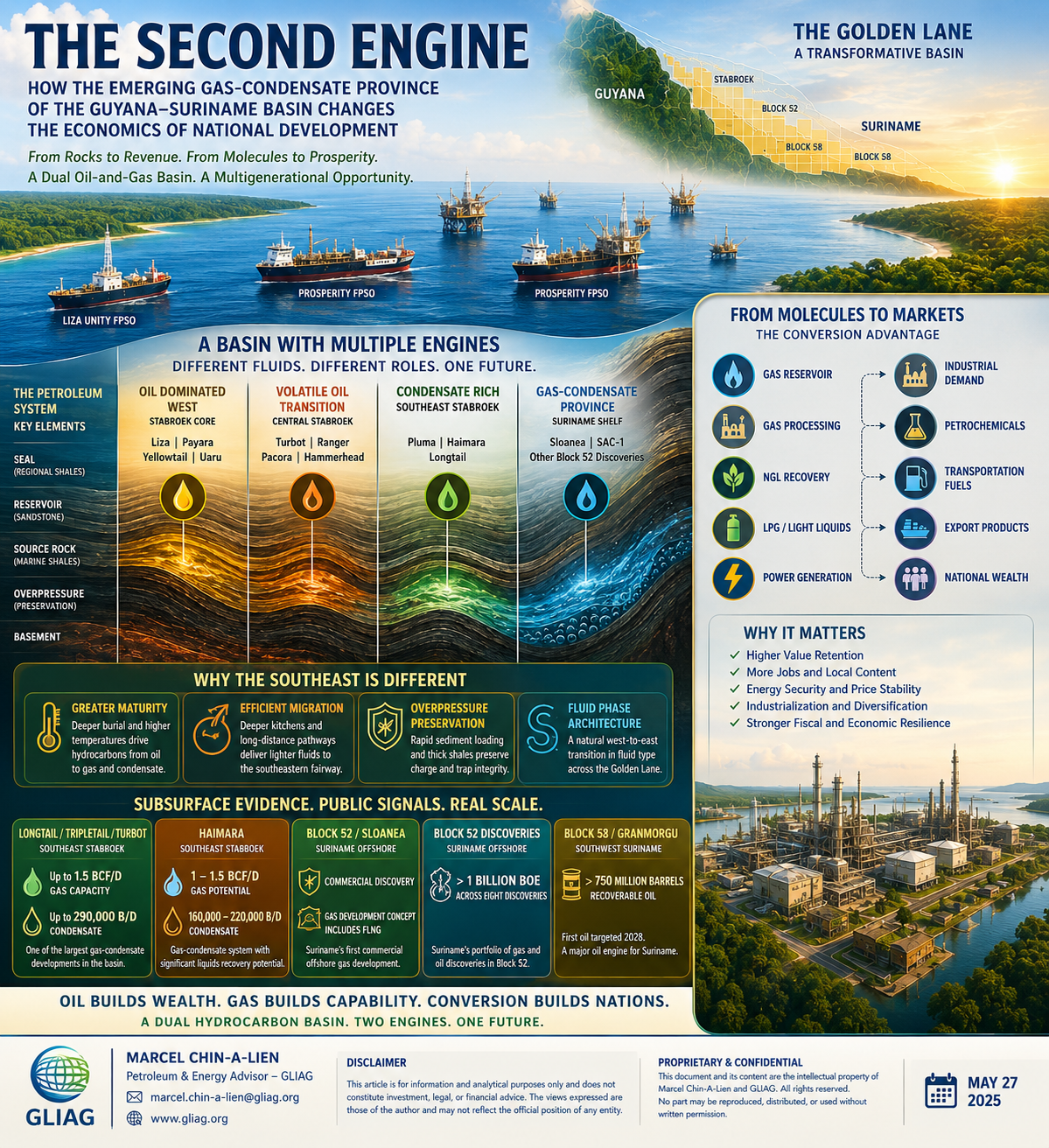
Why the Southeastern Golden Lane May Be Revealing a New Fluid Domain in the Guyana–Suriname Basin
Marcel Chin-A-Lien
Petroleum & Energy Advisor – GLIAG – 24 June 2026
From Rocks to Republics
The first engine of the Guyana–Suriname Basin was discovered through volumes. The second engine may be discovered through fluids.
Introduction
For more than a decade, the Guyana–Suriname Basin has been recognized as one of the world’s most remarkable petroleum success stories.
What began as a frontier exploration province evolved into one of the most prolific deepwater basins discovered in the twenty-first century. Successive discoveries offshore Guyana transformed global perceptions of the basin and demonstrated the presence of a world-class petroleum system capable of generating giant hydrocarbon accumulations. The discoveries at Liza, Payara, Yellowtail, Uaru, and numerous others established an entirely new offshore petroleum province and altered the economic trajectory of a nation.
Across the maritime border, Suriname confirmed that the same petroleum system extended eastward. Discoveries in Block 58 ultimately led to the GranMorgu development, while continued exploration elsewhere offshore Suriname revealed a basin that remained far from fully understood.
Throughout this period, one narrative dominated.
The Guyana–Suriname Basin became known as an oil basin.
That interpretation remains correct.
But it may no longer be complete.
As exploration expanded into the southeastern portion of the basin, a different signal began to emerge. Individual discoveries increasingly appeared associated with lighter hydrocarbon systems than those that first defined the basin’s success.
Longtail.
Haimara.
Sloanea.
The broader Block 52 discovery cluster.
Most recently, SAC-1.
Viewed independently, these discoveries tell separate exploration stories. Viewed collectively, however, they may be revealing something larger.
They may be revealing a change in fluid architecture.
And if that interpretation is correct, it could mark the beginning of a new chapter in the geological evolution of the Guyana–Suriname Basin.
The Basin’s First Engine
The modern history of the Guyana–Suriname Basin is fundamentally a story of oil.
Beginning with the giant discoveries offshore Guyana, the basin demonstrated extraordinary reservoir quality, effective migration systems, robust trapping mechanisms, and world-class source rocks. Exploration success rates exceeded industry norms and rapidly attracted global attention.
As development accelerated, the narrative strengthened further. Floating production systems were designed around oil production. Reserve estimates were discussed in billions of barrels. Government revenues were modeled around oil output. Investor presentations focused on crude oil volumes and future production growth.
Oil became the dominant language through which the basin was understood.
Suriname followed a similar trajectory. The discoveries in Block 58 ultimately culminated in the GranMorgu development and reinforced the perception that the basin’s future would primarily be defined by oil.
For good reason.
Oil discoveries transformed the basin from a frontier province into one of the world’s most important emerging petroleum systems.
Yet geological provinces rarely tell only one story.
As exploration expanded farther into the southeastern Golden Lane, a different signal began to emerge.
Increasingly, discoveries appeared associated with light oil, condensate, gas-condensate systems, and commercial gas accumulations.
The question was no longer whether hydrocarbons existed.
The question became:
What type of hydrocarbons increasingly characterize the southeastern portion of the basin?
That question lies at the heart of understanding the Second Engine.
Discoveries Reveal Resources. Fluids Reveal Basin Evolution.
One of the most common mistakes in petroleum analysis is to focus exclusively on volumes.
Volumes matter.
But fluids matter too.
Oil, condensate, and gas are not simply different commercial products. They are geological signals that reflect source-rock maturity, burial history, migration pathways, pressure conditions, and preservation mechanisms.
Fluid type is information.
It reveals how a petroleum system evolved through geological time.
This distinction is particularly important in the Guyana–Suriname Basin today.
The most interesting question may no longer be:
How much has been discovered?
It may be:
What type of hydrocarbons are increasingly being discovered in the southeastern Golden Lane?
The answer may reveal more about basin evolution than discovery volumes alone.
The Southeastern Signal
The strongest argument for the Second Engine does not originate from any single discovery.
It originates from a pattern.
For much of the basin’s modern history, exploration success was overwhelmingly associated with oil. The discoveries that transformed Guyana and enabled the GranMorgu development offshore Suriname reinforced the perception that the Guyana–Suriname Basin was fundamentally an oil province.
That perception remains justified.
Yet as exploration expanded toward the southeastern Golden Lane, a different signal began to emerge.
Longtail increasingly came to be viewed as a major gas-condensate system. Haimara reinforced that signal through development concepts emphasizing gas management, gas cycling, and condensate recovery. Across the maritime boundary, Sloanea established Suriname’s first credible offshore gas development pathway, while subsequent discoveries within Block 52 continued to expand the inventory of gas-related resources.
Individually, these discoveries represent separate exploration successes.
Collectively, however, they appear increasingly associated with a different hydrocarbon character than the oil-dominated discoveries that first defined the basin.
That observation is important.
The significance of Longtail, Haimara, Sloanea, SAC-1, and the broader Block 52 discovery cluster may not ultimately lie in their individual resource volumes. Their significance may lie in what they collectively reveal about the petroleum system itself.
Why are discoveries along this trend increasingly associated with light oil, condensate, gas-condensate systems, and commercial gas accumulations?
At present, no single discovery provides a definitive answer.
Yet the repetition of the signal is becoming increasingly difficult to ignore.
The southeastern Golden Lane appears to be expressing a different fluid architecture than the oil-dominated systems that first established the basin’s global reputation.
Whether this trend ultimately evolves into a fully recognized gas-condensate province remains uncertain and will require additional drilling, appraisal, testing, and development.
But the geological question has already emerged.
And it is a question that may prove increasingly important to understanding the future evolution of the Guyana–Suriname Basin.
Why the Southeast May Be Different
The most straightforward explanation begins in the source kitchens.
As organic-rich source rocks experience greater burial and higher temperatures, hydrocarbon generation progresses toward lighter fluid phases. Oil may evolve toward volatile oil, condensate, and eventually gas.
If portions of the southeastern basin experienced greater thermal maturity, a greater proportion of lighter hydrocarbons would naturally be expected.
Thermal maturity, however, may not be the entire explanation.
Migration architecture is equally important.
Hydrocarbons do not remain within their source rocks. They migrate through faults, carrier beds, and stratigraphic pathways before accumulating within reservoirs. Different migration histories can produce dramatically different fluid outcomes.
Some accumulations receive predominantly oil charge.
Others receive multiple charge phases, including later gas migration.
The southeastern Golden Lane may possess particularly effective connectivity to mature source kitchens, increasing the probability of condensate-rich and gas-condensate systems.
Pressure preservation may provide another important piece of the puzzle.
The Guyana–Suriname Basin contains extensive overpressured intervals associated with rapid sediment loading and thick shale successions. These conditions can help preserve volatile fluids over geological time scales and contribute to the retention of condensate-rich accumulations.
Taken together, these mechanisms provide a plausible geological framework for understanding the emerging southeastern signal.
The Emergence of a New Fluid Domain
The significance of Longtail, Haimara, Sloanea, SAC-1, and the broader Block 52 discovery cluster may therefore extend beyond their individual commercial value.
They may collectively be revealing a different fluid expression of the Guyana–Suriname petroleum system.
The critical point is that no single discovery proves this interpretation.
Petroleum provinces are not understood through individual wells.
They are understood through patterns.
Longtail may be an isolated gas-condensate discovery.
Haimara may be an isolated gas-condensate discovery.
Sloanea may be an isolated commercial gas discovery.
SAC-1 may be an isolated gas-related discovery.
But if all of them occupy the same broad regional trend and increasingly belong to the same fluid family, then a different interpretation becomes possible.
The southeastern Golden Lane may represent a distinct fluid domain within the Guyana–Suriname Basin.
Rather than being dominated by conventional oil accumulations, this domain appears increasingly associated with light oil, condensate, gas-condensate systems, and commercial gas resources.
The Second Engine
The first engine of the Guyana–Suriname Basin was oil.
It transformed Guyana.
It positioned Suriname for first oil.
It established one of the most successful offshore petroleum provinces of modern times.
The emerging evidence suggests that a second engine may now be revealing itself.
Unlike the first, this engine is not defined by a single giant oil accumulation.
It is defined by a fluid trend.
A trend increasingly characterized by light oil, condensate, gas-condensate systems, and commercial gas accumulations.
Whether future drilling ultimately confirms a fully developed gas-condensate province remains uncertain.
Yet the signal is becoming increasingly difficult to ignore.
The southeastern Golden Lane appears to be telling a different geological story.
Conclusion
The most important discoveries in the southeastern Golden Lane may not be important because of their size.
They may be important because of what they reveal.
The growing concentration of light oil, condensate, gas-condensate systems, and commercial gas discoveries suggests that the Guyana–Suriname Basin may be entering a new phase of geological understanding.
If confirmed, the basin will no longer be viewed solely through the lens of oil.
It will be understood as a more complex petroleum system containing distinct fluid domains shaped by different maturity histories, migration pathways, and fluid preservation mechanisms.
Exploration success is usually measured by discovering more hydrocarbons.
Basin evolution is often revealed by discovering different hydrocarbons.
The first engine of the Guyana–Suriname Basin was discovered through volumes.
The second engine may be discovered through fluids.
About the Author
Marcel Chin-A-Lien is a Petroleum & Energy Advisor and founder of GLIAG, the Geological & Strategic Intelligence Advisory Group. His work focuses on basin intelligence, petroleum systems, energy strategy, and the conversion of geological resources into long-term national capability.
GLIAG – Geological & Strategic Intelligence Advisory Group
From Rocks to Republics
Disclaimer
This publication reflects the author’s independent interpretation of publicly available geological, technical, and industry information. Certain interpretations, including the proposed fluid-domain and emerging gas-condensate province concepts, represent working hypotheses intended to stimulate discussion and further research. They should not be interpreted as reserves estimates, investment advice, or official positions of operators, governments, or regulatory authorities.