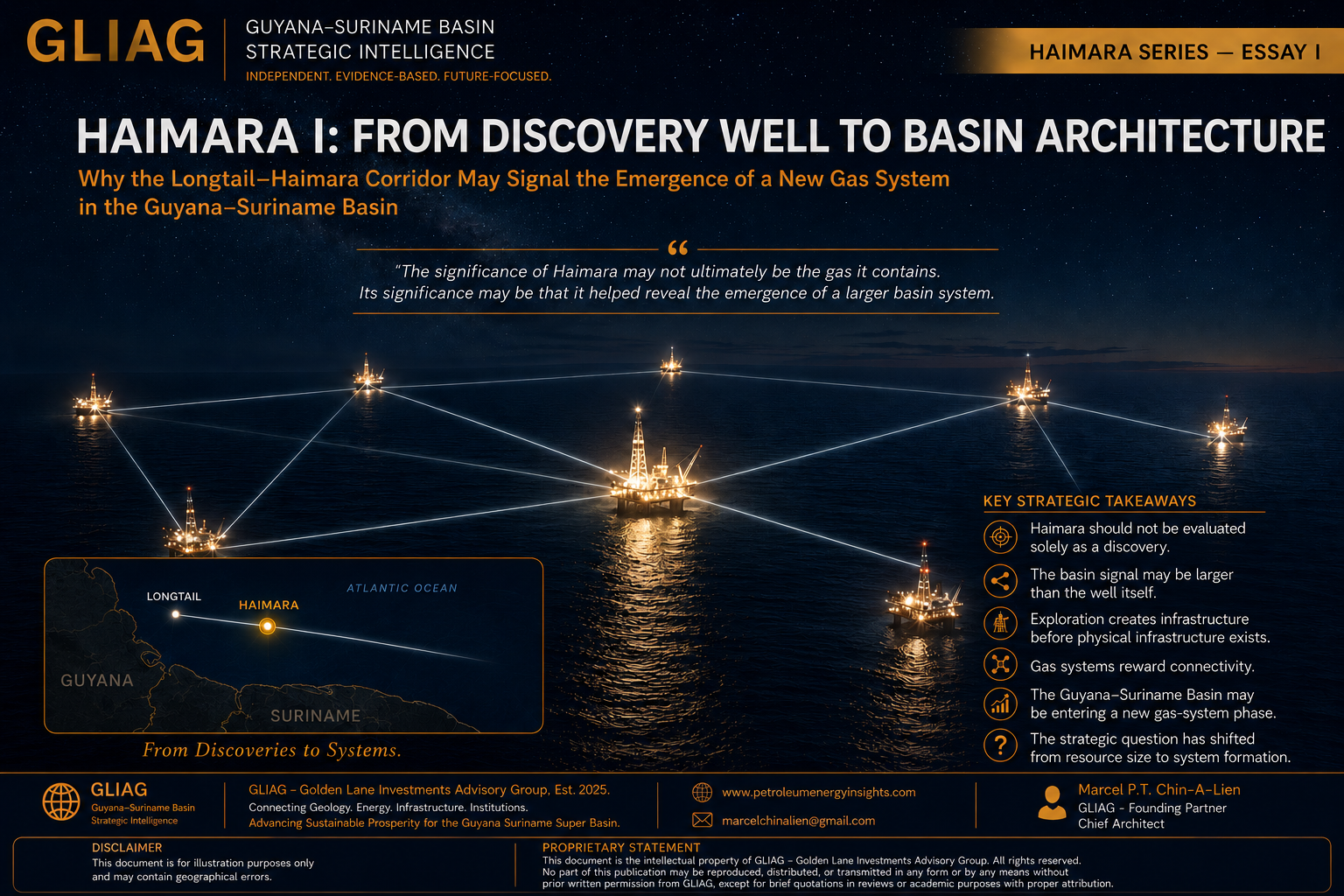
Haimara I: From Discovery Well to Basin Architecture
Why the Longtail-Haimara Corridor May Signal the Emergence of a New Gas System in the Guyana-Suriname Basin
By M.P.T. Chin-A-Lien | GLIAG – Golden Lane Investments Advisory Group | June 17, 2026 | Document ID: GLIAG-HS-001 | v1.0
“The significance of Haimara may not ultimately be the gas it contains. Its significance may be that it helped reveal the emergence of a larger basin system.”
Executive Summary
Haimara is typically discussed as a gas discovery. This essay argues that its greater significance may lie elsewhere.
By examining the Longtail-Haimara corridor through the lenses of connectivity, aggregation, optionality, and infrastructure formation, the article explores how individual discoveries can become components of a larger basin-scale gas architecture.
The central thesis is straightforward: Haimara may ultimately be remembered not for the gas it contains, but for what it revealed about the evolution of the Guyana-Suriname Basin.
Introduction
For much of the petroleum industry’s history, discoveries have been evaluated primarily through the lens of size.
How large is the accumulation? How many recoverable barrels or cubic feet are present? How quickly can production begin?
These are important questions. Yet they are not always the most important questions.
Sometimes a discovery’s greatest significance lies not in its size, but in what it reveals about the larger system around it.
This essay argues that Haimara may represent such a case.
Rather than viewing Haimara solely as a gas-condensate discovery, it may be more useful to view it as an early indicator of a broader gas architecture emerging within the Guyana-Suriname Basin.
From Discovery to Signal
Individual discoveries provide information. Groups of discoveries provide patterns. Patterns provide signals.
The strategic importance of Haimara therefore extends beyond its own resource potential.
When considered alongside Longtail and neighboring gas accumulations, a larger picture begins to emerge.
The basin may be moving toward a stage where gas is no longer viewed as an isolated discovery outcome, but as part of a broader integrated development architecture.
The significance of the signal may ultimately exceed the significance of the individual well.
The Resource Size Illusion
The petroleum industry often assumes that larger discoveries are inherently more important. Yet resource size alone does not determine strategic value.
Gas systems depend upon infrastructure, aggregation, connectivity, and market access.
A discovery can be geologically significant while remaining strategically constrained. Conversely, a discovery can become highly important because of the role it plays within a larger system.
This creates what may be called the Resource Size Illusion.
The question changes from: “How large is Haimara?” to: “What kind of system becomes possible because Haimara exists?”
Gas Systems Reward Connectivity
Unlike oil, gas development rewards connectivity.
Gas requires networks: gathering systems, processing facilities, transportation corridors, industrial demand centers, power generation, and export infrastructure.
The value of gas often increases as connections increase.
Viewed through this lens, the Longtail-Haimara area begins to resemble more than a collection of discoveries. It begins to resemble the early framework of a future network.
From Discoveries to Optionality
Each additional gas discovery contributes more than reserves. It contributes optionality.
Optionality expands the range of future development pathways.
Gas may support domestic power generation, industrial development, petrochemicals, LNG exports, regional energy systems, or hybrid combinations of these pathways.
The value of optionality lies not in predicting a single future, but in preserving multiple futures.
In this sense, discoveries function as reservoirs of future choice.
Basin Evolution and the Two-Speed Future
Oil and gas rarely evolve at the same pace.
The Guyana-Suriname Basin has already demonstrated the characteristics of a rapidly developing oil province.
Gas follows a different timeline. Gas development requires synchronization among infrastructure, markets, financing, industrial demand, and policy frameworks.
The result is a Two-Speed Basin. Oil develops first. Gas develops later.
Yet gas may ultimately have broader implications for industrialization, energy security, and economic diversification.
The Strategic Meaning of Aggregation
Aggregation is one of the most underestimated forces in petroleum development.
Individual discoveries are geological events. Aggregation is a systems event.
When sufficient discoveries accumulate, entirely new infrastructure pathways become possible.
The economic threshold for pipelines, processing facilities, and industrial investment becomes easier to achieve.
The significance of Haimara therefore lies not merely in resource addition, but in its contribution to critical mass.
Why Haimara Matters to Suriname
Although Haimara is often viewed through a Guyanese lens, basin evolution does not respect political boundaries.
Infrastructure economics, industrial competition, energy markets, and investor behavior operate across wider systems.
If a gas architecture emerges in one part of the basin, neighboring states will inevitably be affected.
For Suriname, the strategic question is not whether Guyana develops gas. The strategic question is how Suriname positions itself within an emerging basin-wide gas system.
This requires strategic intelligence rather than simple reserve counting.
From Reservoirs to Systems
The history of petroleum development is often written through discoveries.
Yet mature energy provinces are ultimately built upon relationships.
Relationships between fields. Relationships between infrastructure assets. Relationships between producers and consumers. Relationships between geology, engineering, economics, and policy.
The most transformative developments occur when these relationships become mutually reinforcing.
At that point, the basin ceases to be a collection of reservoirs. It becomes a system.
The Discovery Behind the Discovery
Every basin eventually reaches a point where the most important questions cease to be geological.
The challenge becomes institutional, infrastructural, economic, and strategic.
Can discoveries be connected? Can infrastructure be synchronized? Can resources be converted into productive capability? Can energy systems support national development?
From this perspective, Haimara reveals something larger than a gas accumulation.
It reveals a shift in the way the basin itself must be understood.
Key Strategic Takeaways
- Haimara should not be evaluated solely as a discovery.
- The basin signal may be larger than the well itself.
- Exploration creates infrastructure before physical infrastructure exists.
- Gas systems reward connectivity.
- The Guyana-Suriname Basin may be entering a new gas-system phase.
- The strategic question has shifted from resource size to system formation.
Conclusion
History often remembers discoveries. Yet history is frequently shaped by the systems that discoveries eventually create.
Haimara may ultimately prove important not because of the gas it contains, but because of the architecture it revealed.
Its significance may lie in helping illuminate a larger transition underway within the Guyana-Suriname Basin.
A transition from isolated discoveries toward interconnected energy systems. A transition from reservoirs toward relationships. A transition from geology toward basin intelligence.
Related GLIAG Doctrines
Exploration as Infrastructure Doctrine; Resource Size Illusion Doctrine; Optionality Reservoir Doctrine; Two-Speed Gas Basin; Gas Province Emergence Doctrine; Molecule-to-Market Doctrine; From Reservoirs to Systems; Basin Intelligence as Public Infrastructure.
Author Note
The GLIAG Basin Intelligence Series explores the intersection of geology, infrastructure, energy systems, governance, and long-term capability formation. The objective is not merely to describe discoveries, but to understand the systems that emerge around them and the implications those systems carry for society, industry, and policy.
Disclaimer
This publication is intended for educational, research, and strategic-intelligence purposes only. It does not constitute investment advice, engineering advice, legal advice, or official policy guidance. Illustrative graphics and conceptual maps may contain simplifications or geographic inaccuracies. Interpretations are based on publicly available information available at the time of publication.
Proprietary Statement
Copyright GLIAG – Golden Lane Investments Advisory Group. All rights reserved. No part of this publication may be reproduced, distributed, stored, transmitted, or incorporated into derivative works without appropriate attribution and written permission where applicable.
Archive Record
GLIAG Flagship Essay Library; Haimara Series – Essay I; GLIAG Basin Intelligence Series; GSB Transition Series; Status: Published Foundation Essay.
“The future of the Guyana-Suriname Basin will not be determined by discoveries alone. It will be determined by the systems built around them.”
Archive Classification:
GLIAG-HS-001 | GLIAG Flagship Essay Library | Haimara Series – Essay I | Published Foundation EssayCopyright GLIAG – Golden Lane Investments Advisory Group. All rights reserved. | Proprietary and Confidential | Illustrations for publication purposes only and may contain