Part 2: Execution Synchronization Timeline (SH-2050-EST)
Execution Synchronization Timeline (EST) 2025-2050
Strong Institutions. Smart Laws. Disciplined Execution. Intergenerational Prosperity.
Written and designed especially for Switi Sranan, with Soso Lobi: by Marcel P. T. Chin-A-Lien
My own, also recommended roadmap for Switi Sranan.
Founding Partner of GLIAG, Golden Lane Investments Advisory Group

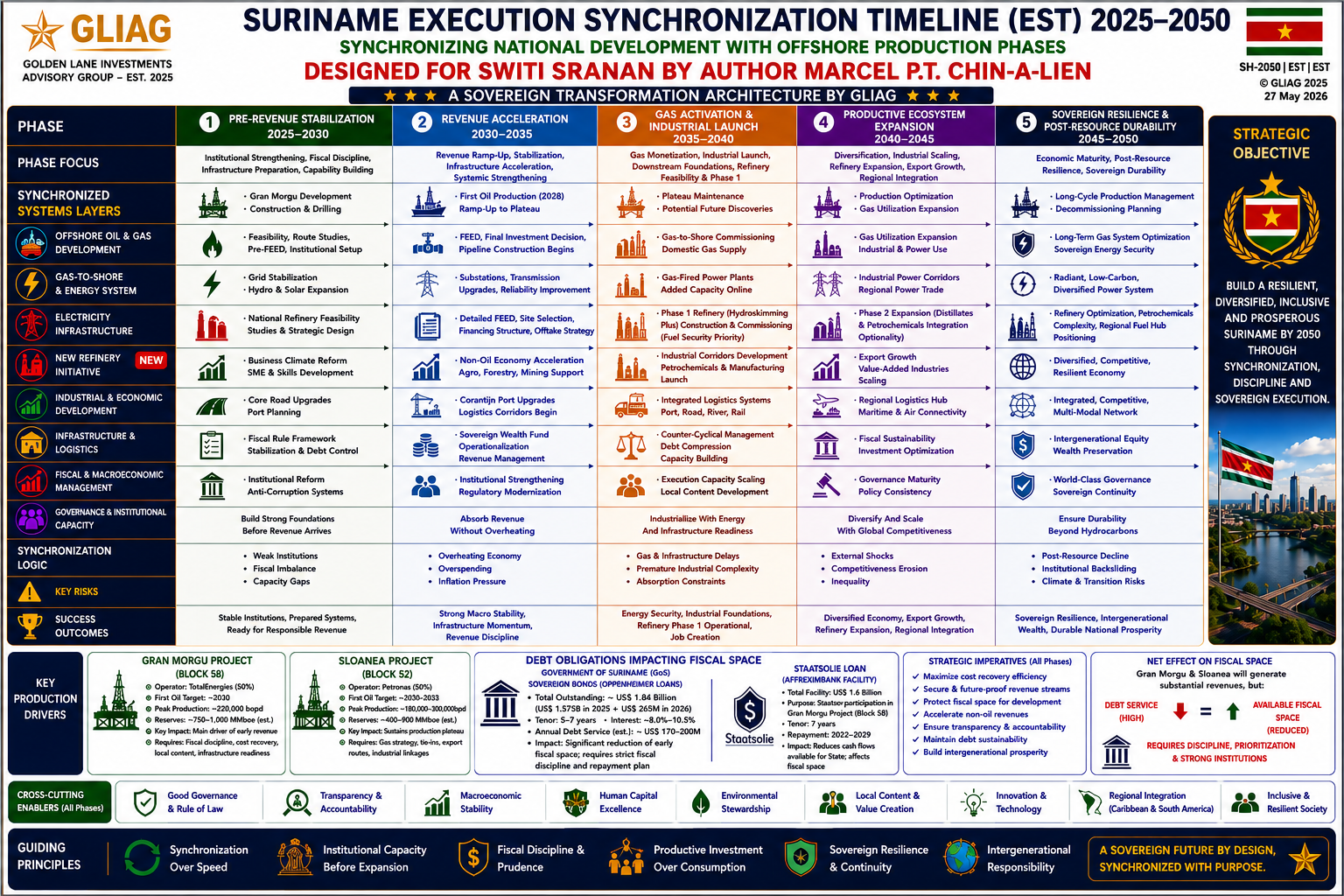
Figure 1. Suriname Execution Synchronization Timeline (EST) 2025-2050. The final EST image incorporates the Key Production Drivers layer in the lower half of the architecture, linking Gran Morgu, Sloanea, debt obligations, strategic imperatives, and net fiscal-space effects to the national synchronization doctrine.
Executive Framing
The Suriname Execution Synchronization Timeline (EST) is not a conventional development roadmap. It is an execution-governance architecture designed to synchronize national institutional development with the timing, scale, volatility, and depletion profile of offshore petroleum production.
The central doctrine underlying the EST is that hydrocarbons alone do not create prosperity. Resource wealth only becomes sovereign prosperity when production timing, infrastructure deployment, fiscal management, institutional strengthening, industrial sequencing, and social absorption capacity evolve in disciplined alignment.
This is the core meaning of Execution Synchronization. The objective is not simply to reach first oil or to monetize gas. The objective is to convert temporary offshore production into permanent national capability.
Why Synchronization Matters
Historically, many petroleum states have failed not because they lacked resources, but because their execution systems matured more slowly than their revenue flows. Revenue arrived before institutions. Spending accelerated before governance stabilized. Industrial ambitions expanded before logistics systems existed. Political cycles overtook long-term planning horizons.
The result was often structural instability: inflation, corruption, debt accumulation, fragmented infrastructure, resource dependency, and weakened national resilience. SH-2050 attempts to reverse this sequence by treating time, institutional readiness, and fiscal discipline as strategic variables.
Rather than treating oil production as the endpoint of national development, SH-2050 treats first oil as the beginning of a far more complex sovereign transition process.
The Five-Phase EST Architecture
The timeline organizes national transformation into five synchronized phases: Pre-Revenue Stabilization (2025-2030), Revenue Acceleration (2030-2035), Gas Activation and Industrial Launch (2035-2040), Productive Ecosystem Expansion (2040-2045), and Sovereign Resilience and Post-Resource Durability (2045-2050).
Each phase represents a different national operating environment requiring different legal frameworks, fiscal controls, infrastructure capacities, institutional priorities, and social-development objectives.
The framework deliberately emphasizes sequencing discipline over rapid expansion. This means that Suriname must build institutional capacity before large-scale revenue acceleration, preserve fiscal space before major industrial expansion, and convert petroleum income into productive national systems before depletion becomes structurally visible.
The Role of the Key Production Drivers Layer
The Key Production Drivers section has been incorporated into the lower strategic architecture of the EST because it represents the bridge between offshore production systems and national transformation capacity.
Without this layer, the execution framework would risk becoming overly institutional and insufficiently anchored to the physical production systems that generate fiscal space. The EST is production-synchronized: it must remain tied to real production timing, project ramp-up, debt obligations, state participation exposure, and deliverability constraints.
The Key Production Drivers layer therefore anchors the national strategy to Gran Morgu, Sloanea, Government of Suriname debt obligations, Staatsolie financing exposure, strategic imperatives, and the net effect on fiscal space.
Gran Morgu as the First Oil Anchor
Gran Morgu represents the primary first-oil anchor within the EST. It provides the initial revenue base around which early fiscal stabilization, institutional strengthening, debt management, and public-investment discipline must be organized.
The strategic importance of Gran Morgu is not limited to production volume. Its deeper significance lies in whether early petroleum revenues are governed through transparent, rules-based, disciplined systems that prevent premature expenditure, protect fiscal space, and create the foundation for long-term sovereign transformation.
In the EST logic, Gran Morgu is not merely a petroleum project. It is the first major test of Suriname’s ability to convert resource production into institutional maturity.
Sloanea as the Gas-System and Industrialization Anchor
Sloanea functions differently from Gran Morgu. Where Gran Morgu anchors early oil revenue, Sloanea anchors the possible gas-to-shore, industrial-energy, and downstream development pathway.
The Sloanea project is therefore linked to a later and more complex phase of national development: gas monetization, domestic energy security, industrial corridors, petrochemicals, power generation, logistics integration, and export-oriented value creation.
The EST treats Sloanea not as an isolated gas project, but as a potential system-enabling platform. Its value depends on deliverability, infrastructure timing, anchor demand, industrial readiness, financing structure, and governance capacity.
Fiscal-Space Reality and Debt Discipline
A major weakness in many resource-state development plans is that they emphasize future revenues while underweighting existing fiscal constraints. The EST intentionally includes sovereign debt obligations, Staatsolie financing exposure, debt-service compression, and fiscal-space limitations because these factors determine how much petroleum wealth can actually be converted into developmental capacity.
The core doctrine is simple: gross petroleum revenues are not equivalent to available sovereign development capacity.
A portion of early resource income may be absorbed by debt repayment, infrastructure amortization, state participation financing, operational expenditures, stabilization reserves, and institutional buildout requirements. The timeline therefore emphasizes disciplined prioritization rather than expansionary optimism.
Strategic Imperatives Across All Phases
The Key Production Drivers section identifies strategic imperatives that apply across all phases: maximize cost-recovery efficiency, secure future-proof revenue streams, protect fiscal space for development, accelerate non-oil revenues, ensure transparency and accountability, maintain debt sustainability, and build intergenerational prosperity.
These imperatives convert the image from a visual roadmap into an execution doctrine. They define the behavioral rules that must guide decision-making regardless of political cycle, commodity price environment, or project-specific optimism.
The point is not simply to earn more revenue. The point is to ensure that every unit of revenue strengthens the republic’s long-term capacity rather than weakening it through dependency, leakage, or poorly sequenced commitments.
Net Effect on Fiscal Space
The EST explicitly shows that Gran Morgu and Sloanea may generate substantial revenues, but those revenues will not automatically translate into unrestricted fiscal space. Debt service, state participation financing, cost recovery dynamics, infrastructure spending, and institutional demands may reduce the immediately available fiscal envelope.
This is why SH-2050 treats fiscal discipline as a survival doctrine. The early petroleum era will require prioritization, institutional strength, and transparent decision-making. Without those safeguards, high revenues can coexist with weak development outcomes.
The net fiscal-space message is therefore deliberately cautious: petroleum development can expand national opportunity, but only if the state manages obligations, timing, and expenditure quality with discipline.
From Resource Extraction to Sovereign Durability
The deeper objective of SH-2050 is not merely to produce hydrocarbons. The objective is to transform finite offshore production into durable sovereign capability.
Petroleum reservoirs deplete. Production plateaus decline. Commodity cycles fluctuate. Fiscal pressures increase when expectations rise faster than productive capacity. Therefore, the true success metric of SH-2050 is not cumulative oil and gas production, but whether Suriname converts temporary resource income into permanent institutions, diversified industries, infrastructure, education, technology, intergenerational savings, and resilient national systems.
This is why the later phases of the EST increasingly emphasize diversification, export ecosystems, industrial competitiveness, logistics integration, sovereign continuity, and post-resource resilience.
Synchronization as a National Survival Doctrine
The EST treats synchronization as a national survival doctrine. Infrastructure deployed too early may become fiscally unsustainable. Industrialization launched too quickly may exceed absorption capacity. Social spending expanded prematurely may create structural dependency. Debt accumulated before stable production may compress future fiscal flexibility.
The framework therefore aligns production timing, institutional maturity, fiscal readiness, infrastructure scaling, industrial complexity, governance capacity, and societal adaptation within a coordinated national transition system.
This is why the timeline prioritizes institutional capacity before expansion, synchronization over speed, productive investment over consumption, and resilience over short-term acceleration.
Final Doctrine Statement
SH-2050 is designed to answer a single strategic question: how can Suriname transform offshore petroleum wealth into a durable sovereign civilization system that survives beyond the petroleum era itself?
The answer proposed by the EST is disciplined synchronization between geology, production, fiscal governance, infrastructure, institutions, industrialization, human capital, and long-term national execution.
This is the doctrine embedded in the final EST image: from vision to execution, from resources to republic.
Document Controls, Disclaimer and Confidentiality
© 2026 GLIAG Strategic Intelligence Sovereign Solutions. Intellectual Property. All Rights Reserved.
Strategic Reference Tables
| Author | Marcel P.T. Chin-A-Lien |
|---|---|
| Institutional Framework | GLIAG Strategic Intelligence / Golden Lane Investments Advisory Group |
| Document Class | SH-2050 | ESF | EST | Cumulative Doctrine Layer |
| Date | 29 May 2026 |
| Status | Working Draft – Publication/Advisory Version |
| SH-2050 Execution Doctrine: Strong Institutions. Smart Laws. Disciplined Execution. Intergenerational Prosperity. From Vision to Execution. From Resources to Republic. |
|---|
| Control | Entry |
|---|---|
| Author attribution | M.P.T. Chin-A-Lien / Marcel P.T. Chin-A-Lien |
| Institutional attribution | GLIAG Strategic Intelligence / Golden Lane Investments Advisory Group |
| Document type | Cumulative strategic-intelligence working document |
| Version logic | TFCCWV: true full complete cumulative Word version; accumulation-only continuation layer for SH-2050 / EST / ESF doctrine. |
| Confidentiality | Proprietary strategic-intelligence material. Not for unauthorized distribution, reproduction, alteration, or commercial use without written permission. |
| Disclaimer | This document is a strategic, analytical, and policy-oriented framework. It does not constitute legal, financial, investment, engineering, or governmental advice. All figures, project references, and strategic interpretations should be independently validated before use in official decision-making. |
Prepared as a true, full, complete, cumulative WordPress-ready HTML version of the SH-2050 / EST manuscript, with the final EST image embedded directly in the HTML.


About the Author — Marcel Chin-A-Lien
Global Petroleum and Energy Advisor
48 Years of Transformative Expertise | Exploration, Oil & Gas Ginat Fields Finder – Business Development, M&A, PSC Design, Contract Strategy
Marcel Chin-A-Lien brings nearly five decades of unmatched global expertise at the highest levels of the energy sector—where technical mastery meets business acumen to unlock extraordinary value.
His career has delivered multi-billion-dollar giant field discoveries, spearheaded the iconic first capitalist upstream ventures in the USSR, shaped successful offshore bid rounds, and secured enduring cash flow streams from exploration and production activities across mature and frontier basins such as the Dutch North Sea.
A rare fusion of technical, commercial, and managerial insight, Marcel holds four postgraduate petroleum degrees spanning geology, engineering, international business, and management—uniquely positioning him to bridge the worlds of exploration strategy, M&A, PSC design, and contract negotiation.
Fluent in seven languages and culturally attuned to diverse business environments, he has navigated complex geographies from Europe to Asia, Africa, and the Americas—driving innovation, de-risking investments, and aligning stakeholder interests from national oil companies to supermajors.
Whether advising on frontier basin entry, government negotiations, fiscal regime optimization, or asset valuation, Marcel’s critical insights integrate Exploration & Production with Business Development and Commercial Realism—generating sustainable growth in volatile energy markets.
Credentials and Distinctions
- Drs – Petroleum Geology
- Engineering Geologist – Petroleum Geology
- Executive MBA – International Business, Petroleum, M&A
- MSc – International Management, Petroleum
- Energy Negotiator – Association of International Energy Negotiators (AIEN)
- Certified Petroleum Geologist #5201 – AAPG (Gold Standard)
- Chartered European Geologist #92 – EFG (Gold Standard)
- Cambridge Award – “2000 Outstanding Scientists of the 20th Century”, UK
- Paris Awards – “Innovative New Business Projects”, GDF-Suez (2x Gold Awards, 2003)
Strategic Expertise
- Exploration Strategy & Giant Field Discovery
- Upstream M&A and Asset Valuation
- Production Sharing Contract (PSC) Design & Fiscal Optimization
- Government and IOC Negotiation Advisory
- Bid Round Structuring and Evaluation
- Integrated Technical-Commercial Due Diligence
For trusted advisory services at the nexus of technical excellence, commercial clarity, and geopolitical understanding, connect directly:
Public Profile: LinkedIn
Email: marcelchinalien@gmail.com
Regards, Marcel Chin-A-Lien