Written by Marcel Chin-A-Lien – Petroleum & Energy Advisor – Founding Partner GLIAG – Golden Lane Investments Advisory Group
GLIAG Strategic Intelligence Essay
Abstract
Modern online fraud is no longer best understood as crude deception by isolated criminals. It has evolved into an industrialized system of psychological manipulation, institutional mimicry and digital trust engineering.
Scammers increasingly imitate the surface architecture of legitimacy: professional profiles, elite universities, corporate titles, investment language, fake intermediaries, forged mandates and emotionally calibrated communication.
This essay examines the rise of synthetic credibility across LinkedIn, email, investment fraud, romance-investment scams and petroleum-broker schemes, drawing on cybercrime reporting, criminology, psychology and organized-crime research.
1. From Obvious Fraud to Synthetic Trust
The traditional image of internet fraud — crude emails, grammatical errors and implausible promises — is increasingly outdated. Contemporary scams often appear polished, patient and socially intelligent.
They do not always begin with a request for money. They begin with identity construction: a plausible profile, a prestigious affiliation, a vague but respectable occupation and a low-pressure message designed to initiate conversation.
This shift is central to understanding modern fraud. The scam no longer needs to look perfect. It only needs to appear coherent enough to pass through the first filter of human trust.
The Economist’s 2025 investigation and podcast series Scam Inc., led by Sue-Lin Wong, described online fraud as a sophisticated, predatory, multi-billion-dollar global industry connected to human trafficking, corruption and money laundering.
The series framed scam networks not as isolated tricksters, but as an emerging underground economy with organizational depth and international reach. The Economist, Scam Inc.
2. Social Engineering as Applied Psychology
Social engineering exploits ordinary human cognition. Victims are not necessarily naïve. They are often responding to carefully engineered signals of authority, similarity, intimacy, scarcity, opportunity or urgency. Psychological mechanisms such as authority bias, reciprocity, social proof, scarcity and emotional vulnerability are repeatedly used in cyber-enabled fraud.
This is why modern scams are best understood as psychological systems rather than merely technical intrusions. The fraudster does not only attack a bank account or a device. The fraudster attacks trust, attention, hope, fear and social expectation.
In romance-investment scams, sometimes called “pig-butchering” scams, the victim is gradually groomed through emotional attachment before being introduced to a fake investment opportunity. The emotional relationship reduces skepticism; the fake platform supplies the illusion of rational financial proof. The manipulation works because intimacy and financial logic are fused into one narrative.
3. LinkedIn as a Trust Surface
LinkedIn has become more than a professional-networking platform. It is now a trust surface: a space where identity, credentials, corporate affiliation and social proximity are displayed as reputational signals. This makes LinkedIn attractive not only to professionals, but also to recruiters, intelligence gatherers, scammers and social-engineering operators.
A common pattern involves a profile that appears superficially impressive but structurally incoherent: an elite university claim, a vague investor title, a prestigious company name, low network density, limited activity and skills that do not match the claimed profession. Such inconsistency does not prove fraud by itself. But it is a meaningful risk signal.
Analytical principle: professional incoherence is often a stronger warning signal than lack of prestige. Prestige can be copied. Coherence is harder to fake.
This is especially important for senior professionals, consultants, engineers, investors and energy-sector specialists. Their public profiles often contain enough authority and network visibility to attract both legitimate contacts and manipulative approaches. A vague message from a polished but incoherent profile may be the first step in a trust-building sequence.
4. Synthetic Credibility
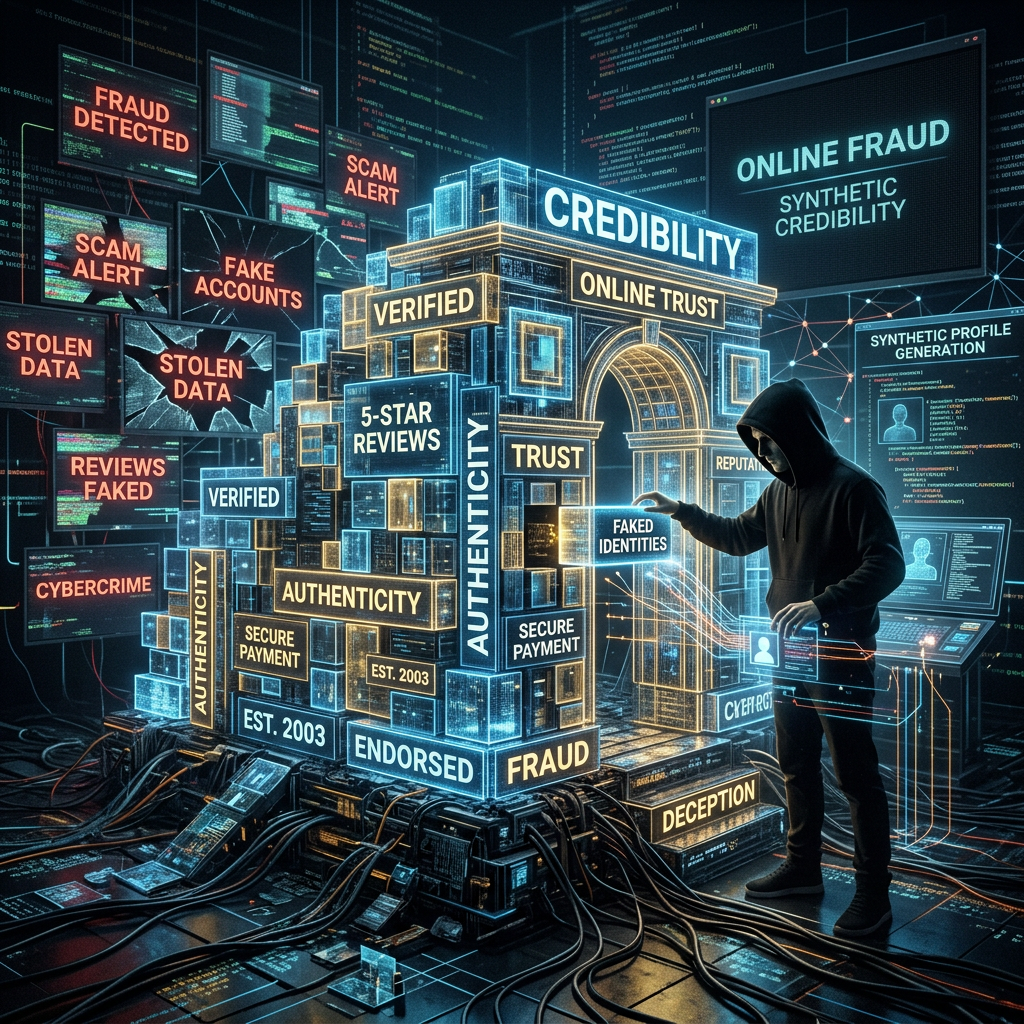
The central concept proposed here is synthetic credibility: the artificial production of trust through borrowed symbols of legitimacy. These symbols may include elite universities, corporate logos, professional titles, polished language, fake websites, institutional email formats, social-media profiles, staged conversations and fabricated business documents.
Synthetic credibility does not require full authenticity. It requires enough surface legitimacy to delay suspicion until the target has emotionally, financially or socially invested in the interaction.
Modern scams increasingly imitate institutions rather than oppose them. They do not always appear as outsiders breaking into trust systems. They often appear as the trust system itself: the investor, the broker, the recruiter, the consultant, the government intermediary, the inheritance lawyer, the oil allocation agent or the attractive professional contact.
5. Scam Compounds and the Industrialization of Fraud
Recent investigations show that many online scams are now operated through organized, quasi-corporate systems. Southeast Asian scam compounds have been linked to transnational organized crime, trafficking, forced criminality, money laundering and corruption.
The Global Initiative Against Transnational Organized Crime described cyber-scam operations in Southeast Asia as a transnational organized-crime crisis that expanded rapidly after the COVID-19 pandemic. Its 2025 report on “compound crime” examined heavily organized scam ecosystems involving guarded facilities, trafficked labor, corruption and large-scale financial fraud. Global Initiative Against Transnational Organized Crime, 2025
UNODC has similarly warned that fake job offers can lead people into scam centers where they are forced to conduct online fraud. This complicates the moral picture: some apparent perpetrators are themselves trafficked or coerced victims. UNODC, Inflection Point 2025
6. The Scale of the Problem
The scale of cyber-enabled fraud is now systemic. The FBI’s Internet Crime Complaint Center reported that victims of cryptocurrency-related investment fraud alone reported more than $6.5 billion in losses in 2024. The FBI also identified phishing, spoofing, extortion and personal-data breaches among the most common complaint categories. FBI IC3 2024 Internet Crime Report
Business email compromise remains another major threat category. It exploits trust in familiar business processes: invoices, payment instructions, executives, suppliers, lawyers and counterparties. The method is simple in appearance but sophisticated in execution: attackers insert themselves into the ordinary flow of business trust.
7. Petroleum and Offshore-Energy Fraud
The petroleum and offshore-energy sectors have a distinct vulnerability profile. Oil, gas and commodity transactions often involve high values, intermediaries, confidentiality, cross-border documentation and complex authority chains. This creates fertile ground for fake crude allocations, forged mandates, false refinery access, fake national-oil-company introductions and commission-bait structures.
In this environment, fraudsters exploit complexity itself. They use geopolitical language, sovereign references, broker terminology, urgency and exclusivity to create the impression of access. The victim is not merely deceived by a person; the victim is drawn into a theater of institutional legitimacy.
Fake oil-broker emails, fraudulent allocation letters, supposed refinery access, inheritance claims, “heritage” emails and fabricated introductions from politically sensitive regions all belong to a wider family of trust-manipulation techniques. Their common mechanism is not the specific commodity or country reference. It is the creation of artificial authority.
8. Diagnostic Framework
A practical credibility assessment should examine five dimensions:
- Identity coherence: Does the claimed role match the employment history, skills, geography and activity?
- Institutional trace density: Is there evidence beyond the profile itself?
- Communication specificity: Does the sender explain why they contacted this particular person?
- Platform migration pressure: Do they quickly push toward WhatsApp, Telegram or private channels?
- Financial or confidential escalation: Does the interaction move toward investment, documents, introductions, payments or sensitive information?
The strongest warning sign is often not one dramatic inconsistency, but the accumulation of small incoherences: vague titles, mismatched skills, thin networks, generic outreach, prestige signals without substance and rapid movement toward private conversation.
9. Ethical Caution
Scam analysis must avoid stereotyping by nationality, ethnicity or region. Fraud is transnational, adaptive and networked. Southeast Asia, Eastern Europe, West Africa, the Middle East and other regions appear in different investigations, but the correct analytical unit is not ethnicity or geography. It is the criminal system: recruitment, coercion, identity fabrication, money movement, platform exploitation and psychological manipulation.
A serious analysis must also remain victim-sensitive. Scam victims are not simply foolish. They are targeted by systems designed to exploit normal human trust. In some cases, the people sending scam messages may themselves be coerced laborers trapped inside criminal compounds.
Conclusion: Trust Literacy as Security Infrastructure
Modern scams increasingly imitate institutions rather than oppose them. They borrow the language of business, the symbols of education, the aesthetics of professionalism and the emotional grammar of friendship or romance. The future of fraud prevention therefore requires more than technical cybersecurity. It requires literacy in trust architecture.
The key question is no longer simply: “Is this message suspicious?”
The deeper question is: “Is this identity coherent, verifiable and institutionally real?”
In an age of synthetic credibility, critical judgment becomes a form of security infrastructure.
Selected Sources
- The Economist — Scam Inc.
- FBI — 2024 Internet Crime Report
- UNODC — Inflection Point 2025
- Global Initiative Against Transnational Organized Crime — Compound Crime