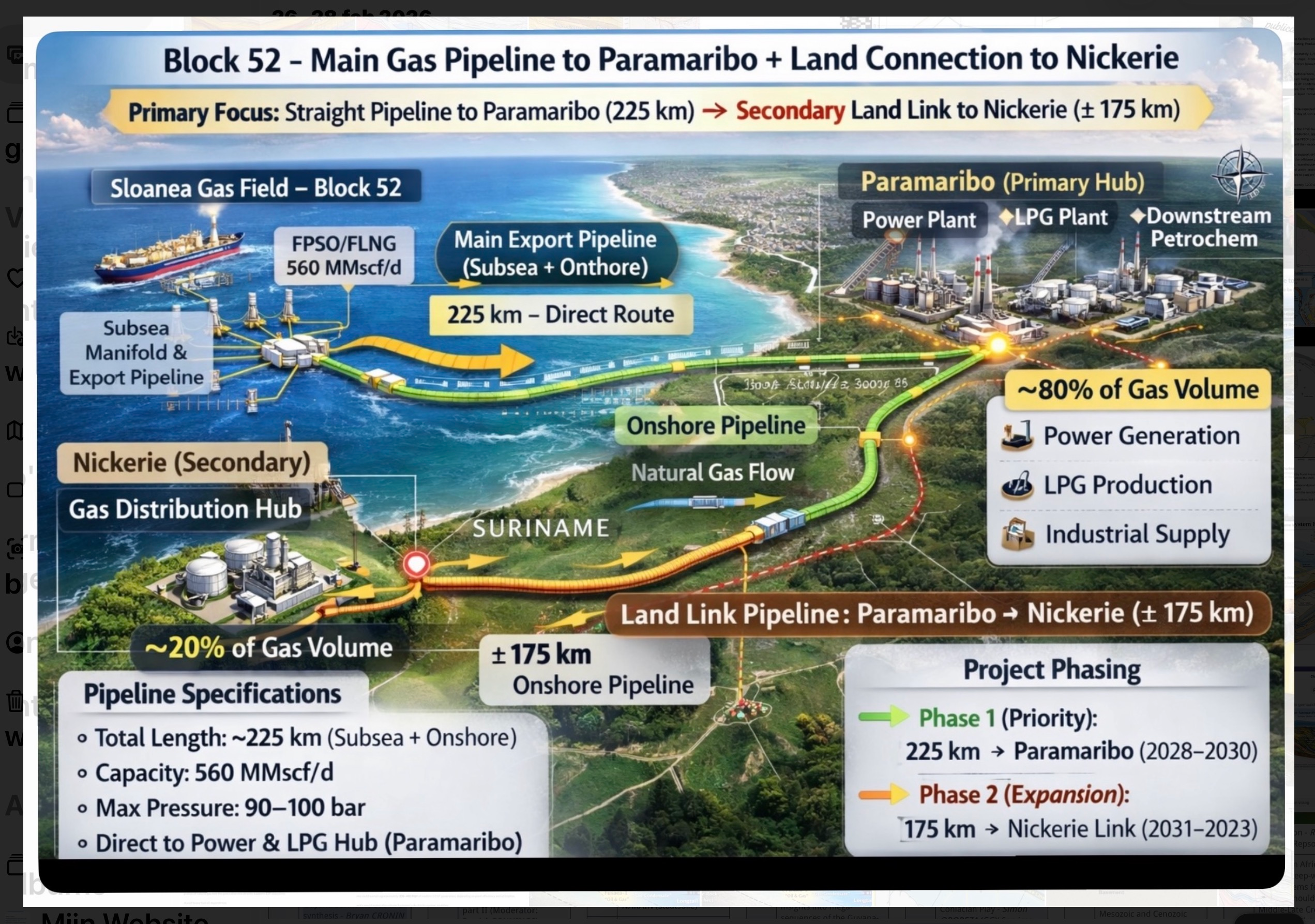
Gas Utilization as a Catalyst for Resilient Economic and Social Development in Suriname
By Marcel Chin-A-Lien – 12 May, 2026
Petroleum & Energy Advisor
Petroleum & Energy Insights / GLIAG – Golden Lane Investments Advisory Group
Disclaimer: The main image is intended to illustrate the concept.
Executive Thesis
Suriname is approaching a decisive historical moment. Offshore petroleum development will generate new fiscal income, but fiscal income alone does not guarantee national transformation. The true strategic challenge is whether Suriname can convert petroleum resources into durable economic capability, industrial diversification, infrastructure modernization, energy security and social resilience.
This article argues that Gas-to-Shore (GtS) and broader domestic gas utilization should be treated not merely as energy projects, but as potential macro-economic development platforms. Properly structured, natural gas can become a catalytic multiplier for power generation, industry, employment, infrastructure, investment attraction, housing, logistics and long-term national competitiveness.
Recent developments in Guyana, especially around the Wales Gas-to-Energy corridor and associated Region Three infrastructure expansion, provide a powerful real-world proxy for Suriname. Guyana demonstrates that once gas-based energy infrastructure becomes credible, it begins to reshape not only electricity supply, but also roads, bridges, housing, industrial zones, logistics, land values, investor expectations and national development geography.
For Suriname, this reinforces a central strategic position advanced through GLIAG and Petroleum & Energy Insights: gas should not be viewed only as an export molecule, but as a national development catalyst.
1. Introduction: The Real Meaning of Gas
Natural gas is often discussed in narrow commercial terms: reserves, production volumes, pipeline capacity, LNG export value, power tariffs and project economics. These are essential considerations, but they do not capture the full national-development significance of gas.
For a small emerging petroleum state such as Suriname, gas may become one of the most important instruments for translating offshore resource wealth into onshore economic transformation.
How can Suriname use part of its gas resource base to create a more resilient, diversified and productive national economy?
This distinction is fundamental. LNG exports may monetize gas commercially, but Gas-to-Shore can monetize gas nationally. LNG can generate revenue; GtS can generate systems. LNG can support field economics; GtS can support industrialization, social development and long-term state capability.
2. Guyana as a Real-Time Proxy for Suriname
Guyana’s Wales Gas-to-Energy development is increasingly demonstrating that Gas-to-Shore is not merely a technical energy project. It is becoming a broader economic transformation mechanism.
A May 12, 2026 publication by Guyana’s Department of Public Information, titled “Pres Ali outlines major road expansion to ease Region Three traffic woes”, reported that President Irfaan Ali inspected major road alignments and announced plans to expand and interconnect road networks across Region Three, including areas from La Jalousie to Tuschen. The same report linked this infrastructure expansion to rapid housing growth, industrial development, the Wales Gas-to-Energy project, a data centre, a fertiliser plant and a gas bottling facility.
This is strategically important because it shows that the Wales gas development is already producing wider multiplier effects beyond power generation.
- Gas infrastructure creates the basis for lower-cost and more reliable energy;
- Reliable energy supports industrial feasibility;
- Industrial feasibility requires roads, bridges, logistics and housing;
- Infrastructure expansion stimulates land development and investment confidence;
- Investor confidence reinforces further economic clustering.
In short, energy becomes geography. Roads begin to follow power. Housing begins to follow infrastructure. Industry begins to follow reliability. Capital begins to follow confidence.
3. The Multiplier Architecture of Gas-to-Shore
3.1 The Energy Multiplier
The first effect of GtS is energy supply. Domestic gas can support power generation, reduce dependence on imported liquid fuels, improve grid reliability and lower the cost base for households, government services and businesses. For Suriname, reliable and competitively priced electricity would directly improve industrial competitiveness, public-sector service delivery, household welfare, small-business productivity, digital infrastructure viability and national investment attractiveness.
3.2 The Industrial Multiplier
Gas can also become a feedstock and enabling fuel for industrial activity. Depending on scale, pricing and infrastructure, domestic gas could support fertilizer production, alumina and mineral processing, agro-processing, cold storage, manufacturing, petrochemical options, data centers, industrial parks and energy-intensive logistics services. This is where gas moves from being a commodity to becoming a development platform.
3.3 The Infrastructure Multiplier
Gas-to-Shore requires pipelines, power plants, substations, transmission networks, access roads, ports, logistics hubs and industrial land planning. These investments create secondary economic activity in construction, engineering, transport, maintenance, services and local contracting.
3.4 The Social Multiplier
Energy reliability is also social policy. Affordable and reliable electricity improves education, healthcare, digital access, household security, small enterprise development, food preservation and quality of life. A well-designed gas strategy therefore has social-development implications far beyond the energy sector.
3.5 The Confidence Multiplier
Perhaps the most underestimated effect is psychological and institutional. Investors do not invest only in natural resources. They invest in credible systems. A functioning GtS system signals that a country can coordinate geology, engineering, finance, infrastructure, regulation, land-use planning and industrial policy.
4. Suriname’s Strategic Choice: LNG Only or Hybrid Development?
Suriname should not frame the question as a simplistic choice between LNG and Gas-to-Shore. LNG may be commercially necessary. It can support field development, foreign exchange earnings, project bankability and international partnerships. However, an export-only approach risks underutilizing the domestic transformation value of gas.
The more robust strategic framework is a hybrid gas monetization model:
- allocate part of the gas resource base to LNG or export monetization;
- reserve a strategic portion for domestic energy security and industrialization;
- phase domestic demand creation realistically;
- anchor early gas use in power and LPG/NGL applications;
- expand later toward fertilizer, alumina, data centers and industrial clusters where commercially viable.
LNG may optimize project monetization. Gas-to-Shore may optimize national economic complexity. Suriname needs a disciplined balance between both.
5. The GLIAG Vision: Gas as a National Development Catalyst
GLIAG – Golden Lane Investments Advisory Group – has consistently advanced the view that Suriname’s oil and gas development should not be treated as a narrow extractive-sector opportunity. Instead, petroleum should be used as a catalyst for a broader national transformation agenda.
This vision has been developed through multiple essays, conceptual frameworks and strategic publications on Petroleum & Energy Insights, including work on:
- Suriname Gas Master Plan concepts;
- Gas-to-Shore development scenarios;
- hybrid GtS + LNG strategies;
- domestic gas allocation frameworks;
- industrial gas utilization;
- regional Guyana–Suriname energy integration;
- Gas-to-Shore versus FLNG value comparison;
- industrial corridor development;
- sovereign energy-economic architecture;
- and the concept of the Petroleum Catalytic State.
The central GLIAG thesis is that petroleum wealth should not merely generate income. It should generate national capability.
In this sense, GLIAG positions itself as a Surinamese strategic advisory group and “Petroleum System Development Architect”: a platform that seeks to connect upstream resource development with downstream industrialization, infrastructure, investment attraction, energy security and resilient national development.
6. The Petroleum Catalytic State
Many resource-producing countries have struggled because they remained traditional resource states. They exported raw commodities, collected revenues, imported finished goods and remained vulnerable to commodity cycles. Suriname has the opportunity to pursue a different path: the Petroleum Catalytic State.
| Traditional Resource State | Petroleum Catalytic State |
|---|---|
| Exports hydrocarbons | Uses hydrocarbons to build national systems |
| Focuses mainly on fiscal revenue | Focuses on long-term national capability |
| Imports most refined products and energy-intensive goods | Builds selected domestic value chains |
| Depends heavily on commodity cycles | Builds economic resilience through diversification |
| Measures success by production volumes | Measures success by transformation outcomes |
The Petroleum Catalytic State does not reject exports. Rather, it uses export income and domestic energy allocation together to build infrastructure, industry, human capital and institutional competence.
7. Lessons from Guyana for Suriname
7.1 Infrastructure Demand Will Arrive Quickly
Once energy and industrial projects become credible, pressure rises rapidly on roads, bridges, housing, land-use planning, logistics and public services. Suriname should anticipate these effects before they become bottlenecks.
7.2 Industrial Zones Require Early Planning
Industrial clustering does not happen automatically. It requires land, energy, water, roads, ports, regulation, environmental safeguards and investment promotion.
7.3 Housing and Labor Mobility Matter
Energy-industrial projects attract workers and create settlement pressure. Suriname should integrate housing strategy into its energy and industrial planning.
7.4 The State Must Coordinate Systems
The main challenge is not only technical. It is institutional. The state must coordinate ministries, regulators, state enterprises, investors, communities and infrastructure agencies.
7.5 Gas Strategy Is Development Strategy
Gas policy should not be isolated within the energy sector. It should be integrated with industrial policy, infrastructure policy, fiscal planning, education, regional development and social strategy.
8. Risks and Socratic Warnings
A serious strategy must also recognize risks. Gas-to-Shore does not automatically produce prosperity. Roads do not automatically produce productivity. Industrial zones do not automatically create industry. Cheap energy without planning can lead to waste, speculation, debt and inefficient subsidies.
- Premature overbuilding: building infrastructure before demand is bankable;
- Export-only bias: monetizing gas externally while missing domestic transformation value;
- Unfocused industrial policy: trying to support too many industries at once;
- Weak governance: unclear roles, opaque contracts and poor institutional coordination;
- Debt stress: using future petroleum income to finance poorly sequenced projects;
- Social imbalance: allowing energy-led growth to increase inequality or regional disparities.
Is Suriname building projects, or is Suriname building a system?
9. Strategic Recommendations for Suriname
9.1 Develop a National Gas Utilization Policy
Suriname should clearly define how gas will be allocated among power, industry, LNG/export, LPG/NGL, fertilizer, alumina, petrochemicals and regional integration.
9.2 Establish a Phased Gas-to-Shore Roadmap
A realistic roadmap should move from early anchor demand to larger industrial demand:
- Phase 1: power generation, LPG/NGL and grid reliability;
- Phase 2: industrial parks, fertilizer screening, mineral processing and data infrastructure;
- Phase 3: regional integration, export-linked industries and advanced downstream development.
9.3 Create Bankable Industrial Demand
Gas infrastructure requires credible offtake. Suriname should identify bankable anchor users before committing to oversized infrastructure.
9.4 Link Gas Planning to Spatial Planning
Gas corridors should be linked to roads, ports, housing, industrial zones and environmental safeguards.
9.5 Use Guyana as a Proxy, Not a Blueprint
Guyana offers a live example, but Suriname must adapt the lessons to its own population size, fiscal capacity, institutional realities, gas volumes and development priorities.
9.6 Position Suriname as a Strategic Second Mover
Suriname can learn from Guyana’s first-mover experience and avoid some of the congestion, sequencing and institutional overload risks now emerging across Guyana’s fast-growing energy corridors.
10. Diplomatic Regional Perspective
Guyana and Suriname are two independent sovereign states. Each country must preserve its own national interest, fiscal strategy and institutional autonomy. At the same time, the Guyana–Suriname Basin creates opportunities for complementary regional development in gas infrastructure studies, industrial demand aggregation, regional power strategy, technical training, emergency response, logistics, service-sector development and cross-border economic corridors.
Regional cooperation should strengthen sovereignty, not dilute it.
Conclusion: Gas as the Foundation of Resilient Development
Guyana’s Wales Gas-to-Energy development and related Region Three infrastructure expansion increasingly support the strategic thesis long advanced by Petroleum & Energy Insights and GLIAG: Gas-to-Shore can become much more than an energy solution. It can become a macro-economic catalyst.
For Suriname, this creates a major strategic opportunity. If gas is intelligently allocated, transparently governed and linked to industrial planning, it may help create energy security, lower operating costs, industrial diversification, employment, foreign investment, regional development, social resilience and long-term national capability.
The future of Suriname will not be determined only by how much oil or gas is discovered offshore. It will be determined by how wisely the country converts those resources into systems onshore.
That is the essence of the GLIAG vision: to help Suriname move from petroleum income to petroleum-enabled transformation — from Gas-to-Shore to Growth-to-State.
References & Related Strategic Publications
This article builds on the strategic thesis advanced in multiple publications, essays and development frameworks by Petroleum & Energy Insights and GLIAG regarding Gas-to-Shore, domestic gas utilization, hybrid LNG + GtS development, industrial gas allocation, energy-to-economy architecture and the long-term transformation of Suriname into a resilient petroleum catalytic state.
Related publications and analytical materials are available at:
Petroleum & Energy Insights
www.petroleumenergyinsights.com
Contextual reference:
- “Pres Ali outlines major road expansion to ease Region Three traffic woes”, Department of Public Information, Guyana, May 12, 2026.
Short CV — Marcel Chin-A-Lien
Marcel Chin-A-Lien is a petroleum and energy advisor, strategic analyst and founder/publisher of Petroleum & Energy Insights. His work focuses on the Guyana–Suriname Basin, Suriname’s offshore petroleum development, gas monetization, Gas-to-Shore strategies, downstream industrialization, refinery concepts, fiscal and economic modeling, and the broader transformation of petroleum resources into long-term national economic value.
He is associated with GLIAG – Golden Lane Investments Advisory Group, a Surinamese strategic advisory initiative focused on supporting Suriname’s transition into a modern energy-industrial economy. Through GLIAG and Petroleum & Energy Insights, he has developed multiple strategic concepts on Suriname’s Gas Master Plan, hybrid GtS + LNG development, refinery development, petroleum catalytic state architecture, industrial corridors, energy security and sovereign economic resilience.
His work combines petroleum geology, energy strategy, macro-economic development thinking, investment positioning and national industrial policy analysis, with a particular focus on how Suriname can convert offshore petroleum resources into durable social, industrial and economic transformation.