Predictive Exploration™ Series
Marcel Chin-A-Lien – February 2026
Petroleum & Energy Insights Advisor
Co-founder, Golden Lane Investments Advisory Group
Executive Overview
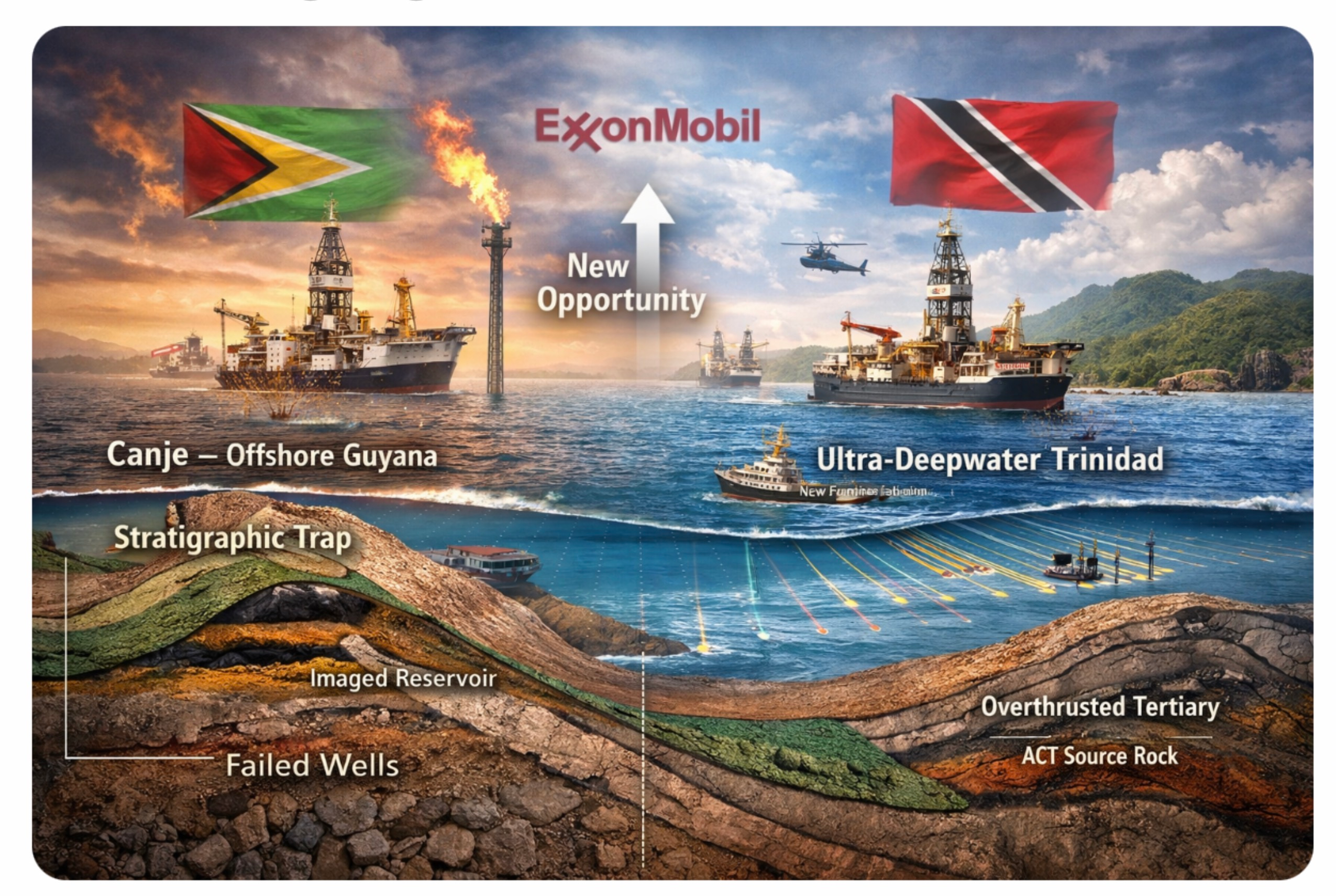
ExxonMobil’s apparent pivot from the Canje Block (Guyana) toward Ultra-Deepwater 1 (UD-1) offshore NE Trinidad is not a geological contradiction.
It is a capital allocation decision shaped by stratigraphic trap performance, ultra-deepwater cost thresholds, and portfolio optionality.
Canje is not geologically dead.
The drilled wells demonstrate working petroleum system elements.
However, no commercial development anchor has yet emerged.
UD-1 represents early-cycle optionality where large-scale seismic de-risking precedes drilling.
1. The Canje Record: Robust Geological Testing
- Bulletwood-1: 2,846 m water depth; TD 6,690 m; confirmed seismic interpretation; evidence of non-commercial hydrocarbons. (JHI Associates)
- Jabillo-1: 2,903 m water depth; TD 6,475 m; Upper Cretaceous strat trap objective; no commercial discovery declared. (Investegate)
- Sapote-1: 2,549 m water depth; TD 6,758 m; Upper Cretaceous strat trap objective; non-commercial hydrocarbons reported in deeper target. (Offshore Energy)
Conclusion: Charge exists. Reservoir exists. Commercial trap robustness remains unproven.
2. Why Canje Becomes Economically Sensitive
Ultra-deepwater amplifies geological imperfection. At ~2.5–2.9 km water depth and ~6.5–6.8 km TD:
- Well cost escalates dramatically
- Operational risk increases
- Minimum commercial size rises
After three non-commercial outcomes, marginal probability of success must improve materially to justify another nine-figure well.
3. Why Exxon Moves to NE Trinidad (UD-1)
- UD-1 consolidates seven blocks.
- Water depths: 2,000–3,000 m.
- ~6,000 km² 3D seismic contracted before drilling. (Reuters)
- Exxon signaled regional leverage from Guyana experience. (Reuters)
Interpretation: Exxon is buying information before drilling. Canje is post-drill refinement. UD-1 is pre-drill portfolio generation.
4. Canje vs UD-1 Decision Tree
Illustrative capital allocation logic: late-cycle refinement versus early-cycle optionality.
5. Probability of Success vs Expected Monetary Value
EMV = PoS × NPVsuccess − Well Cost
This sensitivity illustrates why declining PoS after multiple non-commercial wells compresses expected value unless discovery size is very large.
Socratic Dialogue Sidebar
Socrates: If Canje shows hydrocarbons, why leave?
Student: Because they are not commercial.
Socrates: Is that geology or economics?
Student: Both. Ultra-deepwater punishes modest columns.
Socrates: Then why Trinidad?
Student: Because seismic first buys knowledge before drilling.
Socrates: So the move is not from “bad basin” to “good basin”?
Student: It is from late-cycle refinement to early-cycle optionality.
Balanced Conclusion
Canje is a technically working petroleum system lacking a commercial anchor. Its future requires a materially improved geological thesis.
UD-1 is frontier geology with large option value and seismic-first de-risking.
The pivot reflects capital discipline, not geological abandonment.
References
- JHI Associates – Bulletwood-1 Results
- Investegate – Jabillo & Sapote Reporting
- Offshore Energy – Sapote-1
- Reuters – UD-1 Seismic Contract
- Reuters – UD-1 Award & Strategic Framing
About the Author
Marcel Chin-A-Lien is a Global Petroleum & Energy Advisor with 48 years of international experience spanning giant field discovery, upstream M&A, PSC design, fiscal optimisation, and government negotiation.
He integrates petroleum systems analysis with commercial strategy, investment realism, and contract architecture to align geology with capital discipline.
Certified Petroleum Geologist (AAPG #5201) | Chartered European Geologist (EFG #92) | Energy Negotiator (AIEN)
Contact: marcelchinalien@gmail.com