Author: Marcel Chin-A-Lien – Global Petroleum and Energy Advisor
Abstract
A recently proposed unified view of mantle melting frames decompression melting in buoyant mantle upwellings as a universal process, with magma diversity controlled primarily by depth of extraction, degree of melting, volatile content and lithospheric thickness [web:4].
Complementary numerical and experimental work on volatile-rich melts demonstrates that tiny fractions of carbonated and hydrated melts at depth can strongly modify melt transport, metasomatize the lithosphere, and focus magmas towards the surface [web:1][web:16].
When this conceptual framework is applied to the Guiana Shield (Guyana Craton) beneath Suriname and Guyana, the mapped magmatic suites and mineral systems provide concrete support for a long-lived interaction between a thick cratonic root and repeated volatile-rich mantle upwellings [web:14][web:5][web:15].
This paper outlines how these processes are recorded in the rock record and discusses implications for critical and “transition-enabling” minerals in the region, including REE, HFSE, U–Th and battery-relevant metals [web:5][web:12][web:15].
1. Introduction
The Guiana Shield, forming the northern portion of the Amazonian Craton, underlies Guyana, Suriname, French Guiana and adjacent offshore basins and comprises
Archean nuclei, Paleoproterozoic greenstone–TTG belts, high-grade metamorphic belts and younger felsic volcanic–granitoid terrains [web:14][web:20].
Its geological history is dominated by the Trans-Amazonian Orogeny (ca. 2.26–2.05 Ga), associated crustal growth and magmatism, followed by stabilization and Proterozoic cratonic evolution [web:14][web:20].
In parallel, the offshore Guyana–Suriname margin records Jurassic–Cretaceous rifting and construction of a thick Central Atlantic Magmatic Province (CAMP) volcanic basement during Pangea breakup [web:8].
Recent mantle-dynamics research introduces a unified concept: mantle upwellings begin by generating small-fraction, volatile-rich melts at high pressure, evolving into alkaline and tholeiitic basalts as decompression continues and melt fractions increase, with lithospheric thickness controlling the depth of melt extraction [web:4].
2. Unified Mantle-Melting and Volatile-Rich Melt Channels
The unified model proposes that in buoyant mantle upwellings, the first melts to appear near the solidus at depths on the order of 200–250 km are carbonated silicate melts produced by oxidation of mantle carbon, compositionally akin to kimberlitic melts [web:4].
These melts are extremely buoyant and exist at very low melt fractions, yet they exert a disproportionate control on permeability, melt focusing and reactive channel formation in the asthenosphere [web:4][web:1].
As these volatile-rich channels rise beneath a lithospheric lid of varying thickness, decompression and increasing degrees of melting lead to an orderly progression from kimberlitic/ultramafic melts to alkaline basalts and eventually tholeiitic basalts, especially where lithosphere has been thinned by extension or plume activity [web:4].
Numerical models of reactive melt transport show that even a few percent of volatile-bearing melt can strongly enhance melt–rock reaction, dissolve fusible components from the surrounding mantle, and concentrate incompatible elements within channelized melt pathways [web:1][web:16].
These channels efficiently transport melts towards the base of the lithosphere, promoting metasomatism and refertilisation of the cratonic root and creating a chemically heterogeneous mantle capable of generating diverse magmas through time [web:1][web:6].
In cratonic settings, this implies that a once-depleted lithospheric mantle can be progressively re-enriched in volatiles, REE, HFSE and other incompatible elements by successive generations of deep, volatile-rich melts [web:3][web:6].
3. Geological Expression in the Guiana Shield / Guyana Craton
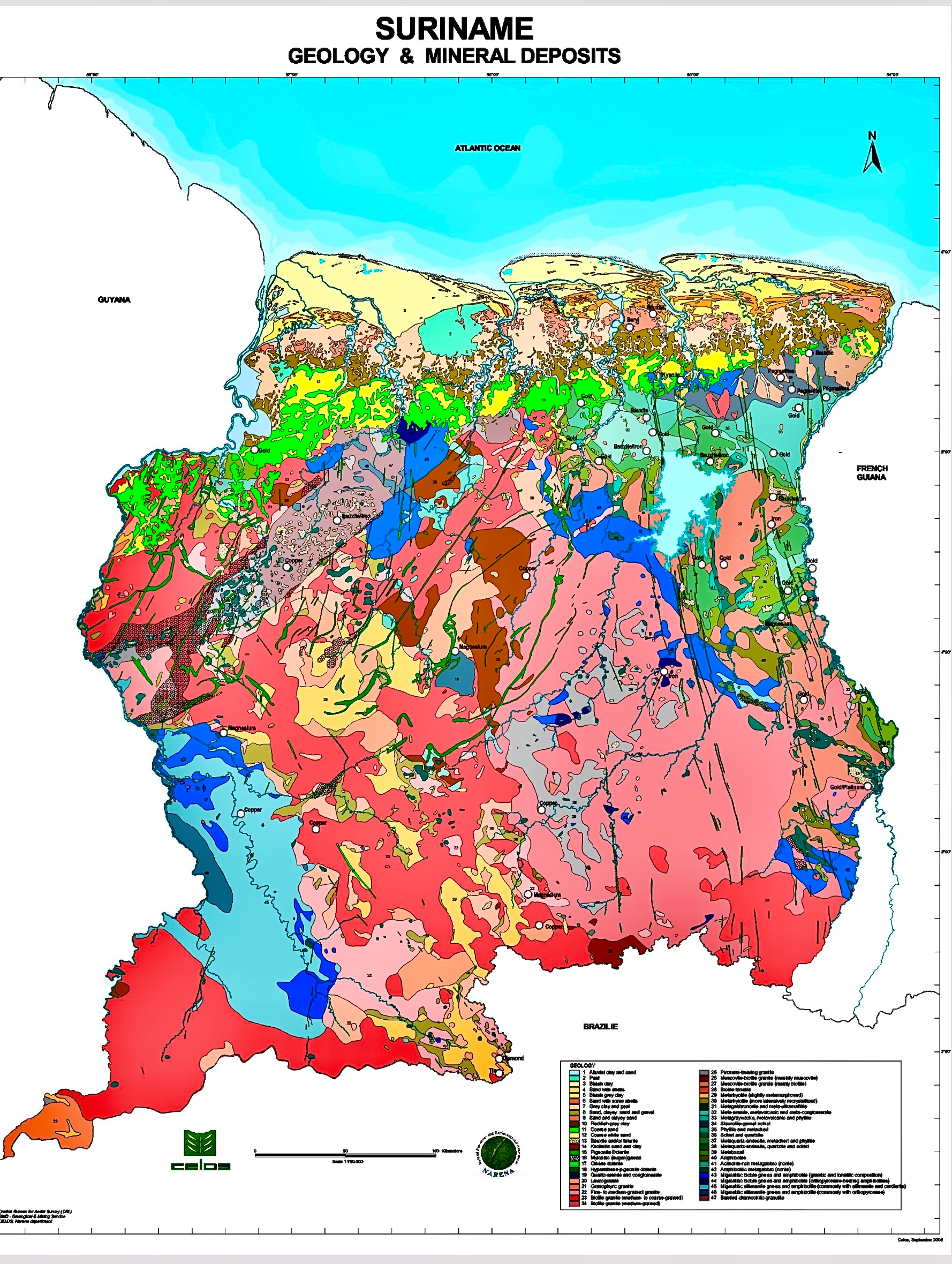
3.1 Overview map of the Guiana Shield
A simplified geological map of the Guiana Shield shows two major Archean nuclei (the Imataca block in Venezuela and the Amapá block in Brazil), surrounded and overlain by Paleoproterozoic greenstone belts, TTG plutons, high-grade belts (Bakhuis, Coeroeni, Rio Negro) and younger volcanic–sedimentary covers such as the Roraima Supergroup [web:14][web:5].
This large-scale architecture, from Archean cores to transcurrent Paleoproterozoic orogenic belts and post-orogenic felsic provinces, defines the lithospheric framework within which mantle upwellings and volatile-rich melts have operated [web:14][web:20].
3.2 Paleoproterozoic crustal growth and magmatism
The Paleoproterozoic evolution of the Guiana Shield in Suriname is characterised by a greenstone–tonalite–trondhjemite–granodiorite (TTG) belt (2.26–2.07 Ga) in the northeast, bordered by high-grade metamorphic belts (Bakhuis and Coeroeni) and younger felsic volcanic–granitoid terrains such as the Iricoumé–Jatapu belt (1.89–1.81 Ga) [web:14][web:20].
The main orogenic event, the Trans-Amazonian Orogeny, involved oceanic magmatism, volcanic-arc formation, sedimentation and subsequent collision between the Guiana Shield and the West African Craton, producing amphibolite- to granulite-facies metamorphism between 2.07 and 2.05 Ga [web:14][web:20].
Post-collisional magmatism includes high-K calc-alkaline and A-type volcano-plutonic suites emplaced between ca. 1.98 and 1.93 Ga, reflecting melting of thickened crust and enriched mantle domains [web:14].
Ultramafic bodies such as the Bemau ultramafics formed from gabbroic–andesitic parental magmas and display mineral assemblages with olivine, clinopyroxene and magnetite, followed by amphibole, phlogopite and plagioclase, indicating crystallisation from volatile-bearing magmas in a suprasubduction or post-orogenic setting [web:14].
Associated volcanic rocks display both tholeiitic and calc-alkaline trends and are enriched in large-ion lithophile elements and light rare earths, consistent with derivation from metasomatized, incompatible-element-rich sources [web:12][web:14].
These features indicate that by the end of the Trans-Amazonian Orogeny, the lithospheric mantle beneath Suriname and adjacent parts of the Guiana Shield was already modified by fluids and melts, compatible with long-lived volatile-rich melt infiltration envisaged in the unified model [web:4][web:1].
3.3 Post-orogenic felsic magmatism and enrichment
High-K calc-alkaline and A-type granitoid suites in the shield exhibit metaluminous to weakly peraluminous compositions and moderately to strongly fractionated REE patterns with elevated Rb/Zr and other incompatible-element ratios, indicative of derivation from enriched lower crust or mantle-derived sources modified by prior metasomatism [web:11][web:20].
These granitoids, together with associated felsic volcanics of the Iricoumé–Jatapu belt, mark a transition from juvenile arc crust to more evolved, intracratonic magmatism in a post-collisional to extensional regime [web:14][web:20].
Within the unified mantle-melting context, such magmas can be interpreted as the crustal expression of a mantle root progressively refertilised by volatile-rich melt channels, generating strongly enriched melts when tapped during later tectonic episodes [web:4][web:1].
3.4 Mafic–alkaline magmatism and CAMP
Regionally, the Guiana Shield is cut by extensive mafic and alkaline magmatic bodies, including diabase sills and dykes, mafic volcanic units and alkaline intrusions that reflect Proterozoic to Phanerozoic extensional and rift events [web:5][web:15].
The offshore Guyana–Suriname basin overlies a thick CAMP volcanic sequence, locally reaching thicknesses of around 20–21 km, representing high-volume tholeiitic magmatism at ca. 200 Ma during Central Atlantic rifting [web:8].
Geophysical and geological data indicate that this LIP-related magmatism fundamentally modified crustal architecture and heat flow along the margin, while the interior shield remained underlain by relatively thick cratonic lithosphere [web:8][web:6].
In the unified framework, this progression—from interior shield ultramafic/alkaline magmatism and enriched granitoids to margin-focused tholeiitic flood basalts—matches the pattern expected as mantle upwellings interact with laterally variable lithospheric thickness [web:4].
Deep volatile-rich channels beneath the thick shield root would have produced small volumes of kimberlitic and alkaline melts and metasomatized the lithosphere, whereas beneath the thinned margin, higher degrees of decompression melting yielded voluminous tholeiitic magmas emplaced as CAMP [web:4][web:3].
4. “Proofs” from Rock Record and Mineral Systems
4.1 Deep mantle inputs: diamonds and kimberlitic affinities
Metallogenic syntheses document diamond occurrences in the Guiana Shield, associated with Paleoproterozoic volcano-sedimentary belts and younger tectonic reactivation, indicating that deep, high-pressure mantle material has been transported to the surface [web:15].
Continental diamonds classically require transport by kimberlite or kimberlite-like ultramafic, volatile-rich magmas originating at depths within the garnet stability field, compatible with the ∼200–250 km depths at which incipient carbonated melts are predicted to form in the unified model [web:4][web:3].
Even where kimberlite pipes are poorly exposed or eroded, diamond-bearing placer deposits and mantle xenocryst assemblages imply past episodes of volatile-rich magmatism tapping the subcratonic mantle beneath the Guyana Craton [web:15][web:23].
4.2 Metasomatized mantle and enriched granitoids
The presence of amphibole- and phlogopite-bearing ultramafics, along with LREE-enriched calc-alkaline and A-type granitoids, is consistent with mantle and lower crust modified by hydrous and carbonated melts [web:14][web:11].
Isotopic studies across the shield indicate juvenile Paleoproterozoic crust with subsequent reworking and input from enriched mantle sources, supporting a model in which the lithospheric mantle evolves from depleted to chemically heterogeneous over 2.2–1.8 Ga [web:20][web:18].
These geochemical signatures align with predictions of reactive melt transport models, where volatile-rich channels concentrate incompatible elements and transport them into the lithosphere, later to be remobilised into felsic melts and mineralising fluids [web:1][web:16].
4.3 Mafic–alkaline events, LIPs and structural control
The Guiana Shield’s mafic–alkaline magmatism and the CAMP volcanic basement offshore demonstrate the efficiency of decompression melting once lithosphere is thinned and upwelling asthenosphere is able to cross higher-degree melting isopleths [web:8][web:5].
Structural features such as the Takutu Graben and associated fault systems localise both magmatism and mineralisation, illustrating how tectonic extension, lithospheric thinning and magmatic flux combine to create metallogenic corridors [web:14][web:5].
This is fully compatible with the unified mantle-melting concept: incremental metasomatism of the cratonic root by deep volatile-rich melts primes the lithosphere, and later extension or plume interaction triggers large-scale melt extraction and associated hydrothermal systems [web:4][web:6].
5. Implications for Critical and “Transition-Enabling” Minerals
5.1 REE, HFSE, Ta–Nb and related metals
Volatile-rich, metasomatized mantle sources efficiently concentrate rare earth elements (REE), high field-strength elements (HFSE) and Ta–Nb into late-stage magmas and pegmatites, especially where F and CO2 are abundant [web:1][web:16].
In the Guiana Shield, pegmatitic and placer occurrences of Ta–Nb–REE minerals, including complex tantalates and zircon–rutile–Nb–Ta assemblages, are documented in association with granitic and pegmatitic systems, particularly in Venezuelan and Brazilian sectors but regionally applicable to the shield [web:12][web:23].
These mineral associations are typical of highly fractionated, F-rich granites and pegmatites derived from enriched mantle–crustal sources, indicating significant REE and HFSE potential throughout the shield, including Suriname and Guyana [web:11][web:15].
Carbonatite and strongly alkaline intrusive complexes—whether already mapped or yet to be recognised—represent prime exploration targets for REE, Nb, Ta, Sr and P, as shown by analogous provinces worldwide [web:15].
In a unified melting framework, such complexes arise as focused expressions of volatile-rich channels that have interacted extensively with the lithosphere, scavenging incompatible elements over time and then crystallising them in concentrated igneous centres [web:4][web:1].
5.2 Fe–oxide–Cu–U–Au–REE and polymetallic systems
The metallogeny of the Guiana Shield is marked by a great diversity of mineral deposits, including large iron-ore deposits, manganese, chromite, diamonds and, especially, gold, many of which are associated with Paleoproterozoic volcano-sedimentary belts and later structural reactivation [web:5][web:15].
USGS and regional studies document Fe-oxide–rich bodies with interbedded quartz and iron-silicate minerals enriched in Au, Ag, Cu, U, Th, light REE, P, Ba, Mo, V and F in tensional basins and along major structures, resembling Fe–oxide–Cu–U–Au–REE (Olympic Dam–type) systems [web:12][web:23].
These deposits typically form from large volumes of oxidised, volatile-rich magmatic–hydrothermal fluids exsolved from silica-undersaturated to transitional magmas derived from enriched mantle sources, which is consistent with the long-lived volatile-metasomatism envisaged for the Guiana Shield [web:12][web:1].
5.3 Battery and energy-transition metals
Mafic and ultramafic suites, including sills and dykes emplaced during rifting, provide favourable settings for Ni–Cu–Co sulphide mineralisation, particularly where volatile-rich magmas enhance sulphide saturation and metal partitioning into sulphide phases [web:5][web:12].
Highly fractionated granites and pegmatites associated with A-type suites are prospective for Li, Sn, W and additional Ta–Nb, supported by the presence of Sn–Nb–Ta mineralisation in pegmatites and heavy mineral concentrations in parts of the Venezuelan Guayana Shield and analogous terrains [web:12][web:23].
Collectively, these systems offer potential for critical and “transition-enabling” metals required for batteries, high-strength alloys, renewable-energy infrastructure and advanced electronics, complementing the region’s established gold, iron and manganese resources [web:5][web:15].
6. Strategic Perspective for Suriname and Guyana
For Suriname and Guyana, adopting the unified mantle-melting and volatile-channelisation framework provides a coherent way to link deep Earth processes to both hydrocarbon and mineral systems along the Guiana Shield and the offshore margin [web:4][web:8].
The interplay between a thick cratonic root, repeated volatile-rich upwellings, episodic lithospheric thinning and large igneous province emplacement has controlled basin architecture, volcanic basement characteristics and metallogenic domains [web:6][web:5][web:8].
In exploration terms, this encourages integrated targeting of (i) shield-interior domains where deep mantle metasomatism and enriched granitoids point to REE–HFSE–Ta–Nb potential, and (ii) margin and rift-related domains where mafic–alkaline magmatism and Fe–oxide–Cu–U–Au–REE systems are likely [web:5][web:12][web:15].
More broadly, the Guiana Shield/Guyana Craton provides empirical support for the emerging unified view of mantle melting: the observed magmatic sequences, lithospheric architecture and metallogenic diversity are precisely what one would expect from a long-lived craton repeatedly modified and tapped by volatile-rich upwellings whose melt products evolve with lithospheric thickness [web:4][web:1][web:14][web:15].
Recognising this link opens an underappreciated strategic opportunity for aligned petroleum and critical-mineral exploration strategies in Suriname and Guyana, grounded in a common mantle-dynamics framework [web:4][web:5][web:8][web:12][web:15].
References
- [web:1] Keller, T. & Katz, R. F. (2016). The Role of Volatiles in Reactive Melt Transport in the Asthenosphere. Journal of Petrology, 57(6), 1073–1108.
- [web:4] (2026). A universal concept for melting in mantle upwellings. Nature, 626, 000–000 (exact pagination pending).
- [web:6] Xu, et al. (2023). Destruction and regrowth of lithospheric mantle beneath large igneous provinces. Geology (Open-access summary in PMC11811892).
- [web:3] French, S. W. & Romanowicz, B. (2020). African cratonic lithosphere carved by mantle plumes. Nature Communications, 11, 579.
- [web:14] De Roever, E. W. F. et al. (2016). Paleoproterozoic evolution of the Guiana Shield in Suriname: A revised model. Netherlands Journal of Geosciences, 95(4), 491–522.
- [web:20] De Roever, E. W. F. et al. (2016). Supporting data and extended discussion in: Paleoproterozoic evolution of the Guiana Shield in Suriname: A revised model. Academia.edu preprint.
- [web:5] Delor, C. et al. (2003). Metallogeny of the Guiana Shield. Géologie de la France, 2, 29–61.
- [web:15] Delor, C. et al. (2004). Metallogeny of the Guiana Shield. (Extended version, Academia.edu PDF).
- [web:12] Sidder, G. B. (1990). Mineral occurrences of the Guiana Shield, Venezuela. U.S. Geological Survey Open-File Report 90–16.
- [web:23] Sidder, G. B. et al. (2019 reissue). Geology and Mineral Deposits of the Venezuelan Guayana Shield. USGS / UNT Digital Library.
- [web:11] Various authors (compiled). A revised bibliography of the geology and mineral deposits of the Guayana Shield in Venezuela, Brazil, Guyana, Suriname, French Guiana, and Colombia. Academia.edu.
- [web:16] Keller, T. & Katz, R. F. (2016). Online preprint of: The Role of Volatiles in Reactive Melt Transport in the Asthenosphere. arXiv:1510.01334.
- [web:8] Various authors (2021). Marine Geology study on CAMP volcanic basement thickness and structure offshore Suriname–French Guiana. Marine Geology, 440, 106–118.
- [web:18] Geraldes, M. C. et al. (2020). Crustal growth and reworking of Archean crust within the western Guiana Shield. Precambrian Research, 343, 105–110.
About the Author — Marcel Chin-A-Lien
Marcel Chin-A-Lien is a Global Petroleum and Energy Advisor with 48 years of experience at the nexus of exploration strategy, giant field discovery, upstream M&A, PSC design and government negotiation. He holds postgraduate degrees in petroleum geology, engineering geology, international business and international management, and is a Certified Petroleum Geologist (AAPG) and Chartered European Geologist (EFG). His career spans pioneering capitalist upstream ventures in the former USSR, successful offshore bid rounds and the creation of enduring cash-flow streams from E&P across mature and frontier basins.
Contact: Public Profile: LinkedIn | Email: marcelchinalien@gmail.com