By Marcel Chin-A-Lien, Petroleum & Energy Advisor – 7th February 2026
Why this article ?
As capital markets, policymakers, and end-users become more carbon-literate, a blunt truth is emerging: not all barrels are equal. Differences in crude quality, production configuration, methane management, flaring practice, power supply, and refining complexity can move a project from “carbon-advantaged” to “carbon-penalized.”
In that context, the Golden Lane petroleum province (Guyana–Suriname Basin) stands out. Its oils are widely traded as light, relatively low-sulfur crudes—qualities that tend to reduce both the complexity of refining and the emissions intensity associated with producing premium transport fuels.
In parallel, Suriname’s coming GranMorgu development has been explicitly framed by the operator as a low-emissions project design, with quantified Scope 1–2 targets and technical levers to keep operational emissions low.
Golden Lane in one paragraph
The “Golden Lane” is shorthand for the prolific Cretaceous petroleum fairway spanning offshore Guyana into offshore Suriname.
Its commercial signature is a combination of high deliverability, repeatable development concepts (FPSO-based), and a product slate dominated by light-to-medium crude oils. For example, Guyana’s Liza crude is reported at approximately ~32° API with ~0.58–0.59 wt% sulfur, positioning it as a broadly “light” crude with moderate-to-low sulfur by global standards.
Sources: Guyana Petroleum Management Programme crude description; ExxonMobil crude summary report; S&P Global methodology note for Liza. (Guyana Petroleum Management Programme) (ExxonMobil Liza crude summary) (S&P Global / Platts note)
What “lower CO2” actually means — and what it does not
When people say a crude “generates less CO2,” they often mix two different ideas:
- Combustion CO2 (Scope 3, end-use): primarily a function of carbon content per unit energy in the final fuels (gasoline, diesel, jet). Across crude oils, combustion CO2 per unit energy does not vary wildly, but lighter crudes can be modestly advantaged because their product yields tend to be richer in lighter fractions and require less severe processing.
- Lifecycle / “well-to-tank” emissions (Scopes 1–2 and upstream/downstream processing): often where the big differences live. Energy-intensive production (steam, mining), routine flaring, high methane leakage, and heavy upgrading can raise emissions substantially.
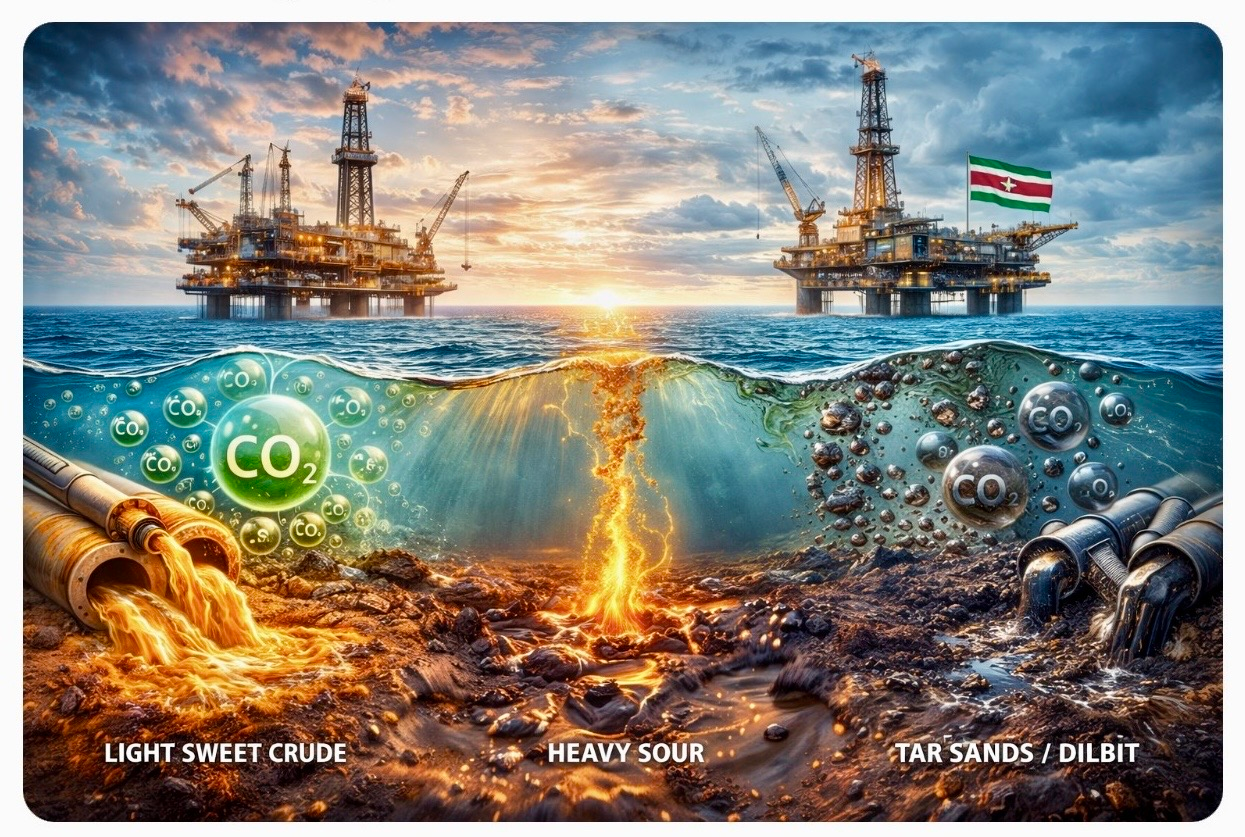
In short: Golden Lane’s most defensible carbon advantage is not a dramatic change in tailpipe CO2, but a structurally favorable combination of crude quality and project configuration—especially when compared to heavy sour crudes and oil sands pathways that require more upgrading and/or more energy per barrel.
GranMorgu: Suriname’s “designed-for-low-emissions” entry into Golden Lane
For Suriname, the headline is not only the resource scale, but the design philosophy. TotalEnergies states that GranMorgu is being developed as a low-emission, low-cost project, with a Scope 1–2 emissions intensity of less than 16 kg CO2e/boe, supported by an all-electric FPSO, no routine flaring, and systems intended to minimize methane emissions.
Source: TotalEnergies project description (GranMorgu). (TotalEnergies: GranMorgu – transition strategy & emissions design)
While crude assay details for GranMorgu’s produced blend are not yet widely published in the same way as established benchmarks, test results reported for Block 58 discoveries indicate oils commonly in the mid-30s API range in key wells—consistent with a premium, light oil province. (RBN Energy: Block 58 test gravities)
Comparative table: Golden Lane vs major global crude archetypes
The table below is designed for investor and technical audiences: it combines quality indicators (API gravity and sulfur) with a practical reading of carbon implications. API and sulfur numbers are typical published values; “carbon implication” is an informed, high-level interpretation that distinguishes combustion from lifecycle drivers.
| Crude / Archetype | Typical API (°) | Typical Sulfur (wt%) | Market shorthand | CO2 / emissions implication (high-level) |
|---|---|---|---|---|
| Golden Lane – Liza (Guyana) | ~31.9–32.0 | ~0.58–0.59 | Light, relatively low sulfur | Carbon-advantaged vs heavy crudes primarily through quality-driven processing efficiency; strong strategic fit for “lower-intensity supply chains.” |
| Suriname – GranMorgu (planned) | Appraisal indicates mid-30s in key tests (project blend TBD) | TBD | Likely light | Explicit low-emissions design (Scope 1–2 <16 kg CO2e/boe per operator), all-electric FPSO, no routine flaring. |
| Brent (North Sea benchmark) | ~39.8 | ~0.37 | Light sweet benchmark | High-quality crude; generally efficient refining routes; often used as the “premium” comparator. |
| WTI (US benchmark) | ~39.6 (benchmark) / assay examples higher | ~0.24 (benchmark) | Light sweet benchmark | Very favorable refining characteristics; often near the top of quality spectrum. |
| Arab Light (Saudi Arabia) | ~33.3 | ~1.96 | Medium sour | Higher sulfur raises processing intensity vs sweet crudes; emissions penalty is more about refining/processing than combustion. |
| Maya (Mexico) | ~21–22 | ~3.4 | Heavy sour | Carbon-disadvantaged due to heavier fractions and higher sulfur driving more severe refining and often higher lifecycle intensity. |
| Western Canadian Select (WCS) / Oil sands blend | ~20–22 | ~3.0–3.8 | Heavy sour dilbit | Typically among the higher lifecycle intensities due to upgrading/dilution and energy-intensive pathways (project dependent). |
Notes on sources for typical properties: Liza crude specifications from Guyana Petroleum Management Programme and ExxonMobil assay. Brent/WTI typical figures are widely reported; WTI assay examples available from ExxonMobil. Arab Light specs reported by S&P Global / Platts. Maya specs reported in S&P Global methodology documentation. WCS typical properties from published monitoring/summary datasets.
Key sources: Liza crude description (Guyana) • ExxonMobil Liza assay • Arab Light (Platts periodic table reference) • Maya typical specs (Platts methodology) • WCS typical specs (CrudeMonitor) • ExxonMobil WTI Light assay example
Investor lens: where Golden Lane’s advantage actually monetizes
Crude quality becomes investable when it reduces friction in the value chain. Golden Lane oils are attractive because they tend to:
- Clear more refineries with minimal constraint (light, relatively low sulfur oils are easier to process into high-value middle distillates).
- Reduce upgrading burden compared with heavy oils (less energy and hydrogen demand for conversion and desulfurization).
- Support “lower-intensity” narratives—when paired with disciplined methane and flaring management.
GranMorgu is particularly notable because the operator has put the low-emissions intent into explicit design choices (all-electric FPSO, no routine flaring, methane monitoring), and has communicated a quantified Scope 1–2 target. (TotalEnergies: GranMorgu emissions design)
Scientific backbone: how lifecycle emissions are assessed (briefly)
The most widely cited open frameworks for crude oil lifecycle emissions include:
- OPGEE (Stanford): engineering-based upstream emissions estimator used in research and referenced in regulatory contexts.
- Oil-Climate Index (OCI) (Carnegie): compares oils across the supply chain using open models (including OPGEE).
- ICCT methodologies: practical frameworks for default and actual crude carbon intensity accounting.
- GREET (Argonne/DOE ecosystem): broad lifecycle analysis platform used across transportation fuel pathways.
- IPCC inventory guidance: foundational carbon content and inventory logic for national reporting.
Representative sources: (Stanford OPGEE project page) • (Carnegie: Know Your Oil / OCI) • (ICCT crude GHG methodology, PDF) • (DOE/Argonne GREET methodology guidance, PDF) • (IPCC Good Practice Guidance – Energy, PDF)
Diplomatic conclusion: the “good barrel” argument, carefully stated
Golden Lane petroleum—by virtue of its generally light, market-flexible crude quality—sits in a structurally advantaged position relative to heavy sour and oil sands pathways. The most defensible “lower-CO2” argument is best framed as follows:
- Combustion CO2 differences among crudes exist but are not the whole story.
- Lifecycle emissions differ meaningfully—especially when production is energy-intensive or methane/flaring controls are weak.
- GranMorgu is noteworthy because the operator has publicly articulated a low-emissions operating concept and Scope 1–2 target, aligning technical design with investor expectations.
In a world that increasingly prices carbon—explicitly or implicitly—this is not a public-relations detail. It is a strategic attribute.
Selected Reading & Reference Library
Core scientific frameworks and methodologies
- Carnegie Endowment (2015): Know Your Oil: Creating a Global Oil-Climate Index. PDF
- Stanford (OPGEE): Oil Production Greenhouse Gas Emissions Estimator (project page). Link
- El-Houjeiri & Brandt (OPGEE documentation): engineering basis and assumptions. PDF
- ICCT (2014): Crude Oil Greenhouse Gas Emissions Calculation Methodology. PDF
- DOE/Argonne (2025): GREET methodology guidance (45ZCF-GREET). PDF
- IPCC (Energy guidance): carbon content and inventory fundamentals. PDF
Golden Lane crude quality and public assays
- Guyana Petroleum Management Programme: Liza crude characteristics. Link
- ExxonMobil crude summary report: Liza assay (API, sulfur, yields). PDF
- S&P Global / Platts methodology note introducing Liza assessment (quality context). Link
Suriname / GranMorgu: emissions design and project disclosures
- TotalEnergies: GranMorgu low-emissions design and Scope 1–2 intensity statement. Link
- SBM Offshore: GranMorgu FPSO award (capacity and project parameters). Link
- RBN Energy (2025): Block 58 test gravities (context for expected blend quality). Link
Benchmark crude specifications (comparators)
- ExxonMobil crude summary report: WTI Light assay example. PDF
- S&P Global / Platts: Arab Light typical API and sulfur (periodic table reference). Link
- Platts methodology documentation (Americas) including Maya typical specs. PDF
- CrudeMonitor: WCS typical properties (API, sulfur). Link
About the Author
Marcel Chin-A-Lien is a Petroleum & Energy Advisor with extensive experience in petroleum geology, basin analysis, and energy strategy. He advises companies, institutions, and investors on upstream geology, exploration risk, and long-term energy positioning, with a particular focus on Suriname, the Guyana–Suriname Basin, and frontier petroleum systems.