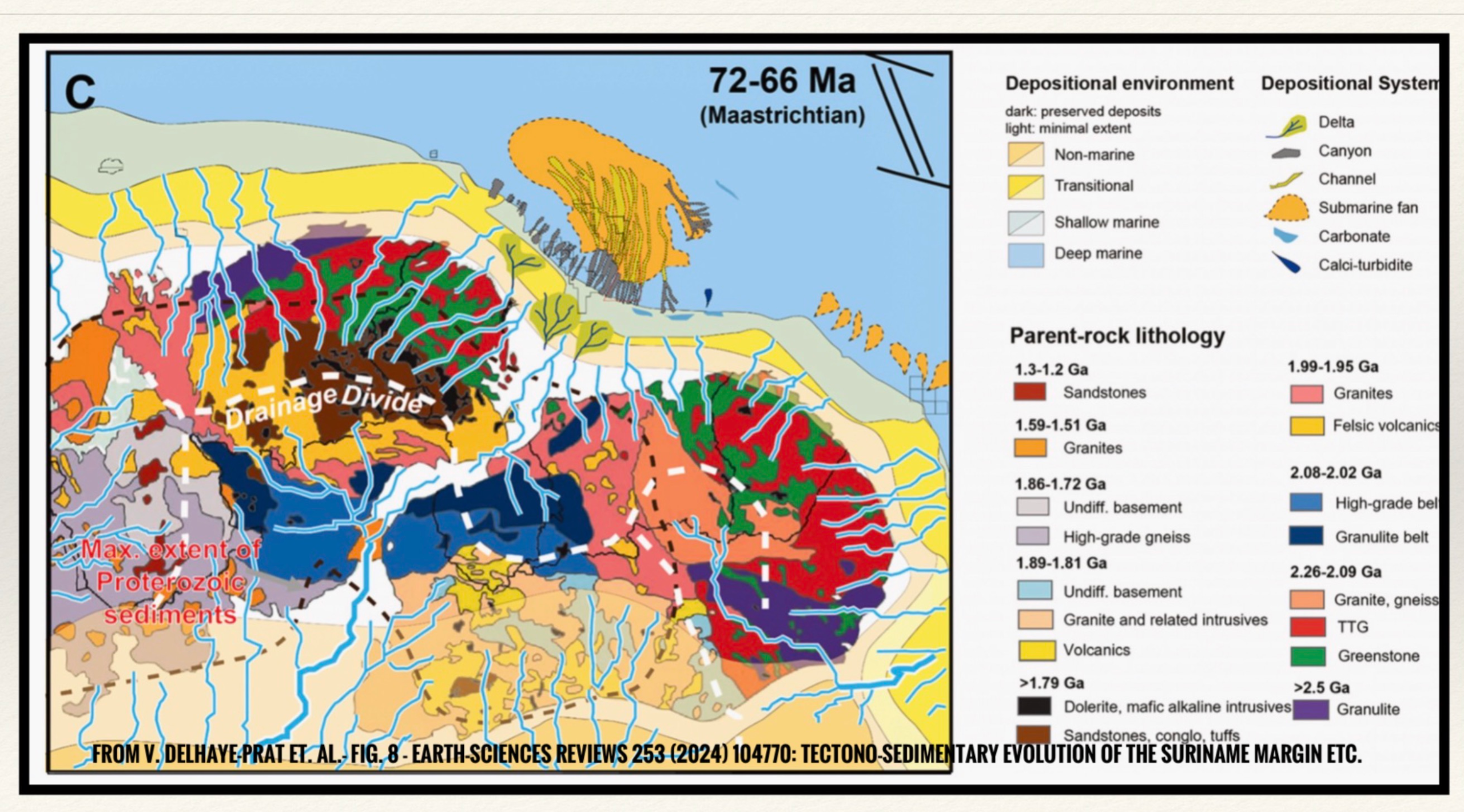
Blocks 58 and 52 did not “just happen.” The world-class offshore discoveries in Suriname are the downstream expression of a subtle but decisive Upper Cretaceous reorganization of sediment routing into the Guyana–Suriname Basin. This article explains how Santonian hinterland uplift, drainage fragmentation, and the development of shelf-edge canyons transformed a single-canyon system into a distributed, sand-rich deepwater petroleum province.
→ Read the full analysis on sediment routing, deepwater fans, and Block 58
From One Canyon to Many: How the Upper Cretaceous Rewired Sediment Supply to the Guyana–Suriname Basin
The world-class deepwater petroleum systems offshore Guyana and Suriname did not emerge by chance. They are the downstream expression of a profound Upper Cretaceous reorganization of South America’s hinterland, drainage networks, and continental margin. At the heart of this transformation lies a shift from a single dominant sediment gateway—the Berbice Canyon—to a distributed system of shelf-edge canyons feeding multiple deepwater fans, including today’s prolific Block 58 / Gran Morgu fairway and Block 52 / Sloanea fairway.
The Early Upper Cretaceous: A Single Gatekeeper
During the Cenomanian–Turonian, sediment delivery to the Guyana–Suriname Basin was remarkably focused. The Berbice Canyon functioned as the primary conduit routing clastics from the Guiana Shield into deep water. This configuration reflects a tectonically quiescent hinterland: a low-relief, stable shield drained by long-lived, integrated river systems. High global sea levels flooded the shelf, allowing only the deepest, structurally inherited canyon to bypass sediment efficiently into the basin.
The result was a point-sourced deepwater system, characterized by limited along-strike variability and comparatively modest sand delivery.
The Santonian Turning Point: Hinterland Reorganization
From the Santonian onward, this simplicity broke down. Subtle but regionally significant uplift affected the northern margins of the Guiana Shield, driven by far-field stress transmission linked to early Andean orogenic phases along western South America. Although distant, these tectonic forces were sufficient to tilt drainage gradients, reactivate ancient basement structures, and fragment previously integrated river systems.
Large trunk rivers were segmented or diverted, watersheds migrated, and sediment routing became partitioned into multiple shorter, steeper catchments draining directly toward the Atlantic margin.
The Birth of Suriname’s Shelf-Edge Canyons
This hinterland reorganization coincided with relative sea-level fall and progressive shelf narrowing. Together, these conditions promoted canyon incision along the Suriname margin. From the Santonian through the Campanian, new shelf-edge canyons developed, each tapping a distinct hinterland source and delivering sediment directly to deep water.
Among these systems were the precursors of the typically Suriname sediment sourced Gran Morgu fan complex in present-day Block 58 and the Sloanea fan complex in Block 52. Compared to the earlier Berbice-dominated phase, these younger systems transported sediment over shorter distances, with less reworking and higher sand-to-mud ratios—an ideal recipe for high-quality deepwater reservoirs.
Why This Matters
This Upper Cretaceous shift—from a single sediment gateway to a distributed, canyon-fed margin—helps explain the exceptional reservoir development, along-strike variability, and petroleum system richness of the Guyana–Suriname Basin. It is a reminder that even on so-called “passive” margins, far-field tectonics and subtle hinterland uplift can decisively control where sand goes, and ultimately, where hydrocarbons are found.
The success of Block 58 is not only a story of charge and trapping—it is a story written upstream, in the Santonian reshaping of a continent.
Reference: V. Delhaye-Prat et. al., Tectono-sedimentary evolution of the Suriname marginin the Cretaceous: A sequence-stratigraphic framework. Earth -Science Reviews 253 (2024) 104770.
About the Author — Marcel Chin-A-Lien
Global Petroleum and Energy Advisor
49 Years of Transformative Expertise | Exploration, Oil & Gas Giant Fields Finder – Business Development, M&A, PSC Design, Contract Strategy
Marcel Chin-A-Lien brings nearly five decades of unmatched global expertise at the highest levels of the energy sector—where technical mastery meets business acumen to unlock extraordinary value.
His career has delivered multi-billion-dollar giant field discoveries, spearheaded the iconic first capitalist upstream ventures in the USSR, shaped successful offshore bid rounds, and secured enduring cash flow streams from exploration and production activities across mature and frontier basins such as the Dutch North Sea.
An exceptional fusion of technical, commercial, and managerial insight, Marcel holds four postgraduate petroleum degrees spanning geology, engineering, international business, and management—uniquely positioning him to bridge the worlds of exploration strategy, M&A, PSC design, and contract negotiation.
Fluent in multiple languages and culturally attuned to diverse business environments, he has navigated complex geographies from Europe to Asia, Africa, and the Americas—driving innovation, de-risking investments, and aligning stakeholder interests from national oil companies to supermajors.
Whether advising on frontier basin entry, government negotiations, fiscal regime optimization, or asset valuation, Marcel’s critical insights integrate Exploration & Production with Business Development and Commercial Realism—generating sustainable growth in volatile energy markets.
Credentials and Distinctions
- Drs – Petroleum Geology
- Engineering Geologist – Petroleum Geology
- Executive MBA – International Business, Petroleum, M&A
- MSc – International Management, Petroleum
- Energy Negotiator – Association of International Energy Negotiators (AIEN)
- Certified Petroleum Geologist #5201 – AAPG (Gold Standard)
- Chartered European Geologist #92 – EFG (Gold Standard)
- Cambridge Award – “2000 Outstanding Scientists of the 20th Century”, UK
- Paris Awards – “Innovative New Business Projects”, GDF-Suez (2x Gold Awards, 2003)
Strategic Expertise
- Exploration Strategy & Giant Field Discovery
- Upstream M&A and Asset Valuation
- Production Sharing Contract (PSC) Design & Fiscal Optimization
- Government and IOC Negotiation Advisory
- Bid Round Structuring and Evaluation
- Integrated Technical-Commercial Due Diligence
For trusted advisory services at the nexus of technical excellence, commercial clarity, and geopolitical understanding, connect directly:
Public Profile: LinkedIn
Email: marcelchinalien@gmail.com