Written by Marcel Chin-A-Lien – Geoscientist, Petroleum Explorationist, Oil & Gas Finder – Business & Policy Developer – Energy Insights Advisor.
On June 23th, 2025. The birthday of and therefore especially dedicated to my (our) beloved late father (R.I.P.), from Switi Sranan.
This whitepaper intends to offer a scientific, comparative analysis of local content policies in global petroleum economies. focusing on Suriname, with lessons drawn from Guyana, Nigeria, Trinidad & Tobago, Brazil, Ghana, Angola, and East Africa.
The document integrates legal, institutional, economic, and employment impact assessments, tailored for Suriname’s developing offshore sector.
My own musings that I wish to share, with all whom it may interest and serve.
For the dear and most beautiful country of my grandparents, parents, extended family and friends.
Tan bun allamala, odi odi, soso lobi.
1. Methodology
- Comparative review of legislation, PSCs, impact reports, and peer-reviewed sources;
- Focus 8 countries: Guyana, Nigeria, Trinidad, Brazil, Ghana, Angola, Kenya/Tanzania;
- Assessment of enforcement, capacity, transparency, and effectiveness mechanisms.
2. Case Studies
Guyana (Local Content Act 2021)
- Mandatory quotas up to 100% in 40 categories of goods/services;
- Independent Secretariat ensures audit and reporting duties;
- Result: +US$1.5 billion in local spending, >3,900 jobs (2024 data);
- Risks: white-collar skill gap, bureaucratic inefficiencies.
Nigeria (NOGICDA 2010)
- Minimum 30% local content enforced via NCDMB certification;
- 1% contract levy funds training, SME growth;
- Local content rose from ~5% to ~30% since 2010;
- Challenges: infrastructure, price competitiveness, loosened enforcement recently.
Trinidad & Tobago
- Policy model (no binding law) since 2004, SME database and training schemes;
- Strong downstream sector, but NOC issues (e.g., Petrotrin crisis impact).
Brazil (ANP Resolution 36/2007)
- Enforceable quotas per concession contract by ANP agency;
- Heavy Petrobras pre-salt dominance;
- Corruption risks surfaced due to Petrobras-linked scandals (Lava Jato).
Ghana, Angola & East Africa
- Ghana (2013): mandates 5% local equity and local registration;
- Angola (2020): Sonangol-driven mandatory JV structures;
- East Africa: developing frameworks (modeled on Ghana/Nigeria); still incomplete.
3. Comparative Summary Table
| Country | Law Enacted | Independent Oversight | Min. Local Content % | Sanctions | Transparency |
|---|---|---|---|---|---|
| Guyana | Yes (2021) | Secretariat | PSC-based | Fines/Audits | PSC published |
| Nigeria | Yes (2010) | NCDMB | ~30% | Fines/Fund | Mandatory Plans |
| Trinidad | Policy only | MEEI Ministry | Flexible | Contractual | SME database |
| Brazil | Yes (2007) | ANP | Fixed per block | Fines | Concession terms |
| Ghana | Yes (2013) | Committee | 5% equity | Audits | Partial |
| Angola | Yes (2020) | Sonangol | Broad | Contractual | NOC controlled |
| East Africa | In draft | Committees | Pending | Legal (weak) | – |
4. Economic Impact – Simulations for Suriname
4.1 Local Spending (2025–2030)

Figure 1 – Projected local spending (USD million annually) under three policy scenarios for Suriname’s petroleum development.
Assumptions:
- Baseline: Existing PSCs without law; spending grows from USD 100 million at 5% annually;
- Moderate policy: Law plus authority; local spending boosts 15–20% per year;
- Full policy: Includes Local Content Fund, SME support; growth up to USD 400 million yearly;
- Benchmarked to Nigeria, Guyana, Brazil data, adjusted to Suriname’s offshore scale.
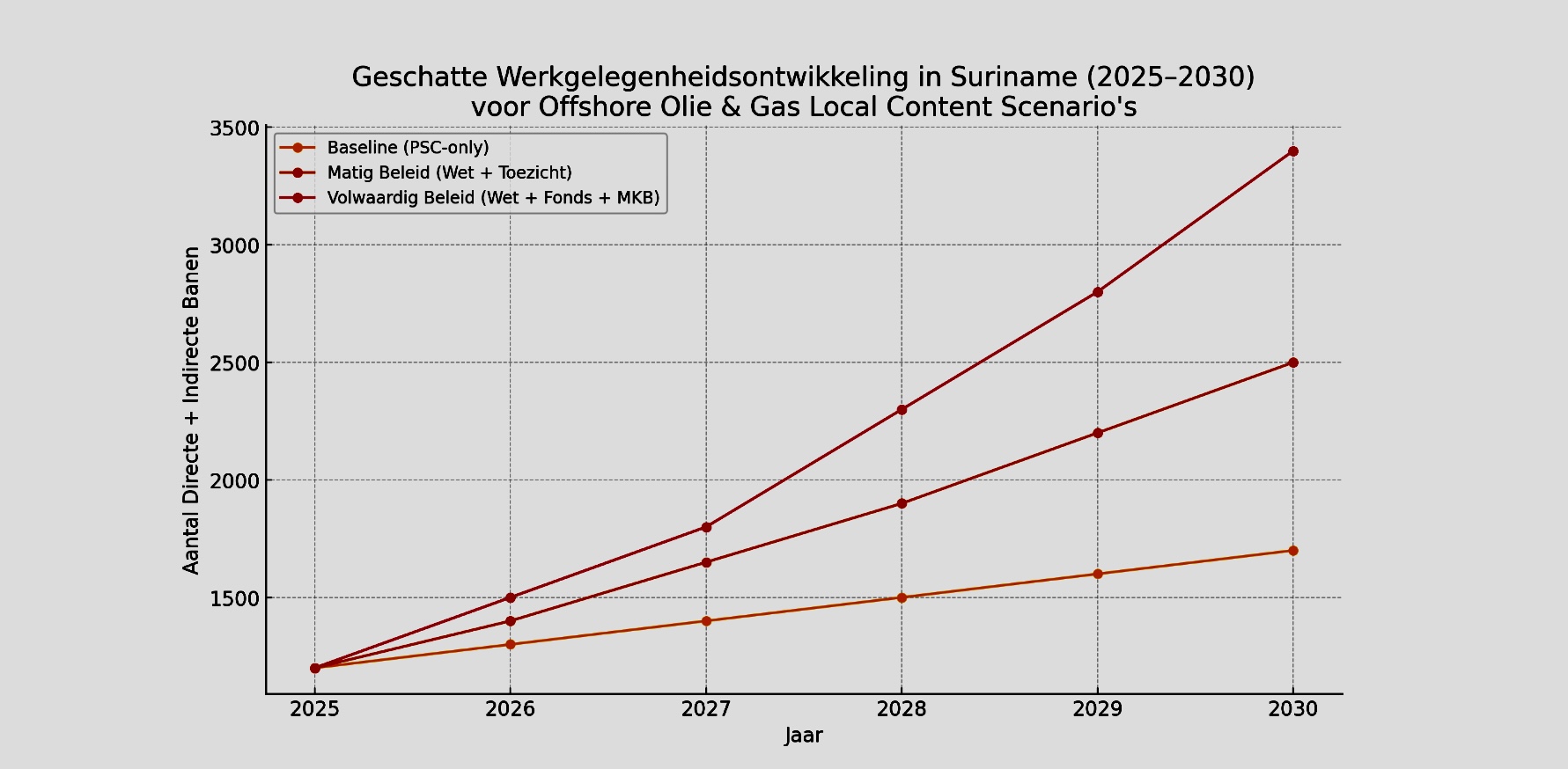
4.2 Employment Creation (2025–2030)

Figure 2 – Estimated number of direct and indirect jobs created under three local content policy levels for Suriname.
Analysis and Assumptions:
- Baseline: Modest rise to 1,700 jobs by 2030;
- Moderate policy: +25–50% additional jobs, reaching ~2,500;
- Full policy: High-tech SME and service sector boom—up to 3,400 jobs;
- Multiplier: 1 direct oil/gas job generates 1.2–1.5 indirect jobs (services, transport, logistics);
- Derived from Ghana and Nigeria field data, adapted for Suriname’s scale.
5. Policy Recommendations for Suriname
- Enact a binding Suriname Local Content Act—define quotas, scope, compliance;
- Establish an independent Local Content Authority (not under Staatsolie);
- Mandatory certification, annual reporting (as Nigeria);
- Create a Local Content Development Fund—training, SMEs, industrial parks;
- Publish PSC clauses and annual performance reports (Guyana model);
- Introduce strong anti-corruption safeguards (Brazil/Trinidad lessons).
6. Conclusion
Suriname holds exceptional potential to shift from discretionary, contract-based local content to a structured, legally enforceable regime. Doing so could triple or quadruple annual domestic spending and create thousands of sustainable jobs. The small-country model could offer Suriname enduring competitiveness in the Caribbean region’s energy landscape.
7. References & Sources
- Guyana Local Content Act (2021); DPI and Secretariat reports;
- Nigeria NOGICDA (2010); NCDMB Annual Reports;
- Trinidad & Tobago LCR policy documents (MEEI 2004–2020);
- Brazil ANP Resolução 36/2007; pre-salt field studies;
- Ghana Petroleum Commission Reports (2015–2020);
- Angola Ministry of Mineral Resources decree 2020;
- World Bank (2021), “Maximizing local content” policy review;
- IMF (2023), Oil & Gas local content recommendations;
- Peer-reviewed: Energy Policy Journal (2022): “The impacts of local content policies on economic growth”;
- Various news sources (Stabroek News, Kaieteur News, Financial Times).
© 2025 Marcel Chin-A-Lien. All rights reserved. | Professional whitepaper for policy, academic, and investor use.

About the Author — Marcel Chin-A-Lien
Global Petroleum and Energy Advisor
48 Years of Transformative Expertise | Exploration, Oil & Gas Ginat Fields Finder – Business Development, M&A, PSC Design, Contract Strategy
Marcel Chin-A-Lien brings nearly five decades of unmatched global expertise at the highest levels of the energy sector—where technical mastery meets business acumen to unlock extraordinary value.
His career has delivered multi-billion-dollar giant field discoveries, spearheaded the iconic first capitalist upstream ventures in the USSR, shaped successful offshore bid rounds, and secured enduring cash flow streams from exploration and production activities across mature and frontier basins such as the Dutch North Sea.
A rare fusion of technical, commercial, and managerial insight, Marcel holds four postgraduate petroleum degrees spanning geology, engineering, international business, and management—uniquely positioning him to bridge the worlds of exploration strategy, M&A, PSC design, and contract negotiation.
Fluent in seven languages and culturally attuned to diverse business environments, he has navigated complex geographies from Europe to Asia, Africa, and the Americas—driving innovation, de-risking investments, and aligning stakeholder interests from national oil companies to supermajors.
Whether advising on frontier basin entry, government negotiations, fiscal regime optimization, or asset valuation, Marcel’s critical insights integrate Exploration & Production with Business Development and Commercial Realism—generating sustainable growth in volatile energy markets.
Credentials and Distinctions
- Drs – Petroleum Geology
- Engineering Geologist – Petroleum Geology
- Executive MBA – International Business, Petroleum, M&A
- MSc – International Management, Petroleum
- Energy Negotiator – Association of International Energy Negotiators (AIEN)
- Certified Petroleum Geologist #5201 – AAPG (Gold Standard)
- Chartered European Geologist #92 – EFG (Gold Standard)
- Cambridge Award – “2000 Outstanding Scientists of the 20th Century”, UK
- Paris Awards – “Innovative New Business Projects”, GDF-Suez (2x Gold Awards, 2003)
Strategic Expertise
- Exploration Strategy & Giant Field Discovery
- Upstream M&A and Asset Valuation
- Production Sharing Contract (PSC) Design & Fiscal Optimization
- Government and IOC Negotiation Advisory
- Bid Round Structuring and Evaluation
- Integrated Technical-Commercial Due Diligence
For trusted advisory services at the nexus of technical excellence, commercial clarity, and geopolitical understanding, connect directly:
Public Profile: LinkedIn
Email: marcelchinalien@gmail.com