Marcel Chin-A-Lien
Petroleum & Energy Advisor
Golden Lane Investments Advisory Group
3 March 2026
Abstract
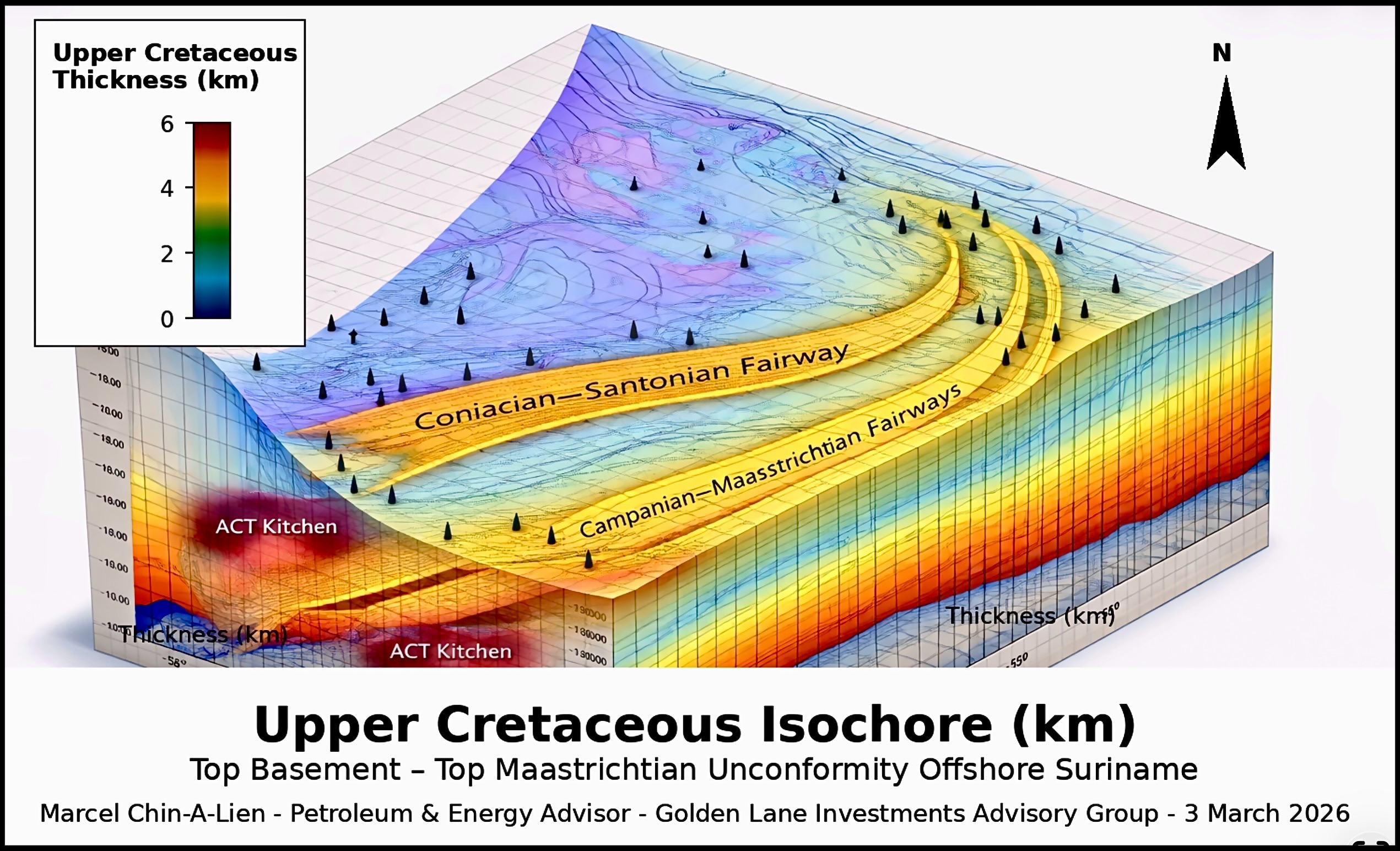
This paper presents a three-dimensional isochore (thickness) model of the Upper Cretaceous interval offshore Suriname, defined between Top Basement (Base Jurassic) and the Top Maastrichtian Unconformity.
Thickness was computed as the difference between the two structural surfaces (depth positive downward).
The isochore reveals a coherent accommodation architecture controlled primarily by Jurassic rift inheritance and amplified by post-rift sag-phase thermal subsidence.
Thickness increases systematically from shelf to graben to deepwater basin, reaching approximately 6–6.5 km in the northwestern depocenter.
1. Context
Suriname Offshore lies within the Guyana–Suriname Basin along the Equatorial Atlantic margin.
Basin architecture reflects rift inheritance, transform segmentation, and passive margin subsidence.
Thickness patterns in the Upper Cretaceous are therefore a direct proxy for accommodation distribution, burial history, and the basin’s structural template for deepwater depositional systems.
2. Data and Method
Structural depth surfaces were taken from the GeoAtlas of Suriname structural configuration maps (Staatsolie, 2025).
Upper Cretaceous thickness was calculated as:
Upper Cretaceous Thickness = Depth(Top Basement) − Depth(Top Maastrichtian)
Because both horizons are mapped in meters below sea level using the same datum and projection, subtraction yields physically meaningful thickness.
The result was validated by multiple spot-checks across shelf, graben and deepwater domains to confirm (i) correct sign convention and (ii) reasonable magnitude.
3. Results – Thickness Variation by Paleogeographic Domain
3.1 Shelf Domain (0–2 km)
Across the southern shelf and coastal plain, the Upper Cretaceous interval is relatively thin, reflecting limited accommodation over structural highs and rift shoulders.
Landward onlap and partial bypass reduce preserved thickness.
3.2 Graben and Transitional Slope Domain (2–4 km)
Thickness increases markedly within inherited rift depressions (e.g., Nickerie and Commewijne grabens), where differential subsidence created persistent accommodation lows.
This domain represents a structurally amplified stacking zone and a key transition between shelf accumulation and deepwater export.
3.3 Deepwater Basin Domain (4–6+ km)
Maximum thickness occurs in the northwestern deepwater depocenter, where long-term sag-phase thermal subsidence and efficient gravity-driven sediment transfer produced sustained stratigraphic stacking.
Thickness converges basinward, consistent with structural confinement and depocentral accumulation.
4. Most Probable Controls on Thickness
- Rift inheritance (first-order): Jurassic basement geometry established long-lived structural lows that partitioned accommodation.
- Sag-phase thermal subsidence (amplification): post-rift thermal decay increased basinward subsidence and preservation potential.
- Sediment routing efficiency (filling mechanism): gravity-flow systems preferentially delivered sediment to structurally confined deepwater depocenters.
- Paleogeographic boundaries: structural highs (including the Demerara Plateau) influenced accommodation partitioning and depositional pathways.
- Compaction and burial: secondary modification of thickness patterns may occur, but is not the dominant regional control.
5. 3D Isochore Figure
Figure 1. Upper Cretaceous Isochore (km), Top Basement – Top Maastrichtian Unconformity, Suriname Offshore. See image at the top.
6. Implications
- Burial and maturity: deepwater depocenters coincide with maximum burial and are prime candidates for elevated maturity and overpressure potential.
- Depositional architecture: graben-to-slope transitions likely focused sediment routing and stacking corridors feeding deepwater systems.
- Exploration framing: the isochore provides a structural foundation for predictive fairway mapping and integrated basin intelligence.
7. Conclusions
Upper Cretaceous thickness offshore Suriname increases systematically from shelf to graben to deepwater basin, reaching ~6–6.5 km in the northwestern depocenter.
The isochore architecture is best explained by rift inheritance controlling accommodation, sag-phase thermal subsidence amplifying basinward thickening, and sediment routing efficiently filling depocentral space.
This 3D isochore model provides a robust structural layer for subsequent depositional, burial and petroleum system analyses.
References
Allen, P. A., & Allen, J. R. (2013). Basin Analysis: Principles and Applications. Wiley-Blackwell.
Basile, C., & Brun, J. P. (1999). Transtensional deformation along the Africa–South America transform margin. Tectonophysics.
Covault, J. A., et al. (2009). Submarine channel evolution and basin-floor fan systems. AAPG Bulletin.
Magoon, L. B., & Dow, W. G. (1994). The Petroleum System. AAPG Memoir 60.
McKenzie, D. (1978). Some remarks on the development of sedimentary basins. Earth and Planetary Science Letters, 40, 25–32.
Moulin, M., et al. (2010). Kinematics of the Equatorial Atlantic opening. Tectonophysics.
Mutti, E., & Normark, W. R. (1987). Comparing examples of modern and ancient turbidite systems. Marine and Petroleum Geology, 4, 103–132.
Nemčok, M., et al. (2016). Structural evolution of the Guyana–Suriname Basin and implications for hydrocarbon prospectivity. AAPG Bulletin.
Posamentier, H. W., & Walker, R. G. (2006). Deep-water turbidites and submarine fans. In: Facies Models Revisited (SEPM).
Reading, H. G., & Richards, M. (1994). Turbidite systems in deep-water basin margins. Sedimentary Geology.
Shipboard Scientific Party. (2004). Proceedings of the Ocean Drilling Program, Leg 207: Demerara Rise.
Staatsolie. (2025). GeoAtlas of Suriname. Staatsolie Maatschappij Suriname N.V.
Tissot, B. P., & Welte, D. H. (1984). Petroleum Formation and Occurrence. Springer.
Watts, A. B. (2001). Isostasy and Flexure of the Lithosphere. Cambridge University Press.
Appendix A – Extended References for Further Consultation
ODP / Demerara Rise
- Shipboard Scientific Party. (2004). ODP Leg 207 Proceedings: Demerara Rise.
- Erbacher, J., Mosher, D. C., Malone, M. J., et al. (2004). ODP Scientific Results, Leg 207.
Equatorial Atlantic Opening & Transform Segmentation
- Basile, C., & Brun, J. P. (1999). Tectonophysics.
- Moulin, M., et al. (2010). Tectonophysics.
- Heine, C., et al. (2013). Plate kinematics and margin segmentation during the South Atlantic opening. Earth-Science Reviews.
Deepwater Routing, Channels and Fans
- Posamentier, H. W., & Kolla, V. (2003). Seismic geomorphology and submarine fan systems. SEPM Special Publication.
- Covault, J. A., et al. (2009). AAPG Bulletin.
Source Rock / OAEs
- Jenkyns, H. C. (2010). Geochemistry of Oceanic Anoxic Events. Geochemistry, Geophysics, Geosystems.
- Arthur, M. A., & Sageman, B. B. (2005). Sea-level control on organic-rich shale deposition. SEPM Special Publication.
Correspondence: marcelchinalien@gmail.com